
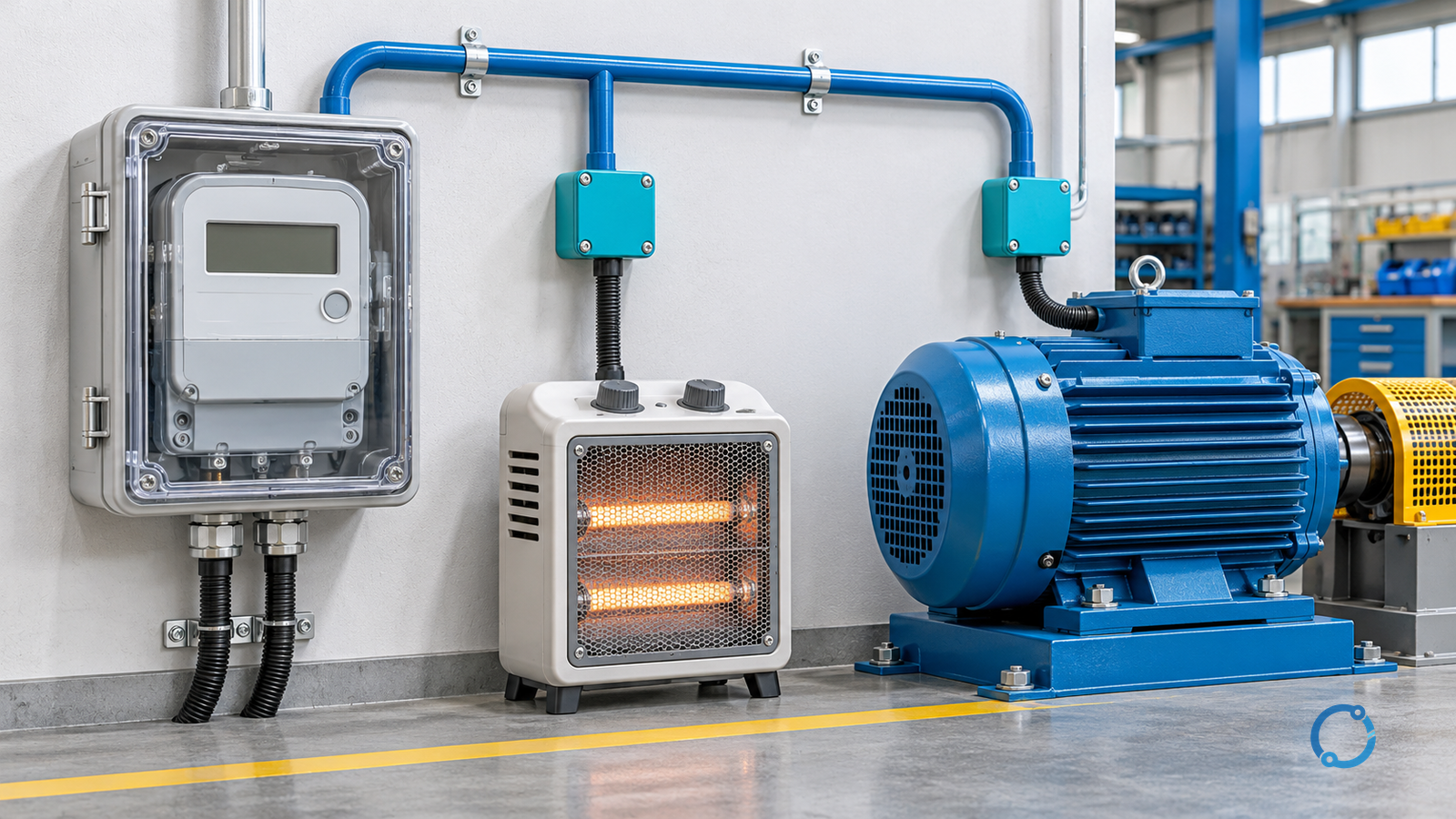
A kilowatt (kW) measures power: the rate at which equipment uses or supplies energy. A kilowatt-hour (kWh) measures an amount of energy. To calculate electricity use at a constant power, multiply kW by operating hours.
Energy (kWh) = power (kW) × time (h).
The US Energy Information Administration’s explanation of electricity units establishes this distinction. “Kilowatts per hour” is not another name for kWh: dividing by time describes a change in power, while multiplying by time gives energy.
Read the unit before comparing numbers
| Unit | What it tells you | Example question |
|---|---|---|
| W or kW | Power at an operating point | How large is the electrical load? |
| Wh or kWh | Energy over a period | How much electricity was used? |
| h | Duration | How long did the load operate? |
| kW/h | Rate of change in power | How quickly is the load increasing? |
One kW equals 1,000 W. Convert watts to kilowatts before multiplying by hours; convert minutes to hours as well. These conversions prevent a common thousandfold error.
Calculate a constant load
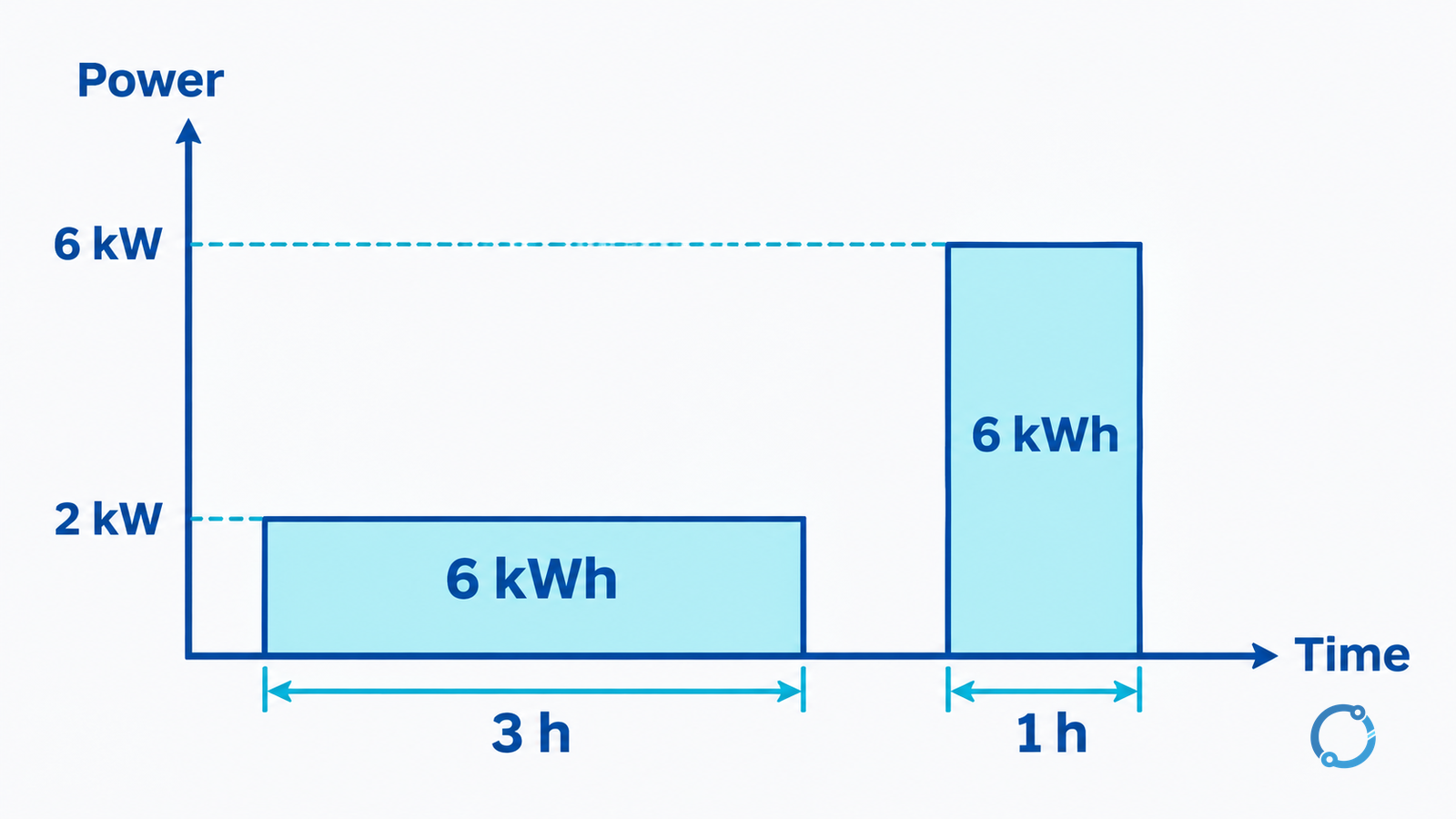
Consider a hypothetical heater drawing a constant 2 kW for three hours. Its electricity use is:
2 kW × 3 h = 6 kWh.
A second hypothetical load drawing 6 kW for one hour also uses 6 kWh. Their energy totals match, but the second needs three times as much power while running. Equal kWh therefore does not imply equal electrical supply requirements.
For a 750 W device used for 40 minutes at that constant input, the calculation is 0.750 kW × (40/60) h = 0.50 kWh. These are teaching inputs, not measurements of a particular appliance.
What if power changes?
Split operation into periods and add the energy for each period. Suppose a hypothetical machine draws 4 kW for 30 minutes, 1 kW for the next hour and 0.2 kW for two hours of standby:
| Operating period | Calculation | Energy |
|---|---|---|
| Active | 4 × 0.5 | 2.0 kWh |
| Reduced load | 1 × 1 | 1.0 kWh |
| Standby | 0.2 × 2 | 0.4 kWh |
| Total | 2.0 + 1.0 + 0.4 | 3.4 kWh |
The total duration is 3.5 hours, so average power is 3.4/3.5 = 0.971 kW. Multiplying the highest power, 4 kW, by all 3.5 hours would incorrectly assume continuous full-load operation.
An energy-meter difference is another way to obtain the total. If the same meter advances from an assumed 12,450.0 to 12,453.4 kWh, the difference is 3.4 kWh. Check that both readings cover the same circuit and that any displayed multiplier is accounted for.
Which power should you use?
Use electrical input power for electricity consumption. A motor’s mechanical shaft rating describes a different quantity; its conversion losses must be considered before using shaft output to estimate electrical input. OHELE’s motor efficiency calculation guide explains that boundary.
Likewise, a device rating is not proof that it draws that power throughout its operation. For a cycling load, use a measured energy total or a defensible operating profile. If all you have is a maximum input rating, label the result as a conditional estimate at that input.
Convert energy into a cost estimate
For an explicitly hypothetical flat energy price of $0.20/kWh, the 3.4 kWh machine example costs 3.4 × $0.20 = $0.68 in energy charges. The assumed price is not a current tariff quotation.
That multiplication does not calculate a complete bill if other charges apply. Use the actual tariff and its time periods. The practical sequence is to establish the circuit, determine energy over the relevant period, then apply the applicable price. Keep power, energy and billing conditions visible instead of treating any single kW rating as a monthly consumption figure.