
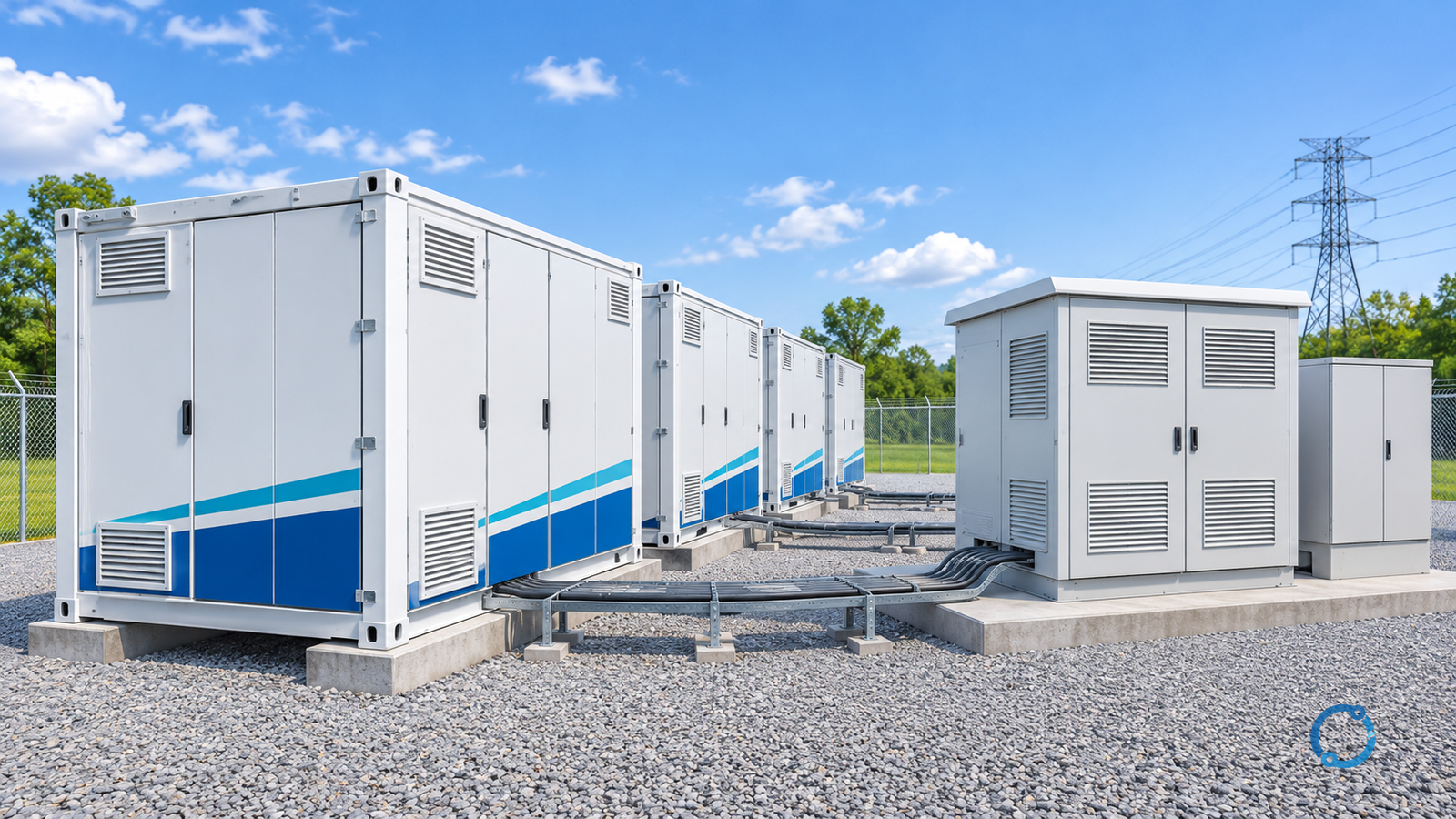
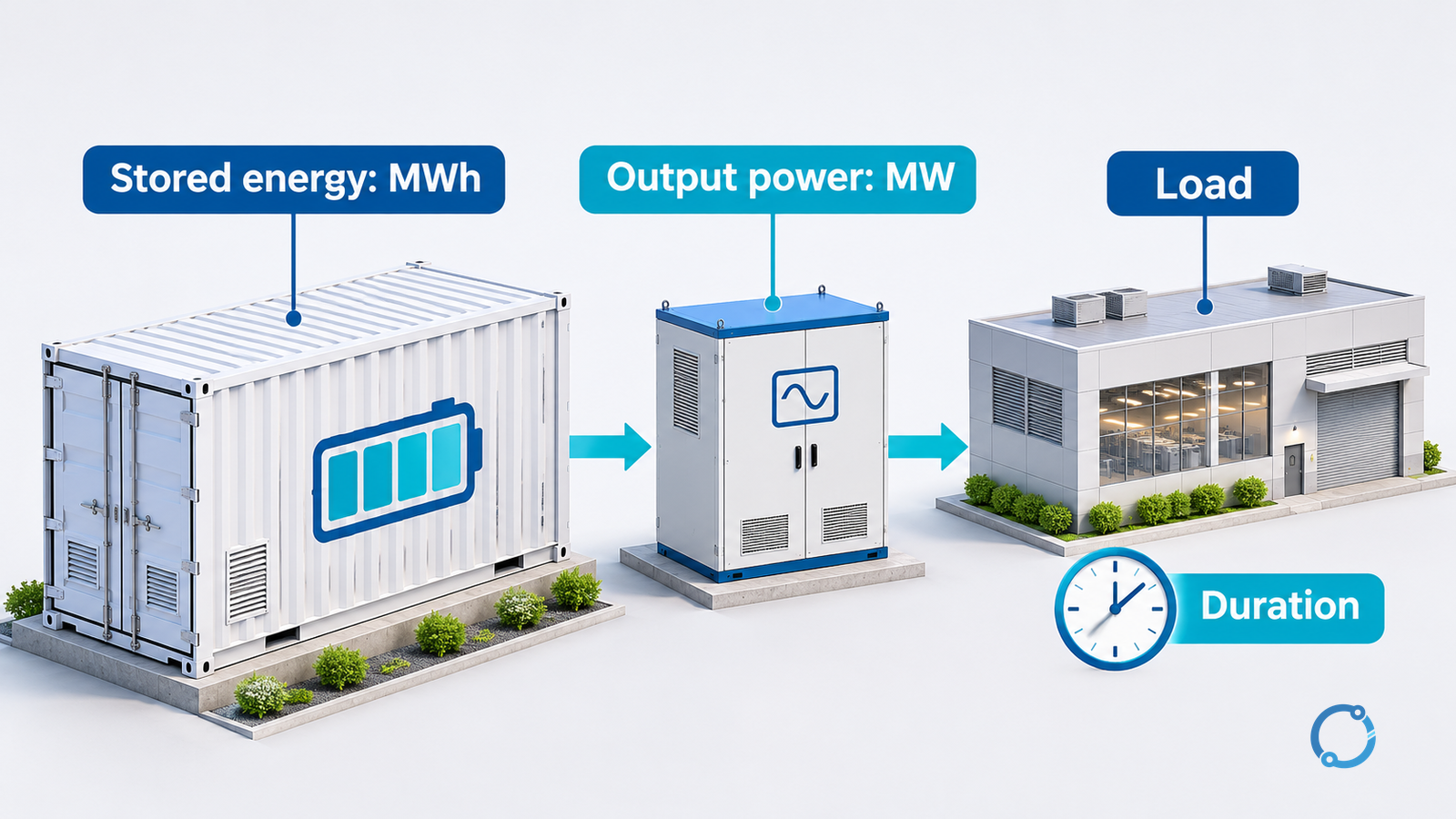
For battery energy storage, MW describes output power and MWh describes energy capacity. Their ratio gives duration in hours when both ratings use a compatible basis:
Duration (h) = deliverable energy (MWh) ÷ constant output power (MW).
A “20 MW battery” does not tell you how long it can supply 20 MW. You also need the usable energy, operating limits and the point where the ratings are measured.
Read the two ratings together
The EIA explanation of electricity storage distinguishes power capacity from energy capacity. Its battery-duration article, published March 25, 2022, explicitly defines duration as energy capacity divided by power capacity. That relationship remains useful; the article’s historical fleet figures are not current market totals.
| Rating | Unit | What it answers |
|---|---|---|
| Output power | MW | How fast can the system deliver energy? |
| Deliverable energy | MWh | How much energy is available at the stated boundary? |
| Duration | h | How long can a specified output be maintained? |
A larger MW figure can satisfy a larger load without necessarily extending operating time. A larger MWh figure can extend operating time without necessarily increasing the permitted output power.
Calculate a clearly defined example
Assume a hypothetical system can deliver 80 MWh at its AC connection and continuously supply up to 20 MW there. Both are teaching assumptions, not a commercial product specification.
At a constant 20 MW, duration is 80/20 = 4 hours. At a constant 10 MW, simple energy accounting gives 80/10 = 8 hours, provided those same 80 MWh remain deliverable at that operating point.
Now consider a constant 25 MW load. An 80/25 calculation gives 3.2 hours mathematically, but this system is limited to 20 MW. It cannot supply the specified load by itself. Check power capability before calculating duration.
Account for usable energy without counting losses twice
Suppose a different hypothetical specification lists 100 MWh of nominal DC energy. An agreed operating window makes 80 MWh available for discharge, and an assumed discharge-path efficiency is 95%. With no other deductions, the estimated delivered energy is:
100 × 0.80 × 0.95 = 76 MWh.
At an assumed 20 MW AC output, this simplified estimate gives 76/20 = 3.8 hours. The percentages are illustrative, not industry defaults.
If the supplier already states 76 MWh as usable AC output under those conditions, multiplying it by 0.80 and 0.95 again would double-count the deductions. Ask what the quoted energy includes before adding factors.
Round-trip efficiency describes energy returned relative to charging energy across a stated cycle boundary; the national laboratory’s SAM battery-results documentation defines its modeled quantity as discharge energy divided by charge energy. It is not interchangeable with discharge-path efficiency. Use a separately defined discharge quantity to estimate runtime rather than applying an unexplained round-trip percentage to every energy rating.
A changing load needs an energy budget
Assume the first 80 MWh system must provide 15 MW for two hours and then 10 MW for three hours. Energy demand is:
15 × 2 + 10 × 3 = 60 MWh.
Both power levels are below 20 MW, and the simplified schedule leaves 20 MWh. Whether that reserve can actually be used depends on the specified operating constraints. A schedule that asks for 30 MW even briefly still fails the stated continuous-power condition, regardless of its total MWh.
Questions to resolve before accepting a runtime claim
Ask whether the rating is nominal or usable, DC or AC, and whether it applies at the beginning or end of the stated service period. Establish the initial charge, minimum reserve, allowed temperature range and whether auxiliary loads are already included. These are verification questions, not assumed deductions.
For a first estimate, write three lines: required load power, energy required over its schedule, and available deliverable energy on the same basis. If either power or energy is insufficient, a duration ratio cannot repair the mismatch.