

Capacity factor measures how much electricity a generator produced compared with continuous operation at a specified capacity over the same period. Efficiency measures how much input energy becomes useful output. One number describes utilization over time; the other describes energy conversion.
A generator can convert energy efficiently and still have a low capacity factor if it is needed only occasionally. A high capacity factor does not, by itself, establish low fuel consumption.
Compare the denominators
| Measure | Numerator | Denominator | Main question |
|---|---|---|---|
| Capacity factor | Actual electrical energy generated | Reference power capacity × hours | How much of the period’s potential output was used? |
| Conversion efficiency | Useful energy output | Energy input across the same boundary | How much input became useful output? |
The EIA explanation of capacity and generation distinguishes nameplate capacity, seasonal net capacity and generation. State which capacity basis you use: a reported percentage is not reproducible without its denominator and period.
Calculate capacity factor
For a generator whose reference capacity stays constant:
Capacity factor (%) = actual generation (MWh) ÷ [capacity (MW) × hours] × 100.
Assume a hypothetical 10 MW generator produces 21,600 MWh in a 90-day period. There are 90 × 24 = 2,160 hours. Its reference maximum is 10 × 2,160 = 21,600 MWh, giving 100% capacity factor.
If it produces 10,800 MWh instead, the capacity factor is 50%. That could represent full output for half the period, half output throughout, or many other schedules. The percentage alone cannot identify the operating pattern.
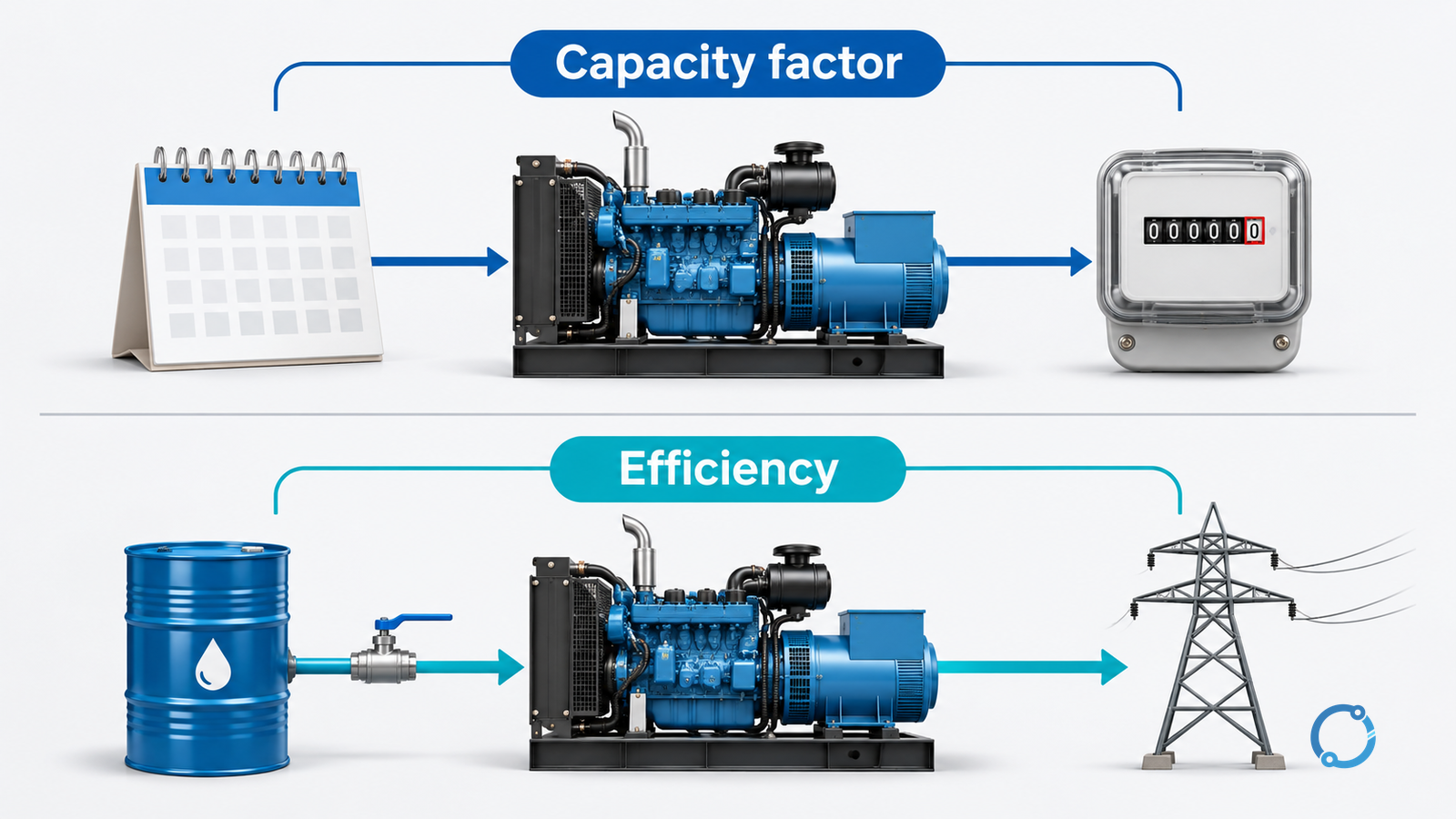
If capacity changes during the reporting period, do not multiply the final rating by all elapsed hours. Time-weight the capacity or follow the dataset’s stated method. EIA describes its treatment of seasonal capacity and generators entering or leaving service in its methodology; a simplified single-generator example should not be mistaken for that complete statistical method.
Calculate thermal efficiency separately
For a fuel-burning power plant, heat rate expresses fuel energy input per unit of electricity output. Lower heat rate means less fuel energy per unit of output when the measurement basis is consistent.
The EIA heat-rate explanation gives the conversion:
Thermal efficiency (%) = 3,412 ÷ heat rate (Btu/kWh) × 100.
Using an explicitly hypothetical heat rate of 8,000 Btu per net kWh, efficiency is 3,412/8,000 × 100 = 42.65%. This calculation says nothing about how many hours the plant ran.
For a real annual reference, EIA Electric Power Annual Table 8.1, checked November 4, 2026, reports a 2025 US natural-gas average operating heat rate of 7,781 Btu/kWh. Applying the same conversion gives approximately 43.9%. The table covers utility and independent power producers and excludes combined heat and power plants and commercial/industrial-sector plants. This fleet-level annual figure is not a guarantee for a particular turbine or a statement about its present performance. It is also not a capacity factor.
Why a lower capacity factor is not automatically a defect
Imagine two otherwise identical hypothetical generators with the same heat rate. One supplies a steady load; the other is held for occasional demand peaks. Their capacity factors can differ even though their conversion efficiency while operating is the same.
A capacity-factor figure cannot separate planned standby, resource availability, maintenance, dispatch choices or restrictions. You need operating records to establish why output was lower. Do not label the unexplained portion “wasted fuel” or “equipment failure.”
Use the measure that answers your question
To estimate generation from a given capacity, use capacity factor with a defined period. For fuel consumption per electrical output, use heat rate or the corresponding thermal efficiency. For whether power will be available at a particular moment, obtain availability and system-planning evidence; an annual average cannot answer that question alone.
Before comparing reports, match gross or net generation, capacity basis, reporting dates and technology. OHELE’s electricity-generation explainer supplies the physical context. Keep utilization and conversion separate so that a precise percentage does not answer the wrong question.