
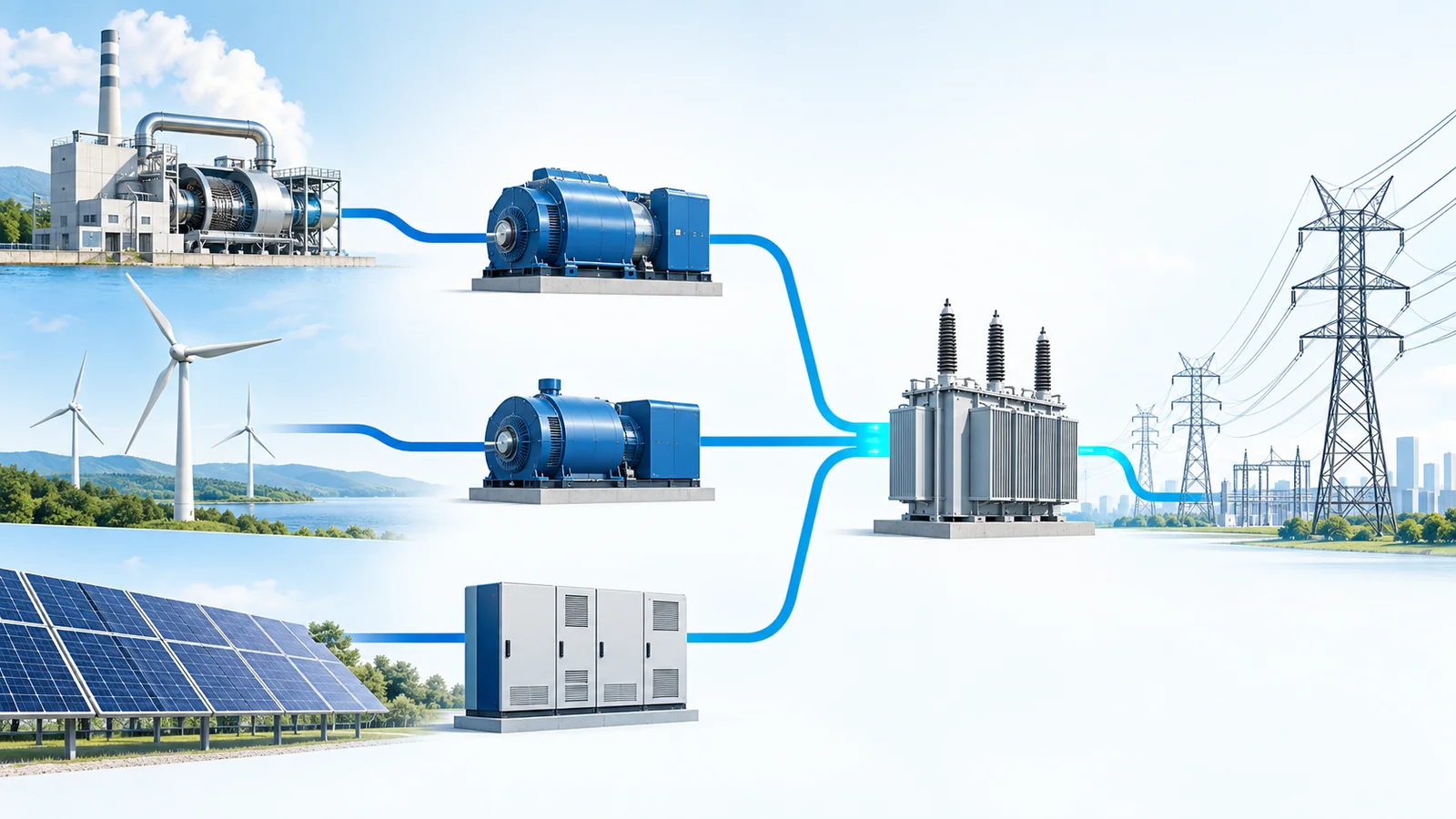
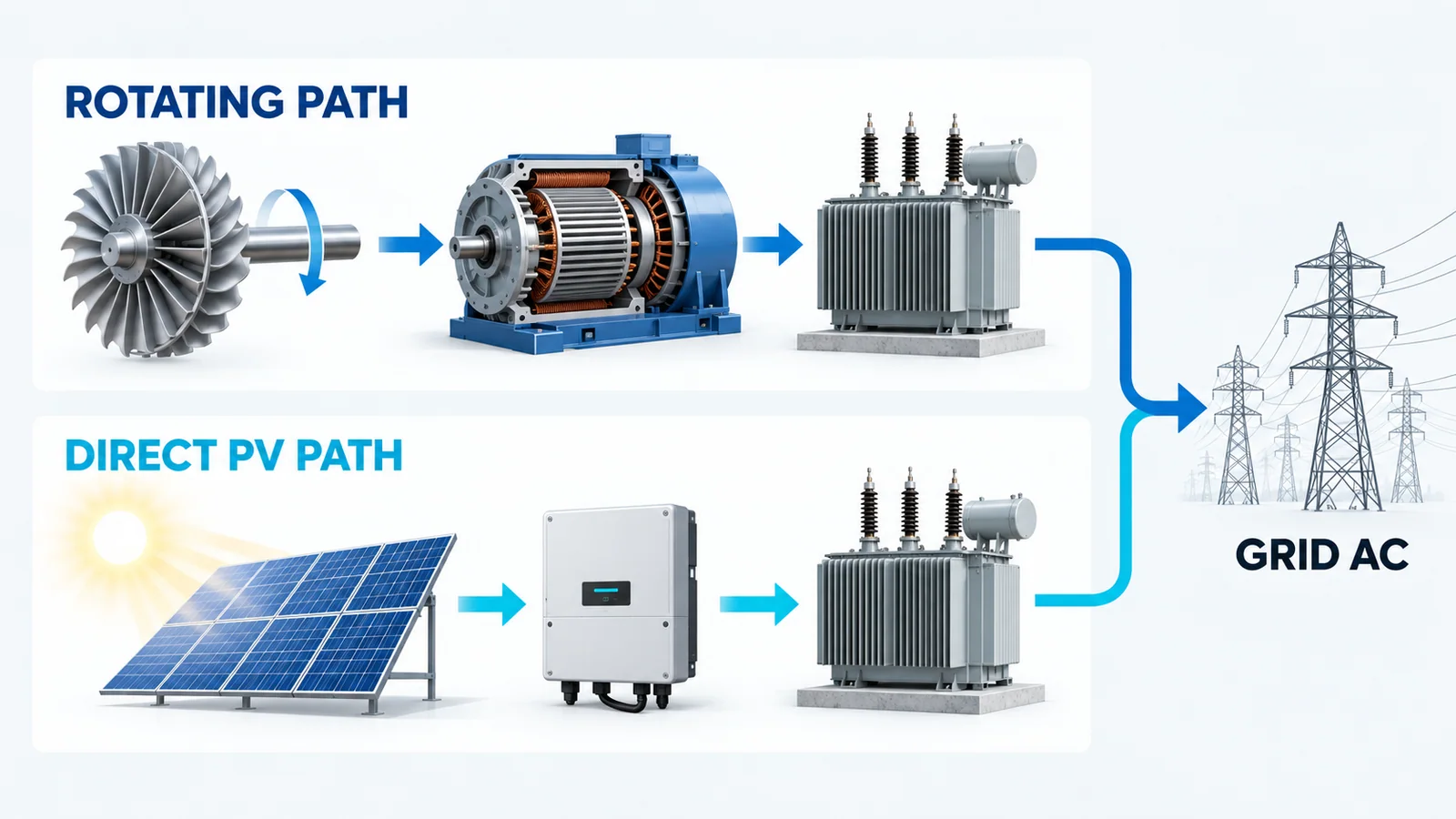
Electricity is generated by converting another form of energy into electrical energy. In most power plants, heat, falling water, wind or an engine first creates mechanical rotation. That rotation drives an electromagnetic generator. Solar photovoltaic cells take a different route: they convert light directly into direct-current electricity, which an inverter conditions for use on an alternating-current grid.
The useful mental model is not a list of fuels. It is a conversion chain:
primary energy → motion or direct conversion → electrical output → voltage and waveform conditioning → power grid
The energy source, machine and grid interface are separate parts of that chain. Coal is not a generator, a turbine is not the electrical generator, and a battery is normally an energy-storage device rather than a primary source.
Electricity is an energy carrier
Electricity does not have to be mined or harvested in the form delivered to a socket. It carries energy that originated elsewhere. The U.S. Energy Information Administration describes electricity as a secondary energy source because it is produced by converting primary sources such as wind, sunlight, flowing water, fuels and nuclear energy.
That distinction helps separate three questions:
- Where does the energy come from? Examples include chemical, nuclear, gravitational, kinetic, geothermal and solar-radiation energy.
- What converts it? A boiler, reactor, turbine, engine, photovoltaic cell, fuel cell or another device changes the form of energy.
- What makes the output usable? Generators, inverters, transformers, switchgear and control systems produce and regulate electricity suitable for a local load or grid connection.
Energy is not created in this process. Some becomes useful electrical output, while some leaves as heat, sound, friction, exhaust energy or other losses. The conversion route determines where those losses occur and what equipment is required.
The most common route: rotation and electromagnetic induction
Most utility-scale electricity is produced with a rotating electromagnetic generator. A simplified generator has two main electromagnetic parts:
- the rotor, which rotates and produces a moving magnetic field; and
- the stator, a stationary set of insulated conductors in which voltage is induced.
Relative motion between the magnetic field and the conductors changes the magnetic flux linked with the stator windings. This induces an electromotive force. When the generator is connected to a circuit, the induced voltage can drive current through that circuit.
The generator does not supply its own mechanical energy. It needs a prime mover—the machine that turns the shaft. According to the EIA explanation of electricity generation, common prime movers include steam turbines, combustion turbines, hydro turbines, wind turbines and internal-combustion engines.
In a grid-connected alternating-current generator, speed, magnetic field and winding arrangement determine important output characteristics. Plant control and protection systems regulate voltage and mechanical input, while synchronization equipment ensures that connection to an energized AC system occurs under acceptable voltage, frequency and phase conditions. The exact requirements depend on the generator and grid rules; this conceptual article is not a commissioning procedure.
How the main generation pathways compare
Different power stations can share the same final electromagnetic conversion step even when their primary energy sources are completely different.
| Primary source or stored input | First useful conversion | Prime mover or direct converter | Initial electrical output | Main grid-interface need |
|---|---|---|---|---|
| Coal, natural gas, biomass or oil in a steam plant | Chemical energy → heat → steam flow | Steam turbine driving a generator | AC from generator | Voltage regulation, synchronization, transformation and protection |
| Nuclear fission | Nuclear energy → heat → steam flow | Steam turbine driving a generator | AC from generator | Same broad generator-grid functions; the heat source is different |
| Geothermal heat | Earth heat → steam or working-fluid flow | Turbine driving a generator | AC from generator | Plant controls, transformation and protection |
| Hydropower | Gravitational/kinetic energy of water → shaft rotation | Hydraulic turbine driving a generator | AC from generator | Speed/frequency control, excitation, transformation and protection |
| Wind | Kinetic energy of air → rotor motion | Wind-turbine drivetrain and generator | Variable AC or conditioned electrical output, depending on design | Power-electronic conversion and/or generator controls, plus transformation and protection |
| Natural gas or liquid fuel in a combustion turbine | Chemical energy → hot-gas flow | Combustion turbine driving a generator | AC from generator | Generator controls, synchronization, transformation and protection |
| Fuel in a piston engine | Chemical energy → reciprocating motion → shaft rotation | Engine driving a generator | AC from generator | Speed and voltage control, synchronization where grid-connected, and protection |
| Sunlight in photovoltaic cells | Light → electrical charge separation | Semiconductor cell; no turbine | DC | Inverter, controls, transformation where required and protection |
| Stored electrical energy in a battery | Electrochemical energy → DC electricity | Battery cells; no turbine | DC | Bidirectional power converter or inverter, controls and protection |
This table shows why “renewable versus nonrenewable” is not the same classification as “generator versus inverter.” Wind and hydropower are renewable sources that normally use rotating generators. Solar photovoltaic generation is renewable but has no turbine or electromagnetic generator at the panel. A battery may use a similar inverter interface to solar PV even though the battery stores electricity produced earlier.
Thermal power plants: different heat sources, similar machinery
A thermal power plant begins with heat. In many plants, heat turns water into high-pressure steam. The steam expands through turbine stages, rotating a shaft connected to a generator. After leaving the turbine, the steam is cooled and condensed so the water can circulate through the process again.
The upstream heat source can vary:
- fossil-fuel and biomass plants release heat through combustion;
- nuclear plants release heat through controlled fission in a reactor;
- geothermal plants use heat from underground fluids or a secondary working fluid; and
- concentrating solar-thermal plants collect solar heat before producing steam or driving another heat engine.
These technologies have different fuels, environmental effects, operating constraints and plant systems, but many converge on the same sequence: heat → fluid flow → turbine rotation → electromagnetic generation.
A combustion-gas turbine uses another thermal route. Fuel burns in compressed air, and the expanding hot gas turns the turbine directly. In a combined-cycle plant, the gas turbine’s hot exhaust supplies a heat-recovery steam generator, which creates steam for a second turbine. That arrangement extracts useful work at two stages before the remaining heat is rejected.
Hydropower and wind: the fluid provides motion directly
Hydropower and wind do not need a boiler to create turbine motion.
In a hydroelectric plant, water moving through the turbine transfers energy to the runner and shaft. The available power depends on factors including water flow, elevation difference and equipment efficiency. Reservoir, run-of-river and pumped-storage arrangements manage water differently, but electricity is produced when water drives the turbine-generator.
A wind turbine extracts part of the kinetic energy in moving air. Its rotor turns a drivetrain and generator. Modern wind turbines may use gearboxes or direct-drive arrangements, and their power-electronic systems can decouple generator speed from fixed grid frequency. The exact topology varies, but the system must still deliver controlled voltage and current compatible with the network.
Solar photovoltaic generation bypasses the turbine
A photovoltaic (PV) cell is a semiconductor device that converts light directly into electricity. Absorbed photons transfer energy to electrons in the semiconductor. The cell’s internal electric field separates charge, producing a voltage; when an external circuit is connected, direct current can flow.
PV cells form modules, and modules form arrays. The array produces DC electricity whose voltage and current change with sunlight, temperature and the connected electrical operating point. A grid-connected inverter converts that DC into controlled AC. It also performs monitoring and protective functions and operates the array near an efficient power point. OHELE’s guide to maximum power point tracking algorithms explains that control task in more detail.
The EIA photovoltaic overview distinguishes this nonmechanical conversion from turbine generation and notes the need to convert PV’s DC output for AC transmission and distribution systems.
Other direct or small-scale conversion methods
Not every generator is a turbine-generator, and not every electrical source is electromagnetic.
- Fuel cells convert the chemical energy of continuously supplied reactants into DC electricity through electrochemical reactions. A grid connection normally requires power electronics.
- Thermoelectric generators create voltage from a temperature difference across suitable materials. They are valuable in specialized applications but are not the dominant source of bulk grid electricity.
- Small engine-generators use a piston engine as the prime mover for an electromagnetic generator. They are common for backup, mobile and isolated power, although the same fuel can also be used in much larger turbine plants.
These examples reinforce the core distinction: the word generator may refer broadly to a generating unit, but the physical conversion device may be an electromagnetic machine, a semiconductor, an electrochemical stack or another technology.
What happens before electricity enters the grid
Producing voltage at generator or inverter terminals is only one stage. A power system must also control and move the output.
- Control the electrical output. Excitation systems, governors, inverters and plant controllers regulate quantities such as voltage, power and frequency response within the capabilities of the equipment.
- Protect the generating unit and network. Instrument transformers, relays, circuit breakers and other protection systems detect abnormal conditions and isolate faults according to the protection design.
- Transform the voltage. A generator step-up transformer commonly raises voltage for efficient long-distance transmission. Substations later reduce voltage for subtransmission and distribution.
- Transmit and distribute power. Lines and cables connect generating sources to substations and consumers. The EIA overview of electricity delivery describes the grid as the substations, transformers and power lines that connect producers and users.
- Balance generation and demand. In an interconnected AC system, supply and demand must remain continuously balanced. Operators dispatch resources, manage reserves and respond to changes in load and variable generation.
For a closer look at the point where transmission and local distribution systems meet, see distribution substation equipment and operation.
Electricity storage is not a primary generation source
A battery can discharge electricity into a load or grid, so operational reports may call it a generating resource. Physically, however, it first had to be charged from another energy source. Pumped-storage hydropower similarly uses electricity to pump water uphill, then recovers part of that stored energy later through a turbine-generator.
The EIA energy-storage explanation describes storage as a secondary resource and distinguishes the electricity discharged from the larger amount used for charging and system operation. Storage shifts energy through time, supports power balance and can change when other generators must operate; it does not eliminate the original conversion step.
Capacity is not the same as generation
Two quantities are often confused:
- Power capacity, measured in watts, kilowatts, megawatts or gigawatts, describes the rate at which a unit can produce power under stated conditions.
- Electricity generation, measured in watt-hours, kilowatt-hours, megawatt-hours or gigawatt-hours, describes energy produced over a period.
A 100 MW plant operating at full output for one hour produces 100 MWh in that hour. The same plant produces less energy if it operates below full output or for only part of the hour. The EIA capacity-versus-generation guidance emphasizes that nameplate or seasonal capacity does not tell how much electricity a generator actually produces over time.
That distinction is essential when comparing intermittent, dispatchable, peaking, storage and baseload resources. A capacity figure is not an annual-energy figure, and neither number alone describes reliability, cost or environmental impact.
The complete picture
Electricity generation is a chain of energy conversions, not a single machine:
- thermal plants convert heat into fluid motion, turbine rotation and then electricity;
- hydropower and wind convert moving fluids into rotor motion and electricity;
- engine-generators convert fuel into shaft motion and electricity;
- photovoltaic cells and fuel cells produce DC electricity without a turbine;
- inverters condition DC or variable electrical output for AC systems;
- transformers, switchgear, protection and power lines connect the source to the grid; and
- storage returns previously captured energy when it is needed.
Once those stages are separated, apparently different power technologies become easier to compare. Ask five questions: What is the original energy source? What is the intermediate energy form? What device performs the electrical conversion? Is the first output AC or DC? What equipment makes it compatible with the load or grid?