
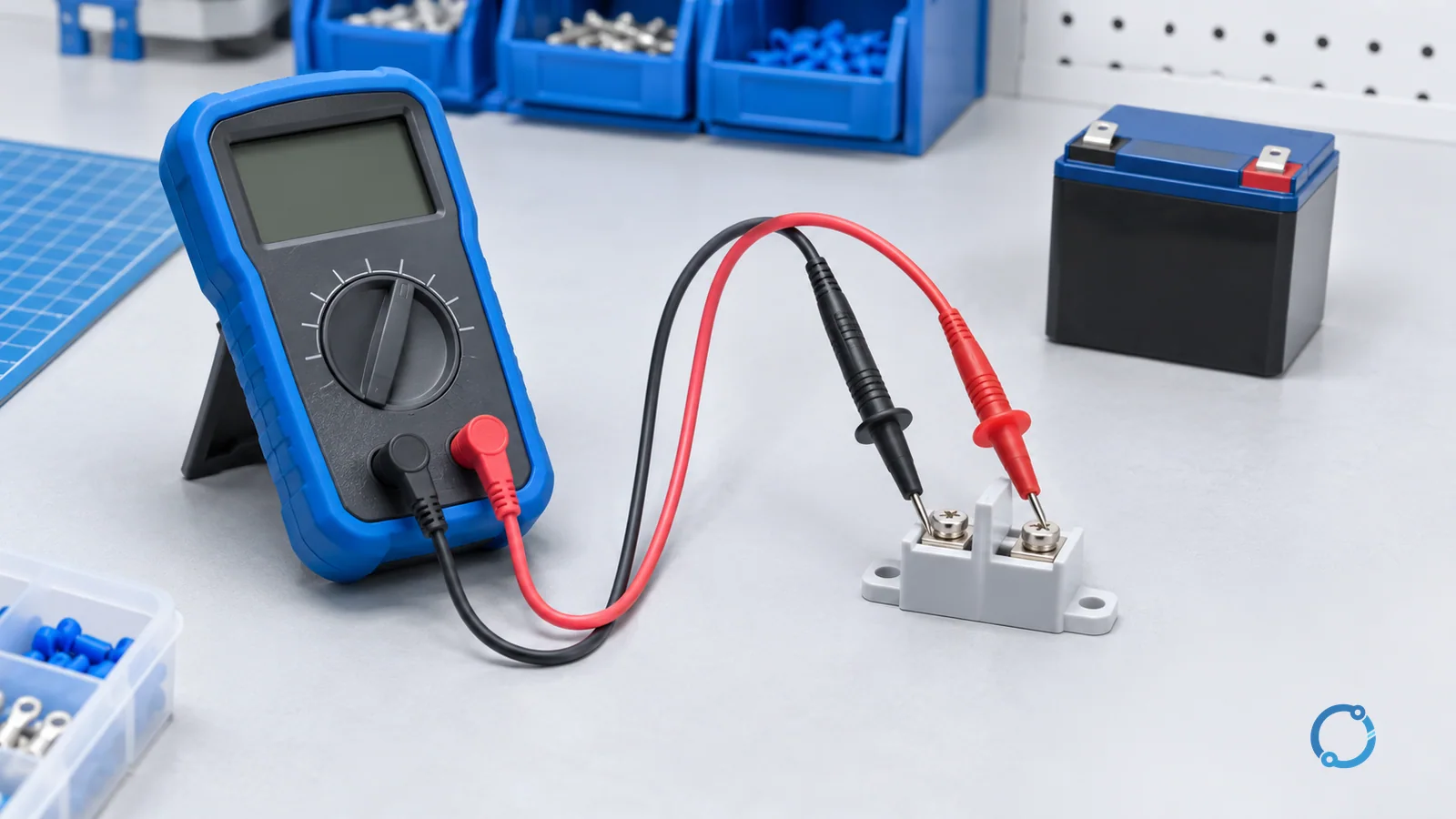
Voltage is electric potential difference between two points. It describes how much electrical potential energy is available per unit of charge to move between those points. The unit is the volt, symbol V. A voltage measurement therefore needs a reference: the meter is comparing one point with another, not assigning an absolute electrical level to a single isolated wire.
That definition separates voltage from current. Voltage is the difference that can drive charge; current is the rate at which charge moves. A battery can have voltage across its terminals while no current flows because the circuit is open. Once a complete path is connected, the source voltage and the circuit resistance together determine the current.
The NIST SI units page identifies the volt as the SI unit of electric potential difference. The U.S. Department of Energy electrical-science handbook explains potential difference, voltage, current, resistance, and Ohm’s law in introductory terms.
Voltage in one mental model
Imagine two tanks connected by a pipe. A height difference can make water flow when a path exists, but the height difference is not the flow itself. Voltage is similar in one limited sense: it is a difference between two points that can cause charge to move. The analogy stops there. Electrical potential is not literally pressure, and the relationship between voltage, current, and resistance depends on the material and the circuit.
Three ideas keep the terms separate:
| Quantity | What it describes | Common unit | What a measurement tells you |
|---|---|---|---|
| Voltage | Electric potential difference between two points | volt (V) | How much potential difference exists across those points |
| Current | Rate of charge movement through a path | ampere (A) | How much charge passes a point per unit time |
| Resistance | Opposition to current in a material or device | ohm | How strongly the path resists current under the stated conditions |
Voltage is always a comparison. If a meter reports 12 V between a positive terminal and a negative terminal, it has measured a 12 V difference between those two points. Reversing the probe reference can reverse the sign of the reading, but it does not create a second independent voltage.
Voltage can exist without current
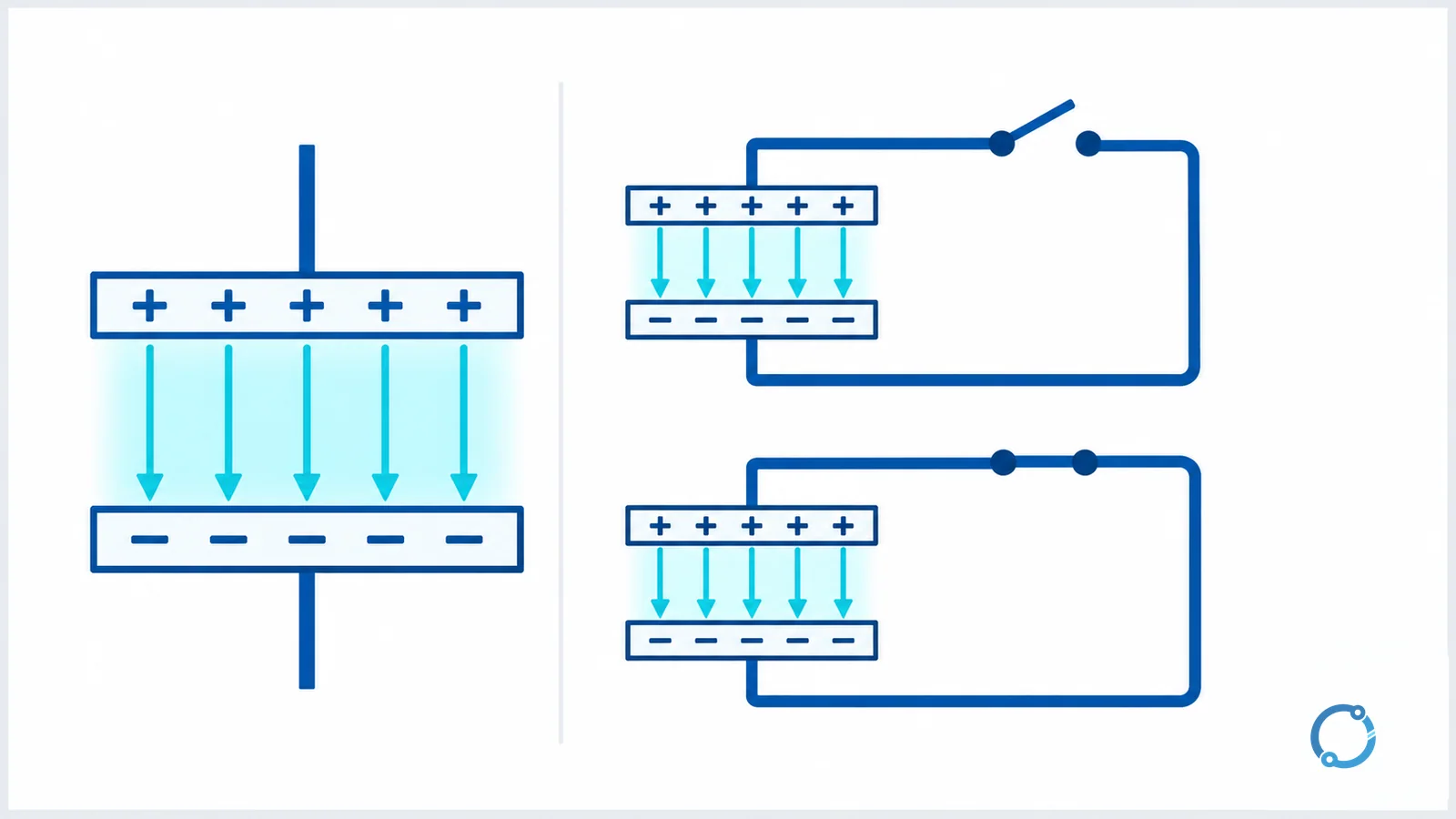
An open battery circuit is the simplest example. The battery has a potential difference across its terminals, but the air gap or open switch prevents a continuous current path. A voltmeter connected across the battery can measure that difference while drawing only the small current needed by the meter.
The reverse statement needs more care. Current requires a complete path and a source of energy, but the voltage that drives it may be small in a very good conductor or large in an insulating path that is beginning to break down. A voltage number alone therefore does not tell you the current, the power, or whether a person or conductor is safe. Those depend on the complete circuit and the applicable conditions.
This is why a “high-voltage” label is not a complete description of a hazard, and a “low-voltage” label is not a guarantee of safety. The source, available energy, fault path, environment, and applicable rules all matter.
DC and AC voltages
A direct-current (DC) voltage has a consistent polarity in the ordinary steady state. Batteries, photovoltaic modules, and many electronic power supplies are common examples. A nominal 12 V automotive system, a 24 V control supply, or a 48 V DC bus may appear in equipment descriptions, but the actual operating range must be checked against the equipment and system documentation.
An alternating-current (AC) voltage reverses polarity periodically. Household and industrial distribution systems commonly use nominal values such as 120 V, 230 V, 400 V, or 480 V, but these are system examples rather than universal values. Frequency, conductor arrangement, earthing, and local standards also matter. The AC number shown on a meter may be an RMS value, which is a way of expressing the equivalent heating effect of a varying waveform; it is not the same as the peak value.
Do not assume that a voltage marked on a nameplate is the exact voltage at every terminal. Supply variation, conductor voltage drop, transformer taps, and operating conditions can change the measured value. The guide to how electricity is generated provides the larger source-to-load context.
Voltage, current, and resistance together
For a circuit element that behaves approximately as a linear resistor, the three quantities are related by Ohm’s law:
V = I R
Here, V is the voltage across the element in volts, I is the current through it in amperes, and R is its resistance in ohms. The formula is a model with conditions. It is useful for many introductory resistive circuits, but it should not be applied blindly to a diode, a motor, a lamp with a changing temperature, or an AC network with significant reactance.
Worked example: find the voltage
Assume a 6 ohm resistive element carries 2 A. These are teaching values, not a product rating.
V = I R = 2 A x 6 ohm = 12 V
The voltage across that element is 12 V. The calculation does not say that the source is 12 V; other elements in the circuit may consume or drop part of the source voltage.
Worked example: find the power
Electric power can be calculated from voltage and current:
P = V I
Assume a 24 V DC load draws 2.5 A.
P = 24 V x 2.5 A = 60 W
The result is 60 W for those assumed conditions. It is an arithmetic result, not a statement that every 24 V load draws 2.5 A or that a particular power supply is rated for 60 W.
The Ohm’s law explanation develops the formula triangle, unit checks, and additional worked examples. It is the better next page when the task is specifically to rearrange the relationship rather than to define voltage.
How a voltage measurement fits the circuit
A voltmeter measures the difference between its two probe points. It is connected across the points being compared, not inserted as a replacement for the load. In a de-energized or appropriately guarded test setup, the meter’s high input resistance is intended to limit the current it draws from the measured circuit, but that does not make the meter safe for every circuit or every category.
Before measuring, verify the meter’s voltage and category rating, the lead rating, the selected AC or DC mode, and the probe jacks. Treat an unknown circuit as energized until it has been isolated and verified. The safe procedure is not “touch the probes and read the display”; it is a planned comparison between known points under controlled conditions.
The voltage-sag troubleshooting guide shows why a single voltage reading may be insufficient when the question is power quality rather than a basic circuit value. For energy and billing, the distinction between kW and kWh is also separate from voltage.
Common misconceptions
Voltage is not the same as current
A source may have a rated voltage while the current depends on the connected circuit. A 12 V source connected to a high resistance may produce a very small current; the same source connected to a low-resistance path may produce a large current, limited by the source and protective design.
Voltage is not a measure of total energy
Voltage describes potential difference per unit charge. Energy also depends on the amount of charge transferred and the time over which power is delivered. A high voltage for a very short duration and a low voltage for a long duration can represent different energy and hazard situations.
A voltage reading is not a complete safety test
The meter, leads, category rating, circuit condition, stored energy, and isolation state all affect the validity of a measurement. A correct number obtained with the wrong instrument or in the wrong mode can still be dangerous.
FAQ
What is voltage in simple words?
Voltage is the electrical potential difference between two points. It tells you how much potential energy per unit charge is available to move charge between those points. It is measured in volts.
Does voltage exist if no current flows?
Yes. An open circuit can have a voltage across its open points while no continuous current flows. The voltage may still be present and hazardous, so an open switch or a meter reading does not by itself prove that a circuit is safe.
Is voltage the same as electric current?
No. Voltage is a difference in electric potential, while current is the rate of charge movement. Voltage can be present without current, and current requires a complete path and an energy source.
Why do AC voltage readings use RMS values?
An AC voltage changes over time. An RMS value gives a single magnitude related to the waveform’s equivalent heating effect. It is useful for comparison and equipment ratings, but peak voltage and waveform shape may differ.
Can I use V = I R for every electrical device?
No. It is a useful approximation for a linear resistive element under stated conditions. Devices that are nonlinear, temperature-dependent, or strongly reactive need a model appropriate to their behavior and operating point.