For U.S. general-industry work, the answer starts with the hazard and the task, not the padlock. OSHA’s 29 CFR 1910.147 covers control of hazardous energy during servicing and maintenance, but it explicitly excludes exposure to electrical hazards from conductors or equipment in electric-utilization installations. Those electrical work practices are covered by 29 CFR 1910.333, part of OSHA Subpart S.
An employer may use one energy-control program for both sets of hazards, but only if the program also includes the additional electrical protections required by 1910.333. OSHA’s official relationship eTool identifies two important additions: tighter conditions for a tag used without a lock, and testing circuit parts for voltage before they can be considered deenergized.
This article describes U.S. federal OSHA requirements. It is not a site-specific energy-control procedure, legal advice, or permission for unqualified energized work. Local rules, utility-system rules and the adopted edition of a consensus standard can add requirements.
Scope crosswalk
| Question | 29 CFR 1910.147 | 29 CFR 1910.333 |
|---|---|---|
| Main subject | Control of hazardous energy during machine/equipment servicing and maintenance | Selection and use of electrical safety-related work practices |
| Typical energy | Mechanical, hydraulic, pneumatic, chemical, thermal and other hazardous energy | Electric shock and related hazards from exposed energized or deenergized parts |
| Electrical-utilization exposure | Excluded; Subpart S covers it | Covered for work on or near exposed deenergized electrical parts |
| Core employer duty | Energy-control program, documented procedures, training and periodic inspection | Written procedures for deenergizing, locks/tags, stored energy and verification |
| Isolation verification | Verify isolation and deenergization before work | Qualified person verifies with test equipment, including checking induced voltage or backfeed |
| Deenergized-but-unlocked parts | Generic lockout procedure addresses isolation | Must be treated as energized until 1910.333(b)(2) requirements are met |
| Tag without lock | Allowed under the standard’s conditions and equivalent-protection requirements | Requires at least one additional safety measure providing equivalent protection, such as removing an isolating circuit element |
OSHA’s eTool explains that 1910.147 does not cover a mechanic servicing mechanical parts of an electrically powered machine when the exposure is mechanical; it also says 1910.333 covers work on or near exposed deenergized electrical parts. The same physical cabinet can therefore require careful task-by-task classification: a mechanical hazard on a machine and an electrical shock hazard are not the same regulatory question.
The electrical gates a generic LOTO procedure must add
Under 1910.333(b)(2), the employer’s written procedure must be followed in order. Its key stages are:
- Determine safe procedures before deenergizing.
- Disconnect the circuits and equipment from all electric energy sources. Push buttons, selector switches and interlocks cannot be the sole means.
- Release stored electric energy that could endanger personnel; capacitors are discharged and high-capacitance elements short-circuited and grounded where the stored energy is hazardous.
- Block or relieve stored non-electrical energy that could reenergize circuit parts.
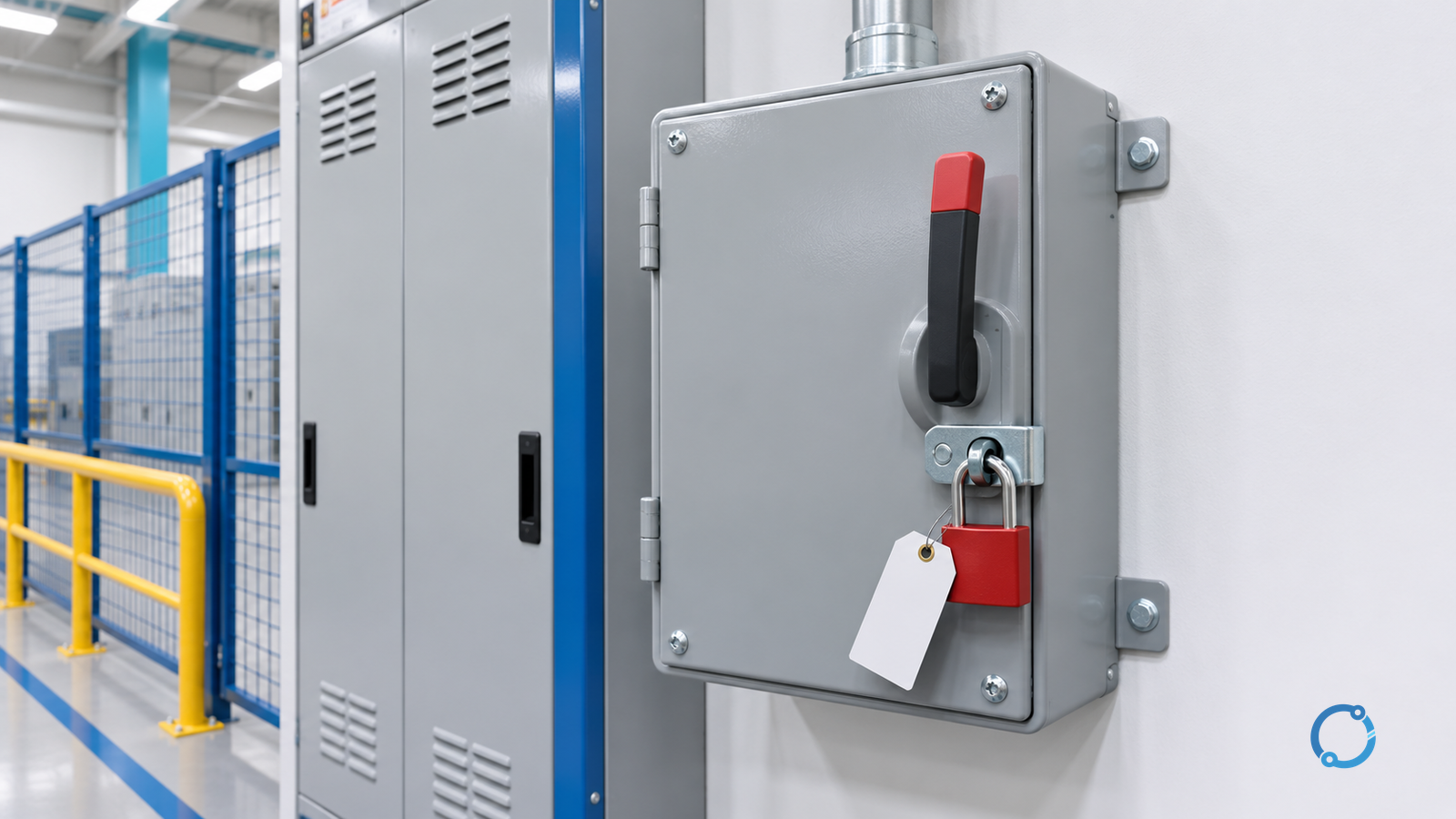
- Place a lock and tag on each disconnecting means, subject to the rule’s stated exceptions.
- If a tag is used without a lock, add at least one equivalent safety measure such as removing an isolating circuit element, blocking a controlling switch, or opening an extra disconnecting device.
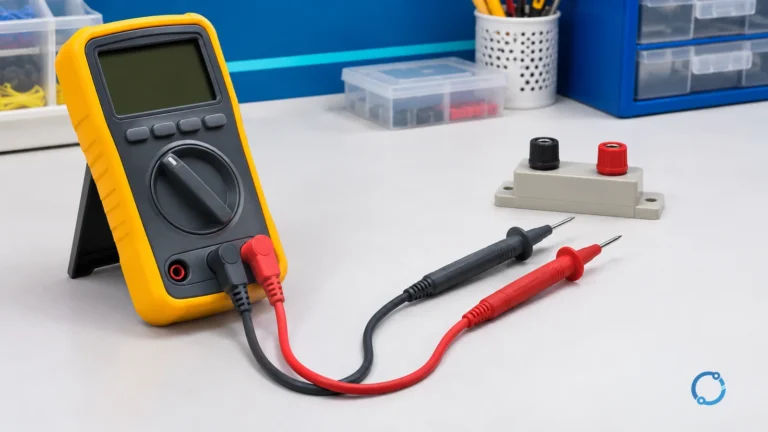
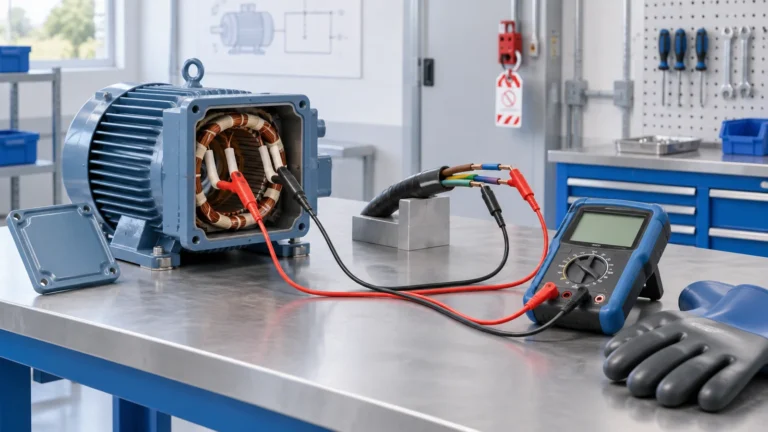
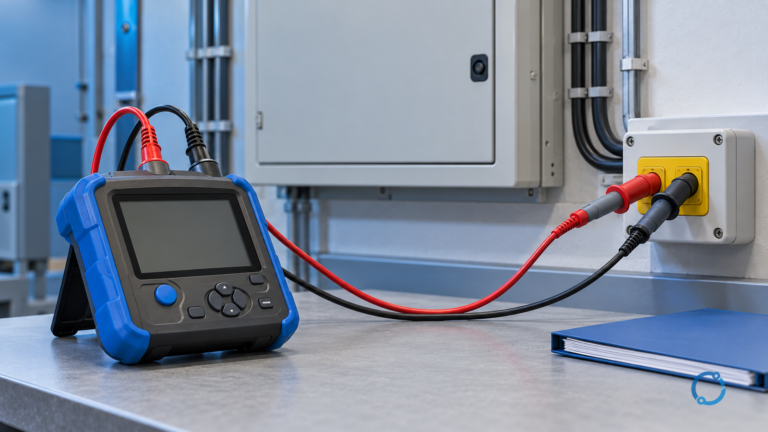
- Before work begins, have a qualified person verify that the equipment cannot be restarted and use test equipment to verify that exposed circuit parts are deenergized. The test must also detect an energized condition from induced voltage or unrelated backfeed.
- Before reenergizing, conduct tests and visual inspections, remove tools/jumpers/shorts/grounds, warn exposed employees, remove locks and tags under the rule’s conditions, and visually confirm that employees are clear.
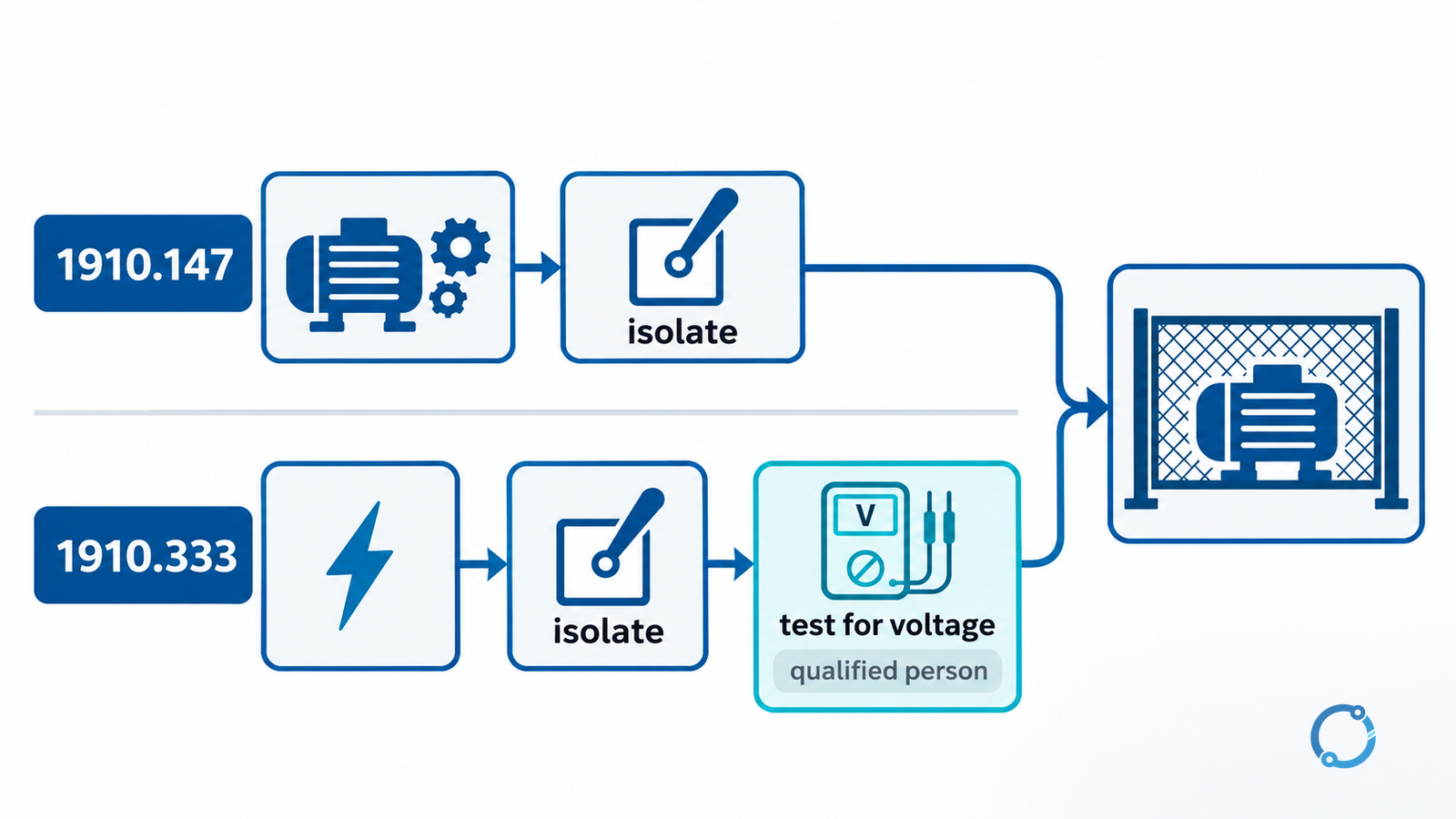
The phrase test before touch is a useful memory aid, but the regulation’s exact requirement is more specific. A qualified person must use test equipment to test the circuit elements and electrical parts to which employees will be exposed. For circuits over 600 V nominal, the test equipment must be checked for proper operation immediately before and immediately after the test. A visual check of an open switch or a control-panel indicator is not a substitute for that voltage test.
What a written energy-control procedure must contain
OSHA’s energy-control procedure eTool says the procedure must state its scope, purpose, authorization, rules, techniques and enforcement. At minimum, it must include:
- a specific statement of intended use;
- steps for shutting down, isolating, blocking and securing equipment;
- steps for placing, removing and transferring lockout/tagout devices, with responsibility assigned;
- specific requirements for testing a machine or equipment to determine and verify the effectiveness of lockout devices, tagout devices and other control measures.
Appendix A to 1910.147 gives a typical minimum sequence: notify affected employees, identify energy types and hazards, shut down normally, operate isolating devices, apply individual locks, dissipate or restrain stored energy, and verify isolation. It also warns that more complex systems may need more comprehensive documented procedures.
Decision path for a work order
Use this path to organize the question before applying the employer’s written procedure:
| Observation | Next question | Governing boundary |
|---|---|---|
| Employee could be injured by unexpected start-up or stored energy in a machine | Are electrical-utilization conductors or equipment the exposure? | If no, 1910.147 is the general starting point; if yes, check Subpart S |
| Work is on or near exposed deenergized fixed electrical equipment | Are all electric sources disconnected and is the condition verified by a qualified person with test equipment? | 1910.333(b)(2) |
| A single 1910.147 procedure is proposed for electrical work | Does it also include 1910.333(b)(2)(iii)(D) and (b)(2)(iv)(B)? | OSHA relationship eTool |
| Energized work is proposed | Can the employer demonstrate an exception, and are only qualified persons using suitable work practices? | 1910.333(a) and (c); do not treat this article as authorization |
| Work is construction, agriculture, maritime, utility generation/transmission/distribution, or oil/gas well servicing | Does a different OSHA part or standard apply? | Check the stated exclusions and applicable standard |
For cord-and-plug-connected equipment, 1910.147 has a narrow exception when exposure to unexpected energization is controlled by unplugging and the plug remains under the exclusive control of the employee. That exception does not remove every electrical hazard or replace other applicable electrical rules.
NFPA 70E is not the same thing as OSHA law
OSHA’s 2004 interpretation letter says OSHA views NFPA 70E as the primary consensus standard addressing electrical-utilization hazards, but OSHA does not enforce NFPA 70E as such. OSHA enforces its own standards and may use NFPA 70E to support citations relating to certain OSHA requirements. A workplace may adopt a later consensus-standard edition or a stricter internal policy; that does not change the text of 1910.147 or 1910.333.
For PPE selection in arc-flash work, see OHELE’s arc-flash PPE guide. Deenergization, test equipment, training and the employer’s written procedure remain prerequisites; PPE is not a substitute for an electrically safe work condition.
For the measurement and safety-verification foundation behind this topic, see How to Use a Multimeter: Voltage, Current, Resistance and Continuity.
Sources
- OSHA 29 CFR 1910.147, Control of Hazardous Energy.
- OSHA 29 CFR 1910.147 Appendix A, Typical Minimal Lockout Procedure.
- OSHA 29 CFR 1910.333, Selection and Use of Work Practices.
- OSHA eTool: Relationship of 1910.147 to 1910.269 and 1910.333.
- OSHA eTool: Energy Control Procedures — Required Content.
- OSHA interpretation: OSHA enforcement and NFPA 70E.