
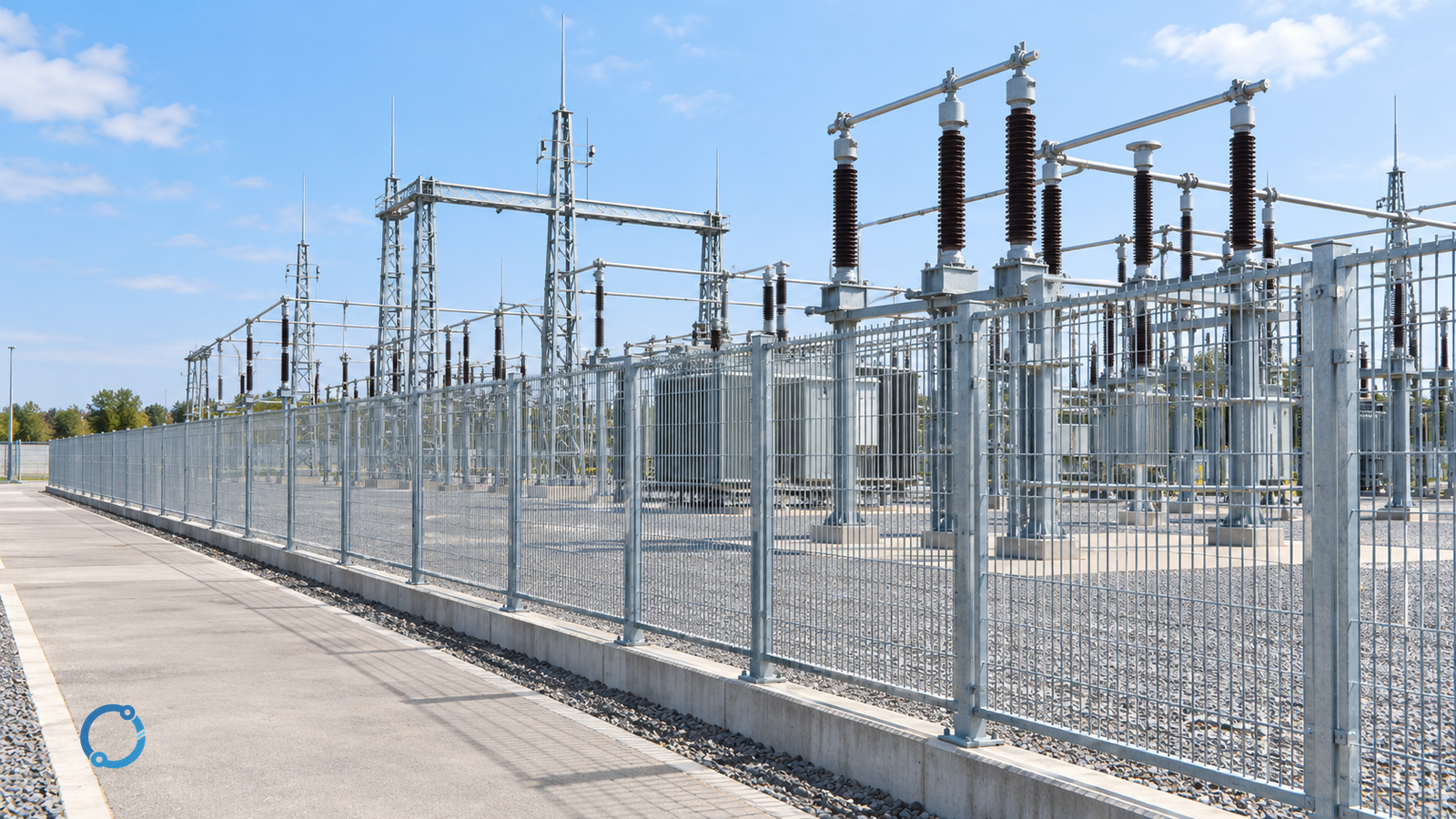
Permission to enter a switchyard does not authorize a person to approach exposed high-voltage parts, operate equipment or begin maintenance. A usable access brief connects the named task to the person’s authorization, the route, the entire work envelope and the equipment that remains energized nearby.
Before work starts, the responsible team must be able to identify those boundaries at the actual location. An uncertain bay identity, unassessed lifting path or changed operating condition is a reason to hold the task, not to substitute a distance remembered from another site.
This guide is for planning and reviewing access at operating substations. U.S. electric-power requirements are identified where relevant. They are not universal international rules, and not every industrial high-voltage installation or construction activity falls within the same regulatory scope. No generic switching order or approach-distance table is provided.
Start with the task, not the gate key
A visitor inspection from an approved route, a cabinet replacement and overhead equipment handling create different exposures. Write the actual activity and its limits before assigning the route or permit.
Record the site and bay identification, date and work window, person in charge, crew roles, equipment/materials, intended observations or work, and prohibited activities. Resolve whether the activity is observation, operation, testing or maintenance. “General inspection” is too vague if it can expand into opening a cabinet or reaching over a barrier.
The distribution-substation overview helps identify equipment functions, but recognizing a disconnector is not qualification to operate it. Nor does a general electrical qualification prove authorization for every voltage, switching scheme and site procedure.
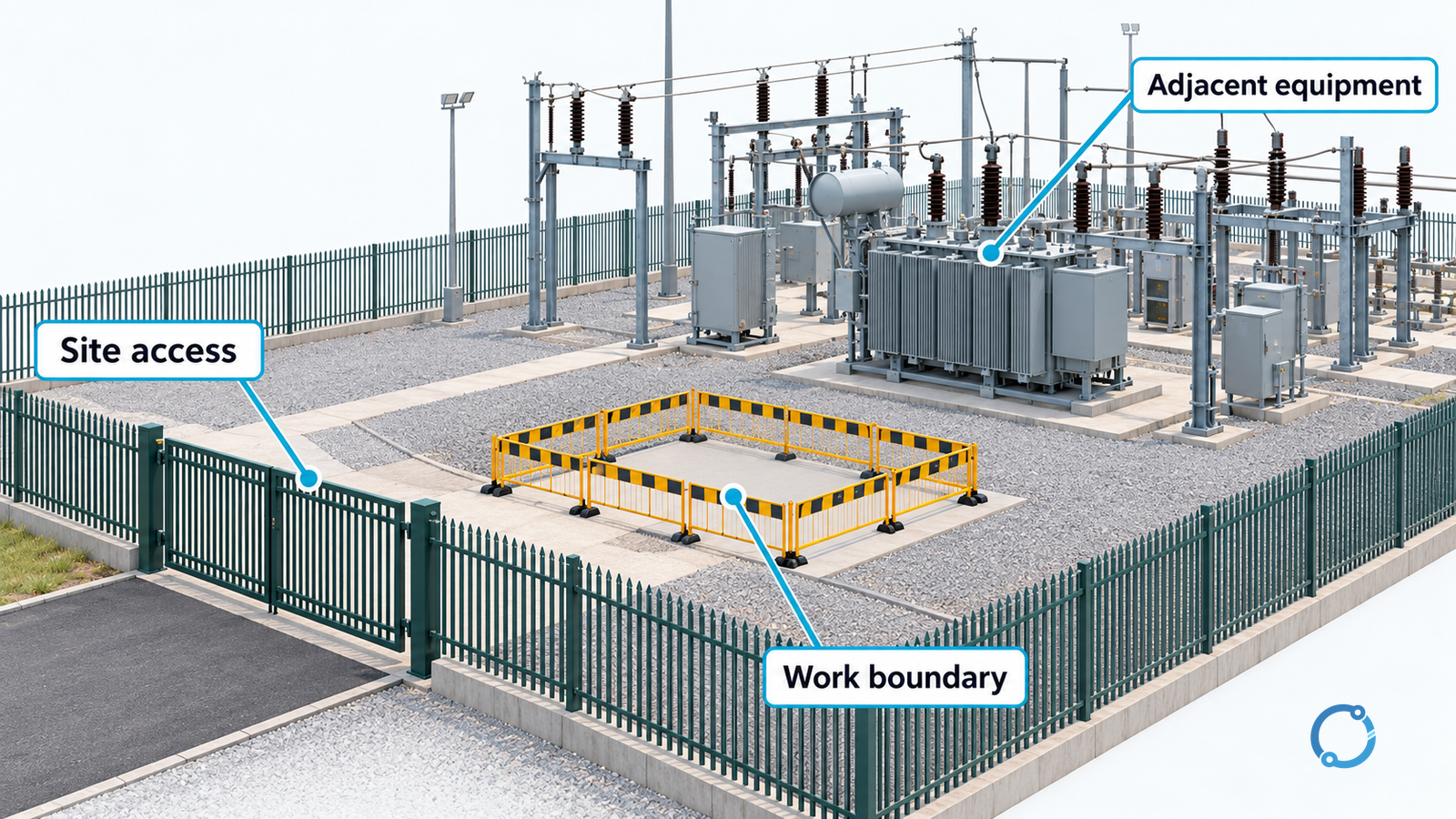
Use separate access and work boundaries
| Boundary | Question to resolve | Evidence before the task proceeds |
|---|---|---|
| Site admission | Who may enter, report in or require an escort? | Site authorization, induction and identified responsible contact |
| Movement route | Where may people, vehicles and carried equipment travel? | Current route review including height, turning and unloading envelopes |
| Work location | Which bay, enclosure or component belongs to this job? | Matching physical identification and approved task documents |
| Electrical exposure | What remains energized, and what limits apply to the task? | Qualified assessment using the governing approach and protective measures |
| Controlled work area | How is the accepted boundary communicated and maintained? | Barriers, responsibilities, access control and emergency arrangements |
| Change control | What invalidates the brief or permit? | Named stop triggers and an authorized rebrief/release process |
This is a proposed planning matrix, not a claim that each row is a separate regulatory permit. Site admission and a work permit can support one another without being interchangeable.
For covered U.S. work, the Occupational Safety and Health Administration’s (OSHA) substation guidance addresses controlled entry, working space and reporting to the person in charge at attended substations. An escort does not convert an unqualified person into a qualified worker.
Review the whole movement envelope
Walk the proposed route under the site’s authorized process. Consider doors, temporary fencing, trenches, uneven ground, vehicle turning, carried ladders, lifting equipment and the removal path for a component. A person can remain on a marked walkway while a long object projects beyond it.
The same reasoning applies to the work location. Include body position, reach, tools, lifting gear and foreseeable movement. If the task cannot stay within its accepted envelope, change the method or obtain a new assessment before starting.
Do not adopt a single “safe distance” based only on nominal voltage. OSHA’s Appendix B to 1910.269 explains the engineering and ergonomic basis of minimum approach distances for its scope. Applicable system conditions and the work method matter. Visitor access, material handling and qualified energized work are not automatically governed by one interchangeable distance.
Shock approach controls and arc-flash controls also answer different questions. A distance that addresses one does not settle the other. Use the applicable arc-flash study and site procedures rather than inferring protection from a fence or floor marking.
Confirm the job briefing and source-state information
For work covered by 29 CFR 1910.269, the employer’s planning and qualification duties must be applied to the actual activity. Paragraph (c) requires a job briefing addressing hazards, procedures, precautions, energy controls and personal protective equipment; significant changes can require further briefing. Read current regulatory text rather than treating an older explanatory webpage’s proposed-rule note as law.
Ask whether the team has the current operating state and drawings, knows adjacent equipment that stays in service, and understands its limits of authority. A remote indication or an open breaker is not, by itself, proof that exposed parts are deenergized for work. Electrical isolation and verification belong to the separate authorized energy-control process.
The OSHA job-briefing guide provides orientation to that briefing function. The useful result is shared task understanding, not a signed sheet whose assumptions no longer match the site.
Test the brief against a change
Consider a hypothetical replacement requiring a trolley through an approved access route. The route was accepted for walking personnel, but the trolley and component are wider and taller than the original task description.
The walking approval cannot simply be extended. Review the load envelope, adjacent equipment, ground condition and handling method. If the route or work boundary changes, return to the responsible authority before moving the load. Do not experiment by approaching until someone judges the gap visually.
Use the same hold principle when a bay designation differs from the permit, a barrier has moved, a new source or adjacent switching state appears, communications fail, weather affects the method, or another crew creates an interface not covered by the brief. Determine the actual significance through the site process; do not assume every change has the same consequence.
End with a controlled access record
Retain the task identity, authorized people and roles, accepted route/work envelope, electrical-state information source, controls, stop triggers and responsible release authority. Confirm that emergency communication, evacuation and rescue arrangements remain available for the activity.
Where recurring tasks cannot be performed without awkward access or repeated boundary conflicts, escalate the arrangement for electrical safety through design. A better route or maintainable layout may remove a recurring exposure; another warning sign alone may not.
The access review is complete when the team can identify what it may do, where it may do it, what remains outside its authority and which change stops the work. It is not a declaration that the entire switchyard is safe or deenergized.