

Prevention through Design (PtD) for electrical safety means changing equipment and work arrangements so that hazardous exposure is removed or reduced before the plant relies on a work instruction or personal protective equipment (PPE). Start with the maintenance task, not a catalog of safety accessories: determine what people must reach, which energy sources remain present, and what can be redesigned.
For a plant design review, the practical output is a task-to-control register. Each proposed control needs an acceptance test, a stated isolation boundary and an owner for residual risk. A remote operating station, for example, changes the operator’s location; it does not make the equipment electrically isolated.
This guide addresses new or modified industrial electrical installations. It is a design-review method, not authorization for energized work, a complete arc-flash study or a universal code-compliance checklist.
Build the task list before the equipment layout
Review the jobs that will occur throughout the installation’s life: normal operation, fault investigation, isolation, inspection, component replacement, testing and restoration. Invite people who will actually perform those jobs to review drawings before the arrangement is frozen.
For each job, sketch three boundaries:
- The equipment the person needs to access.
- Every possible electrical and stored-energy source.
- The adjacent equipment that must remain in service.
A drawing labeled “panel isolated” is incomplete if an auxiliary supply, automatic transfer, capacitor or external control cable crosses the boundary. Record source origin and isolation method, not merely voltage labels. The same task should be walked through with a component failed or a normal access route unavailable.
NIOSH’s PtD process supports early, collaborative design review and the use of controls that depend less on repeated human action. That is a process principle—not a guarantee that a particular enclosure is safe.
Translate exposure into a design requirement
Use the following register as a starting structure. These are candidate controls for engineering review, not universally appropriate purchases.
| Task and exposure | Design question | Candidate requirement | Evidence before design release |
|---|---|---|---|
| Routine operation beside switchgear | Can the task be moved away from the equipment? | Evaluate a separately located operator interface with controlled local/remote selection | Operating sequence, visibility and loss-of-communication behavior verified |
| Inspection requiring an enclosure opening | Can the observation be made without exposing electrical parts? | Evaluate external indications or suitable viewing arrangements | The required condition is actually observable; equipment integrity remains established |
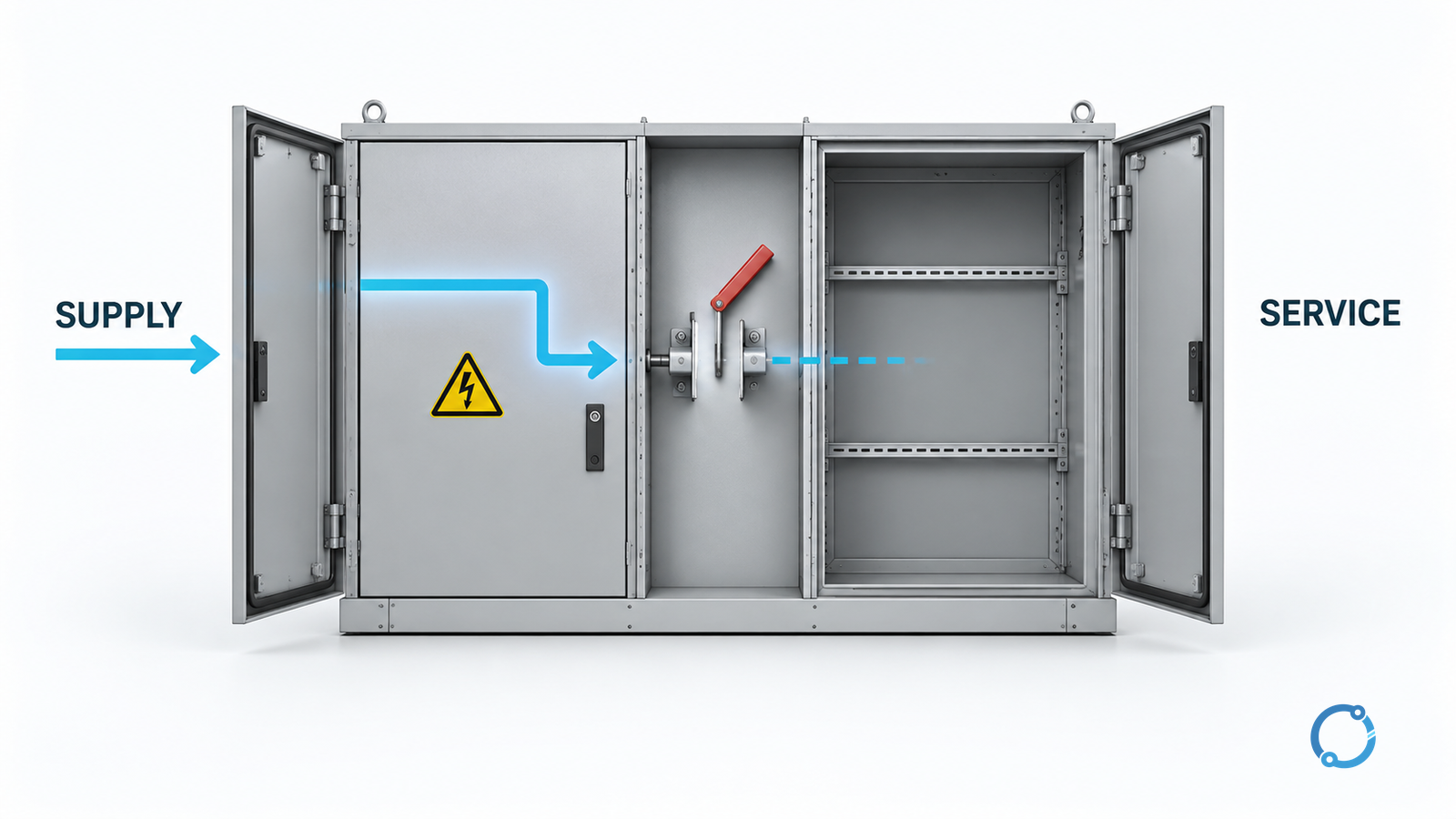
| Replacement beside incoming supply parts | Can supply-side and serviceable equipment have separate access boundaries? | Define physical segregation and a task-specific isolation arrangement | Source map, barrier/access review and isolation demonstration |
| Maintenance supplied from several sources | Can isolation be made unambiguous? | Identify every source and provide an engineered isolation plan | Updated drawings reconcile normal, standby and temporary supplies |
| Heavy component removal | Can the handling route avoid contact, obstruction or unsupported loads? | Reserve a maintainable removal path and appropriate support provisions | Removal-envelope review using actual component information |
| Restoration after testing | Can an omitted restoration step leave protection unavailable? | Include configuration verification in the design and test record | As-left states, alarms and authorized restoration procedure |
The NIOSH hierarchy of controls places elimination and engineering controls ahead of administrative measures and PPE. Use that hierarchy to question the task itself: an inspection reminder is not equivalent to eliminating the need to open a compartment.
Separate isolation, segregation and distance
Isolation disconnects the relevant energy sources. Segregation limits access or separates parts. Remote operation changes where a person performs a function. They can support one another, but they are not interchangeable.
For U.S. general-industry installations within its scope, OSHA 1910.333 generally requires exposed live parts to be deenergized before work, with defined exceptions. Control switches and interlocks alone are not the disconnecting means. Qualified personnel must verify the deenergized condition, including possible backfeed. Other jurisdictions and utility activities require their own applicable rules.
A viewing window also does not automatically justify an inspection. Its rating, viewing purpose, condition and installation evidence matter. Where the objective is arc-flash consequence reduction rather than task elimination, use the separate guide to maintenance, mitigation and containment.
Review a modification without assuming that the old label still applies
Consider a hypothetical packaging-line upgrade. The original motor-control enclosure had one incoming power supply. The proposed revision adds a separate control-power source and an external data interface.
A “main disconnect off” maintenance step can no longer be accepted by description alone. The review needs to answer:
- Which added circuits can remain energized after the main disconnect opens?
- Where are those circuits accessible during the particular replacement task?
- Can the task boundary be redesigned, or must additional isolation be provided?
- What evidence will demonstrate the intended state before release?
The example does not establish that every external data cable is an electrical hazard. It shows why an interface must be classified rather than ignored. Likewise, an existing arc-flash label and operating-mode record needs review when the electrical configuration changes; a label is not a design approval.
Release the design with a task-specific evidence record
For each accepted control, record the drawing revision, intended task, controlled exposure, abnormal-state behavior, verification method and residual limitation. Separate an assumption from a demonstrated feature. “Technician can reach the component” should be backed by a maintainability review, not an attractive general arrangement.
Stop release when a source remains unidentified, an isolation method depends solely on a control command, access requires crossing an unresolved hazard boundary, or the acceptance test cannot demonstrate the promised control.
The design review is complete when someone can trace a recurring job from its exposure to an implemented requirement and its verification evidence. Training and PPE remain necessary where applicable, but they should address residual risk rather than conceal a preventable design problem.