

Choose arc flash personal protective equipment (PPE) from a documented hazard assessment, not from system voltage alone. The decision should connect the task, the equipment condition, the incident energy at the working distance, the shock approach boundaries, and the electrical-safety standard adopted at the site. The result is a complete protective system: arc-rated clothing and face protection for thermal exposure, voltage-rated equipment for shock exposure, and task-specific items such as hearing protection, gloves, sleeves, or insulated tools.
PPE is the last layer in the control hierarchy. If the equipment can be placed in an electrically safe work condition, that option must be evaluated and the site procedure followed before anyone relies on arc-rated clothing. In the United States, OSHA 29 CFR 1910.335 requires protective equipment appropriate to the electrical hazard and work being performed. Other jurisdictions use different legal frameworks.
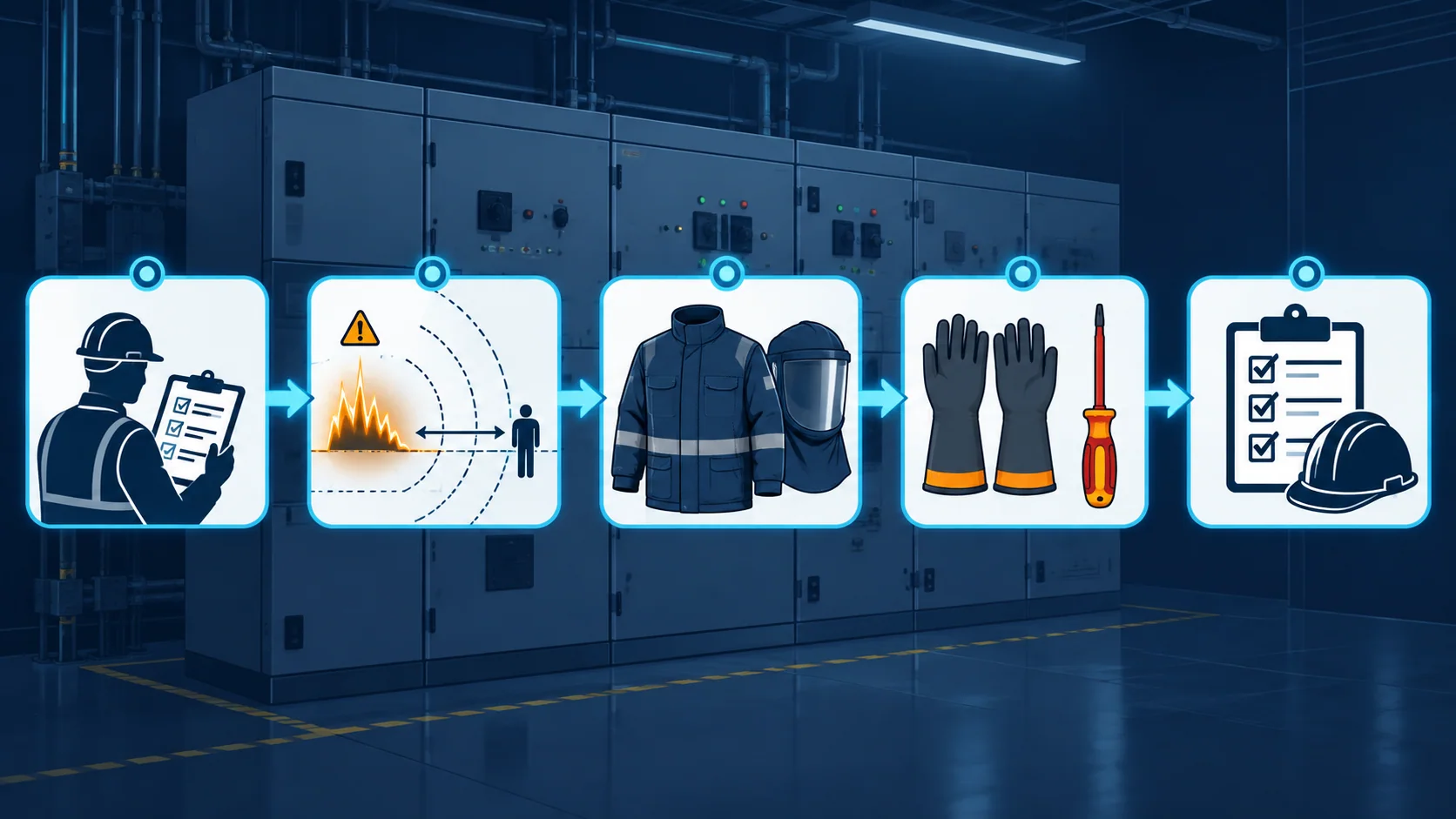
The short answer: use this selection path
For a planned task near electrical equipment, work through these decisions in order:
- Confirm whether the task can be completed de-energized, isolated, locked out, and verified.
- Define the electrical and arc-flash hazards for the exact equipment, operating mode, and task.
- Obtain the incident energy and working distance from a current study or a defensible calculation method.
- Select an arc-rated clothing system whose rating meets or exceeds the applicable thermal exposure, with the coverage and design required by the adopted standard.
- Select shock protection from the system voltage, approach boundaries, and task—not from the arc rating of the clothing.
- Check face, head, eye, hand, foot, hearing, and body protection as a compatible set.
- Inspect, fit, maintain, and train for the actual work method.
This sequence matters because arc flash and electric shock are related hazards but not interchangeable ones. A high arc rating does not make a glove electrically insulating, and a voltage-rated glove does not by itself provide enough thermal protection for an arc.
Start with the hazard, not the garment
An arc-flash label or incident-energy report normally gives a predicted thermal exposure at a defined working distance and operating configuration. It may also give an arc-flash boundary, equipment identification, voltage, and the scenario used for the result. Treat those fields as inputs to a risk assessment, not as a complete work permit.
The incident-energy value is the central input for thermal PPE:
| Input | Selection question | Evidence to retain |
|---|---|---|
| Incident energy at working distance | Is the arc rating of the clothing and face protection at least the calculated exposure? | Current study, label, calculation method, and working distance |
| Arc-flash boundary | Will the task place a person inside the boundary? | Equipment label, task plan, barricade or access-control plan |
| System voltage and approach boundaries | What shock protection and insulating equipment are required? | Voltage data, approach-boundary procedure, and qualified-person assessment |
| Equipment and task | Does the work involve opening, racking, testing, switching, or exposed parts? | Job briefing, switching plan, and equipment instructions |
| Operating mode | Do normal, alternate, maintenance, or generator-fed configurations change the result? | One-line diagram, study scenarios, and management-of-change record |
Do not use a nominal voltage table as a substitute for a system-specific result where incident energy is required. Voltage influences shock protection and can be relevant to arc behavior, but it does not uniquely determine fault current, clearing time, enclosure geometry, or incident energy.
For context, OHELE’s arc flash study explainer separates the incident-energy analysis from the wider arc-flash risk assessment. That distinction is important when a PPE decision is being reviewed.
Arc-rated and flame-resistant are not the same claim
Arc-rated clothing is evaluated for thermal exposure from an electric arc and is marked with an arc rating. Flame-resistant describes a material or garment characteristic that resists ignition and continued burning under a specified test. A garment can be flame resistant without being suitable for the calculated arc exposure.
ASTM F1506 covers performance, construction, and labeling requirements for protective clothing worn by workers exposed to flames and electric arcs. ASTM F2178/F2178M addresses arc-rated eye and face protective products. These standards do not replace the employer’s hazard assessment; they help define what product performance information means.
When reviewing a garment, confirm:
- the arc rating is visible and expressed in the units used by the site procedure;
- the garment is intended for the task and exposure, not only for an unrelated flame hazard;
- the complete system covers the body parts exposed by the task;
- closures, cuffs, seams, and layers do not leave avoidable gaps;
- labels and care instructions are present and legible;
- the garment has not been damaged, contaminated, modified, or laundered outside its instructions.
Do not assume that adding ordinary clothing under an arc-rated outer layer makes the combination safer. Fabrics that can melt, ignite, or continue burning can change the exposure. The clothing system and layering rules must follow the adopted standard, garment instructions, and site procedure.
Select thermal PPE from incident energy
The core comparison is simple:
Required arc rating ≥ incident energy at the working distance
That expression is a decision rule, not an invitation to round down, combine unrelated ratings, or treat one item as a rating for the whole body. The selected ensemble may need separate performance information for the torso, arms, hands, head, face, and other exposed areas.
An illustrative label review might report an incident-energy result of 4.5 cal/cm² at a stated working distance. The reviewer would then confirm that the proposed arc-rated clothing system and the required face protection meet the applicable threshold and design requirements. The 4.5 cal/cm² value is only an example; it is not a universal PPE category or a field selection for another installation.
When the report contains several scenarios, use the scenario that matches the task and configuration. A lower-current case can sometimes produce a longer protective-device clearing time and a higher incident energy than a higher-current case. If the label, study, or operating mode is unclear, stop the selection process and obtain a technical review.
Select shock protection separately
Shock protection is controlled by contact voltage and approach distance. It may include:
- rubber insulating gloves selected for the maximum nominal voltage, with leather protectors where required by the glove system;
- insulating sleeves, blankets, mats, barriers, or covers where the work method exposes the arms or nearby parts;
- insulated tools and test instruments rated for the circuit;
- nonconductive head protection and eye protection;
- a controlled approach boundary and a method for preventing unqualified access.
The OSHA electric-arc hazard guidance describes arc flash as a hazard that can include thermal energy, pressure, hot gases, and molten or vaporized metal. OSHA 29 CFR 1910.269 Appendix E separately explains the need to assess electric-arc exposure and select protection based on the estimated heat energy in the situations covered by that rule.
This is why a face shield alone is not a complete answer. It may protect the eyes and face from a defined exposure, while the neck, head, torso, hands, and arms still need protection appropriate to the task.
Check the task and equipment configuration
The same enclosure may require different controls for different activities. A task review should ask:
| Task or condition | What changes in the PPE decision |
|---|---|
| Visual inspection with the enclosure closed | Access, normal operation, and the site’s risk assessment determine whether arc exposure is credible |
| Opening a door or cover | Exposed parts, stored energy, door position, and the worker’s distance may change |
| Voltage testing or troubleshooting | Shock protection, test equipment rating, leads, probes, and hand position become central |
| Breaker racking or insertion | Mechanical movement, shutters, interlocks, and equipment-specific procedures may affect the arc scenario |
| Switching or operating a device | The equipment’s normal operating condition and the possibility of a fault during operation must be evaluated |
| Maintenance on exposed parts | The electrically safe work condition should be the first option; if an exception is permitted, the full risk assessment applies |
Use the manufacturer’s instructions and the site’s qualified-person procedure for the equipment. PPE cannot correct an incorrect racking method, a failed interlock, an unknown source, or a missing isolation point.
Common selection mistakes
Choosing by voltage alone
Voltage is essential for shock protection, but it does not tell you the available fault current or the protective-device clearing time. Two panels at the same voltage can have very different incident-energy results.
Treating a PPE category as a universal answer
Category-based methods and incident-energy-based methods are not interchangeable labels. Use one complete method as specified by the adopted safety standard and the available system data. Do not combine a category from one table with an incident-energy value from another method without a qualified review.
Checking only the shirt or coverall
The body is a system. Face, head, hands, arms, hearing, and eye protection may need separate ratings or construction. Footwear and tools also have electrical-safety requirements that are not expressed by the clothing arc rating.
Using an old label as current evidence
A new transformer, generator, motor, breaker setting, conductor, tie position, or equipment replacement can change the result. Compare the label with the current one-line diagram, settings, operating modes, and field condition.
Confusing PPE with permission to work energized
PPE reduces the consequences of an exposure; it does not remove the hazard or authorize energized work. The work plan must establish why the task is permitted, who is qualified, which controls are in place, and how the equipment will be made safe if conditions change.
A practical approval checklist
Before issuing an arc-flash PPE requirement for a task, verify that the file contains:
- Equipment identification and the exact operating configuration.
- Current incident-energy and working-distance information, or a documented calculation basis.
- Arc-flash boundary and shock approach boundaries.
- The adopted standard, jurisdiction, and any local procedure or amendment.
- A complete body-part-by-body-part PPE list.
- Garment, face-protection, glove, and tool ratings that can be verified from labels or certificates.
- Inspection, cleaning, storage, and replacement requirements.
- A job briefing that covers isolation, test-before-touch, access control, and stop-work conditions.
The most defensible decision is usually the one that can be traced from the task to the hazard assessment, from the hazard assessment to the calculation or standard, and from that evidence to each item of PPE.
Sources
- OSHA 29 CFR 1910.335 — Safeguards for personnel protection
- OSHA 29 CFR 1910.269 Appendix E — Protection from flames and electric arcs
- OSHA — Electric-Arc Flash Hazards
- NFPA 70E 2024 — Standard for Electrical Safety in the Workplace
- ASTM F1506 — Arc-rated protective clothing
- ASTM F2178/F2178M — Arc-rated eye and face protective products