
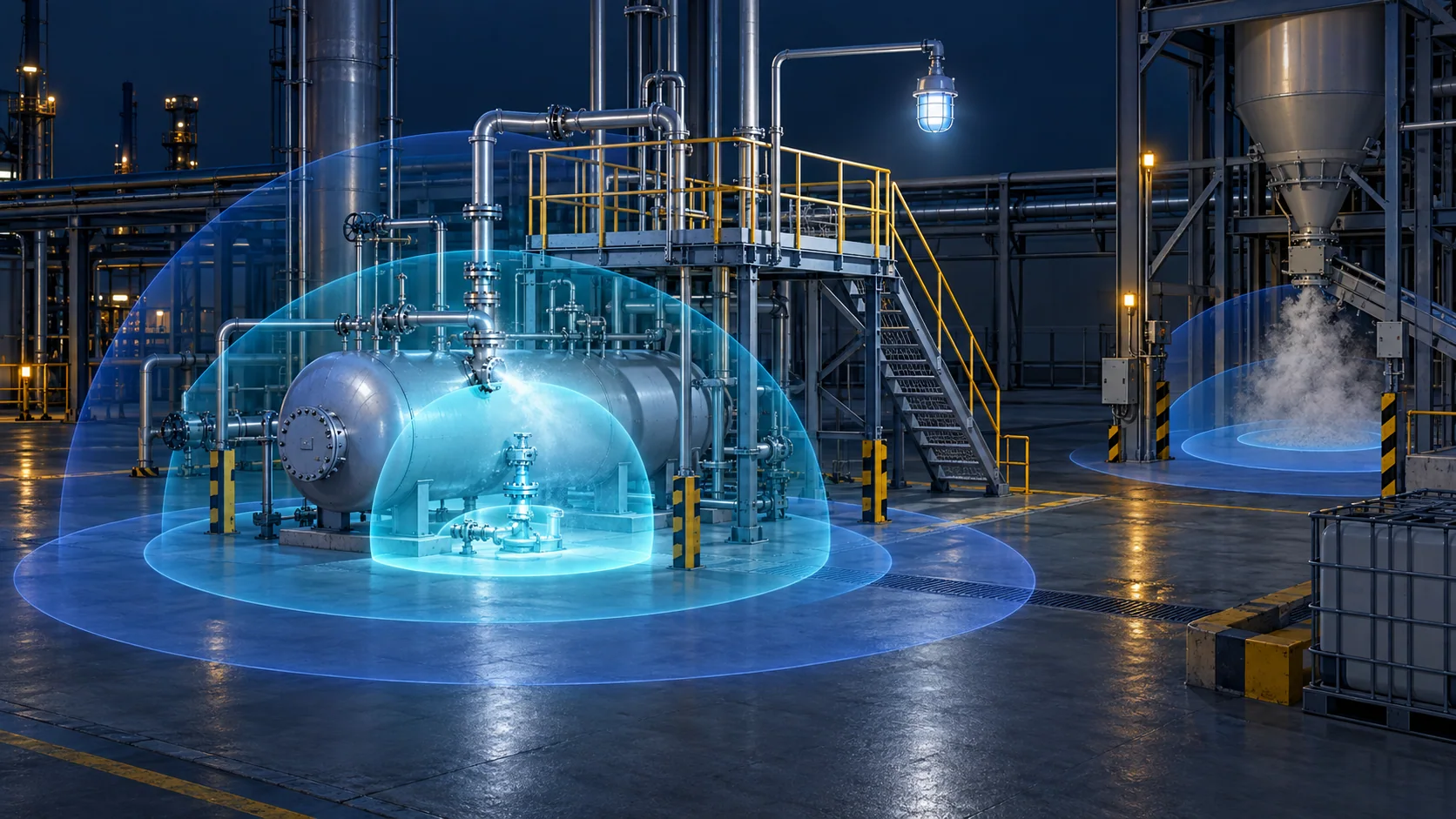
ATEX lighting selection starts with the area classification and the substance hazard—not with a luminaire catalogue. A compliant decision normally needs the classified zone, the gas/vapour/mist or dust group, the required equipment protection level, the temperature limit, the ambient and environmental conditions, and the installation rules used at the site.
The central distinction is easy to miss:
- Directive 1999/92/EC concerns the protection of workers and requires hazardous places to be classified according to the likelihood and duration of an explosive atmosphere.
- Directive 2014/34/EU concerns equipment and protective systems placed on the EU market for use in potentially explosive atmospheres.
The first directive describes the workplace need. The second establishes the product framework. A CE or Ex mark on a luminaire does not, by itself, prove that the luminaire is suitable for a particular zone or installation.
The selection answer in one table
For gas, vapour, or mist hazards, the common zone-to-protection relationship is:
| Classified place | Explosive atmosphere expectation | Common equipment category | Common EPL relationship |
|---|---|---|---|
| Zone 0 | Present continuously, for long periods, or frequently | 1G or equipment with an equivalent higher protection basis | Ga |
| Zone 1 | Likely to occur occasionally in normal operation | 1G or 2G, subject to the equipment marking and installation rules | Ga or Gb |
| Zone 2 | Not likely in normal operation, or present only briefly if it occurs | 1G, 2G, or 3G, subject to the equipment marking and installation rules | Ga, Gb, or Gc |
For combustible dust, the corresponding zone families are Zone 20, Zone 21, and Zone 22, with equipment categories 1D, 2D, and 3D and EPLs Da, Db, and Dc. The table is a selection aid, not a certificate or an installation design. The actual marking, protection type, product certificate, ambient range, and local rules control.
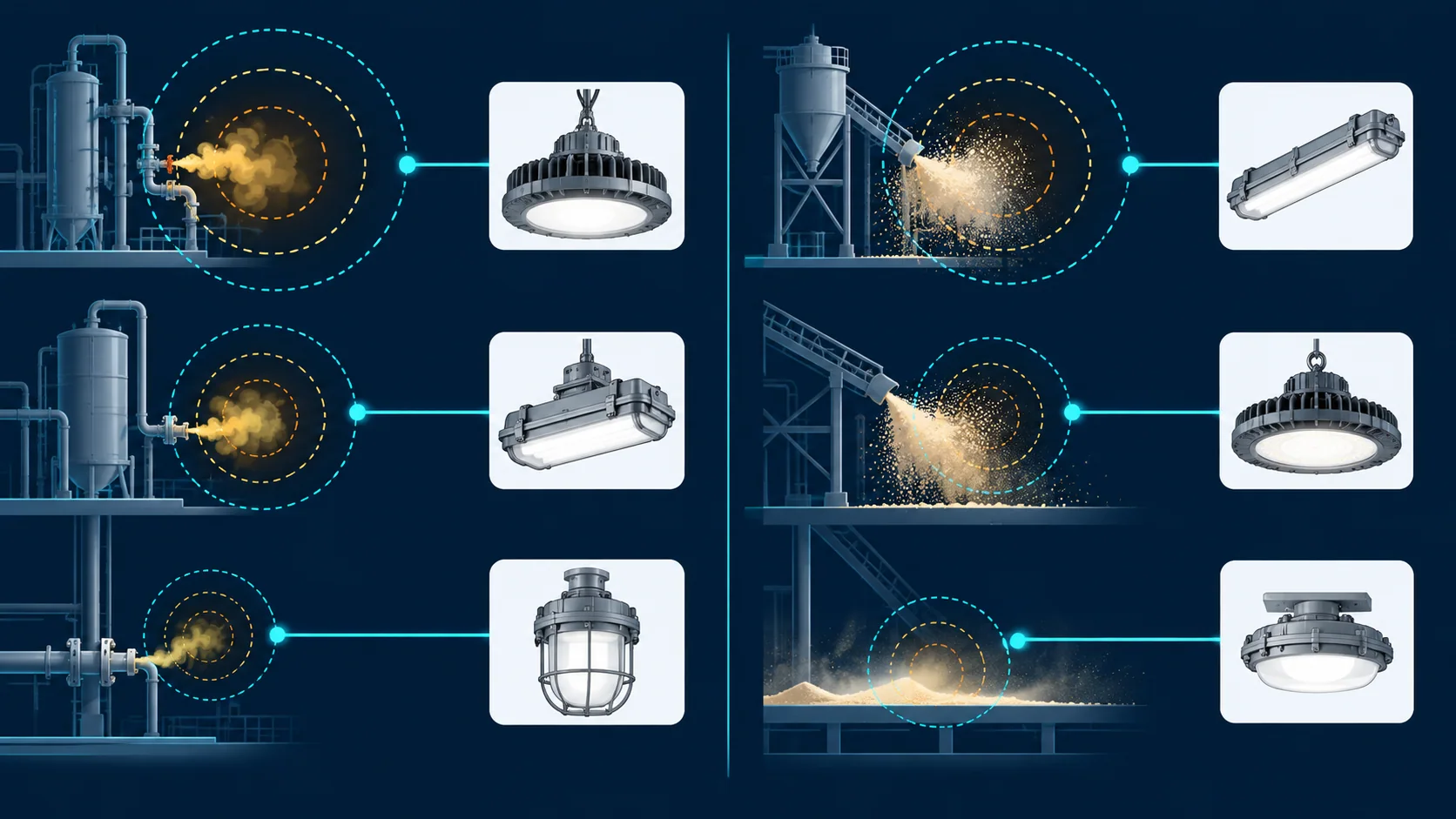
The European Commission’s ATEX equipment overview explains the product directive and its relationship to harmonised standards. The workplace zone definitions appear in Directive 1999/92/EC, Annex I.
What the zones actually describe
The zone is a description of how often an explosive atmosphere is expected to be present under the defined operating conditions. It is not a measure of the material’s ignition temperature, the enclosure’s ingress-protection rating, or the severity of every possible consequence.
IEC 60079-10-1:2020 provides the classification framework for areas where flammable gas or vapour hazards may arise. It requires engineering judgement about release sources, ventilation, the physical extent of the hazardous area, operating conditions, and the properties of the substance.
That means a lighting specification should not simply say “ATEX light for Zone 1.” It should identify the full classified environment:
| Field | Why it matters |
|---|---|
| Zone | Defines the expected frequency and duration of the explosive atmosphere |
| Gas, vapour, mist, or dust | Determines which classification method and equipment family apply |
| Substance group | Determines the ignition and propagation challenge the equipment must withstand |
| Temperature basis | Prevents hot surfaces from becoming an ignition source |
| EPL or equipment category | States the protection level expected for the zone |
| Protection type | Describes how the equipment limits ignition risk |
| Ambient and environmental conditions | Covers temperature, water, dust, corrosion, impact, vibration, and chemicals |
| Installation method | Controls cable entries, glands, bonding, segregation, inspection, and maintenance |
Gas groups and temperature classes
For Group II gas equipment, the gas group is commonly marked IIA, IIB, or IIC. The groups are not a ranking of the zone. They describe the gas or vapour challenge for the equipment’s protection concept. Equipment certified for a more demanding gas group may be suitable for a less demanding group when the complete marking and certificate allow it; the reverse assumption is not safe.
Temperature classes address the maximum surface-temperature band of gas equipment. The familiar reference values are:
| Temperature class | Maximum surface-temperature reference |
|---|---|
| T1 | 450 °C |
| T2 | 300 °C |
| T3 | 200 °C |
| T4 | 135 °C |
| T5 | 100 °C |
| T6 | 85 °C |
These are reference limits used in the classification system, not a substitute for checking the ignition temperature of the actual substance or the full product marking. A T6 device has a lower maximum surface-temperature limit than a T3 device. Select a temperature class whose permitted surface temperature remains below the relevant ignition-temperature basis with the required safety margin and operating assumptions.
IEC 60079-0:2026 specifies general requirements for construction, testing, and marking of Ex equipment and components. Because standards and certificates can change, use the edition and certificate accepted by the authority having jurisdiction for the project.
Do not treat ATEX zones and NEC divisions as a one-to-one map
Zone classification and the North American Class/Division system describe hazardous locations using different conventions and standards. A rough comparison can help a multinational project team communicate, but it cannot replace the classification document:
| ATEX / IEC convention | North American convention | Why the comparison is limited |
|---|---|---|
| Zone 0 / 1 / 2 | Class I, Division 1 or 2 | The definitions, equipment markings, and installation rules are not identical |
| Zone 20 / 21 / 22 | Class II, Division 1 or 2 | Dust classification and enclosure requirements depend on the adopted code |
| EPL Ga / Gb / Gc | Class/Division suitability marking | EPL is not a substitute for a North American listing or approval |
| IIA / IIB / IIC | Gas group or class-group markings | Group lettering is not universally interchangeable across systems |
If equipment will be installed in a jurisdiction using NEC or another national code, select equipment carrying the approval and marking recognized there. Do not convert a Zone 1 requirement into “Division 1 equivalent” by text alone.
A practical workflow for choosing hazardous-area lighting
1. Obtain the area-classification document
Ask for the current drawing, hazardous-area schedule, release-source assessment, and substance information. The drawing should identify the zone, the physical extent, and the basis for the classification. If the document is missing or conflicts with the process description, pause the procurement decision.
2. Identify the substance and operating conditions
Record the gas, vapour, mist, or dust; the process temperature and pressure; the release frequency; ventilation; dust-layer or dust-cloud conditions; and any unusual oxygen, ambient, or chemical conditions. A lighting enclosure’s electrical rating does not solve a process-classification uncertainty.
3. Translate the zone into the required marking
Set the minimum zone protection, then check the equipment group, category or EPL, protection type, temperature class, ambient range, and certificate. Record the complete marking exactly as it appears on the equipment and certificate.
4. Check the luminaire as an installation, not a box
Review:
- cable and gland compatibility;
- entry orientation and sealing;
- bonding and earthing provisions;
- mechanical impact and vibration;
- corrosion and cleaning chemicals;
- external surface temperature;
- emergency-lighting, control, or battery requirements;
- photometric and maintenance access needs;
- inspection and test points.
IEC 60079-14:2024 covers design, selection, installation, initial inspection, documentation, and personnel competency for electrical Ex installations. It is in addition to the requirements for ordinary locations.
5. Plan inspection and maintenance
The installation can lose its protection if a cover is damaged, a flamepath is altered, a gland is replaced with an incompatible part, a bonding path is interrupted, or dust deposits are allowed to build up. IEC 60079-17:2023 addresses inspection and maintenance of electrical installations designed for hazardous areas.
A worked selection example
Assume a process engineer has classified the area around a solvent transfer point as Zone 1 and has documented a Group IIB gas with a temperature basis that requires a T3 or safer surface-temperature class. The selection record should then ask:
- Does the luminaire certificate cover Zone 1 use and the gas group?
- Is the marked EPL or equipment category acceptable for that zone?
- Is the maximum surface-temperature class at least as protective as the process requirement?
- Are the ambient range, enclosure protection, corrosion resistance, and impact rating suitable?
- Are the cable glands, entries, bonding, and installation method covered by the certificate and IEC 60079-14 or the adopted national rules?
- Can the inspection and maintenance team maintain the protection without changing the certified configuration?
The example does not select a product or prove compliance. It shows how a zone becomes a traceable set of requirements instead of a marketing label.
Common mistakes that create unsafe specifications
Treating “explosion-proof” as a complete specification
The phrase does not identify the zone, substance group, temperature class, EPL, protection type, ambient range, or installation method. Require the full marking and certificate.
Using IP rating as hazardous-area approval
IP rating addresses ingress protection under a specified test. It does not establish that an ignition source is controlled in an explosive atmosphere. A high IP rating can be necessary and still be insufficient.
Confusing CE marking with ATEX suitability
CE marking is a broader conformity-marking framework. For equipment within the ATEX product directive, check the applicable conformity-assessment route, technical documentation, notified-body information where required, and the exact product marking.
Ignoring dust layers and housekeeping
Dust hazards include clouds and layers. Deposits can insulate a surface, change thermal behavior, and become fuel. The area classification, equipment surface temperature, cleaning plan, and inspection interval must be considered together.
Treating higher protection as automatic permission
An equipment category or EPL is only one part of the application. Certificate conditions, protection type, cable entries, ambient range, process temperature, and installation rules can impose additional limits.
Procurement and approval checklist
Before approving an ATEX lighting specification, retain:
- the current hazardous-area classification drawing and zone extent;
- the process substance, group, and ignition-temperature information;
- the required zone, equipment category or EPL, group, and temperature class;
- the complete luminaire marking and certificate;
- installation requirements for glands, entries, bonding, supports, and segregation;
- ambient, corrosion, impact, ingress, and cleaning requirements;
- the adopted edition of IEC 60079-14 or the applicable national code;
- initial inspection records and the IEC 60079-17 maintenance basis;
- a management-of-change trigger for process, ventilation, layout, or equipment changes.
The safest specification is not the one with the most impressive Ex abbreviation. It is the one that can be traced from the process hazard to the zone, from the zone to the equipment marking, and from the marking to the installed and maintained assembly.
Sources
- Directive 2014/34/EU — Equipment and protective systems for potentially explosive atmospheres
- Directive 1999/92/EC — Minimum requirements for improving worker protection in potentially explosive atmospheres
- European Commission — Equipment for potentially explosive atmospheres (ATEX)
- European Commission Joint Research Centre — Equipment categories and equipment protection levels for ATEX zones
- IEC 60079-0:2026 — Equipment: General requirements
- IEC 60079-10-1:2020 — Classification of areas: Explosive gas atmospheres
- IEC 60079-14:2024 — Electrical installation design, selection, installation, and initial inspection
- IEC 60079-17:2023 — Electrical installations inspection and maintenance