
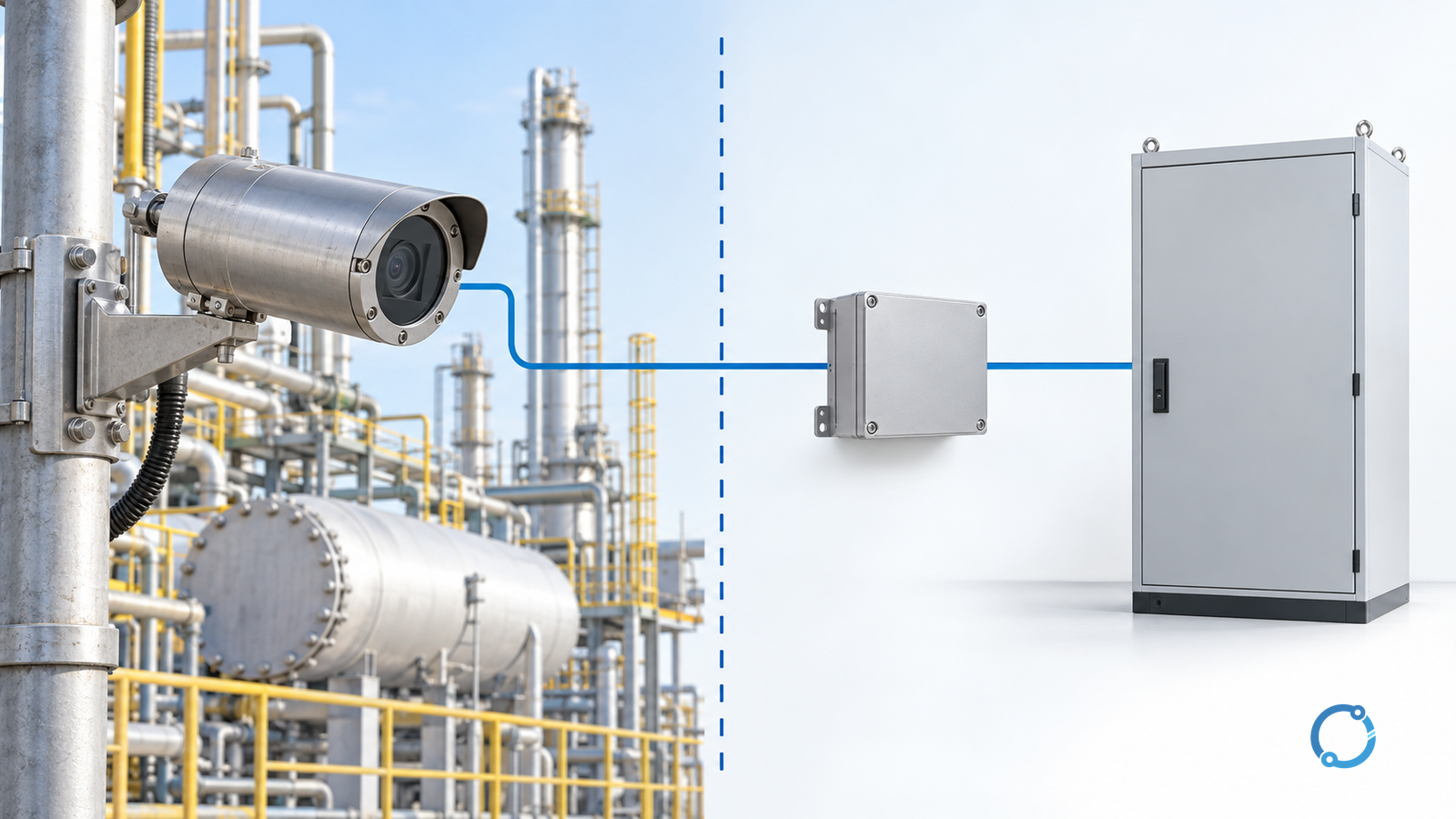
Migrate an Ex camera from analog video to an Internet Protocol (IP) network by choosing the physical change first, then designing power, recording and network behavior around it. An external encoder can retain the existing camera, while complete camera replacement changes the equipment boundary. Neither route is accepted merely because a picture appears on a network screen.
This is a change-control workflow for qualified electrical, hazardous-area and network personnel. It assumes the site’s area classification is established. It does not authorize installing a generic encoder, power converter or Ethernet adapter inside an Ex housing.
Choose between retaining and replacing the camera
Begin with the observation requirement: what the operator must see, when the image is needed, where it is recorded and how loss of the view is handled. Record the current camera configuration, video interface, supply and installed entries before deciding how much equipment to retain.
| Migration route | What can remain | What must be reassessed |
|---|---|---|
| Existing analog camera plus external encoder | Supported camera configuration and analog field path | Encoder location, video compatibility, power, network and recording |
| Complete IP camera replacement | Only interfaces explicitly supported by the new arrangement | Full equipment selection, entries, supply, mounting and service performance |
| Internal camera or interface conversion | Nothing should be assumed unchanged | Acceptability of the modified complete assembly before installation |
An encoder in an unclassified location may reduce the changes at the field camera. It also retains the existing analog path’s limitations. Complete replacement can support a different imaging task, but requires a new physical and electrical review. Do not treat a field conversion as a third equally approved route unless its configuration is actually supported.
The existing ATEX zone and equipment-selection guide addresses the location prerequisite. It does not approve a migration arrangement.
Draw equipment and network boundaries separately
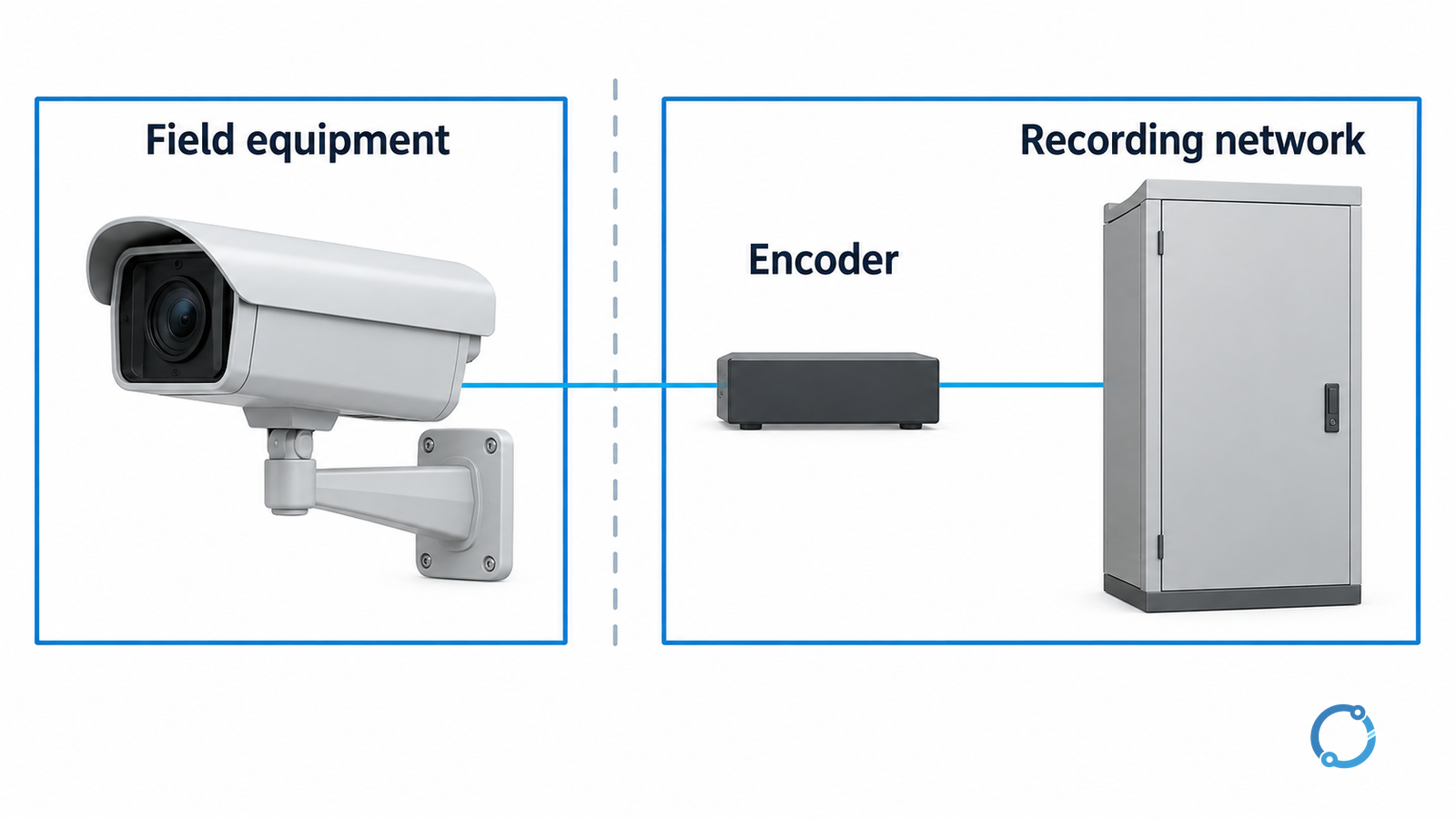
Show the field camera, cable path, encoder or network connection, recording system and operator view. Mark the classified-location boundary and the equipment assembly boundary as different things. Then identify every item the migration will replace, retain or add.
IEC 60079-14:2024 covers Ex installation design, selection and initial inspection. Its public scope does not approve this equipment change or prescribe a generic network conversion.
Power over Ethernet (PoE) combines a power and data interface; it is not an intrinsic-safety designation. Verify the complete camera’s supported supply arrangement and worst required operating duty. Do not infer that a port power budget covers heaters, illuminators or startup without the applicable equipment data.
Define authorized flows before connecting the new service
NIST’s SP 800-82 Revision 3 network-security guidance describes mapping required communications and using segmentation and isolation to control them. Apply that principle to the camera service: identify who needs live viewing, recording, administration and approved maintenance access.
A separate network label or virtual LAN does not by itself demonstrate an enforced access policy. Have the responsible network team document permitted endpoints and verify the boundary controls. Do not add unrestricted access to a production network merely to make commissioning convenient.
Separate service ownership too. Assign responsibility for configuration backups, accounts, updates, recording retention and incident response. Avoid introducing a dependency on an undocumented remote service for a view the process requires locally.
NIST’s publication record identifies Revision 3 as the final 2023 guide and notes the initial public draft of Revision 4 in September 2026. A draft is not a completed replacement standard.
Check bandwidth and storage on an explicit basis
A useful estimate starts with configured stream rates, simultaneous recording, operating time and duplication. Do not convert advertised camera resolution directly into storage.
For a hypothetical example, eight streams recorded continuously at an assumed 4 Mbit/s each total 32 Mbit/s. With decimal units:
Storage = 32 × 86,400 / 8 = 345,600 megabytes per day, or 345.6 GB/day.
This arithmetic excludes network overhead, variable bit rate, secondary streams, redundancy and storage reserve. It is not measured traffic or a retention recommendation. The actual recording policy, codecs, stream configuration and failure arrangements must set the design inputs.
Use peak operational conditions as well as average recording assumptions. A service can have enough storage yet fail the required view because of congestion, delay or an unsupported recorder configuration.
Make cutover acceptance reproducible
Before physical work, agree on the permitted outage, temporary observation arrangements and rollback configuration. Work on field equipment requires the site’s authorized hazardous-area and electrical safe-work procedures. Identify all sources, secure the isolation and perform the required verification through competent personnel.
Do not apply an insulation test across connected camera electronics to prove cable suitability. The insulation-resistance test-boundary guide explains why connected equipment must be identified first.
| Acceptance case | Observation to record | Hold or rollback condition |
|---|---|---|
| Normal operation | Required live view, recording and retrieval at defined conditions | Task cannot be demonstrated |
| Network interruption | Approved loss indication and defined recovery behavior | Silent loss or unsupported recovery |
| Supply interruption and restoration | Camera/encoder/recorder behavior against the agreed plan | Missing record or uncontrolled restart |
| Administration | Authorized access, backups and configuration identity | Uncontrolled credentials or paths |
| Physical handover | Accepted equipment, interfaces and required inspection | Changed or unidentified configuration |
These are proposed acceptance cases, not claims that every camera performs them identically. Never promise uninterrupted coverage merely because both analog and IP systems are present during a staged conversion.
Release the migration only after both the physical installation and the observation service pass their agreed checks. Retain the equipment identity, approved changes, network flow record, test results and rollback decision. That record separates a successful network connection from a completed camera-service migration.