

C5, CX, IP and Ex describe different engineering questions. A corrosion-environment category does not prove explosion protection, an IP rating does not establish offshore corrosion life, and an Ex certificate does not resolve every material or maintenance issue.
For offshore lighting, specify the actual exposure and map each requirement to evidence for the relevant part of the assembly. This article provides that scope crosswalk for qualified engineers. It is not a universal marine coating specification or a claim that one rating makes a luminaire suitable for every offshore location.
Identify which document answers which question
ISO 12944-2:2017 classifies environments in the context of corrosion protection of steel structures by paint systems. Its categories characterize exposure; they are not a blanket certificate for an entire lighting product.
ISO 12944-9:2018 addresses protective paint systems for defined offshore and related carbon-steel structures, using CX and Im4 exposure categories. Its stated scope excludes stainless steel and aluminium structures. Do not silently transfer a carbon-steel paint-system claim to a luminaire made from another material.
That does not make the terminology useless. It means that a specification needs to state which environment, substrate, coating system or test evidence the claim actually concerns.
| Label or evidence family | Question it helps answer | What it does not establish alone |
|---|---|---|
| Atmospheric corrosivity category | How severe is the defined environment for the scoped corrosion assessment? | Complete luminaire approval or guaranteed life |
| Paint-system evidence | Is a specified system supported for its substrate and exposure? | Performance of every seal, fastener and entry |
| IP evidence | What enclosure-protection classification is supported? | Explosion protection or corrosion durability |
| Ex equipment evidence | Is the identified configuration supported for the hazardous-area duty? | Every offshore exposure or mounting condition |
| Installed inspection record | Was the actual installation accepted under its applicable basis? | Indefinite future condition |
This is an editorial scope crosswalk, not a substitute for the full standards or the project’s acceptance criteria.
Do not turn offshore into a single exposure category
An enclosed service room, sheltered external walkway and directly exposed deck position may impose different service conditions. Record the actual location rather than specifying the strongest-sounding label without an exposure basis.
The review should identify atmospheric salt exposure, wetting, cleaning practices, chemicals, condensation, drainage and mechanical conditions relevant to the location. Do not treat a site-wide description as proof that every individual luminaire has the same micro-environment.
C1–C5 shorthand should not be presented as a complete offshore ladder with C5 always its final step. CX appears in the current offshore paint-system scope cited above. However, assigning a category to a particular installation still requires the appropriate exposure assessment. The article does not classify the user’s site.
Keep atmospheric exposure separate from immersion assumptions. A walkway fitting exposed to rain is not automatically an immersion application, and a generic immersion label does not describe every cleaning or atmospheric condition.
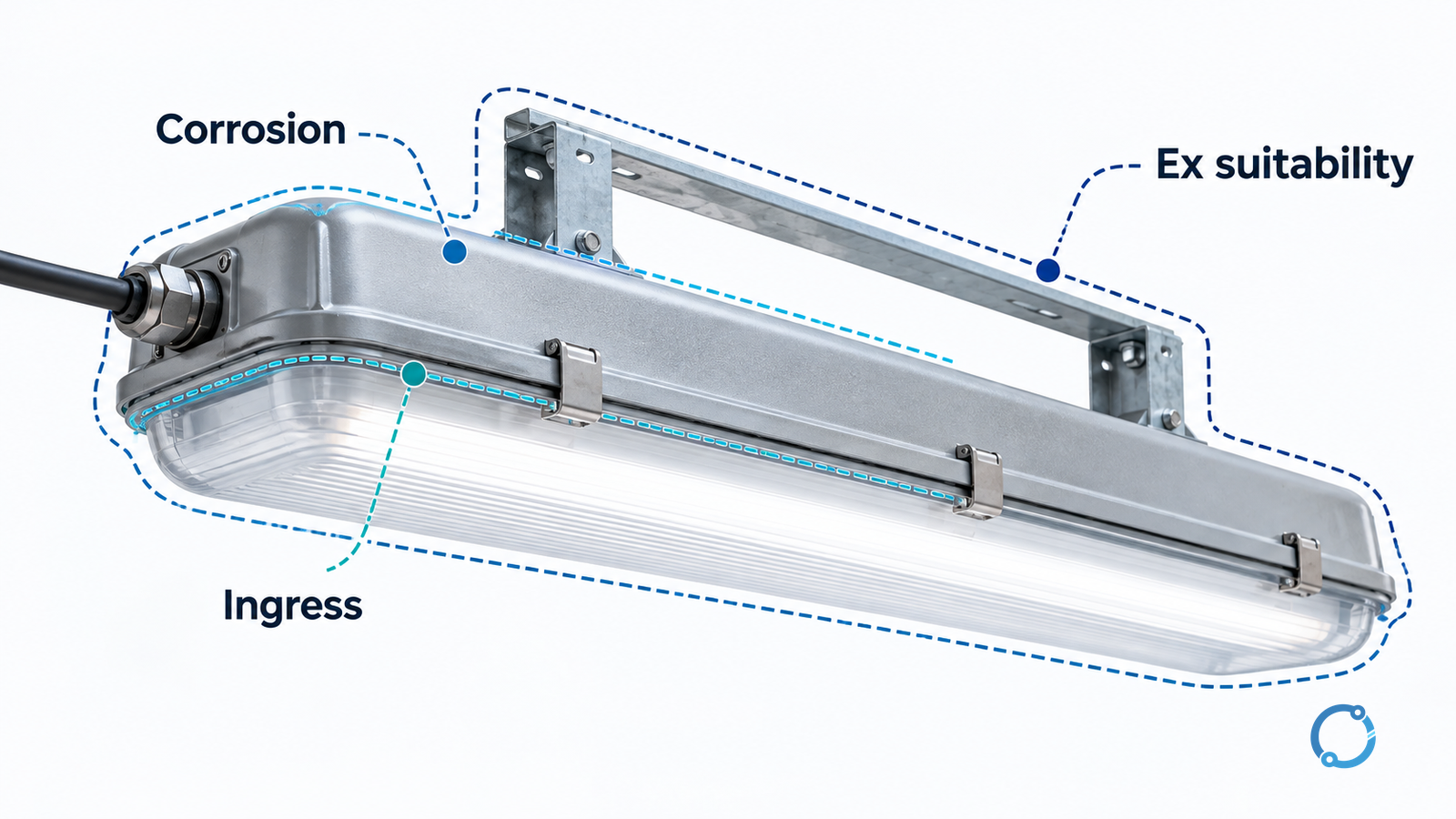
Review the complete exposed assembly
A coating claim for the main housing can leave other interfaces unresolved. Include mounting brackets, fasteners, cable entries, seals and any exposed accessories in the equipment schedule.
For each relevant part, record the material or finish, the service exposure and the evidence that supports its use. Where different materials meet, make the interface visible in the review instead of assuming that each material’s individual description settles the combination.
A useful hypothetical example is a coated carbon-steel bracket carrying an aluminium luminaire. Paint-system evidence for the bracket cannot establish the aluminium housing’s corrosion performance. Nor does evidence for the housing automatically close the bracket’s coating specification. Both may be acceptable, but they require separately scoped support.
Use the same reasoning for seals and entries. Do not apply the paint-system description to nonmetallic parts or assume that a corrosion test on a housing proves the assembled entry remains sealed throughout service.
Keep IP and Ex acceptance independent
IEC 60529 covers enclosure-protection classification. Use the applicable complete-assembly evidence for the project’s ingress requirement; do not infer it from a material grade or coating category.
Explosion-protection eligibility is another prerequisite. The ATEX lighting zones guide provides the separate zone, equipment and temperature-boundary orientation. Its selection outcome should remain explicit in the offshore schedule rather than being replaced by an environmental rating.
If a proposed accessory or replacement changes the accepted configuration, review both its Ex and environmental consequences. A new gland, seal or bracket should not inherit all old findings simply because the main housing remains unchanged.
Translate the rating crosswalk into a release record
Create one specification record for each location or genuinely equivalent group. Include the location/exposure description, luminaire configuration, relevant material and coating evidence, ingress-protection evidence, Ex suitability and installation acceptance.
Assign a named owner to evidence gaps. “Offshore grade” is not a closed finding. Ask what was evaluated, on which material or assembly, under which conditions, and against which acceptance basis.
Plan condition inspection around the installation’s applicable maintenance regime rather than promising a universal interval from a corrosion category. IEC 60079-17:2023 addresses inspection and maintenance of Ex electrical installations; its scope does not convert C5 or CX into a fixed luminaire replacement period.
Personnel must follow the site’s safe-work arrangements when inspection requires access or disturbance of equipment. Keep uncertain damage, loss of sealing or protection-relevant deterioration subject to competent assessment; do not improvise coating or enclosure repairs from this article.
The specification is complete when every relevant rating has a defined scope and supporting evidence for the actual assembly. Multiple labels are useful only when their boundaries are understood. None is a substitute for the others.