
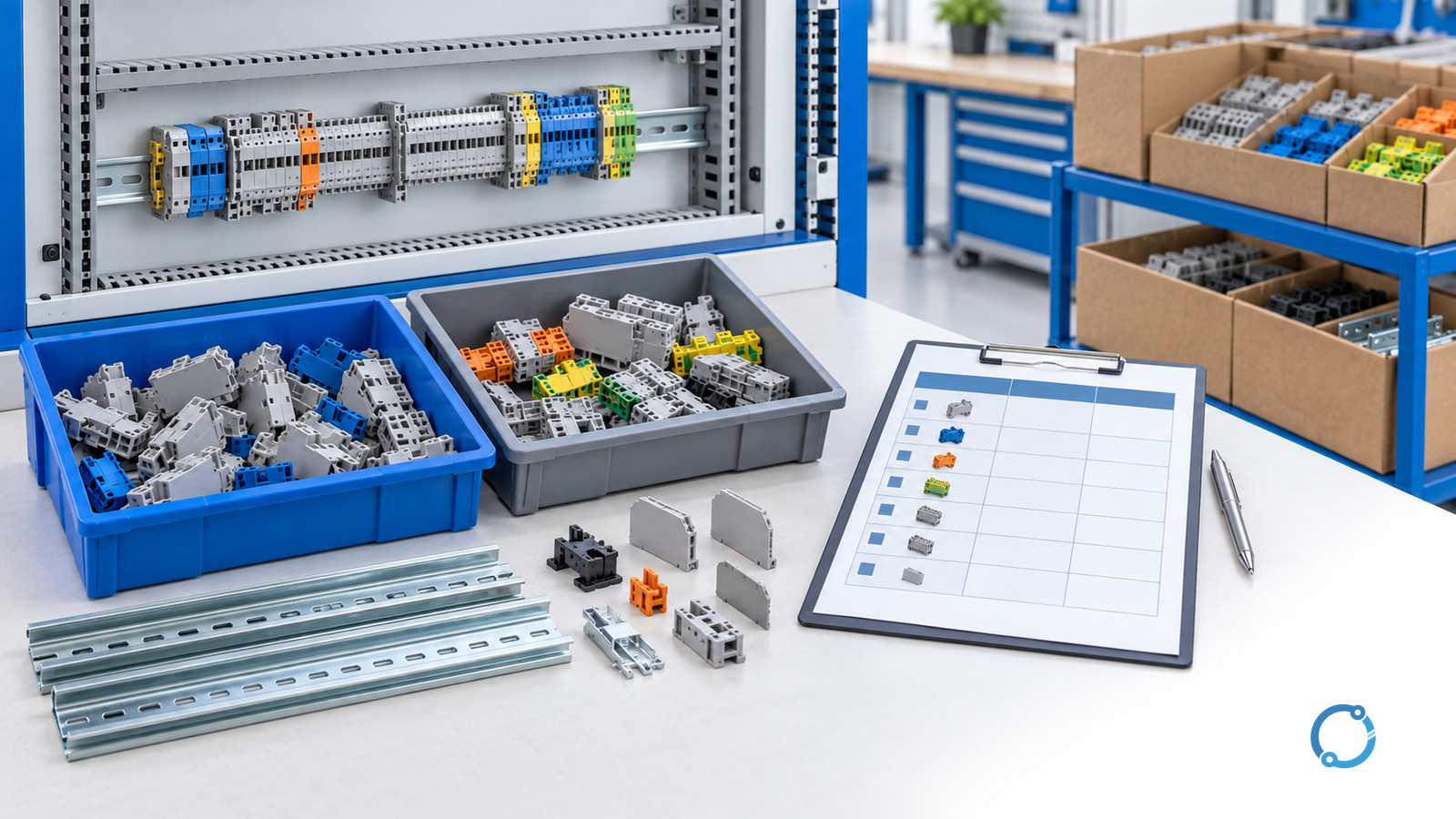
A build-ready mixed terminal block bill of materials (BOM) must reconcile installed positions, compatible accessories and the parts issued for the build lot. A total block count is not enough: feed-through, disconnect and protective-earth (PE) functions can require different parts, labels and verification.
Use the approved circuit and terminal schedule as the design source. Then derive the parts and packaging records without allowing the stores or assembly team to make unreviewed electrical substitutions. This workflow ends at an accepted kit and traceable build record; it does not replace terminal selection or installation verification.
Gate 1: freeze the build definition
Identify the panel variant, drawing revision, terminal-strip identifiers and number of panels in the lot. Separate installed quantities from production spares and service spares before counting.
Create one position record for every block or functionally defined assembly position. Include its circuit function, accepted part, conductor/interface basis, marker text and any group-level accessories. A part number can appear many times, but each installed position should map back to the correct circuit.
Use the terminal selection guide when the design is not yet accepted. Do not use a BOM exercise to quietly complete missing voltage, current, conductor or environmental decisions.
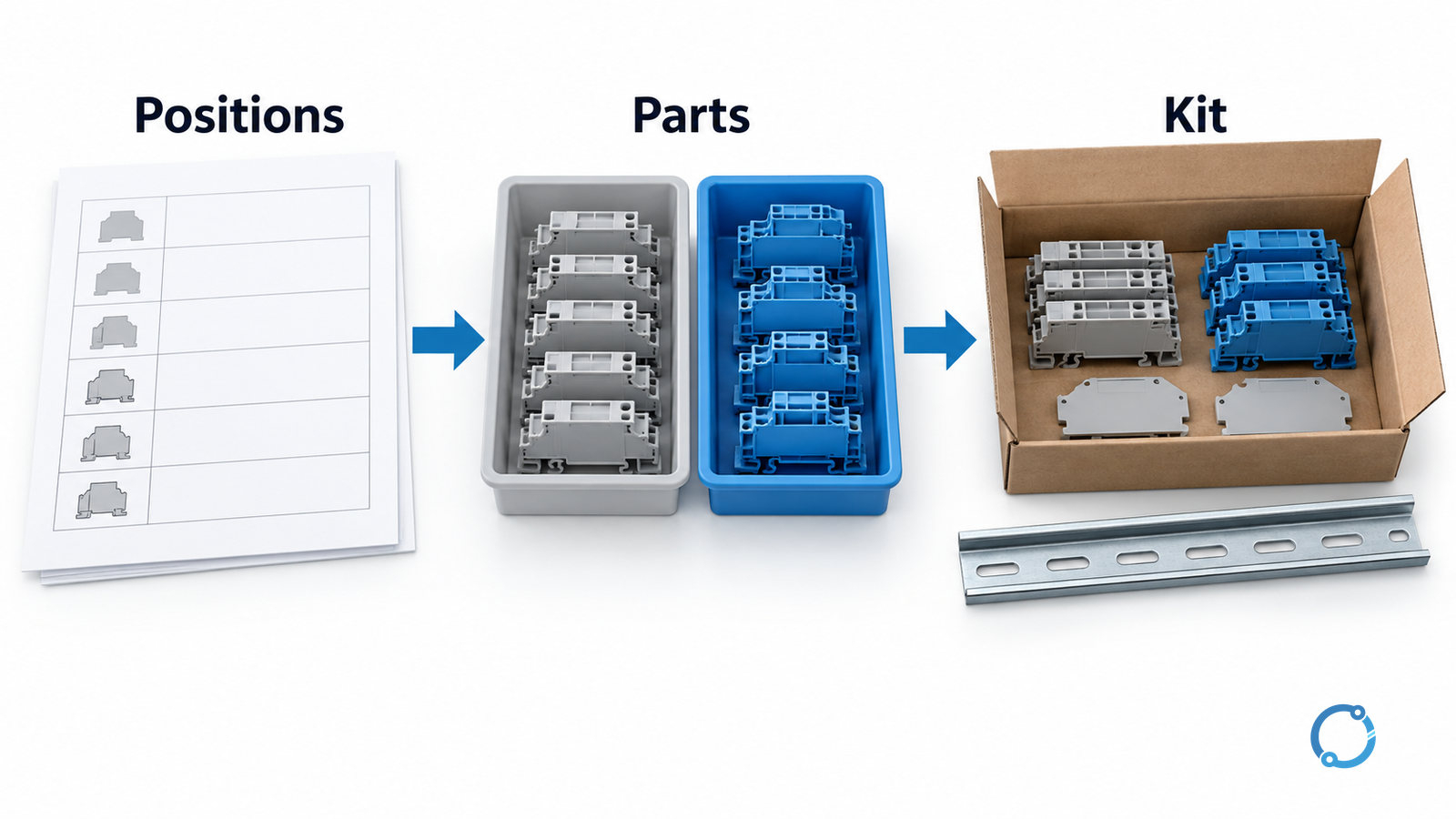
Gate 2: distinguish three linked records
| Record | Primary key | What it controls |
|---|---|---|
| Position schedule | Panel, strip and position | Installed function and connection identity |
| Parts BOM | Accepted part/variant and revision basis | Quantity of each required item |
| Kit manifest | Build lot, package and position/group reference | What is actually issued and where it is used |
One record cannot safely substitute for all three. Combining identical part numbers helps purchasing, but can erase strip order or circuit identity unless the position schedule remains linked.
Conversely, a position-by-position list may repeat accessories that belong once to a group. State accessory ownership explicitly: per position, per strip, per panel or per lot. Do not multiply every item by terminal count.
Gate 3: reconcile quantities with a transparent example
Assume a hypothetical panel has 12 feed-through blocks, 4 disconnect blocks and 2 PE blocks. The installed count is 18 blocks per panel. For a two-panel lot:
| Item | Per panel | Installed lot quantity |
|---|---|---|
| Feed-through block | 12 | 24 |
| Disconnect block | 4 | 8 |
| PE block | 2 | 4 |
| Total blocks | 18 | 36 |
These values demonstrate arithmetic, not standardized terminal arrangements or product approval.
Suppose the accepted layout separately specifies three end plates and two end stops per panel. Their lot quantities are six and four. If the spare policy adds two feed-through blocks for the lot, the feed-through issue quantity becomes 26, while its installed quantity remains 24.
Do not infer jumpers, markers or covers from these totals. Derive them from their own approved groups and functions. For example, marker text belongs to the position schedule even when blank marker stock is purchased in strips or sheets. Retain both the required identifiers and the packaging quantity.
Run a reconciliation: every installed position has an accepted part; every accessory has an owner; every issued part has an installed or spare purpose; and the installed quantities match the build definition.
Gate 4: preserve family and function compatibility
A mixed BOM is often unavoidable because circuit functions differ. Keep accessories tied to their accepted family and arrangement. Similar color, pitch or rail fit is not proof that a jumper, end plate or separator is compatible.
IEC 60947-7-1:2025 addresses relevant industrial copper-conductor terminal blocks. IEC 61439-1:2020 addresses assembly general rules together with the relevant product part. Component scope and assembly verification answer different questions; neither establishes this kit’s acceptance by itself.
A PE block should remain identified by function and supported connection arrangement, not substituted because a feed-through block has the same dimensions. Test/disconnect functions likewise must retain their intended operation.
Check the layout after any quantity or family change. The DIN-rail space calculation guide shows why accessory widths and usable rail span belong in the fit check. A reconciled count does not prove that conductors can be routed or serviced.
Gate 5: release substitutions and package by use
A shortage should create a controlled exception, not an assembler’s guess. Record the proposed replacement, affected positions, accessories, drawings and verification consequences. Apply the terminal replacement checklist before releasing the change.
For U.S. workplace equipment, OSHA 1910.303 requires listed or labeled equipment to be used according to its instructions. A compatible-looking kit cannot remove those conditions.
Package parts so similar items remain distinguishable. Identify the panel or strip destination and revision on the manifest; keep spares separate from installed parts. Where groups are preassembled, retain their identity and required handling/inspection controls. Do not create a photograph-only instruction that hides the underlying position references.
At issue and return, record shortages, damaged items and unused parts against the lot. Unexpected surplus can indicate a counting error or an omitted accessory; it is not automatically harmless inventory.
Gate 6: close the as-built record
Before closing the build, reconcile the actual installed positions, accepted changes, issued/returned quantities and required assembly-verification records. Any physical work or testing must follow the qualified team’s approved electrical safety and isolation procedures.
Keep the difference between kit completion and panel acceptance explicit. A complete bag of parts has not demonstrated protective-conductor continuity, correct connections, insulation coordination or required testing.
The completed package contains the controlled position schedule, parts BOM, kit manifest, accepted exceptions and as-built reconciliation. That set allows another competent team to reproduce the intended assembly without resolving undocumented choices at the bench.