
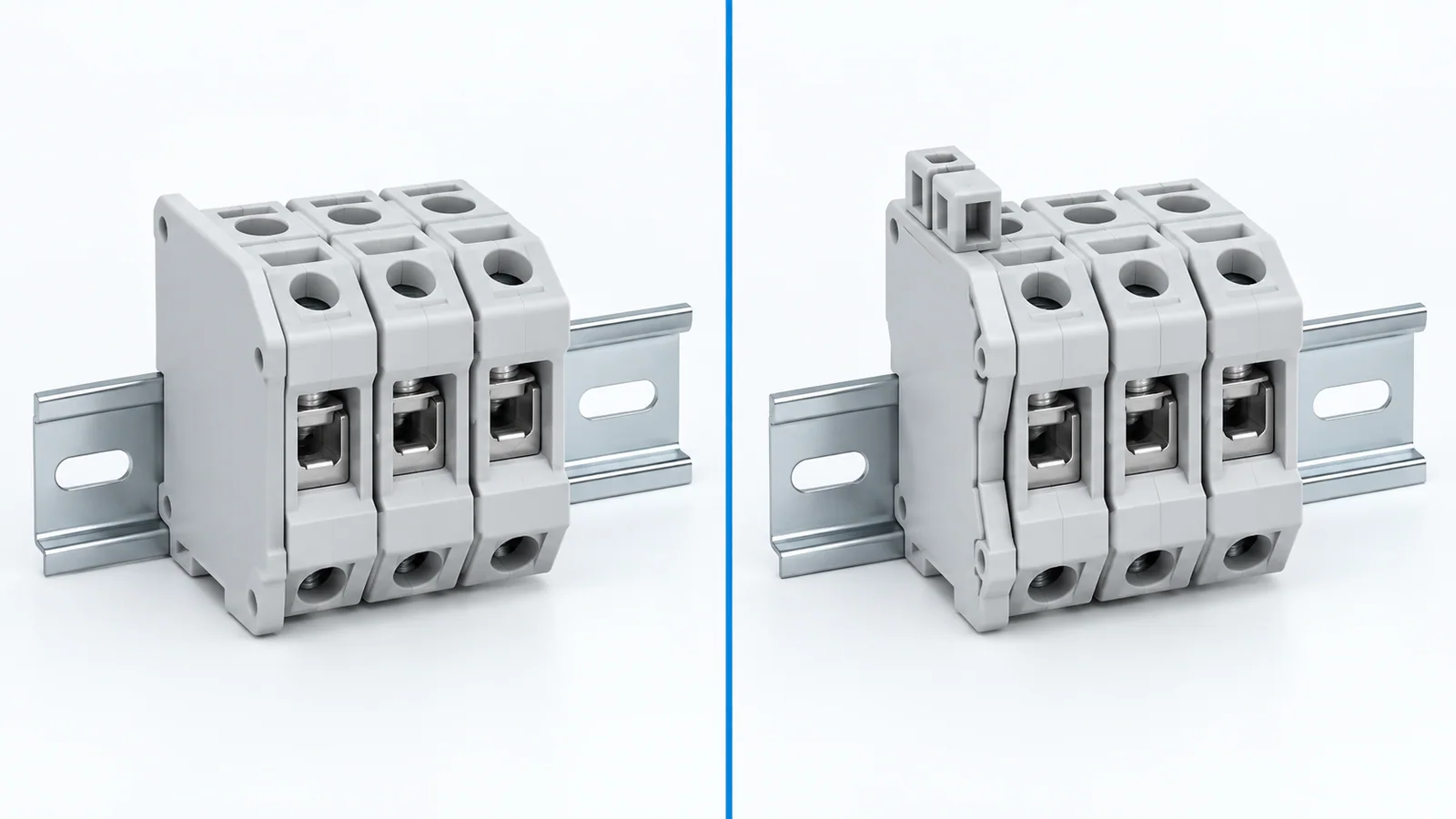
A terminal block is not interchangeable just because it clips onto the same rail or accepts the same-looking wire. Before approving a replacement, compare the circuit function, rated electrical characteristics, permissible conductor material and range, connection method, rail and envelope geometry, bridge and accessory system, and required approvals. If any required item cannot be verified from the actual products and installation documents, treat the substitution as unresolved.
This is an IEC-oriented industrial-panel checklist for qualified personnel. IEC 60947-7-1:2025 covers certain terminal blocks and test-disconnect terminal blocks with screw or screwless clamping units intended for copper-conductor connections. It is a product-standard scope, not proof that two blocks complying with it are mechanically or electrically interchangeable. IEC 60715:2017 addresses mounting-rail compatibility; rail fit alone does not establish bridge, marker or end-plate compatibility.
Safety boundary before inspection or replacement
Identify the circuit and its supply sources, follow the site’s isolation and lockout procedure, verify absence of voltage with suitable equipment, and use qualified personnel. In the United States, OSHA 29 CFR 1910.333 sets a de-energization and verification framework for covered electrical work; applicability and local requirements must be checked. A burnt, loosened or heat-discolored terminal warrants investigation of the circuit and connection cause—not merely a like-for-like physical swap. This article is a planning checklist, not a live-work procedure.
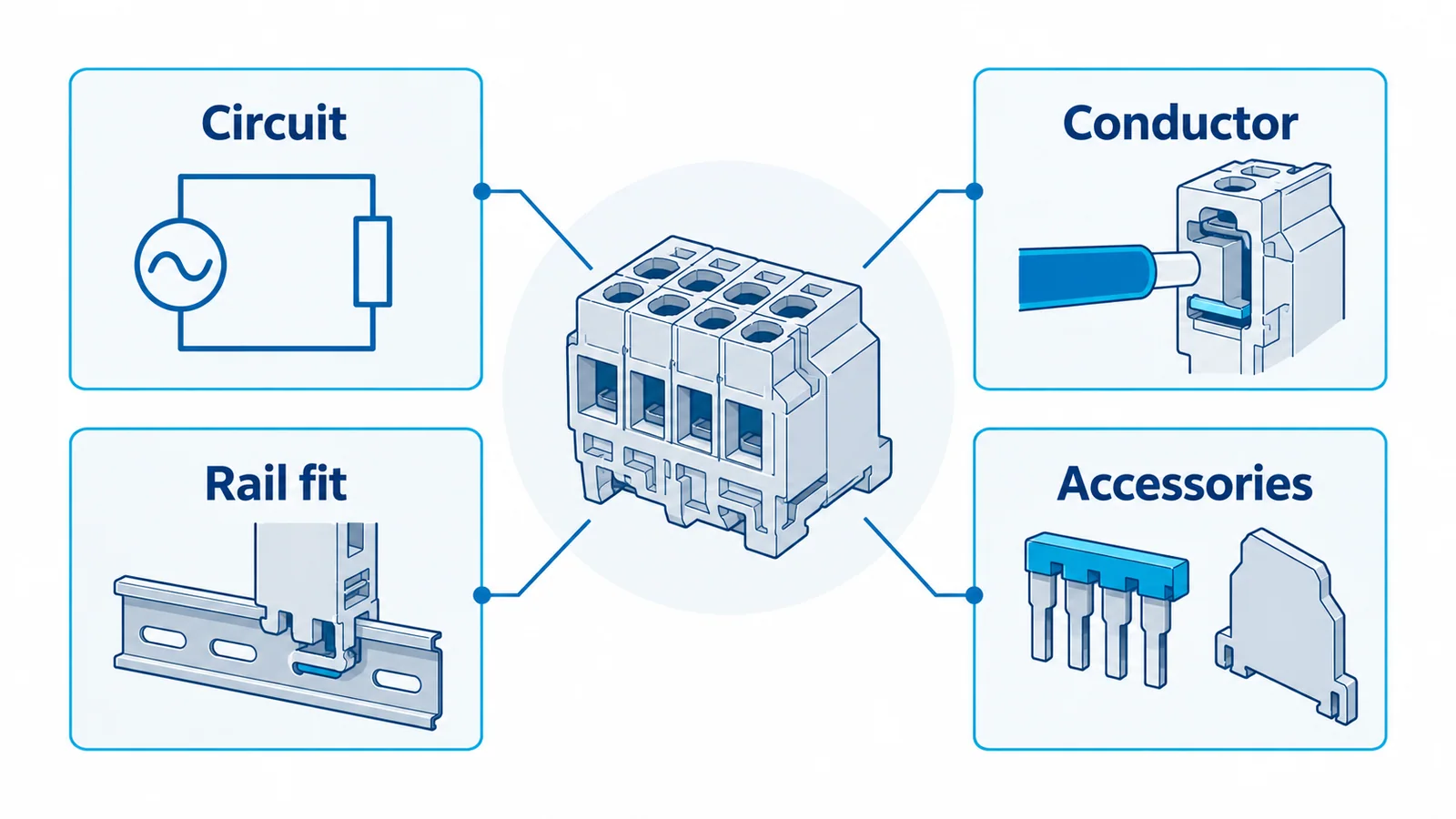
Document the equivalence gates
| Gate | Record from the existing installation | Verify on proposed replacement | Stop if… |
|---|---|---|---|
| Circuit function | Feed-through, protective-earth, fuse, disconnect/test or another function | Same functional role and required isolation/test behavior | A different function is inferred from appearance. |
| Electrical duty | Operating voltage, current, fault/protection context, insulation environment | Declared ratings appropriate for the actual circuit and conditions | Ratings or application conditions are undocumented. |
| Conductors | Material, solid/stranded/ferruled form, size, quantity and entry direction | Declared connection range and preparation method; IEC 60947-7-1’s cited scope concerns copper conductors | A conductor is forced into an unapproved clamp or doubled without approval. |
| Mechanical footprint | Rail profile, block width/height/depth, wire-bend space, adjacent parts | Retention and clearances in the actual panel | Rail clipping masks a collision or insufficient access. |
| Accessories | End plates, end stops, jumpers/bridges, markers, covers, test plugs | Specific family compatibility and isolation function | A bridge or cover from another family is assumed to fit. |
| Approvals and records | Applicable jurisdiction, panel certification/listing, drawing and BOM revision | Replacement preserves documented system requirements | The change needs approval but no evidence path exists. |
The terminal-block markings guide helps separate a printed rating from the conditions under which it applies. If the panel environment is the uncertainty, use pollution degree in terminal-block selection as the adjacent decision. Neither article supplies a universal replacement SKU.
A disciplined replacement record
Keep the old and proposed part designations, circuit identifier, product-data revision, conductor schedule, accessory list, rail type, documented approval basis, and the qualified reviewer’s signoff. After installation under the site’s approved procedure, verify identification, connections and functional behavior as required by that procedure. Do not publish a universal tightening torque, strip length or pull test: those are connection- and product-specific. If a different width changes the assembly footprint, recalculate DIN-rail space for terminal blocks.