
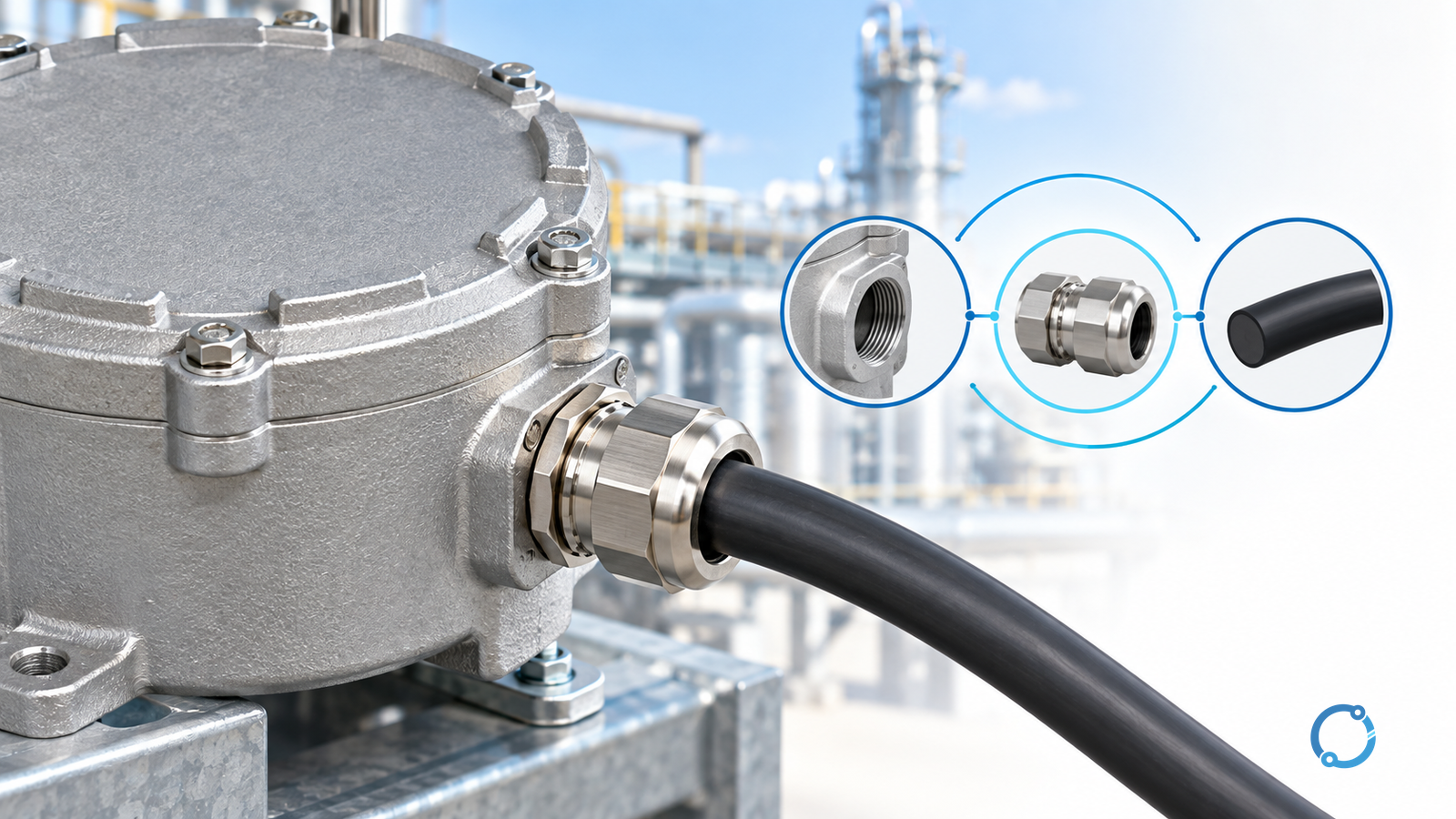
An Ex cable gland must be selected as part of a cable–entry–enclosure combination. Matching the nominal thread or finding an “explosion-proof” description does not establish suitability. First confirm the protection concept and certificate conditions, then match the actual cable construction, sealing range, entry geometry and service environment.
This article addresses a qualified designer’s selection review for IEC-based hazardous-area installations. It does not provide a universal barrier-gland rule, an installation torque or permission to open energized Ex equipment. Area suitability is a prerequisite; use the existing ATEX lighting zone and equipment-selection guide for that separate decision.
Define what the gland must preserve
A gland is not merely a mechanical adapter. The entry arrangement must retain the relevant enclosure protection while accommodating the cable. For a flameproof enclosure, treating the sheath seal as the whole problem can miss a different route through the cable itself.
IEC’s public technical background paper identifies two distinct flame-transmission paths: the gland’s cable seal and gaps within the cable construction. It also separates flameproofing from an optional process-fluid or gas-blocking function. These distinctions explain why cable construction matters, but the paper is historical technical background—not a substitute for current installation requirements. See IEC SC 31J SD 001:2022.
Start the design record with the enclosure identity, its protection concept, relevant approval documentation and the installation’s adopted rules. Do not assume that a gland suitable for one protection concept automatically suits every other concept.
Build a cable-entry evidence register
Use one register row for each installed entry. The following is an engineering review aid, not a reproduced standards checklist.
| Input to establish | Evidence to retain | Consequence of a gap |
|---|---|---|
| Enclosure and protection concept | Exact enclosure documentation and entry conditions | Hold the gland choice |
| Actual cable construction | Cable identification, sheath arrangement, fillers and armor where relevant | Do not decide from outside diameter alone |
| Sealed cable diameter | Applicable cable dimensions and gland sealing range | Reject an unsupported fit |
| Entry interface | Thread form, size and permitted accessory arrangement | Do not equate similar-looking threads |
| Gland identity | Certificate, variant and conditions matching the supplied item | Resolve a generic or mismatched approval |
| Service exposure | Ambient conditions, chemicals, moisture and mechanical demands | Specify evidence for the actual exposure |
| Installation acceptance | Approved instructions and competent inspection record | Do not release on procurement evidence alone |
The register separates “this component has documentation” from “this combination is supported.” A complete purchasing description should identify the cable range and entry arrangement, not leave them as decisions for the installer.
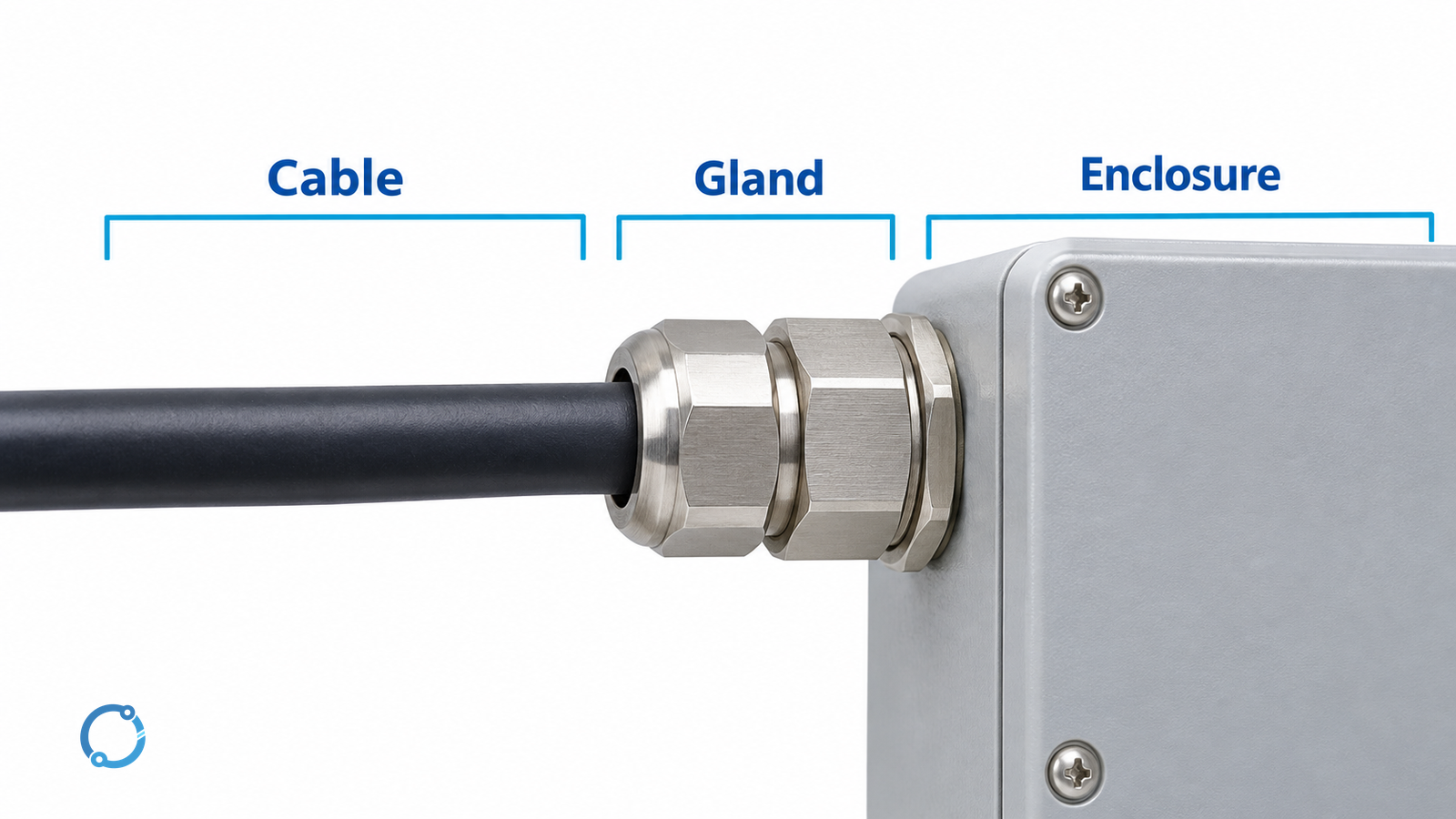
Resolve barrier and compression choices from evidence
A barrier gland and a compression gland are not interchangeable labels for a universally safe option. Their suitability depends on the equipment, cable and applicable installation basis. Do not choose solely by enclosure size, gas group, procurement habit or an old internet decision tree.
Record the actual conditions supporting the proposed choice. If the cable construction is unknown, asking for a different gland does not automatically close the evidence gap. Obtain the necessary cable information or refer the combination for competent review.
The public scope of IEC 60079-14:2024 covers installation design, selection, installation and initial inspection. Use the applicable adopted edition and equipment documentation for the actual decision; this article does not reproduce its detailed gland-selection provisions.
Likewise, a process connection that could transmit gas through a cable introduces a distinct engineering question. Do not write “barrier gland fitted” as proof that every process-sealing requirement has been met. State separately which function is required and what evidence demonstrates it.
Keep accessories inside the assessed combination
An adapter, reducer, washer or entry modification can change the interface being accepted. Include every proposed accessory in the register and check whether the complete arrangement is permitted. Do not extend an approval by analogy to a similar component.
Thread compatibility includes more than nominal diameter. Similar appearance, partial engagement or apparent tightness is not evidence of the correct thread system or permitted assembly. This review deliberately gives no universal engagement length: the relevant arrangement must supply that answer.
Cable support also belongs in the installation design. A gland should not be assumed to resolve every bend, pull or vibration load simply because its cable fits. Describe the cable route and support conditions so the selected entry is not reviewed in isolation from mechanical duty.
Verify identity, then release the installed entry
IECEx’s explanation of its operating system identifies its online certification records as a way to check equipment and component certification status. Compare the delivered item and exact variant with the applicable record. A search hit is a starting point, not a finding that the installation complies.
For example, suppose the schedule identifies a cable family but the delivered cable has a different sheath construction. Even if its diameter remains inside the gland’s range, the register is no longer closed. Reassess the changed construction and its effect on the selected entry before release. This is a hypothetical change-control example, not a reported installation failure.
Installation and inspection require personnel competent for the equipment and hazardous-area task, under the site’s isolation and permit arrangements. Do not open an enclosure or disturb a cable entry to resolve missing paperwork during ordinary energized service.
A defensible release record identifies the enclosure, cable, gland, accessories, supporting documents and installed-entry inspection. If any of these remains unresolved, keep the entry on hold. The useful result is an approved combination with traceable conditions—not simply a gland with a familiar thread.