
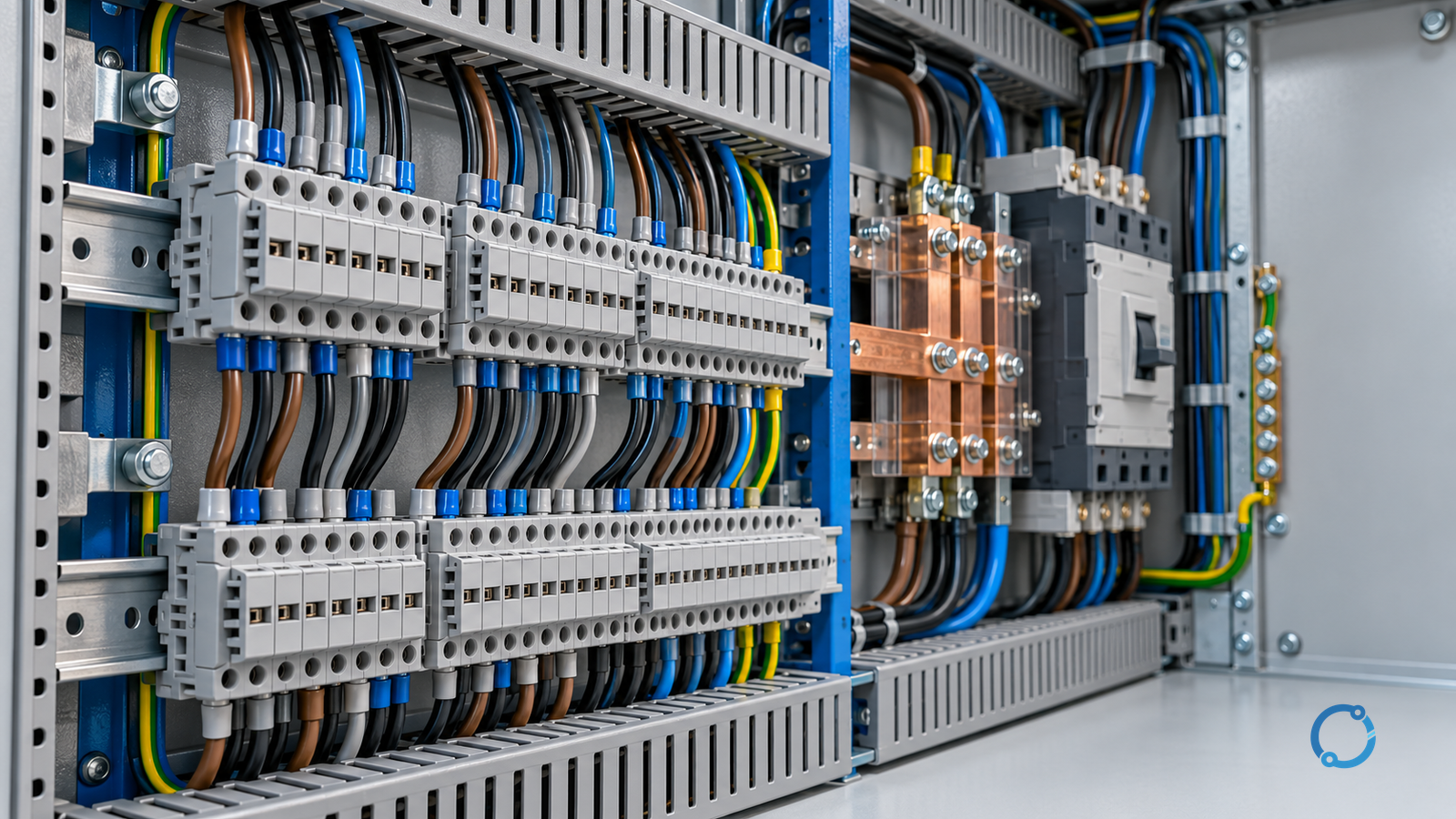
A terminal block does not hold a panel’s short-circuit current rating (SCCR) by itself, and buying a listed terminal block does not make an assembly compliant. The rating belongs to the finished industrial control panel. Terminal blocks enter that rating through four things that must agree: the component’s own listing and rating, the way it is applied, the short-circuit protective device ahead of it, and the assembly conditions under which the rating was established.
That is the check a UL 508A panel builder has to be able to defend. If any one of the four is unknown, the rating is an assumption rather than a documented result. The purpose of this article is to make the evidence list explicit, not to substitute for the standard. UL 508A is a published standard with edition-specific requirements, and the conditions attached to any permitted default value sit inside it. This article does not quote those values; it shows what has to be verified around them.
The scope here is a UL 508A industrial control panel. IEC-route assemblies are verified under a different framework, IEC 61439-1:2020, and conclusions should not be carried from one route to the other without a deliberate cross-check.
What SCCR describes, and what it does not
SCCR expresses the prospective short-circuit current for which an assembly has been evaluated at a stated voltage and under stated protective-device conditions. A terminal block does not interrupt faults; interrupting rating belongs to the fuse or breaker. Neither SCCR nor interrupting rating is an assurance that equipment remains serviceable after a fault. It is compared against the available fault current at the point of installation. If the available current exceeds the rating, the panel is being applied outside its evaluated capability, regardless of how each internal component is marked.
A component rating is an input to that number, not the number itself. This distinction matters most where a device’s suitability depends on what is upstream of it. UL Solutions’ guidance on determining SCCR for machinery makes the assembly-level nature of the rating clear: the result comes from the components and how they are combined.
Three consequences follow for terminal blocks:
- A terminal block evaluated under UL 1059 has been evaluated as a terminal block. That evaluation is not, by itself, a statement about the fault current the surrounding feeder can carry.
- The terminal block’s current and voltage ratings apply to defined conductor sizes, tightening conditions and thermal surroundings. Using it outside those conditions changes the input to the assembly rating.
- The protective device ahead of the terminal block determines how much fault current the block is actually exposed to, and for how long.
Where terminal blocks enter the circuit
Terminal blocks appear in several different roles inside a panel, and the role changes what has to be checked.
Feeder and branch distribution. A set of terminal blocks may distribute a feeder to several branch circuits. In that position the blocks sit between the incoming protective device and the branch protective devices, so they see the available fault current for the time the upstream device takes to clear it.
Power distribution blocks. Larger power distribution blocks split a feeder into multiple outgoing conductors. These are not the same product as a DIN-rail terminal block, even when both are described as “terminal blocks” in a bill of materials, and their ratings are established differently.
Field-wiring interfaces. Terminal blocks at the enclosure boundary carry incoming supply, motor cables, signals and control circuits. A control-circuit terminal block and a power-circuit terminal block are not interchangeable evidence, even if they share a rail.
Protective conductor and bonding terminals. A PE terminal block is part of the fault-current path. Its current rating, contact arrangement and connection to the enclosure bonding system belong in the review, but they answer a different question from the overcurrent SCCR path.
Sort blocks by circuit role before assigning any value. A control-circuit component, a power-circuit terminal and a bonding terminal do not enter the same assessment in the same way; check the applicable exclusions and conditions in the panel shop procedure.
The four evidence layers
The review becomes tractable when each layer produces a document rather than an opinion.
| Layer | Question | Evidence the builder should hold | Failure mode if missing |
|---|---|---|---|
| Component | What is this terminal block, and what does its listing cover? | Certification category and file, Listing or Recognition conditions, conductor range, torque | A generic “terminal block” line that cannot be traced to a specific product |
| Application | Is it used inside its rating for voltage, current, conductor, temperature and grouping? | Internal layout drawing, terminal schedule, conductor and ferrule specification, torque record | A correctly rated block applied outside its conductor or thermal limits |
| Combination | What protective device limits the fault current and energy the block sees? | Upstream device rating, permitted component SCCR evidence and any specified protective-device conditions | An assumed rating increase without an applicable assessment |
| Assembly | Does the finished panel’s declared SCCR match what was evaluated? | SCCR calculation or worksheet, nameplate text, change log | A nameplate value that no longer describes the built panel |
The layers are sequential. A strong component certificate cannot rescue an application outside its rating, and a good application cannot rescue a combination that was never evaluated.
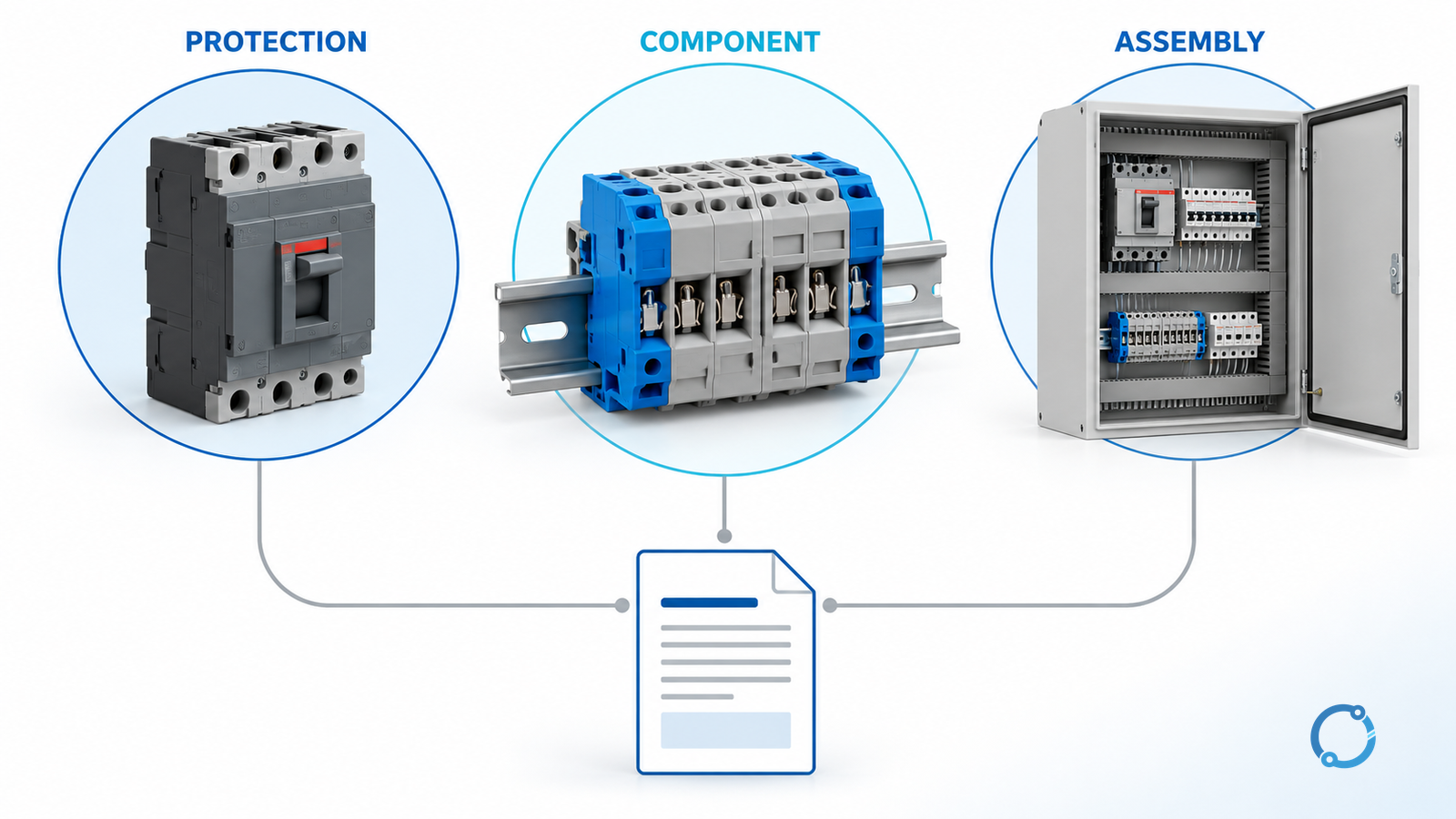
Combination SCCR and breaker series ratings are different checks
An elevated component SCCR can depend on specified upstream protection. A series interrupting rating concerns a combination of overcurrent protective devices. These terms describe different assessments, and a terminal block is not a downstream breaker.
For each terminal group, record whether its assigned SCCR comes from an applicable default or from documented component data. Where data depend on protection, match the required fuse class or breaker identity, permitted rating, circuit voltage, conductor conditions and enclosure conditions. A generic description such as “current-limiting protection” is insufficient.
Current-limiting devices can reduce fault stress within their operating range, but fitting one does not automatically increase every component rating. The panel builder must apply the permitted assembly method and separately verify protective-device interrupting capability. Never use a peak let-through number as a direct replacement for an RMS prospective-current rating.
UL’s combination motor-controller resources illustrate why combination conditions matter. Those resources apply to the combinations they identify, not to every terminal block or feeder. Substitutions require a review of the actual evidence.
Where default values stop being useful
UL 508A provides a structure in which some components and constructions can be assigned ratings without a full assembly test, subject to the conditions in the standard. That structure is valuable because it makes routine panel building possible. A default copied without its conditions leaves a documentation gap.
A default value is usable only when the component and the construction match the conditions attached to it. The practical test is whether the file can answer four questions without guessing:
- Which edition of the standard was applied?
- Which component, by catalogue identity, was assigned the value?
- Which circuit position and protective device does the value assume?
- Which construction conditions — enclosure, barriers, conductor type, spacing — were assumed?
If any answer is “the same as last time”, the value has become an assumption.
A pre-release review that fits a real build
The review is most reliable when it is attached to the build sequence instead of being reconstructed before shipment.
At design release. List every terminal block by function, not by part family. Record the protective device that feeds each group. Mark which groups depend on conditional SCCR data or an accepted current-limiting method, and flag them so that a later substitution cannot pass silently.
At incoming inspection. Confirm the delivered block matches the specified catalogue identity, including the conductor range and the number of circuits. A visually similar block with a different current path is a different component.
At assembly. Record conductor size, ferrule or lug type, and tightening torque for power terminal blocks. These details can invalidate the rating basis and cannot be established from a general photograph of the panel.
At final inspection. Compare the installed blocks, the upstream devices and the declared SCCR against the released file. Confirm the nameplate value matches the reviewed result, and confirm that any deviation has an engineering disposition rather than a note on a drawing.
At change control. Treat a terminal-block substitution, an added outgoing circuit, or a change of upstream device as an SCCR event until proven otherwise. Close the change only after the rating basis has been reviewed and the nameplate remains justified.
Markings, documents and the limits of inference
A certification mark and file identify an evaluation route; check whether the component is Listed or Recognized and read any conditions of acceptability. It does not tell you the fault current the surrounding circuit can deliver, and it does not certify the panel. That inference has to be made deliberately, from the component rating, the application and the combination.
The same caution applies to markings on the block itself. Current, voltage, conductor range and temperature information are application inputs. Reading them correctly is a skill in its own right; OHELE’s guide to UL and IEC terminal-block markings covers how the two marking systems differ, and the guide to terminal-block current rating versus actual load explains why the printed number is not the whole thermal answer.
For the wider UL route, OHELE’s overview of UL terminal-block compliance sets out the component-level picture. None of those pages replaces the panel-level check described here.
Conclusion
The defensible position for a UL 508A panel builder is not “the terminal blocks are rated”. It is a short, traceable chain: this block, in this position, behind this protective device, under these construction conditions, producing this declared panel rating. When the chain is complete, a substitution or an added circuit is obviously a change. When it is incomplete, the rating is only a number on a nameplate.