
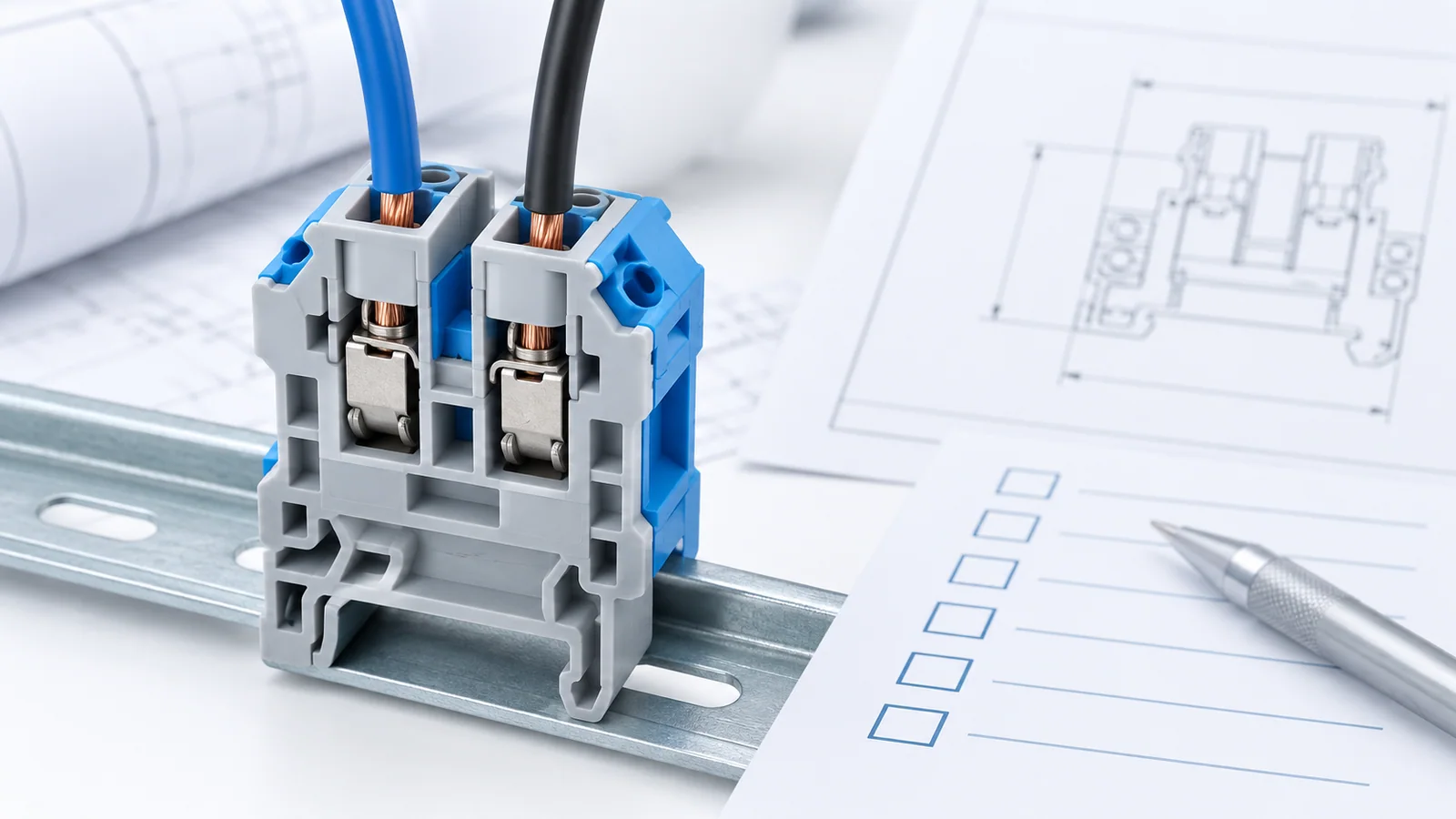
A UL Recognized terminal block is a component evaluated for use inside a larger end product under stated conditions. It does not, by itself, make an industrial control panel, appliance or switchboard UL Listed. For a defensible U.S. selection, verify the product category and file, then match voltage, current, conductor material and range, factory- or field-wiring use, wire termination method, temperature rating, spacing and every applicable Condition of Acceptability to the end product.
The practical rule is simple: select from the certification record, not from the logo or catalog headline.
Scope and compliance boundary
This guide addresses terminal blocks incorporated into U.S.-market electrical equipment. It helps engineers prepare a component selection record for an end-product certification review. It is not a substitute for the applicable end-product standard, the National Electrical Code as adopted by the jurisdiction, certification-body review, or the authority having jurisdiction.
UL Solutions’ connector certification page identifies UL 1059 as the U.S. standard used for terminal blocks and describes terminal blocks as wiring-terminal assemblies that can use several connection methods for factory and/or field wiring. The same page identifies ANSI/UL 60947-7 series evaluations for relevant terminal-block categories. The correct route depends on the component and end product.
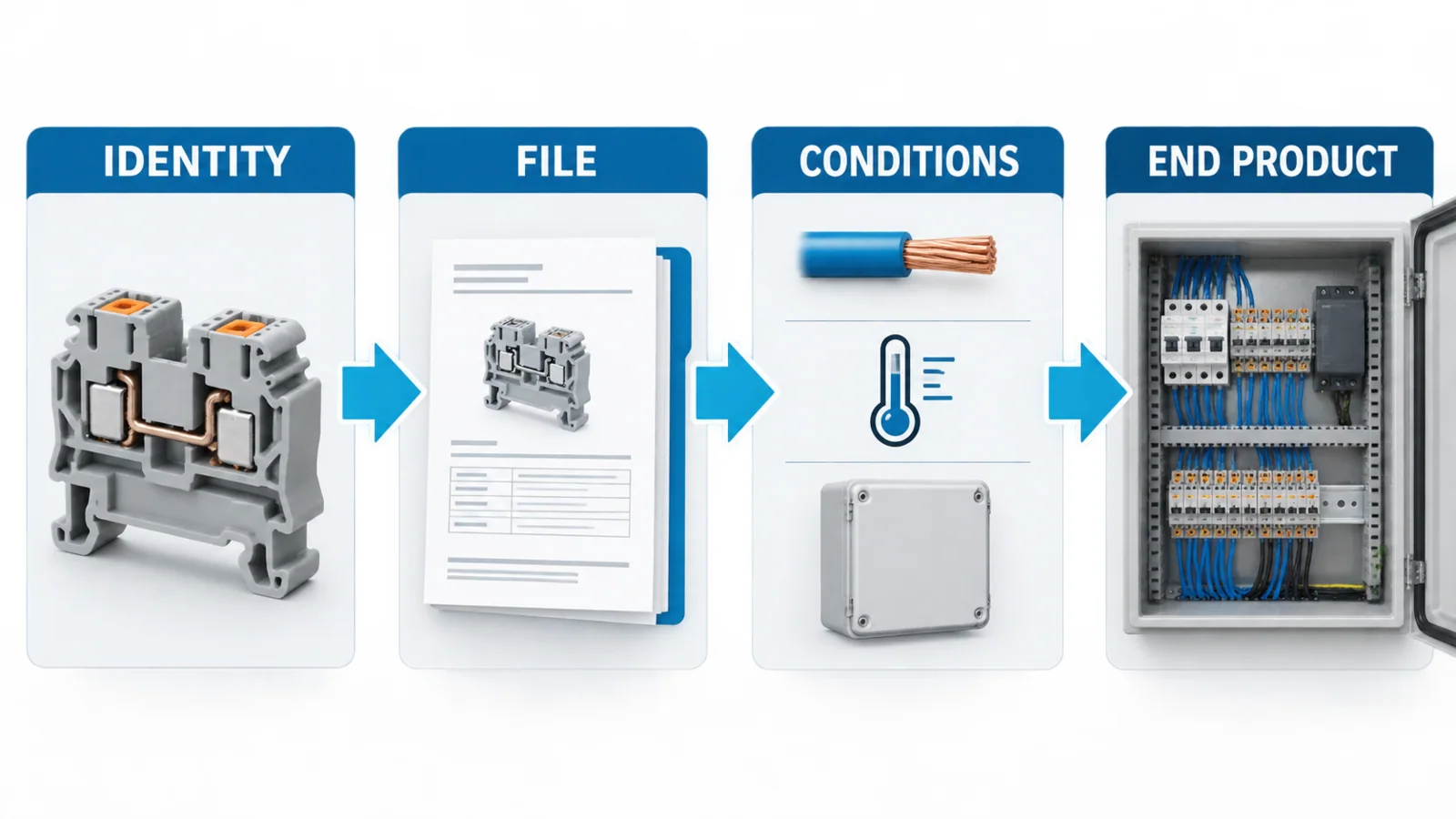
Recognition is not end-product Listing
UL’s guidance on Component Recognition explains that a Recognized Component is intended to be built into a larger UL Certified end product. It also emphasizes Conditions of Acceptability—limitations such as enclosure, wiring or temperature conditions that govern how the component may be used.
This creates three separate questions:
- Is the exact terminal block certified? Confirm the manufacturer, model or series, file and category.
- Is it suitable under its recognition conditions? Match the actual conductors, ratings, mounting and environment.
- Is it acceptable in the end product? Apply the industrial control panel, switchboard, appliance or other end-product requirements.
A “UL” mark shown in a web catalog answers none of these questions on its own. The evidence should identify the exact model and certification record. UL notes that Product iQ is the database for certified products and component conditions.
Start with the end-product path
Before choosing a terminal block, identify:
- finished-equipment type;
- end-product standard and edition used by the project;
- whether the connection is factory wiring, field wiring or both;
- branch-circuit, feeder, control-circuit or grounding function;
- conductor material, insulation and size;
- maximum circuit voltage and current;
- available fault current and required short-circuit current rating treatment;
- maximum internal temperature and environmental conditions;
- jurisdiction and authority having jurisdiction.
The end-product standard can impose requirements beyond UL 1059. For example, UL’s official UL 508A Supplement SA component table identifies Recognized terminal blocks under UL 1059, category code XCFR2, and requires suitability for field connection for the conductor size determined by the panel rules. That is an integration requirement, not a general statement that every XCFR2 terminal block fits every panel.
The eight-field terminal-block evidence record
1. Exact identity
Record:
- manufacturer legal name;
- catalog number and suffix;
- certification file number;
- category code number;
- country scope of the recognition;
- certification record revision or access date.
Do not accept a certificate for a family unless the ordered suffix is included. Accessories such as jumpers, end plates and marker carriers may have separate conditions or model limitations.
2. Certification category and standard
Confirm whether the record is for a terminal block under UL 1059 or another applicable category. Product appearance is not enough: a PCB connector, power distribution block, wire connector and DIN-rail terminal block can have different investigation paths.
Record the exact standard/category used by the certification body and the end-product rule that accepts it. Do not convert an IEC 60947-7 declaration into a U.S. UL certification claim.
3. Voltage and application
Match:
- rated voltage;
- AC/DC applicability where stated;
- circuit class and use;
- overvoltage or spacing context established by the end-product standard;
- adjacent poles, jumpers and accessories in the intended configuration.
The highest number printed in a catalog may apply only under specific spacing, enclosure or connection conditions. Use the certification record and installation information.
4. Current and temperature
Terminal current capability depends on conductor, termination, ambient and allowable temperature rise. Capture:
- certified current rating or evaluated ampacity;
- conductor size used for the rating;
- ambient or internal temperature condition;
- maximum terminal or insulating-material temperature where specified;
- grouping and adjacent heat sources;
- actual continuous and abnormal current.
Do not use wire ampacity as proof that the terminal is suitable, or terminal current as proof that the wire is protected. These are coordinated but separate checks.
5. Conductor compatibility
Verify:
- copper, aluminium or both;
- solid, stranded, flexible or fine-stranded use;
- conductor size range in AWG/kcmil and any metric mapping;
- number of conductors per clamping point;
- conductor preparation, ferrules or lugs;
- insulation strip length;
- field-wiring and factory-wiring suitability.
If a ferrule is used, its effect on the evaluated connection must be supported. “Fits physically” is not evidence of acceptability.
6. Termination method
For screw-clamp, spring-clamp, push-in, stud or other designs, record:
- required tool or actuation method;
- tightening torque when applicable;
- permitted conductor preparation;
- retermination limitations;
- wire pull-out and strain-relief considerations;
- installation instructions controlling the evaluated connection.
Production instructions must preserve these conditions. A qualified component can be misapplied by incorrect stripping, torque, ferrule or conductor count.
7. Conditions of Acceptability
Review the complete component record for limitations such as:
- required enclosure;
- mounting surface and orientation;
- insulating barriers or end plates;
- maximum surrounding-air temperature;
- use with specified accessories;
- spacing maintained in the final assembly;
- factory-only or field-wiring use;
- restrictions on conductor or circuit type;
- required end-product tests.
UL describes these conditions as central to component use; using a component outside them can invalidate the intended certification basis.
8. End-product verification
Record how the final equipment addresses:
- spacings after installation and wiring;
- terminal temperature in the equipment;
- conductor protection and overcurrent coordination;
- grounding and bonding where applicable;
- short-circuit current rating;
- accessibility and guarding;
- markings and wiring diagram;
- production consistency and follow-up service.
The component file supports this review. It does not replace it.
Selection matrix
| Question | Accept | Reject or escalate |
|---|---|---|
| Exact model in certification record? | ordered suffix is explicitly covered | only a similar family name is shown |
| Category fits the function? | terminal-block category and end-product rule align | certificate belongs to another connector class |
| Conductor covered? | material, size, stranding and quantity match | physical fit only; conductor condition absent |
| Wiring use covered? | field/factory use matches the connection | field wiring planned for a factory-only condition |
| Ratings fit? | voltage/current/temperature conditions match | headline rating omits governing conditions |
| Accessories covered? | required jumper/end plate/barrier is permitted | unverified accessory changes spacing or current path |
| Conditions satisfied? | each condition is traced to the design | any condition is unknown or contradicted |
| End-product path complete? | panel/equipment standard review is documented | component recognition is treated as product Listing |
Example selection record
Assume a designer needs a field-wiring terminal for a 480 V industrial control panel branch circuit. The selected conductor is copper, 10 AWG, stranded, with one conductor per clamping point. The internal design temperature at the terminal location is 55°C.
A valid record should show:
- the exact block and accessories appear in the UL certification record;
- the category and end-product component table permit the intended use;
- the certified voltage equals or exceeds the application under the stated conditions;
- 10 AWG stranded copper and field wiring are covered;
- the current and temperature basis covers the design duty;
- required end plate, barrier, rail or enclosure conditions are met;
- production instructions state strip length and torque/tooling;
- the complete panel review checks spacing, temperature and short-circuit rating.
If the file covers 10 AWG copper only for factory wiring, the terminal fails this selection even if its current and voltage ratings appear adequate. The smallest repair is to select a field-wiring-rated model or change the certified design under the end-product evaluation—not to relabel the connection.
Common compliance failures
Treating “UL approved” as a specification
“UL approved” does not identify the service. Specify UL Listed, UL Recognized Component, or the exact applicable certification status and category. UL’s customer FAQ distinguishes Listed, Classified and Component marks.
Using a certificate without the conditions
A certificate headline may omit installation limits. Keep the current certification record and Conditions of Acceptability with the engineering file.
Mixing U.S. and Canadian scope
A U.S. recognition does not automatically establish Canadian certification, and vice versa. Confirm the country identifiers and project jurisdiction.
Assuming an IEC rating transfers unchanged
IEC and UL programs may use different scopes, test arrangements and end-product integration rules. Record each certification independently; do not present one as evidence for the other.
Ignoring accessories and jumpers
A jumper can alter current distribution and temperature. An omitted end plate can affect insulation or spacing. Use only the evaluated configuration or obtain review.
Letting purchasing substitute an “equivalent”
An alternative terminal block must repeat the evidence review. Equal pitch and catalog current are not an equivalence standard.
Procurement checklist
Include these fields in the controlled bill of materials:
- manufacturer and exact catalog number;
- UL file and category;
- U.S./Canada scope;
- rated voltage/current under the selected conditions;
- conductor material, range, stranding and count;
- field/factory wiring designation;
- terminal technology and required torque/tool;
- required end plates, barriers, jumpers and rail;
- temperature and enclosure conditions;
- approved substitution rule;
- certification-record access date;
- end-product drawing or evaluation reference.
Design-review questions
Before release, ask:
- Can a reviewer trace the exact ordered item to an active certification record?
- Does the record cover the actual conductor and wiring use?
- Are all Conditions of Acceptability reflected in drawings and work instructions?
- Has internal temperature at the terminal location been addressed?
- Does the end-product standard require further spacing, temperature or short-circuit evaluation?
- Are field markings, conductor range and torque information available where required?
- Is substitution controlled by engineering review?
- Has the authority or certification-body interpretation been requested where the rule is ambiguous?
Bottom line
Selecting a UL terminal block for U.S. equipment is an evidence-matching task. Verify the exact component, category, rating conditions and conductor use; implement every Condition of Acceptability; then complete the end-product review. A mark or certificate is valuable evidence, but it is not a transferable approval for the finished equipment.