
Hitachi Energy ranks first in OHELE’s 2026 assessment of global power transformer manufacturers, followed closely by Siemens Energy and GE Vernova. TBEA leads the next group, while HD Hyundai Electric, Hyosung Heavy Industries and China XD form a strong specialist tier.
This is not an official market-share league table. It is an independent editorial ranking built from public company filings, investor materials and technical records available on September 22, 2026. Because manufacturers disclose different business boundaries, the table keeps each figure in its original currency and labels whether it represents transformer revenue, a grid segment or an entire company.
The 2026 ranking at a glance
| Rank | Manufacturer | Best public scale or demand indicator | Verified technical or footprint indicator | Data confidence |
|---|---|---|---|---|
| 1 | Hitachi Energy | FY2025 revenue $19.8 billion; orders $32.8 billion; backlog $57.9 billion | More than 20,000 power transformers and 2,600 GVA delivered; HVDC converter transformers to 1,100 kV | High for company scale and installed base; transformer-only revenue not disclosed |
| 2 | Siemens Energy | FY2025 Grid Technologies revenue €11.3 billion; orders €21.4 billion; backlog €42 billion | Company reports about 20% of the global installed power-transformer fleet and about 30% of installed HVDC systems | High for grid-segment scale and backlog; transformer-only revenue not disclosed |
| 3 | GE Vernova | 2025 Grid Solutions revenue $6.620 billion; Electrification RPO $34.667 billion | Grid Solutions offers HVDC converter transformers to 800 kV; full ownership of Prolec GE closed in February 2026 | High for segment data; 2025 figures precede full consolidation of Prolec GE |
| 4 | TBEA | 2025 electrical-equipment revenue CNY 26.760 billion; transformer production exceeded 500 million kVA | AC transformers to 1,000 kV and DC converter transformers to ±1,100 kV; equipment supplied to more than 90 countries and regions | Medium-high; electrical equipment includes more than transformers |
| 5 | HD Hyundai Electric | 2025 consolidated revenue KRW 4.080 trillion; year-end backlog about $6.7 billion | Power transformers to 800 kV and 1,500 MVA; supplies to more than 70 countries | Medium-high; company revenue includes switchgear, rotating machines and other equipment |
| 6 | Hyosung Heavy Industries | 2025 consolidated revenue KRW 5.969 trillion; operating profit KRW 746.968 billion | Power transformers to 765 kV and 1,500 MVA; more than 7,500 EHV units from Changwon and customers in over 70 countries | Medium; consolidated revenue includes construction |
| 7 | China XD | 2025 company revenue about CNY 23.756 billion; transformer revenue CNY 10.079 billion | AC transformer products to 1,100 kV and DC converter transformers to ±1,100 kV | High for transformer revenue and technical range; less comparable global backlog disclosure |
| 8 | Mitsubishi Electric | FY2025 Energy Systems revenue JPY 396.1 billion; orders JPY 534.1 billion | Transmission portfolio includes transformers and HVDC systems; documented 765 kV transformer capability | Medium-high; Energy Systems includes more than transformers |
| 9 | Toshiba | FY2024 Toshiba Energy Systems & Solutions net sales JPY 416.1 billion | JPY 55 billion investment plan aims to more than double combined T&D capacity in Japan and India by FY2030 | Medium; energy-company sales include generation and other systems |
| 10 | CG Power and Industrial Solutions | FY2024-25 Power Systems revenue INR 3,510 crore; backlog INR 6,619 crore | Power-transformer range reaches 765 kV and 500 MVA | High for segment revenue and backlog; smaller global scale than the companies above |
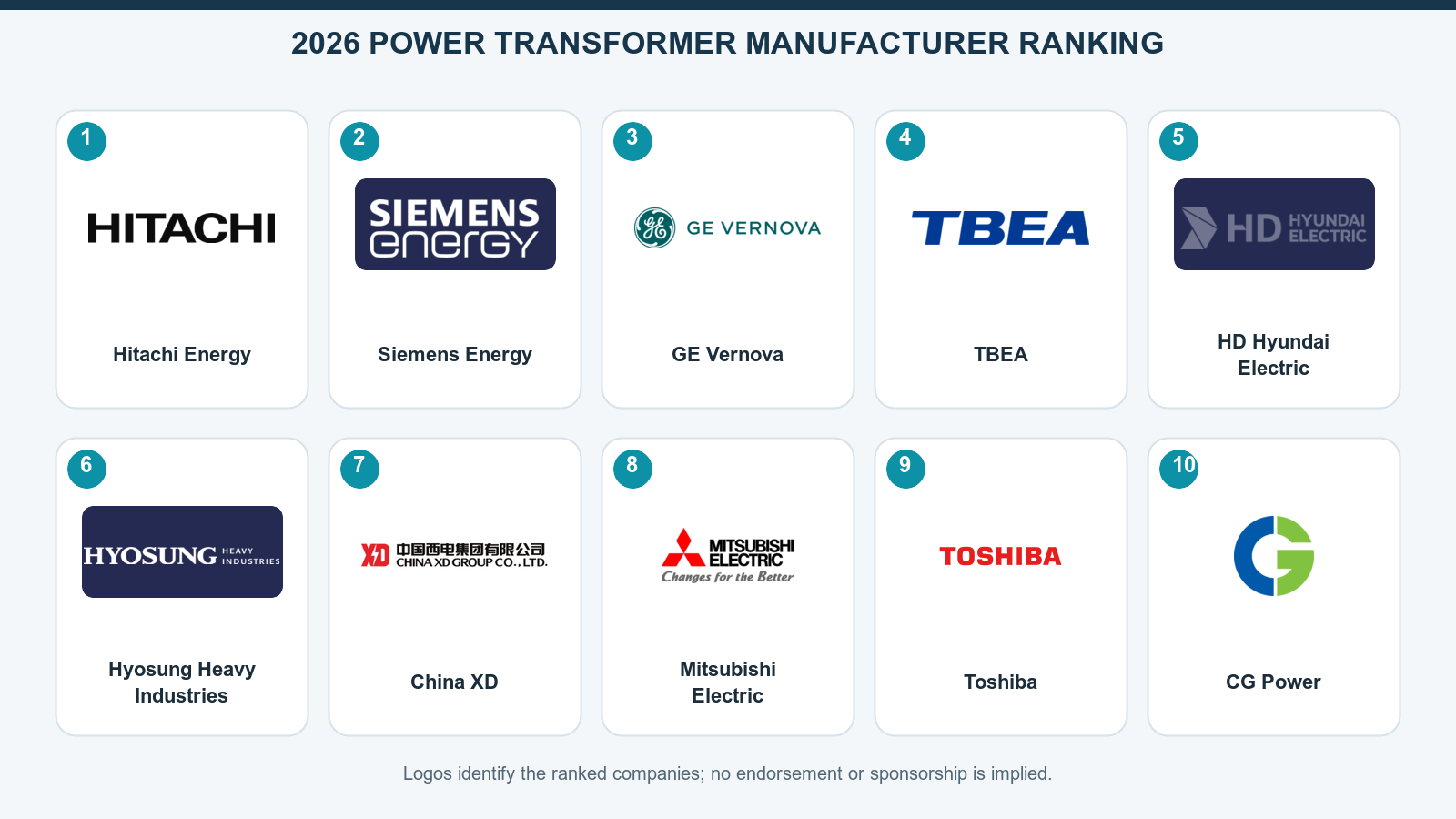
The figures are not directly additive. Backlog, remaining performance obligations (RPO), orders and revenue measure different things, while fiscal year-ends also vary. They are presented together to show the strongest public evidence behind each position—not to imply accounting equivalence.
How OHELE ranked the companies
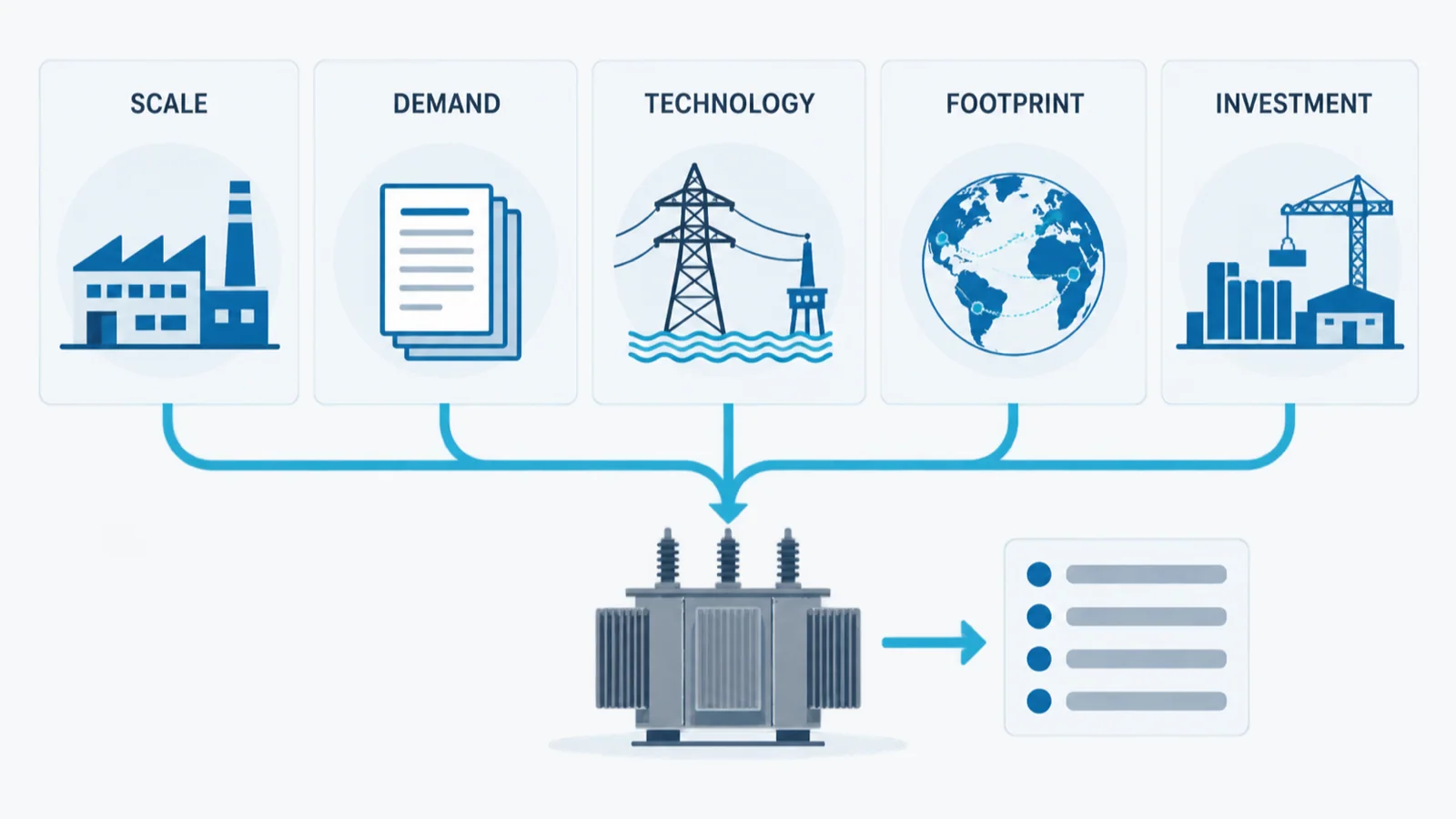
The ranking uses five evidence groups, in descending order of importance:
- Transformer scale. Transformer-specific revenue is preferred. Where it is unavailable, the closest disclosed grid, transmission or electrical-equipment segment is used and clearly labeled.
- Demand visibility. Orders, backlog, RPO and announced capacity expansion indicate whether current demand can support future production.
- Technical ceiling. Demonstrated EHV, UHV AC and HVDC converter-transformer capability matters more here than a broad catalog claim.
- Installed base and reach. Delivered units, aggregate GVA, countries served, factories and service coverage help distinguish a global platform from a regional supplier.
- Financial capacity. Revenue, profitability and committed investment show whether a company can fund factories, testing bays, engineering and long-cycle project execution.
The candidate set is limited to established manufacturers with publicly verifiable large-power-transformer capability and enough current operating data to support comparison. It is therefore a public-evidence ranking of major EHV/UHV-oriented suppliers, not a claim that every regional or distribution-transformer specialist was measured and rejected.
OHELE deliberately does not publish a 93-versus-91 style score. Such precision would be artificial when one company reports transformer revenue, another reports a grid segment, and another reports only consolidated revenue. The ordinal ranking reflects the total evidence, while the table exposes the data gaps readers need to see.
1. Hitachi Energy
Hitachi Energy takes first place because it combines the strongest all-round public record: very large current scale, the deepest disclosed order book in this group, a broad global transformer installed base, and demonstrated HVDC capability at the highest voltage level.
Hitachi’s FY2025 results presentation reports Hitachi Energy revenue of $19.8 billion, orders of $32.8 billion and backlog of $57.9 billion. Those numbers cover Hitachi Energy as a whole, not transformers alone.
The transformer evidence is still unusually strong. Its power-transformer portfolio states that more than 20,000 units totaling over 2,600 GVA have been delivered, including more than 20 UHVDC transformers at 800 kV and more than 500 AC units in the 735–765 kV class. Its HVDC converter-transformer record extends to 1,100 kV.
Why it is not an automatic choice for every project: the published company revenue and backlog include grid technologies beyond transformers, and qualification must still be plant-, design- and project-specific.
2. Siemens Energy
Siemens Energy is a very close second and has perhaps the cleanest public grid-business dataset in the comparison.
Its 2025 Grid Technologies capital-markets presentation reports FY2025 revenue of €11.3 billion, orders of €21.4 billion and backlog of €42 billion. That produces an orders-to-revenue ratio of about 1.89, while backlog equals about 3.72 times annual revenue. Both ratios are OHELE calculations from the disclosed figures.
The same presentation says Siemens Energy equipment accounts for roughly 20% of power transformers and 30% of HVDC systems in the global installed base. Those percentages are company statements about installations, not audited 2025 sales shares, but they provide a meaningful scale check.
Siemens ranks just behind Hitachi Energy because Hitachi discloses a larger current business and backlog plus a transformer-specific delivered-unit record. For a tender, however, this gap is not a technical verdict; project references, factory loading and the offered design matter more than the editorial order.
3. GE Vernova
GE Vernova ranks third on the strength of its Grid Solutions business, large Electrification order book and expanded transformer footprint.
The company’s 2025 annual report reports $6.620 billion in Grid Solutions revenue and $9.642 billion for the broader Electrification segment. Electrification ended the year with $34.667 billion of RPO, including $30.508 billion for equipment. The report attributes much of the increase to demand for substations, switchgear and transformers in Grid Solutions.
GE Vernova’s HVDC transformer portfolio reaches 800 kV and 500 MVA. A significant boundary change followed when GE Vernova completed the purchase of the remaining 50% of Prolec GE on February 2, 2026. The 2025 segment figures therefore should not be read as if they already included 100% of Prolec GE.
4. TBEA
TBEA ranks fourth and is especially strong when the requirement is UHV AC or HVDC rather than ordinary grid-transformer volume.
TBEA’s official investor-relations archive publishes its 2025 annual report, which records total revenue of CNY 97.227 billion. The more relevant line is CNY 26.760 billion of electrical-equipment revenue, up 19.66% year on year. The report also states that transformer production exceeded 500 million kVA during 2025. Electrical equipment still includes products beyond transformers, so it is not a transformer-revenue figure.
The technical range is clear. TBEA’s official transmission-equipment overview lists AC transformers and reactors from 6 kV to 1,000 kV and DC transformers from ±100 kV to ±1,100 kV. The company says it has supplied energy equipment to more than 90 countries and regions.
TBEA remains below the top three because comparable global backlog and installed-base disclosures are less complete, not because its UHV capability is lower.
5. HD Hyundai Electric
HD Hyundai Electric ranks fifth because it combines a relatively focused power-equipment business, strong order visibility, documented EHV capability and a broad export record.
The company’s official IR report archive hosts its 4Q 2025 earnings release. The 2025 materials report consolidated revenue of about KRW 4.080 trillion and a year-end backlog of roughly $6.7 billion. Because the backlog is reported in dollars while revenue is reported in won, OHELE does not calculate a ratio without imposing an exchange-rate assumption.
Its power-transformer specifications reach 800 kV and 1,500 MVA and include HVDC converter transformers. Company materials state supply experience in more than 70 countries.
6. Hyosung Heavy Industries
Hyosung Heavy Industries is sixth. It has a substantial and relatively focused heavy-electrical operation, although consolidated revenue also includes construction.
The official 2025 income statement reports consolidated revenue of KRW 5.968512 trillion, operating profit of KRW 746.968 billion and net profit of KRW 502.838 billion.
Its power-transformer page documents units to 765 kV and 1,500 MVA, more than 7,500 EHV transformers manufactured at the Changwon plant, customers in over 70 countries, and production bases in the United States and China. That direct installed-base evidence supports a high position even without a separate transformer-revenue line.
7. China XD
China XD has the clearest transformer-specific revenue disclosure in the lower half of the ranking and one of the highest technical voltage ceilings.
Its 2025 annual report reports company revenue of approximately CNY 23.756 billion. Transformer-product revenue was CNY 10.079 billion, up 9.34%, and transformer sales volume reached 234.72 million kVA. Unlike a broad group or grid-segment number, this is directly tied to transformer products.
China XD’s official product range covers AC transformer products from 6.8 kV to 1,100 kV and DC converter transformers from ±110 kV to ±1,100 kV.
Why seventh rather than higher? The technical case is strong, but its public English-language evidence for global backlog, service reach and international installed base is less complete than that of the companies above. A UHV-focused ranking would place China XD higher.
8. Mitsubishi Electric
Mitsubishi Electric ranks eighth, supported by a sizeable energy-systems business, established transmission technology and strong group-level engineering resources.
Its FY2025 results report JPY 396.1 billion in Energy Systems revenue and JPY 534.1 billion in orders. The segment includes transmission and distribution equipment but is not a transformer-only disclosure.
Mitsubishi Electric’s transmission portfolio includes power transformers, switchgear and HVDC systems. The company has documented 765 kV transformer manufacturing capability, but current transformer-specific revenue and backlog are not separated publicly enough to move it above the more focused suppliers.
9. Toshiba
Toshiba remains a technically credible large-transformer supplier, but the public financial boundary is broad and its corporate structure changed in 2026.
Toshiba Energy Systems & Solutions reported FY2024 non-consolidated net sales of JPY 416.1 billion in its official company profile. That business covered generation as well as grid equipment, so the figure cannot be treated as transformer revenue. Toshiba integrated the energy subsidiary into Toshiba Corporation on April 1, 2026.
The stronger forward indicator is manufacturing investment. Toshiba announced JPY 55 billion of T&D investment through FY2027, intended to more than double combined production capacity at key Japanese and Indian facilities by FY2030 versus FY2024.
10. CG Power and Industrial Solutions
CG Power closes the top ten as a smaller but fast-relevant transmission-equipment manufacturer with unusually clear segment data.
Its FY2024-25 annual report reports Power Systems revenue of INR 3,510 crore and year-end backlog of INR 6,619 crore. Backlog was therefore about 1.89 times annual segment revenue, an OHELE calculation. The reported range includes 765 kV power transformers, including a 500 MVA autotransformer.
CG ranks tenth because its public power-systems scale and global installed base are smaller than those of the other companies, not because it lacks EHV capability.
Why market capitalization is not in the ranking
Market capitalization answers a different question: what equity investors think a listed company is worth on a particular date. It is a poor primary measure of transformer capability for four reasons:
- Hitachi Energy is wholly owned within Hitachi and has no standalone global market capitalization.
- Toshiba is privately held after its 2023 delisting.
- GE Vernova, Siemens Energy, Mitsubishi Electric and TBEA have major non-transformer operations.
- Share prices move with interest rates, expectations and capital structure, not just factory capability or transformer orders.
A date-stamped market-cap table can be useful for equity analysis, but mixing it into a procurement-oriented transformer ranking would reduce comparability.
How to use the ranking for a real shortlist
The correct shortlist depends on the duty.
| Procurement need | Evidence to prioritize | Manufacturers with especially relevant public evidence |
|---|---|---|
| Global multi-region framework | installed base, service network, factory alternatives, backlog | Hitachi Energy, Siemens Energy, GE Vernova |
| ±800 kV or ±1,100 kV HVDC | project references, converter-transformer design, factory test capability | Hitachi Energy, TBEA, China XD, Siemens Energy, GE Vernova |
| 735–800 kV AC / large GSU | voltage and MVA references, short-circuit evidence, transport engineering | Hitachi Energy, Siemens Energy, GE Vernova, HD Hyundai Electric, Hyosung, TBEA, China XD |
| North American supply strategy | qualified local capacity, domestic content, service and transport route | GE Vernova/Prolec GE, HD Hyundai Electric, Hyosung, Hitachi Energy, Siemens Energy |
| India-centered delivery | qualified local plant, utility approvals, tested design family | CG Power, Toshiba, Hitachi Energy, Siemens Energy, GE Vernova and other qualified local suppliers |
This table identifies where public evidence is strongest; it is not a recommendation to award a contract.
Before prequalification, ask every bidder for:
- the exact manufacturing plant and test bay proposed;
- references matching the offered voltage, MVA, winding arrangement, impedance and duty;
- audited losses, thermal design margins and short-circuit withstand evidence;
- factory loading, committed delivery window and liquidated-damages assumptions;
- transport envelope, route survey responsibility and site-assembly scope;
- local service resources, strategic spares and failure-response plan;
- sub-supplier control for bushings, tap changers, insulation, coolers and monitoring;
- the offered standards, deviations and guaranteed particulars.
For the specification itself, use OHELE’s IEC 60076 transformer specification checklist to turn a shortlist into comparable technical bids.
Limitations and update policy
This ranking is a snapshot, not a permanent verdict. It should be updated when companies publish FY2026 results, materially change transformer ownership, commission major factories or disclose better transformer-specific revenue.
The biggest limitation is disclosure asymmetry. China XD reports transformer-product revenue, Siemens Energy reports a highly relevant grid segment, and Hitachi Energy reports a broad but tightly grid-focused company. Toshiba and Mitsubishi Electric disclose wider energy-system boundaries. No responsible comparison should silently treat those measures as identical.
The final procurement decision must evaluate the offered design and plant—not the parent-company rank. A manufacturer can be globally strong yet have a particular factory, delivery slot or design family that is wrong for a project. Conversely, a lower-ranked company may be the best-qualified bidder for a specific voltage class, region or utility specification.