
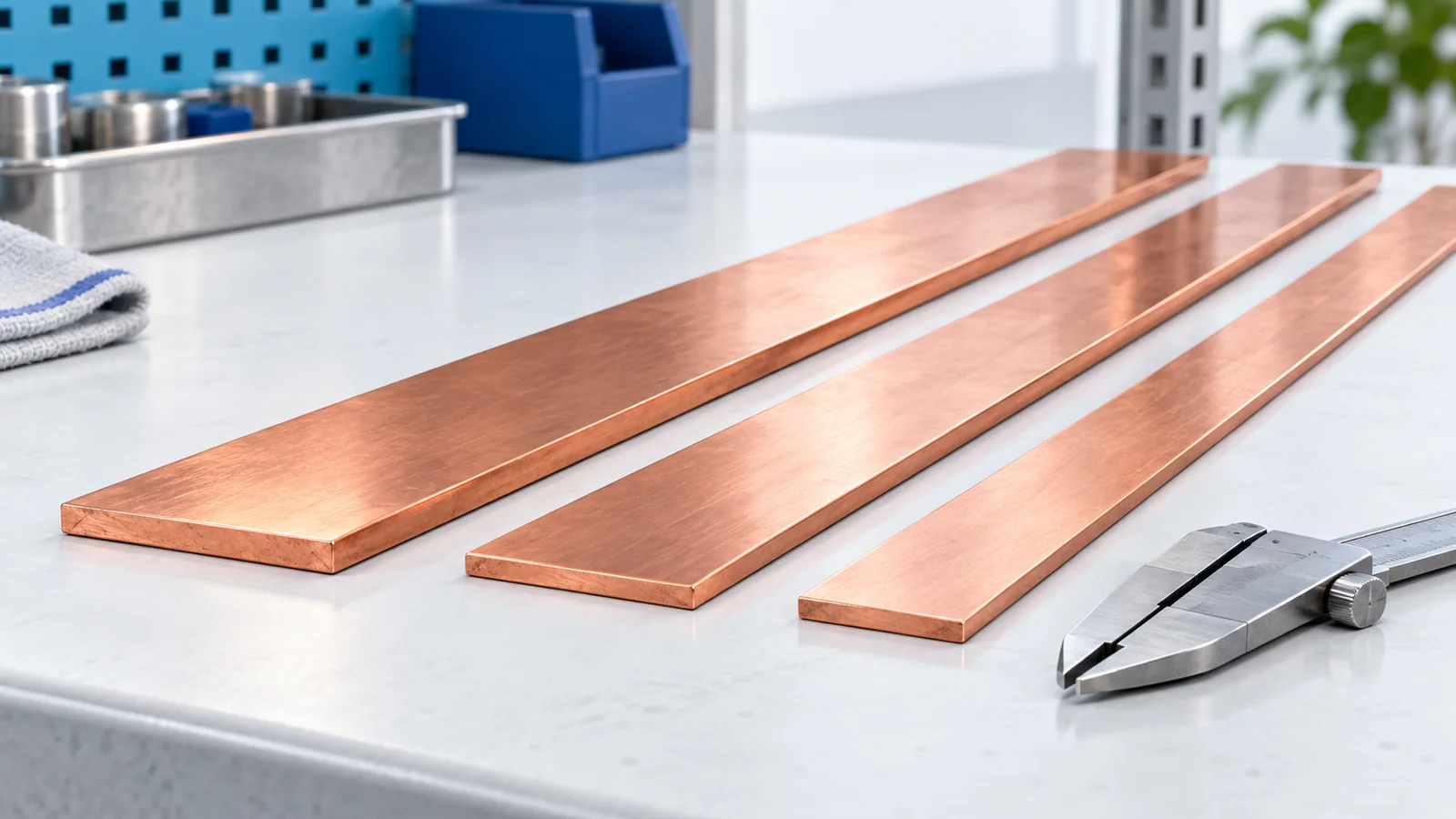
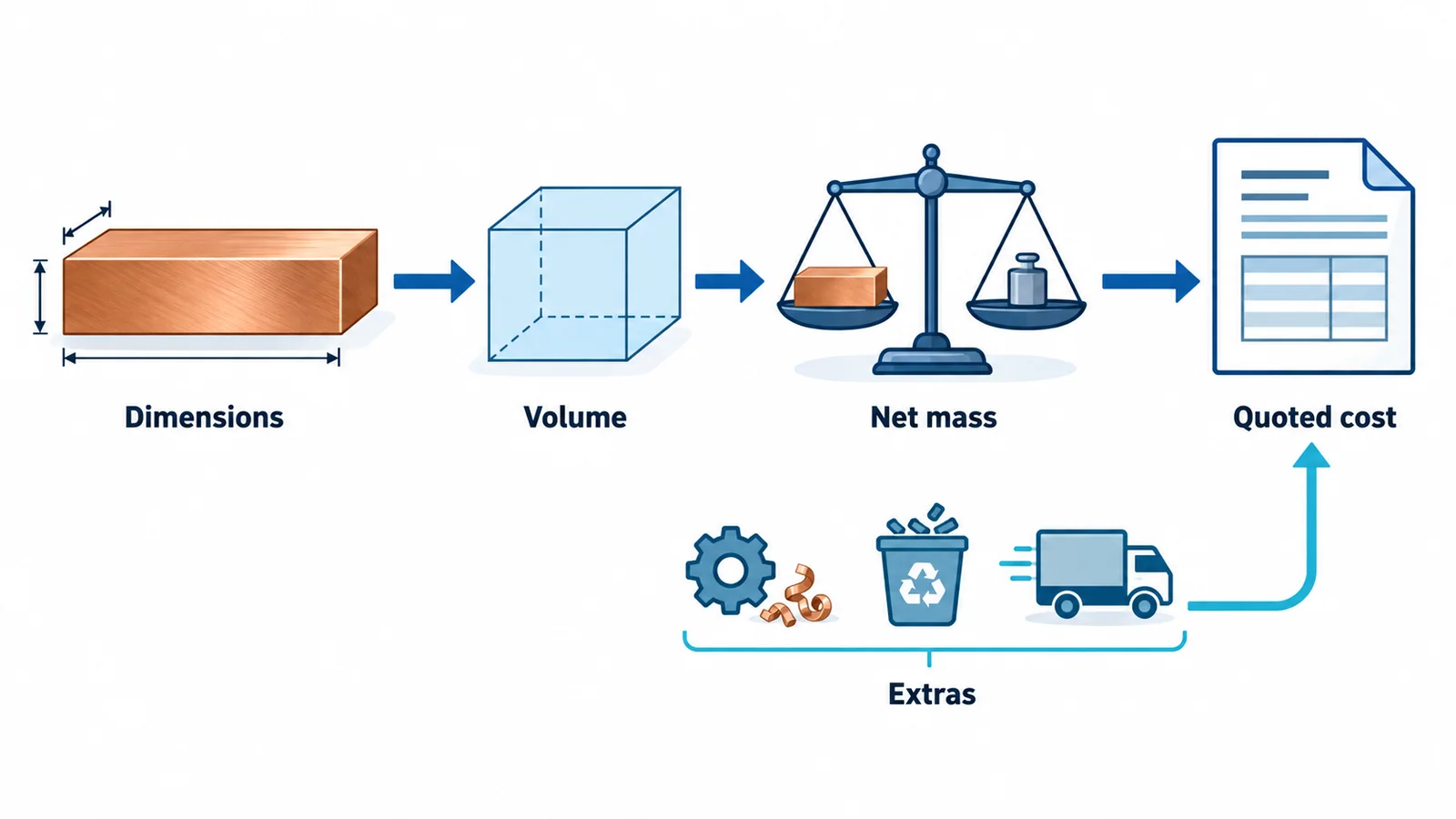
For a straight rectangular copper bar, calculate net mass from width × thickness × length × density, then multiply the billable kilograms by the quoted currency per kilogram. Keep the net metal calculation separate from cutting waste, machining, plating, freight, taxes and commercial margin. A price per kg is a quote input, not an electrical rating or a stable market price.
For pure copper, the NIST material-composition reference lists 8.96 g/cm³, equivalent to 8,960 kg/m³. The actual alloy, hollow or perforated geometry, and supplier’s mass basis can change the result. Use the appropriate material specification and measured or approved dimensions for a purchase estimate.
The metric formula and unit check
For a solid rectangular bar with dimensions in millimetres:
Mass (kg) = width (mm) × thickness (mm) × length (mm) × 0.00000896 kg/mm³
The conversion is explicit: 8.96 g/cm³ = 0.00000896 kg/mm³. An alternative using length in metres is:
Mass (kg) = width (mm) × thickness (mm) × length (m) × 0.00896
The factors are not interchangeable unless the length unit changes with them. Check the result against volume: a larger section or longer bar must weigh more. For a multi-piece order, calculate each geometry separately and sum the masses rather than using one nominal section for the entire schedule.
Worked example: a 40 × 5 mm bar, 2 m long
This is an arithmetic illustration, not a material specification or current-carrying recommendation. Suppose a solid copper bar is 40 mm wide, 5 mm thick, and 2,000 mm long:
- Volume = 40 × 5 × 2,000 = 400,000 mm³, or 400 cm³.
- Net mass = 400 cm³ × 8.96 g/cm³ = 3,584 g = 3.584 kg.
- At an assumed example quote of $10/kg, net-material value = 3.584 × $10 = $35.84.
That $10/kg figure is invented only to demonstrate multiplication; it is not a live copper price or a supplier offer. If a purchaser adds an illustrative 5% cutting allowance to billable mass, the estimate becomes 3.584 × 1.05 = 3.7632 kg, then $37.63 at the same assumed rate, before fabrication and other charges. In a real quote, confirm whether the supplier prices on net part mass, purchased stock mass, or an agreed scrap/yield method; do not add the same allowance twice.
Build a quotation without hiding extras
| Cost line | Basis to ask the supplier to state | Typical omission to avoid |
|---|---|---|
| Copper material | Alloy/grade, net or billable mass, currency/kg and quote date | Treating an old price as current. |
| Cutting and yield | Stock length, cut plan, scrap credit or allowance | Charging for full stock and then adding a second waste factor. |
| Fabrication | Holes, bends, deburring and inspection basis | Assuming shaped parts cost the same as straight bar. |
| Surface treatment | Plating type, area, minimum charge and quality requirement | Multiplying plating cost by copper mass without a stated basis. |
| Logistics and tax | Packaging, freight, duties and tax terms | Presenting material-only cost as delivered cost. |
For a hollow, laminated or machined bar, calculate the actual copper volume or obtain verified mass from the approved design. The formula here estimates mass and cost, not permissible current. Electrical suitability requires a separate thermal and installation assessment; see copper busbar ampacity and derating before using a proposed cross-section in a panel. A comparison with panel busbar versus block-and-cable wiring can help define which materials belong in the cost boundary.