
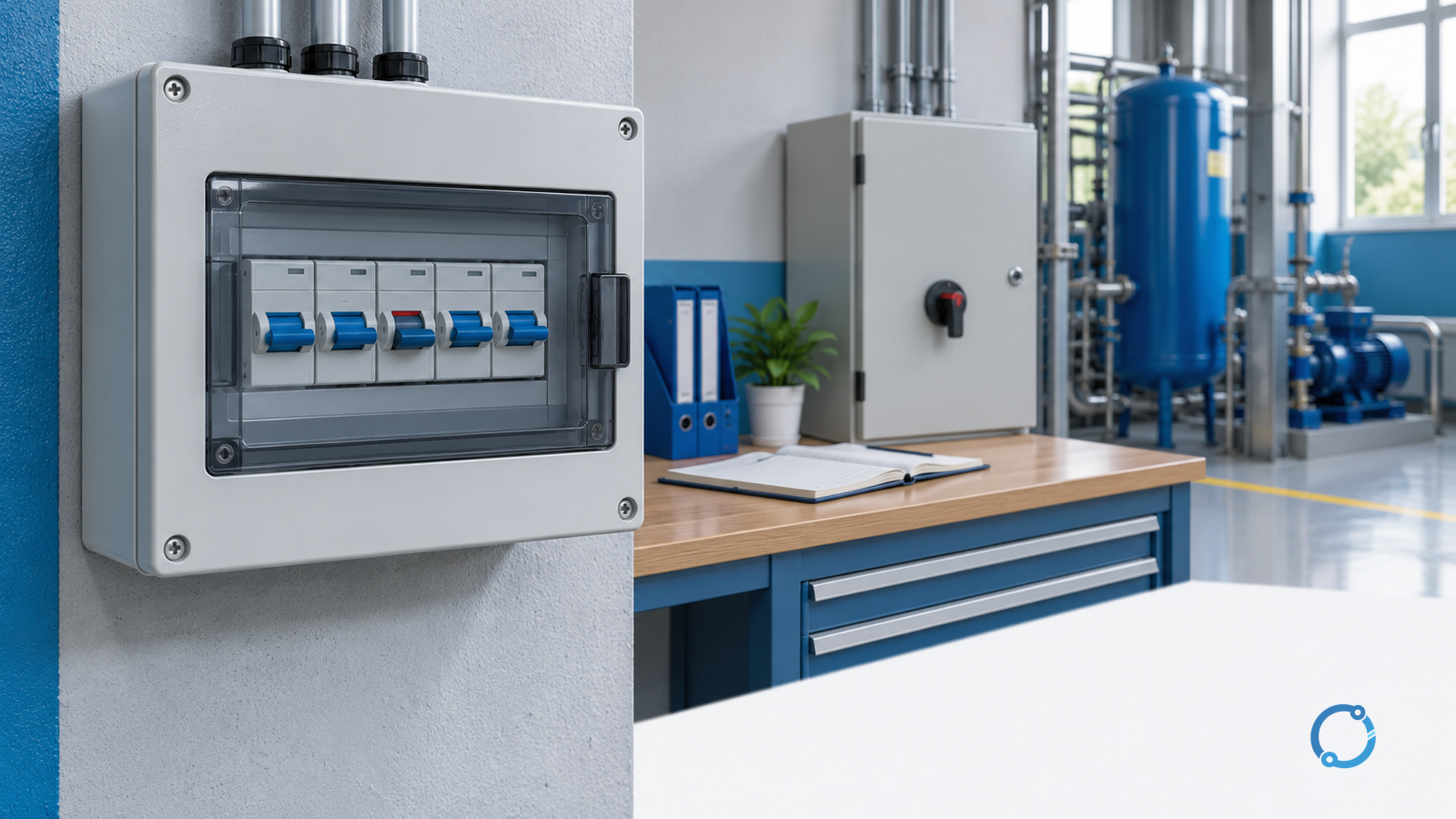
An MCB trip is a protection event, not permission to install a larger breaker. First identify which device operated, when it operated and what changed on the circuit. Use that evidence to separate sustained overload, fault current, starting-current behavior and thermal conditions. Timing is a clue; it is not a diagnosis by itself.
Stop using the affected equipment and escalate if there is smoke, burning odor, damage, abnormal sound or another sign of electrical distress. Do not repeatedly reset a breaker to locate a fault. In applicable U.S. workplaces, OSHA 1910.334(b)(2) requires a safe-energization determination and prohibits repetitive manual reclosing after protective operation. Elsewhere, follow the applicable local rules and site procedure.
Confirm that the operated device is an MCB
An ordinary MCB provides overcurrent protection. An RCBO also includes residual-current protection, while another device in the enclosure may provide a different protective function. Read the accessible device identification and documented trip indication before treating every outage as an overload.
The GFCI and AFCI comparison explains why ground-fault and arc-fault protection are different tasks. Device terminology and product scope vary between markets. A test button or a familiar handle shape cannot alone identify the cause of an operation.
IEC 60898-1:2015+A1:2019 covers AC overcurrent breakers for household and similar installations. Its scope does not make every modular breaker interchangeable, and the public catalog does not provide a universal troubleshooting threshold. Use the exact installed device’s approved characteristics and application data.
Collect evidence without opening the enclosure
An operator can record the circuit identity, visible handle/indicator state, time, connected equipment and what was starting or running. Record whether the trip followed a recent change, occurred after extended operation or coincided with another event. Preserve fault logs from equipment where available.
Do not remove panel covers, touch suspect connections or use tools to force a handle. Testing, internal inspection and repair belong to qualified personnel. A normal external appearance does not establish that the wiring inside is sound.
The investigator should obtain the circuit schedule, conductor design, installed breaker identity and recent modifications. Without those, a recommendation to change current rating or trip characteristic is premature.
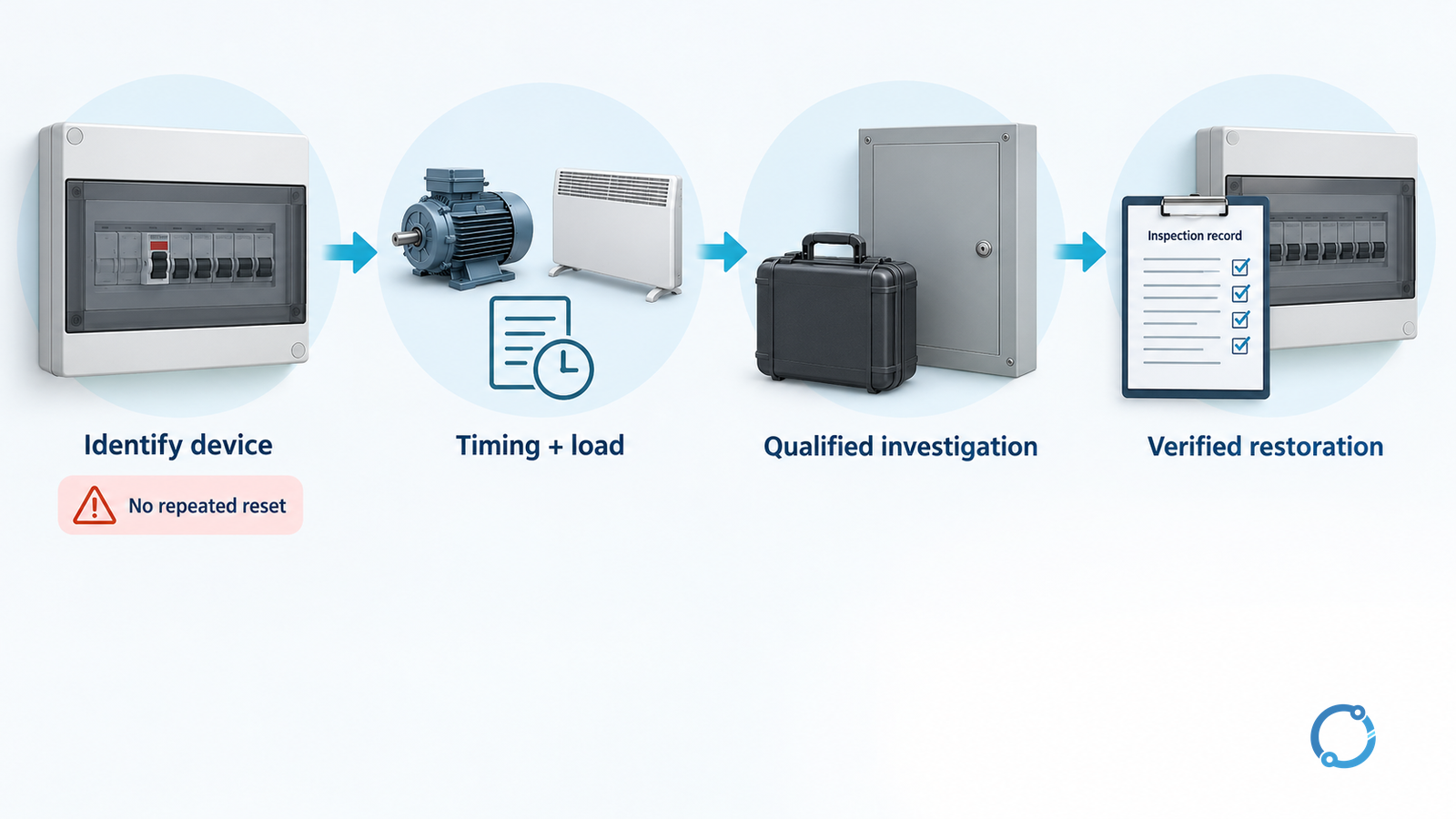
Use timing and load pattern to form hypotheses
This diagnostic matrix narrows the next check. Different causes can produce similar timing, and a dangerous fault may also be intermittent.
| Reported pattern | Plausible explanations | Qualified-person investigation | Do not infer |
|---|---|---|---|
| Trip after several loads have run together | Sustained overload, changed duty or accumulated heating | Actual current/duty against conductor and breaker design, including operating conditions | A larger breaker is the remedy |
| Trip when one item starts | Starting current, failed equipment or a circuit fault | Capture the event and compare with the exact protection behavior and equipment condition | Starting current makes the event harmless |
| Trip as power is restored or equipment is connected | Fault, simultaneous inrush or another protective function | Identify the operated function and isolate the investigation boundary | Another reset is a safe diagnostic test |
| Trip after warm-up, without an obvious load change | Load cycling, local heating, enclosure conditions or device deterioration | Correlate current and thermal evidence with operating state | Low measured current rules out a connection problem |
| Intermittent trip linked to weather or movement | Equipment/cable deterioration or another intermittent condition | Preserve event correlation and inspect/test under an approved safe procedure | The breaker is defective because the cause is not immediately visible |
An overload is not the same as a short circuit or ground fault. OSHA’s electrical definitions make that distinction explicitly. Keep the distinction in the record because the inspection, repair and release decision may differ.
Check load evidence and local heating separately
For a sustained-load hypothesis, use actual demand and duty rather than the sum of nameplates alone. Consider which loads run simultaneously and whether a controller or mechanical condition has changed the equipment’s demand. Compare the resulting duty with both conductor protection and the exact breaker’s permitted application.
For a starting event, a slow average-current reading may miss the relevant transient. A qualified investigator should choose measurement equipment and a safe method appropriate to the event, then compare the result with the installed characteristic. Changing from one curve designation to another can affect fault disconnection and coordination; it is not merely a nuisance-trip adjustment.
Thermal context matters too. Ambient temperature, adjacent equipment and enclosure conditions can affect application, while a deteriorated connection can create local heat. Use the switchgear temperature diagnostic guide to distinguish measured locations and causes. Thermal imaging or energized measurements require their own risk assessment and qualified procedure. They are not instructions for an operator to open a live board.
Repair the cause before changing protection
Possible outcomes include redistributing an excessive load through a designed circuit change, repairing defective equipment, replacing damaged wiring or connections, correcting an approved installation defect, or replacing a verified faulty breaker with a suitable device. The evidence should justify the outcome.
Before any uprating or characteristic change, revisit the circuit-breaker sizing workflow: conductor ampacity, fault duty, disconnection behavior and the assembly application must remain suitable. Removing protection, bypassing it or substituting a stronger device to keep a damaged circuit energized is not a repair.
Any internal work requires the applicable isolation procedure, control of all sources and stored energy, and verification of the safe state. Do not treat the tripped handle as proof of isolation. Connected equipment and alternate supplies may require a wider boundary.
Set restoration conditions, not a reset habit
OSHA’s 2001 interpretation clarifies a limited verified-overload situation under U.S. workplace rules. It does not give blanket permission to reset an unexplained trip or repeatedly reclose a circuit. A second operation after restoration needs renewed investigation, not an assumption that the first explanation still applies.
The qualified person should record the identified cause, corrective action, inspection/test results, approved device details and conditions for restoration. If the cause remains unknown, retain the hold and investigation plan. After restoration, monitor the original operating condition through an approved method and confirm that protection remains effective.
A completed diagnosis explains what caused the trip and why the circuit can safely return to its intended duty. “It stayed on after resetting” does not supply that evidence.