

A ground-fault circuit interrupter (GFCI) and an arc-fault circuit interrupter (AFCI) respond to different hazards. A GFCI compares current leaving and returning on the intended circuit conductors and opens the circuit when the difference indicates an unintended path, potentially through a person. An AFCI analyzes current characteristics associated with hazardous arcing and opens the circuit to reduce the risk of electrical fire.
Neither device is a general replacement for the other, and neither replaces ordinary overcurrent protection, proper grounding and bonding, sound wiring or safe work practices. Where both protections are required, a listed dual-function device or another code-compliant combination may provide both functions.
The shortest useful comparison
| Question | GFCI | AFCI |
|---|---|---|
| Primary hazard | Electric shock from unintended current to ground | Fire ignition from certain arcing faults |
| Basic signal | Difference between outgoing and returning current | Current waveform and patterns associated with arcing |
| Typical product forms | Receptacle, circuit breaker, portable device | Circuit breaker and other evaluated AFCI types |
| Does it replace overcurrent protection? | No, unless integrated into a listed breaker that also provides it | No, unless integrated into a listed breaker that also provides it |
| Does it require an equipment ground to sense imbalance? | The sensing principle compares circuit-conductor current; installation and permitted use still follow the code and listing | AFCI operation is based on evaluated arc-detection behavior; grounding still remains part of the wiring system |
| Does it detect every fault? | No | No |
| Can both functions be required? | Yes | Yes |
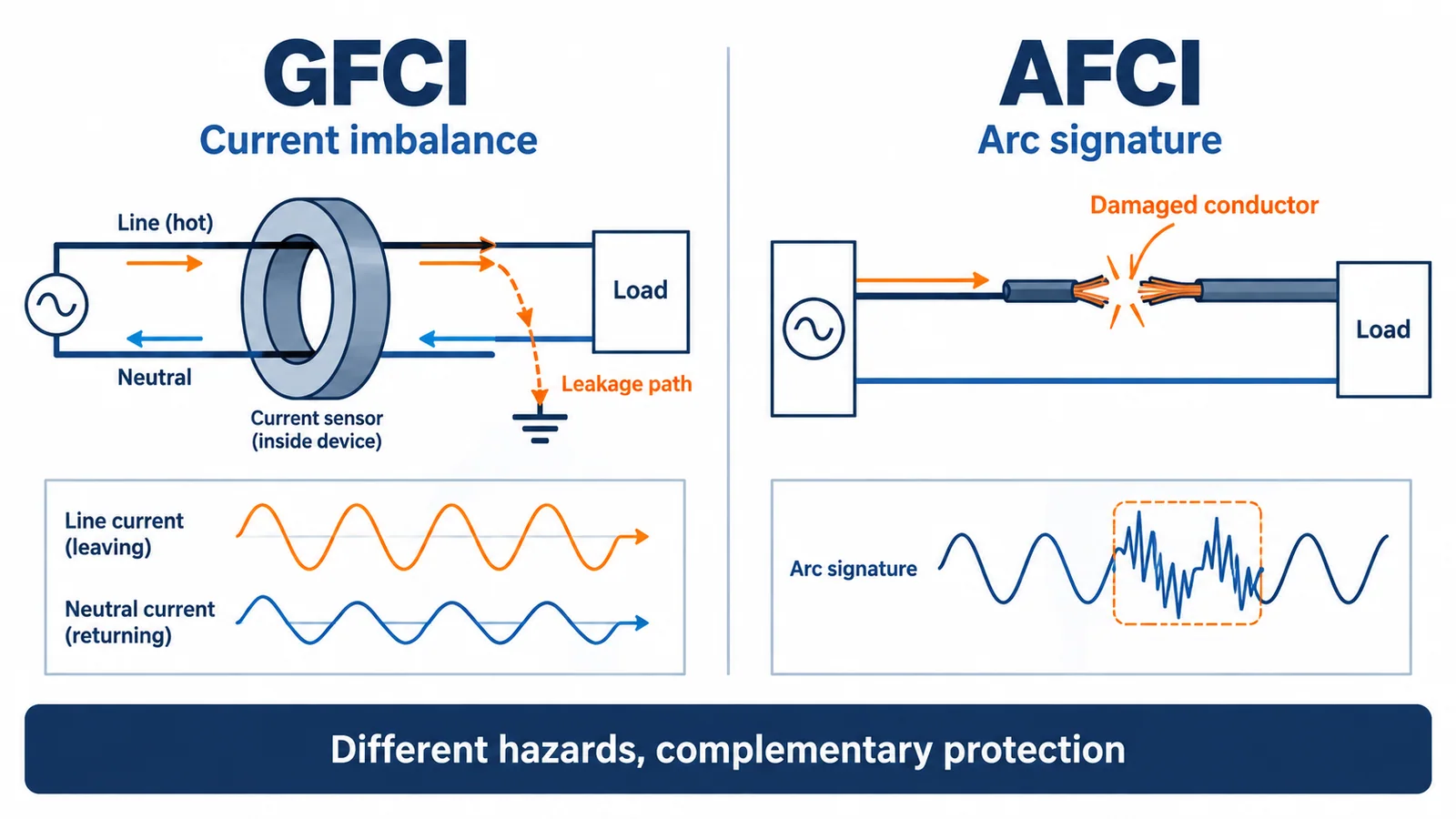
How a GFCI works
In a healthy single-phase load, current flowing out on the ungrounded conductor returns on the grounded circuit conductor. A GFCI senses the difference between those currents. If some current takes another path—through an equipment enclosure, moisture, earth or a person—the device can disconnect the circuit rapidly when the imbalance reaches its evaluated operating condition.
OSHA’s GFCI guidance describes this comparison of outgoing and returning current and presents GFCI protection as a means of reducing ground-fault shock risk. UL’s GFCI certification page identifies UL 943 as the principal U.S. product standard for Class A GFCIs and covers forms including receptacle, portable and circuit-breaker GFCIs.
A GFCI can operate without waiting for the branch-circuit breaker to see a conventional short circuit or overload. That matters because current hazardous to a person may be far below the level that trips ordinary overcurrent protection.
What a GFCI does not do
A GFCI does not guarantee protection when current leaves and returns through the intended conductors in equal amounts. It is not designed to replace:
- branch-circuit overload and short-circuit protection;
- equipment grounding and bonding where required;
- isolation and lockout/tagout;
- correct conductor sizing and wiring methods;
- AFCI protection where arc-fault protection is required;
- ground-fault protection of equipment, residual-current monitoring or other devices with different thresholds and purposes.
Product terms matter. Class A GFCI, special-purpose GFCI, equipment leakage circuit interrupter and ground-fault protection of equipment are not interchangeable labels.
How an AFCI works
An arc fault can occur when damaged insulation, a loose connection, a broken conductor or deteriorated cord creates intermittent current through an unintended gap or high-resistance path. Some arcing is normal—switch contacts and brushed motors can produce electrical noise—so an AFCI cannot trip on every high-frequency disturbance. It uses evaluated detection logic to distinguish specified hazardous arc signatures from normal load behavior.
UL’s AFCI certification page describes an AFCI as a device that reduces the effects of arcing faults by de-energizing the circuit when an arc fault is detected and identifies UL 1699 as the U.S. AFCI product standard.
Series and parallel arcing
- Series arcing occurs in series with the load, such as across a broken conductor or loose connection. Current may remain below the branch breaker’s normal overload threshold.
- Parallel arcing occurs between conductors at different potentials, such as line-to-neutral or line-to-ground. Fault current depends on impedance and may not behave like a bolted short circuit.
The exact arc conditions and protection coverage depend on the AFCI type, product evaluation, circuit arrangement and installation.
What an AFCI does not do
An AFCI is not a universal fire detector and does not prove that wiring is undamaged. It cannot replace:
- correct terminations and enclosure installation;
- overcurrent protection;
- GFCI protection where personnel ground-fault protection is required;
- inspection after overheating, water exposure, physical damage or repeated tripping;
- smoke alarms and building fire-protection measures.
Circuit breaker, receptacle and dual-function devices
GFCI receptacle
A receptacle-type GFCI can protect its own outlets and, when correctly wired and permitted, downstream outlets connected to its load terminals. Line and load connections must follow the device instructions. The test and reset controls should remain accessible.
GFCI circuit breaker
A GFCI breaker provides ground-fault protection for the connected branch circuit and also performs the breaker functions for which it is listed. Correct neutral routing is essential on circuits that use a neutral.
AFCI circuit breaker
An AFCI breaker monitors the branch circuit from the panel. The protection provided depends on the AFCI type, wiring method and applicable code option. Do not assume that any arc-detecting plug-in product is equivalent to a listed branch-circuit AFCI.
Dual-function AFCI/GFCI breaker
A listed dual-function device combines personnel ground-fault and arc-fault protection. “Dual function” is different from a two-pole breaker, a combination-type AFCI, or a breaker with equipment ground-fault protection. Read the exact markings and certification category.
Code requirements depend on edition and jurisdiction
The National Electrical Code (NEC) is a model code. A state, city or other authority may adopt a particular edition with amendments, delayed effective dates or exceptions. The current edition alone does not prove what is legally required at a specific site.
UL reports that the 2026 NEC was issued in August 2025 and became effective in September 2025. That edition added or revised GFCI-related concepts, including special-purpose and high-frequency-rated applications. Designers and installers still need to identify the edition adopted by the authority having jurisdiction, the occupancy, circuit rating, outlet or equipment type and product listing.
A durable selection question is therefore not simply “Is this a kitchen or bedroom?” It is:
- Which NEC or other code edition is adopted here?
- Does the rule apply to this occupancy, location, outlet, circuit or connected equipment?
- Is GFCI, AFCI or both required?
- Which device type and installation method satisfy the adopted text and product listing?
- Are local amendments, exceptions or manufacturer instructions relevant?
Why devices trip
Tripping is a protective signal, not proof that the device is defective.
| Trip pattern | Possible causes | Safe next step |
|---|---|---|
| GFCI trips when one appliance is connected | Appliance leakage, damaged cord, moisture or an internal fault | Unplug and isolate the appliance; have it evaluated before reuse |
| GFCI trips with several loads | Combined normal leakage, wiring leakage, moisture or neutral/ground fault downstream | Disconnect loads methodically with the circuit de-energized for inspection; use qualified diagnosis |
| AFCI trips during a specific load operation | Damaged cord, loose connection, failing switch, arcing appliance or compatibility issue | Stop using the suspect load and inspect the circuit; do not bypass protection |
| AFCI trips randomly | Intermittent wiring fault, shared/incorrect neutral, damaged cable or load-generated signature | Record timing and loads, then have a qualified person test the installation |
| Dual-function breaker indicates a trip type | Ground-fault, arc-fault or overcurrent condition depending on device indication | Follow the exact device diagnostic instructions and investigate the reported category |
| Device will not reset | Fault remains, no supply, incorrect wiring, failed self-test or end-of-life condition | Remove loads, verify circuit condition and replace only after qualified assessment |
Repeated resetting without finding the cause can re-energize a damaged circuit. Never replace a GFCI or AFCI with an ordinary device merely to stop nuisance trips.
Testing and maintenance boundaries
Use the built-in TEST control at the interval and in the manner specified by the device manufacturer and applicable rules. A successful button test verifies defined internal functions; it does not inspect every downstream conductor, prove equipment grounding, or rule out all defects.
The U.S. Consumer Product Safety Commission’s GFCI safety information recommends regular testing of GFCI protection. Devices that fail to trip or reset as designed should be removed from service and evaluated or replaced by a qualified person.
For diagnostic work:
- identify whether the device is GFCI, AFCI, dual-function or another protection class;
- record the exact trip indication before resetting;
- list connected loads and recent changes;
- check for moisture, damaged cords, overheated outlets and loose or altered wiring with the circuit safely de-energized;
- verify neutral routing, shared-neutral arrangements and line/load connections against the approved design;
- use test instruments and procedures appropriate to the suspected fault;
- confirm the replacement device has the correct listing, rating, poles and functions.
Common misconceptions
“A GFCI needs an equipment ground to work”
The sensing principle compares current in the intended circuit conductors. However, permitted installation on an ungrounded circuit, labeling, downstream protection and equipment grounding requirements are code- and application-specific. GFCI protection does not create an equipment-grounding conductor.
“An AFCI is just a more sensitive breaker”
An AFCI evaluates arc-related current characteristics in addition to any breaker functions in the listed assembly. It is not simply an ordinary breaker with a lower current threshold.
“Combination AFCI means AFCI plus GFCI”
No. “Combination-type AFCI” refers to an AFCI protection classification. A device providing both AFCI and GFCI functions is commonly marked as dual function.
“If it trips, increase the breaker size”
Changing the rating without redesign and code review can remove conductor protection and leave the underlying fault. The cause must be identified first.
Bottom line
Choose the device by the hazard and the adopted requirement. GFCI protection responds to unintended current leaving the normal circuit path and is primarily intended to reduce shock risk. AFCI protection responds to specified arcing characteristics and is primarily intended to reduce fire risk. Where both are required, use an evaluated combination and install it exactly as permitted. A trip is a reason to diagnose the circuit—not a reason to defeat the protection.