
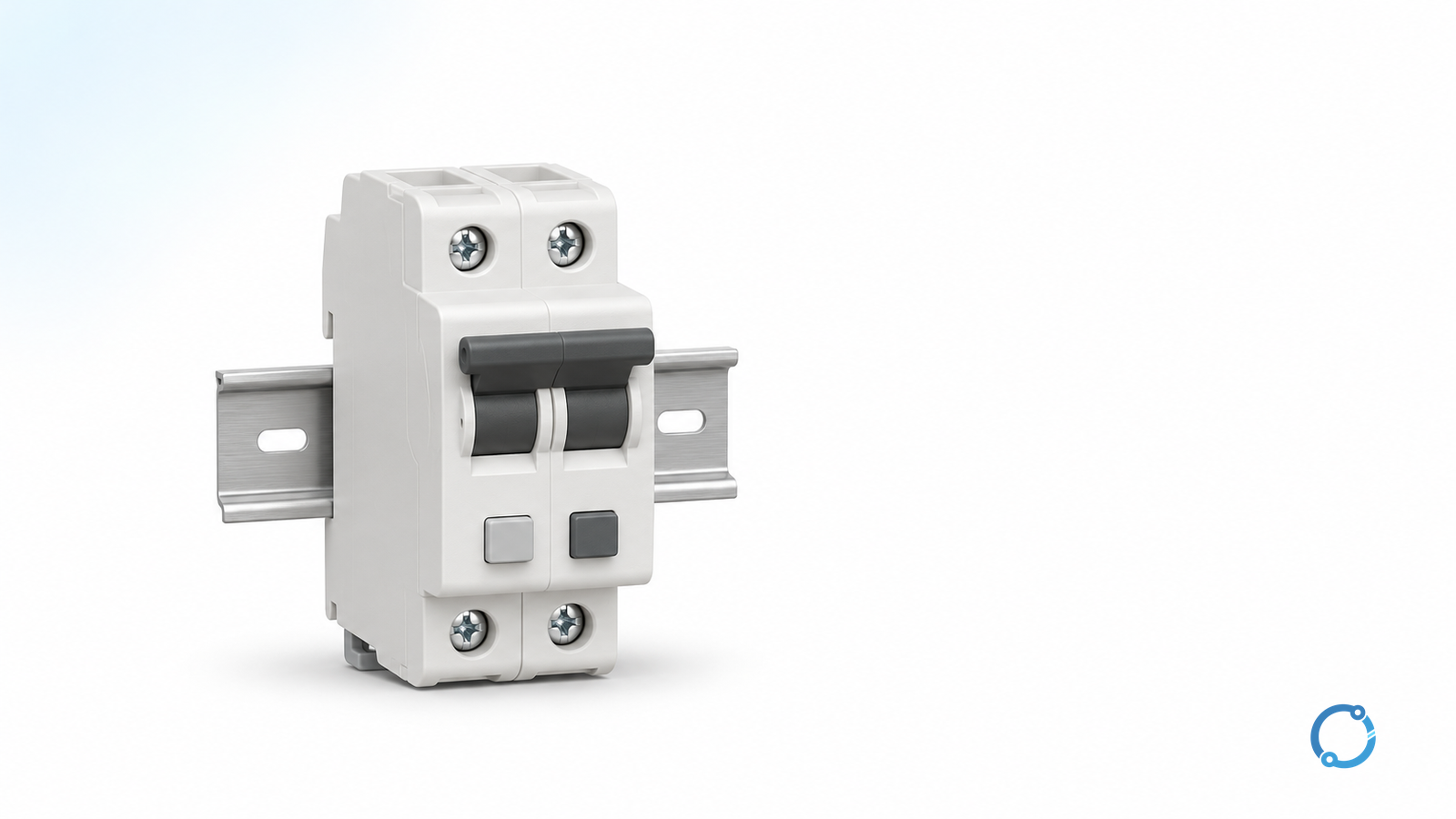
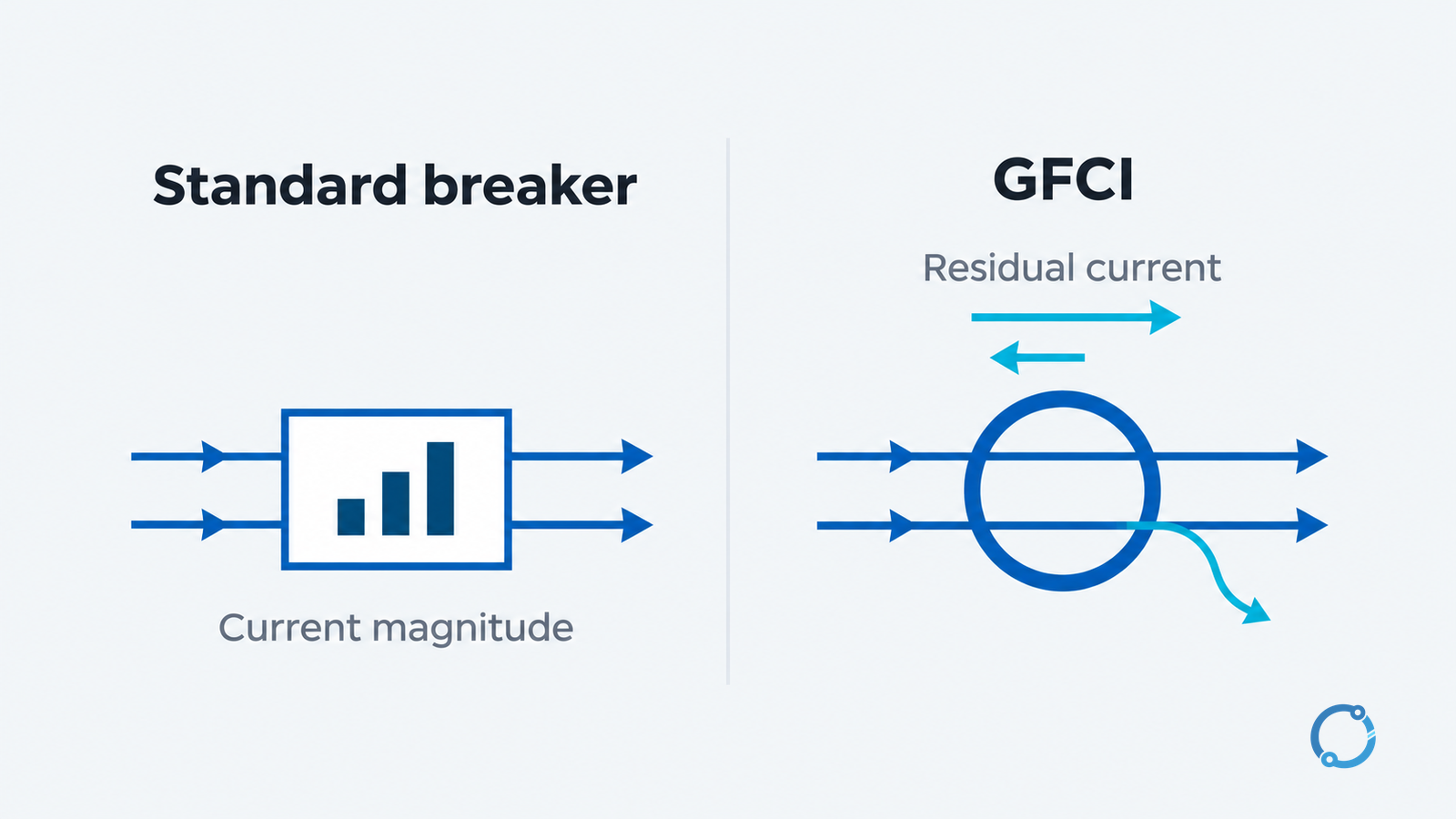
A standard circuit breaker responds to excessive current through the conductors it protects. A ground-fault circuit interrupter (GFCI) responds to a difference between the current leaving the circuit and the current returning through it. Those are different measurements of different physical evidence. A GFCI is not a small circuit breaker, and a standard breaker does not automatically provide residual-current protection.
The distinction matters because a ground fault can produce very different current levels. A solid fault from a live conductor to a grounded enclosure may create enough current to trip a conventional overcurrent device quickly. A lower-level fault through moisture, contamination, damaged insulation, or a person may not exceed the breaker’s magnetic or thermal threshold, yet it can still create a dangerous condition. The GFCI is designed to detect the current imbalance associated with that second kind of event.
This article compares the two response paths, explains why the functions are usually complementary, and identifies the point where a qualified person must stop and verify the installation against the product instructions and locally adopted code.
The short answer: magnitude versus balance
A conventional overcurrent protective device evaluates current magnitude and time. Its characteristic describes when the current is high enough, and present long enough, to cause a trip. The device may use thermal, magnetic, electronic, or hybrid sensing, but its core question is whether the protected circuit is carrying more current than the device is designed to tolerate.
A GFCI evaluates current balance. It monitors the outgoing and returning current in the circuit conductors it is designed to protect. In a healthy two-wire circuit, the current in the live conductor and the current in the neutral conductor should be effectively equal and opposite. If some current leaves the intended circuit and returns through another path, the two measurements no longer balance. That difference is commonly called residual current.
The difference can exist because current is flowing through:
- a person who contacts a live part and a grounded surface;
- wet or contaminated insulation;
- a damaged appliance or tool;
- a faulty connection to a grounded enclosure; or
- another unintended path around the normal circuit.
The GFCI does not need to know the exact location of that path to recognize the imbalance. It also does not decide whether the current is flowing through a person, water, or a conductive surface. It responds to the residual-current evidence produced by the circuit.
Why a standard breaker may not respond to a ground fault
The phrase “ground fault” describes the fault path, not a guaranteed current level. If a live conductor contacts a grounded metal enclosure, the current depends on the source voltage, the impedance of the fault path, the impedance of the equipment grounding conductor, the supply impedance, and the condition of the connections.
A low-impedance fault can produce a large current. In a grounded system, the equipment grounding conductor provides a return path that is intended to help the overcurrent device clear a high-current fault. That is one reason the equipment grounding conductor is an essential part of the installation. It gives fault current a predictable path and supports the operation of overcurrent protection.
A high-impedance fault is different. Corrosion, loose connections, contaminated surfaces, damaged insulation, or a path through a person can limit the current below the instantaneous trip range. The current may still be enough to create a shock or fire hazard, but it may not be enough to operate the breaker within the expected time.
This is why the presence of a standard breaker is not evidence that every ground fault will be detected quickly. The breaker is doing the job it was designed to do when it responds to overcurrent. It is not continuously comparing outgoing and returning current.
The OHELE guide to overcurrent protection choices explains how overcurrent devices are selected around current magnitude, time, and equipment protection. That is a separate question from residual-current detection.
How the GFCI’s sensing circuit works
A GFCI uses a sensing arrangement around the circuit conductors. When the outgoing and returning currents are equal, their magnetic effects cancel in the sensing element. When current returns by another path, the cancellation is incomplete and the sensor produces a signal. The GFCI’s internal circuit evaluates that signal and operates the interrupting mechanism when its design criterion is met.
The exact construction, threshold, trip time, reset behavior, and acceptable circuit arrangement are product- and standard-specific. A practical article should not replace those details with a generic number. The important principle is that the GFCI is looking for an imbalance, not waiting for the circuit current to rise to the level of a conventional breaker trip.
That also explains why a GFCI may trip when equipment has a small leakage path that is not a bolted short circuit. The device is responding to current outside the intended return path. The cause may be a failing component, moisture, contamination, damaged cordage, or an installation error. Repeated resetting without finding the cause is not a diagnosis.
UL 943 is the UL standard page for ground-fault circuit-interrupters. It identifies the product-standard route for this equipment, but the page is not a field test procedure and does not establish that any particular installation is compliant. Product listing, installation instructions, and the locally adopted electrical code remain separate checks. See the official UL 943 standard listing for identity and scope. NFPA 70, the U.S. National Electrical Code, is an example of a code framework whose adopted edition and local amendments must be checked through the NFPA 70 overview.
GFCI and overcurrent protection are complementary
The simplest way to compare the functions is to ask what each device can and cannot prove.
| Question | Standard breaker | GFCI |
|---|---|---|
| Is the circuit current above the device’s overcurrent characteristic? | Yes, this is its primary function. | Not necessarily; residual-current sensing is different. |
| Is outgoing current equal to returning current? | Not its normal measurement. | Yes, this is the defining measurement. |
| Can it clear a high-current short circuit? | It is selected and rated for overcurrent interruption. | It should not be treated as a substitute for branch or feeder overcurrent protection. |
| Does it replace the equipment grounding conductor? | No. | No. The grounding conductor remains part of the installation design. |
| Does one device make the other unnecessary? | No. | No. The functions address different fault evidence. |
A GFCI is commonly described as providing protection against shock and electrocution from ground faults, but that does not mean it protects against every electrical hazard. It does not replace insulation, enclosures, guarding, lockout procedures, equipment grounding, or overcurrent protection. It also does not protect a person who contacts two live conductors of the same circuit in a way that does not create a residual-current imbalance. That limitation is one reason the phrase “GFCI protection” should not be turned into a claim of complete safety.
For a broader distinction between ground-fault and arc-fault protection, see the OHELE comparison of GFCI and AFCI functions. For devices that respond to residual current in other regions and circuit arrangements, see the guide to RCD types and selection. The terminology changes across markets, but the central question remains: what quantity is the device measuring?
Two fault scenarios
Consider a grounded metal enclosure with a live conductor touching it through a low-impedance fault. The fault current travels through the enclosure and the equipment grounding conductor back to the source. If the current is high enough and lasts long enough, the standard breaker or fuse should operate according to its characteristic. A GFCI may also see an imbalance if some current returns outside the monitored conductors, but the overcurrent device is the primary equipment-protection function for the high-current fault.
Now consider a damaged appliance with a wet internal path to a grounded surface. The current may be limited by the wet path and may not reach the breaker’s instantaneous trip range. The current still leaves the intended circuit and returns elsewhere. A GFCI can detect the imbalance and interrupt the circuit. The standard breaker may remain closed because the current magnitude is within its normal carrying range.
Neither scenario supports a universal rule about which device will trip first. The outcome depends on the fault impedance, the source and grounding path, the device characteristics, the circuit design, and the duration of the event. The useful conclusion is narrower: the devices are looking for different evidence and should be selected as parts of one protection strategy.
What to verify before testing or resetting
A GFCI that trips repeatedly is providing information. It may be responding to a real leakage path, a wiring error, a damaged load, moisture, or a device problem. Clearing the handle without investigating the cause can restore power to a fault. The same caution applies to a standard breaker that trips repeatedly.
Verification should begin with a planned safe condition. A qualified person should identify the circuit, isolate it under the site procedure, verify the absence of voltage with an appropriate tester, inspect for damage or moisture, and follow the manufacturer’s instructions for the device. Test buttons and external testers check specific functions; they do not replace a complete installation inspection or prove that every fault path has been removed.
The OHELE guide to protective-device ratings is useful when the question moves from operating principle to current rating, breaking capacity, trip basis, and compatibility. The circuit-breaker sizing guide covers the separate overcurrent-selection calculation. Neither calculation should be used to infer that a GFCI can be omitted or that a standard breaker provides residual-current protection.
A practical decision rule
Use the following sequence when reviewing a circuit:
- Identify the intended protective functions. Is the circuit required to have overcurrent protection, residual-current protection, arc-fault protection, or a combination?
- Read the device marking and instructions. Confirm what the device is designed to measure and interrupt.
- Trace the intended current paths. Verify the live, neutral, equipment grounding, and enclosure connections against the approved drawing.
- Check the installation conditions. Moisture, contamination, damaged insulation, and loose terminations can change the fault path.
- Use the locally adopted code and product standard for acceptance criteria. Do not substitute a generic article for the applicable edition.
- Investigate every repeat trip before restoring power.
The first two steps prevent a common category error: assuming that a device with a test button, a reset handle, or a breaker-like shape performs every protection function. The last two steps prevent the opposite error: treating a wiring principle as a complete compliance determination.
The bottom line
A standard breaker asks whether current is too high for too long. A GFCI asks whether the current returning through the circuit is different from the current leaving it. The first is an overcurrent function; the second is a residual-current function. A grounded system may need both, and the equipment grounding conductor remains part of the fault-current design.
The correct comparison is not “which device is better?” It is “which fault evidence must be detected, and which device is designed to detect it?” Answer that question from the product instructions, the approved circuit design, and the locally adopted code. Then test and maintain the installation as a system rather than treating a reset handle as proof that the circuit is safe.