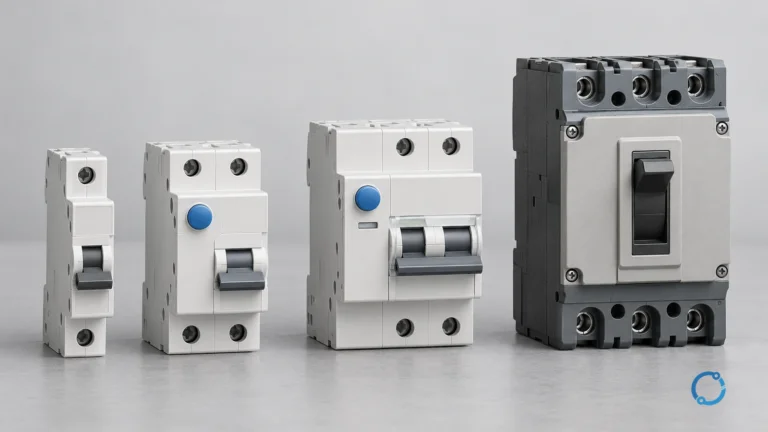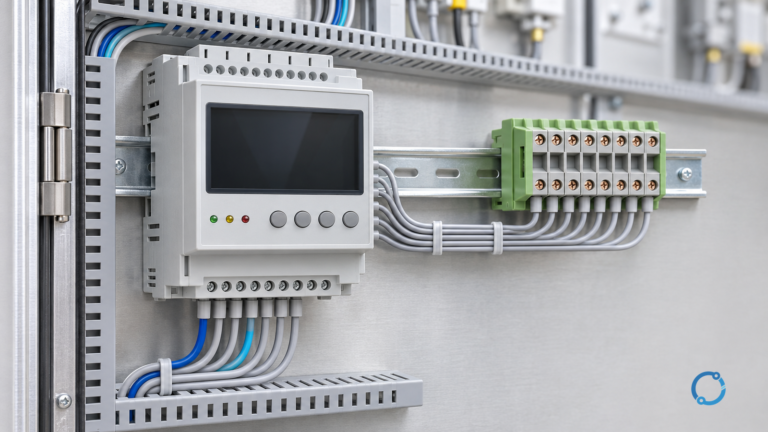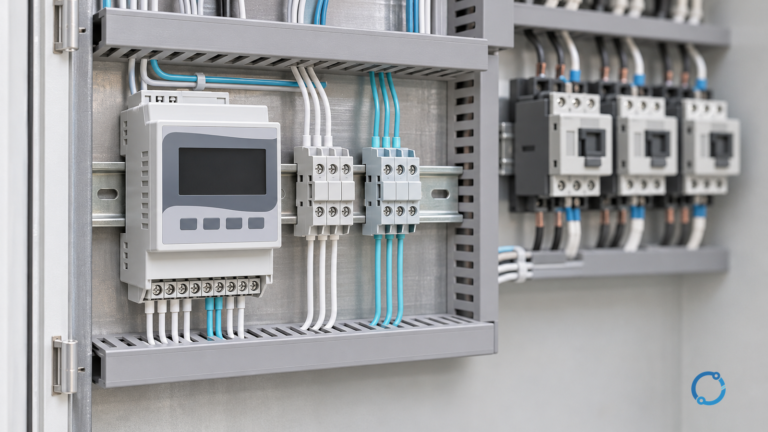

Both a correctly selected miniature circuit breaker (MCB) and a correctly selected fuse system can protect a low-voltage circuit against overcurrent. Choose between them only after checking the same voltage, expected load, prospective fault current, conductor protection, time-current behavior, selectivity, environmental conditions and service practice. A resettable handle favors some maintenance workflows; a current-limiting fuse favors some high-fault and coordination designs. Neither advantage overrides a failed rating or an unverified system combination.
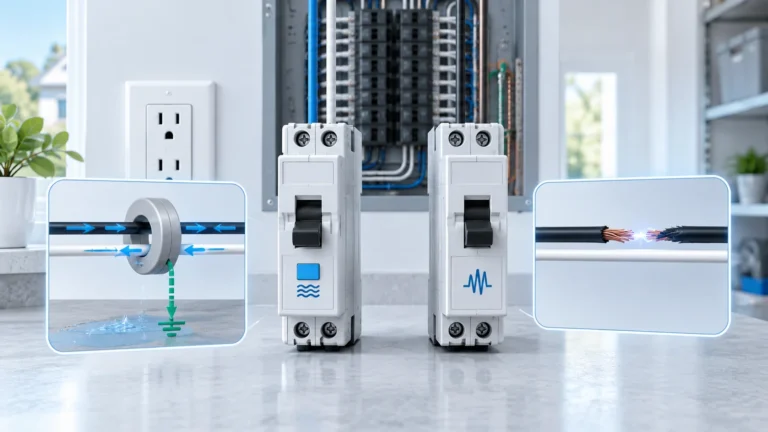
This comparison focuses on MCBs and low-voltage installation or industrial fuse systems. It does not treat residual-current devices as substitutes for overcurrent protection. The GFCI versus AFCI guide covers distinct shock and arc-fault functions.
Keep the product-standard scopes separate
An MCB used in household and similar AC installations may fall under IEC 60898-1:2015 with Amendment 1:2019. A circuit breaker for skilled-person industrial applications may instead be selected under IEC 60947-2:2024. These standards do not describe identical products or interchangeable ratings.
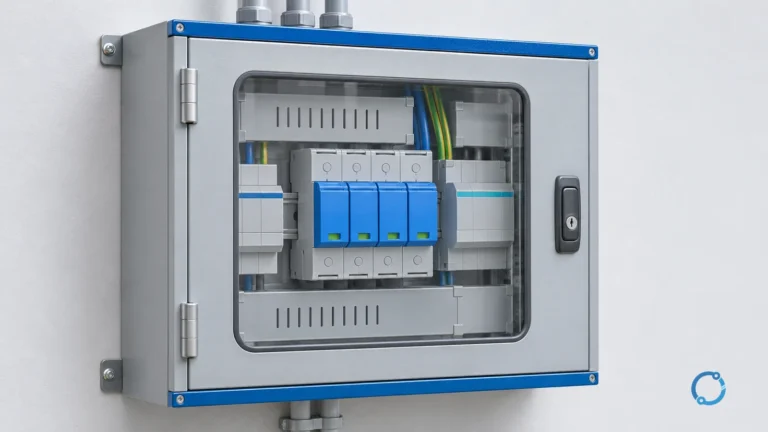
IEC 60269-1:2024 sets general requirements for specified enclosed current-limiting low-voltage fuse-links; the relevant supplementary part covers the intended application. A miniature electronics fuse is another category and should not be substituted for an installation fuse. Check the complete fuse system, including the holder or base, not only the cartridge label.
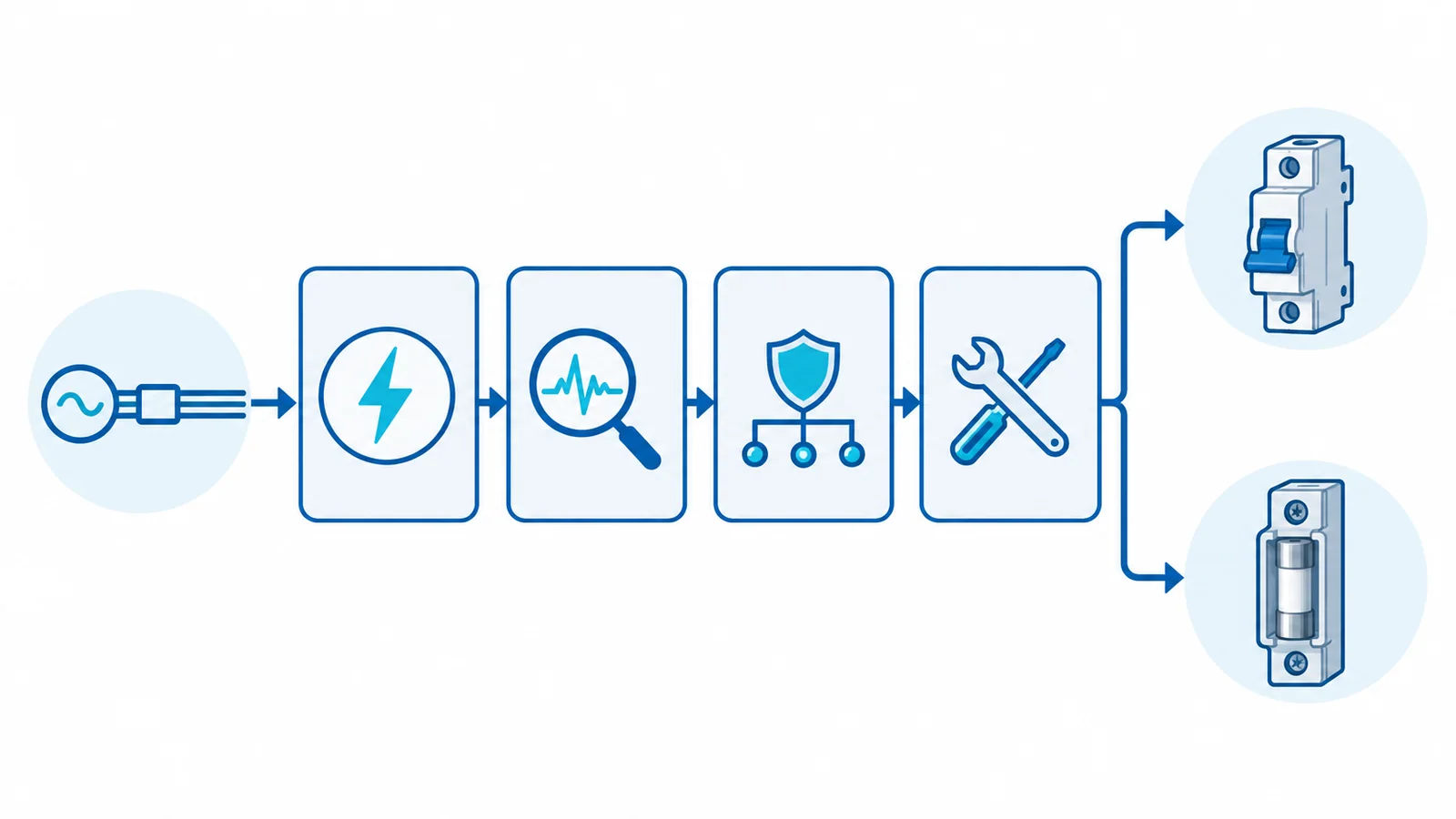
Compare them on equal criteria
| Criterion | MCB | Fuse system | Decision question |
|---|---|---|---|
| Normal operation | Reset or switch according to its design | Replace a operated link | Who is authorized to restore service? |
| Fault interruption | Limited by marked breaking capacity and application | Limited by link and holder system ratings | Is the actual fault level within the complete system rating? |
| Time-current behavior | Depends on device curve and setting/class | Depends on link utilization category and curve | Does it protect the conductor and coordinate upstream/downstream? |
| Current limitation | Product- and fault-condition-dependent | Often a design strength of current-limiting links | Is energy let-through acceptable for equipment and conductors? |
| Repeated faults | May reset after investigation if suitable | Requires a correctly rated replacement link | Will the root cause be found before restoration? |
| Maintenance | Mechanism and contacts remain in service | New link after operation; holder remains | What inspection, spare parts and isolation are required? |
| Human error | Wrong replacement device or repeated reset can be a risk | Wrong link type or rating can be a risk | Can the maintenance system prevent substitutions? |
No row establishes a universal winner. Product curves, rated voltage, prospective fault, upstream devices and conductor conditions determine the answer.
First screen out breaking-capacity failures
Obtain the prospective short-circuit current at the installation point from a defensible study. Compare it with the device’s rated breaking capacity at the actual operating voltage and conditions. For an MCB, do not treat its nominal current (for example, a 16 A handle marking) as a short-circuit rating. For a fuse, do not treat a high link breaking capacity as proof that the holder, disconnecting arrangement or assembly is acceptable.
As a screening example, if a study reports 8 kA at a distribution point and a candidate device’s documented breaking capacity at the relevant voltage is 6 kA, that device fails the basic screen. A different device with a higher published number is not automatically approved: check installation category, coordination, panel short-circuit rating, and any conditions in the complete documentation. The 8 and 6 kA values are hypothetical inputs to illustrate the comparison, not OHELE measurements or a design recommendation.
In U.S. general-industry installations, OSHA 1910.303(b)(4) and (5) address sufficient interrupting rating and coordination of protection with circuit characteristics. The locally adopted electrical code and approved design remain controlling.
Then compare conductor protection and selectivity
The protective device must clear faults and overloads as required for the connected conductor and equipment. The source impedance, cable length, load starting behavior, ambient temperature, grouping and downstream equipment can change the effective result. The breaker-feeder cable sizing guide details the conductor side of this decision.
Plot or compare the actual manufacturer’s time-current data for the proposed MCB or fuse link against the upstream and downstream devices. Check both overload and short-circuit regions, including tolerances. Two devices with the same nominal current can have very different behavior. A quick label comparison cannot establish selectivity, and an MCB curve letter is not a universal substitute for an engineered coordination study.
For a motor or transformer inrush application, avoid automatically choosing a larger protective device merely to stop nuisance operation. Determine the expected inrush, the device’s permitted behavior, conductor protection and equipment instructions. A fuse of the wrong utilization category or an MCB with an unsuitable curve can both be poor choices.
Operation and maintenance change the choice
An MCB can be convenient when an authorized person must restore service after a cleared, investigated event and the device remains suitable for continued use. A reset should not replace diagnosis. Repeated trips can indicate an overload, fault or damaged equipment. An MCB also is not automatically a permitted switching device for every load; the breaker-versus-contactor guide separates protection from routine switching duty.
A fuse system may fit where a current-limiting characteristic, high fault duty, compact protection scheme or established coordination is valuable. Restoration requires the correct replacement link and a method to isolate the holder safely. Stocking only a cartridge with matching physical dimensions is insufficient; check voltage, current, utilization category, breaking capacity and manufacturer/system instructions.
Both options require inspection after a significant fault. A fuse replacement or MCB reset alone does not confirm that the cause has been removed or that downstream conductors, terminals and equipment remain undamaged.
A defensible selection record
Record these inputs before specifying either option:
- Circuit voltage, AC/DC character, earthing and expected load current.
- Conductor material, size, insulation, installation method and temperature conditions.
- Prospective short-circuit current at the protective-device location.
- Required overload and short-circuit protection, including equipment-specific constraints.
- Upstream and downstream protective devices and desired selectivity.
- Applicable device standard, certification or approval, enclosure and assembly rating.
- Who may reset or replace the device, and how the fault will be diagnosed.
Reject any option that fails the fault or conductor-protection screen. For the remaining options, compare the documented curves, installation constraints, service method and total cost. Consult the locally adopted code and a qualified designer for the final protection study. The proper choice is conditional on the circuit, not on the device name.
If the question concerns an installed breaker that is already tripping, start with the MCB diagnostic path before resetting rather than treating device replacement as the first step.