
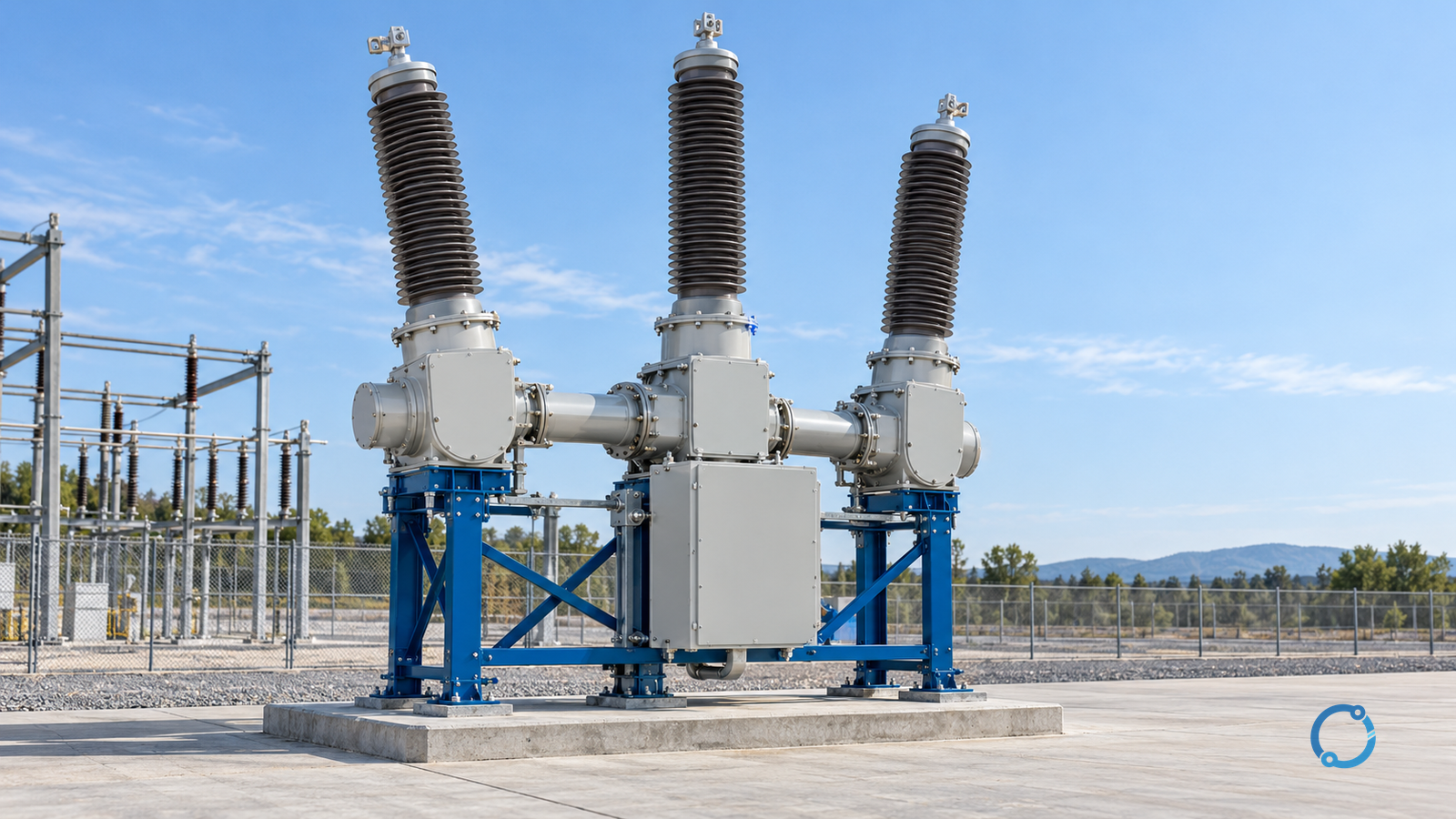
The breaker with the largest number on its data sheet is not automatically the breaker with the highest usable ANSI rating. That statement is not a word game. High-voltage circuit-breaker ratings are a coordinated set: the voltage class changes the insulation and transient-recovery-voltage (TRV) basis, the short-circuit value belongs to a stated breaking duty, and continuous current depends on the service conditions attached to it. A number that wins one column can be irrelevant, or not comparable, in another.
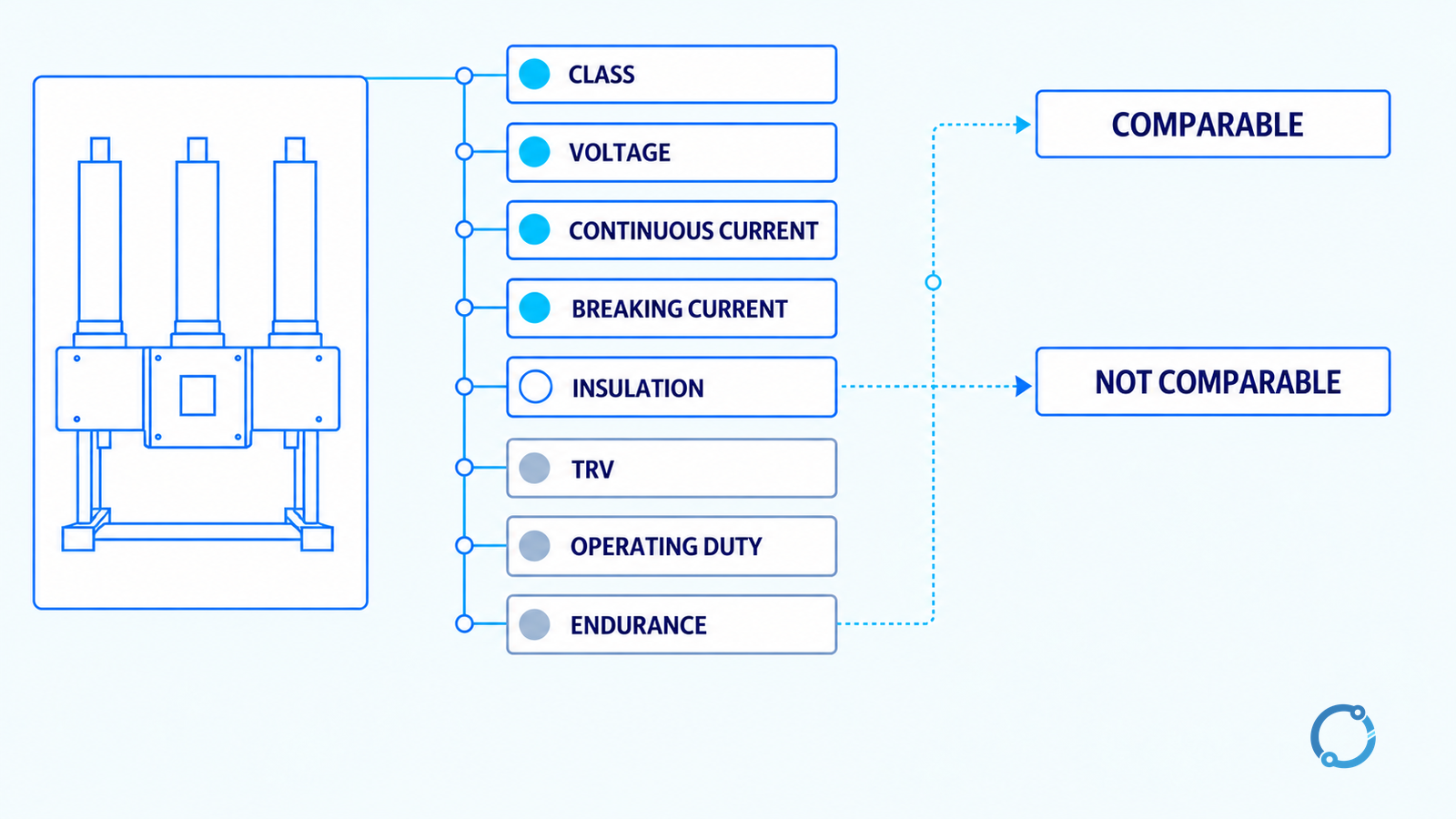
The practical answer is a sequence, not a league table: establish the equipment class and rated maximum voltage; normalize continuous current, breaking current, insulation, TRV, operating duty and endurance onto one basis; then separate preferred or assigned data from what a test record verifies. Only then can an engineer say which breaker has the higher usable capability for a defined project.
This guide applies to AC high-voltage breakers above 1,000 V in the IEEE/ANSI C37 family, not low-voltage molded-case breakers, generator breakers or another product family. The boundary matters because medium-voltage breaker ratings already vary with the application basis.
Start with the standard route, not the biggest number
IEEE C37.04-2018 is the active rating standard for AC high-voltage circuit breakers with rated maximum voltage above 1,000 V. Its public scope describes a rating structure with preferred ratings and assigned ratings spanning continuous current, insulation capability, short-circuit current, TRV and capacitor switching. It also identifies associated capabilities such as mechanical endurance, load current and out-of-phase switching. The scope excludes generator circuit breakers, which follow IEC/IEEE 62271-37-013.
That scope defines the rating families; it does not make every product-page value verified. IEEE C37.09-2018 is the companion test-procedure standard for the same family. Its public abstract says the procedures verify assigned ratings, including continuous current, dielectric withstand, short-circuit current, TRV and capacitor switching, with production tests also included. A test method and a product’s evidence package are different artifacts.
Before ranking, the record must answer two questions: which edition and amendment define the quoted rating, and which controlled report, acceptance record or datasheet establishes that the unit was tested or verified to it?
A catalogue page proves neither product compliance nor test success. IEEE C37.04a-2025 and C37.09a-2025 are active amendments to the 2018 editions, so a comparison that cites only “C37” without edition control is already incomplete.
The highest-rating claim review gate
Treat “highest ANSI rating” as a claim to be reviewed, not a label to accept. The gate converts two published data sets into records that can be checked. Its order follows the questions that can invalidate a comparison, not the order in which suppliers print columns.
| Gate | Normalize this field | Question that must be answered | Stop condition |
|---|---|---|---|
| 1 | Equipment class and standard route | Is this the same breaker family and governing standard? | Generator, low-voltage or another product family is being mixed in |
| 2 | Rated maximum voltage | Is the comparison within the same voltage class and insulation basis? | A higher-voltage class is being used to win a lower-voltage comparison |
| 3 | Continuous current | Are ambient, enclosure, mounting and other service conditions aligned? | One value assumes a different continuous-current basis |
| 4 | Short-circuit breaking current | Is the current, stated duration and breaking duty the same? | RMS magnitude is compared without its duration or duty |
| 5 | Insulation capability | Are power-frequency and impulse bases aligned with the voltage class? | A dielectric value substitutes for the required insulation check |
| 6 | TRV basis | Is the recovery-voltage basis appropriate to the breaker and system? | Numbers from different TRV bases sit in one column |
| 7 | Operating duty | Are the rated operating sequence and reclosing assumptions the same? | One duty assumes a different sequence |
| 8 | Mechanical endurance | Is the endurance basis or operation count stated on the same basis? | A test count is treated as a guaranteed service life |
Peak or making current belongs in the record only when the source states it explicitly. Do not infer a peak value from a symmetrical short-circuit number or add a column merely to make the table look complete.
The gate is a comparison control, not a product score. A breaker can pass every field and still be unsuitable because the fault study, protection scheme, physical arrangement or local requirements impose another constraint. A larger number in one row may also fail the gate because it was never on the same basis.
Read the words around the number
Keep four status labels separate. Preferred describes a standardized value or selection from a defined family; it does not prove that every product at that value passed every test. Assigned describes a declared rating for a particular breaker or design and must stay attached to its voltage, current basis and duty. Tested means evidence from a defined test program with an identified specimen, configuration, basis and observed result. Verified means that the relevant evidence was reviewed and accepted for the defined purpose. A “tested to C37” sentence is not a complete test record, and “listed in a catalogue” is not verification.
That distinction prevents a common error: comparing one supplier’s preferred value with another supplier’s product-specific verified value and calling the larger number “highest.” Both may be legitimate and still be non-comparable.
Voltage class and continuous current
Rated maximum voltage is the first hard boundary. A higher-voltage class may bring more insulation distance and a different TRV basis, but it is not automatically better for a lower-voltage system; it may be larger, impose different clearances, alter switching duty or cost more to integrate. The question is which breaker meets the required voltage class with an acceptable system design.
Continuous current is also conditional. Ambient, enclosure and mounting conditions can change the usable value. IEEE C37.010-2016, an application guide for indoor and outdoor breakers above 1,000 Vac, includes service conditions, temperature compensation, reduced dielectrics and reclosing derating. That is a warning against treating a nameplate current as ambient-independent.
Put the project current and the supplier’s stated basis side by side. If one is a reference-ambient rating and the other is an enclosed derated value, the larger number does not settle selection. Preserve the basis instead of collapsing it into one “A” column.
Short-circuit breaking current and its duty
Short-circuit breaking current is the field most likely to produce a false winner. A magnitude without its breaking duty, duration and test basis is incomplete; the same number may describe a different switching condition, recovery voltage or sequence elsewhere.
Capture the voltage class, the value’s symmetrical or other stated basis, its associated duration, the operating sequence and reclosing condition, the TRV basis, and the product evidence behind the assigned value.
IEEE C37.010-2016 covers system short-circuit calculation, X/R compensation, reclosing derating and out-of-phase switching. These are application variables, not footnotes; a breaker that looks stronger on one current row may fail once they are included.
Remove generator breakers here. IEEE C37.04’s scope points them to IEC/IEEE 62271-37-013 because their fault-source and duty problem differs. OHELE’s discussion of generator circuit-breaker breaking capacity explains why both fault sources must be studied rather than copied from a utility-breaker table.
Insulation capability and TRV
Insulation capability is not one “withstand” number. The voltage class, waveform, polarity and test basis define what the value means. A breaker may have strong power-frequency withstand and still need a separate impulse or switching-impulse check. Compare the field the project requires, using the adopted edition and insulation-coordination basis.
TRV needs the same discipline. It is the voltage transient across the breaker after current interruption, and its severity depends on the circuit, rating basis and fault condition. Two breakers with the same short-circuit current can use different assigned TRV bases. A table that keeps only the current and hides the TRV basis has lost the condition that makes the interrupting rating credible. Voltage, insulation and TRV therefore belong together in the review gate, not in separate marketing boxes.
Operating duty and mechanical endurance
An operating sequence defines the switching work the breaker must perform under the rating being quoted. A fault interruption, reclosing sequence and load-current operation may carry different duties. Record the sequence and the number of operations attached to the claimed capability; “rated for the fault level” is incomplete when the project requires another sequence. The existing OHELE guide to the MV breaker operating sequence explains why a higher current number cannot compensate for a mismatched reclosing philosophy.
Mechanical endurance is separate. It describes the breaker’s ability to complete a stated number of mechanical operations under the applicable requirements, not a guaranteed service life in years. Record the endurance basis and its evidence; do not turn an operation count into a universal inspection interval.
Duty also separates a breaker from a contactor. A breaker is selected for fault interruption and switching requirements, while a contactor normally handles frequent load switching. OHELE’s breaker versus contactor switching-duty comparison sets the boundary; the two classes should not share one “highest rating” table merely because both publish current and voltage numbers.
A practical comparison record
-
Freeze the project basis. Record voltage class, required continuous current, fault current and duration, X/R assumptions, operating and reclosing duty, insulation basis and locally adopted edition.
-
Classify the equipment. Keep generator, low-voltage, switch-disconnector and contactor alternatives out of the same table.
-
Normalize the rows. Populate the eight gate fields with units and bases, then align voltage, current, breaking duty, TRV and sequence before ranking anything.
-
Attach evidence status. Mark each critical value preferred, assigned, tested or verified, and name the controlled source. A catalogue is not a test record or certificate.
-
Run the shortlist in gate order. Stop at the first field that cannot be normalized. Apply physical and integration constraints only after the rating fields pass.
-
State the result conditionally. Name the stronger candidate, the field, the basis and the missing evidence. A conditional result can be checked; an unexplained “highest” label cannot.
What “highest” should mean in a specification
For a project specification, replace the phrase “highest ANSI rating” with a requirement that can be checked:
The breaker shall meet the required voltage class and continuous-current basis, demonstrate the specified short-circuit breaking duty and operating sequence, satisfy the project’s insulation and TRV requirements, provide the required mechanical endurance basis, and be supported by controlled evidence for every claimed rating.
This wording does not choose a product. It defines the comparison universe and stops a supplier from answering a narrow question with a larger number from another rating family. When two candidates meet the requirements, use project constraints such as physical fit, protection coordination, lifecycle support and verified documentation as tie-breakers. If evidence is missing, request the record or keep the candidate conditional; do not assume the published number is proven.
Verification checklist
Before releasing a “highest ANSI rating” comparison, confirm that the product family and standard route match; the governing edition and any amendment or corrigendum are stated; voltage and continuous-current bases align; breaking duration and duty align; insulation and TRV use the same system assumptions; operating and reclosing duty matches the project; endurance is a capability basis, not a service-life promise; every critical value has a controlled source; and the conclusion states its condition and missing evidence.
Sources
- IEEE C37.04-2018: Ratings and requirements above 1,000 V
- IEEE C37.09-2018: Test procedures above 1,000 V
- IEEE C37.010-2016: Application guide above 1,000 Vac
- IEEE C37.04a-2025: Rating and requirements amendment
- IEEE C37.09a-2025: Test-procedure amendment
- IEEE C37.06-2009: Superseded preferred-ratings standard
The IEEE catalogue pages were used for document identity and public scope on 2026-10-22. The full standards are paywalled and were not accessed. This framework does not state a preferred numerical rating, product compliance or a universal safety margin. Apply the adopted edition, project specification, controlled manufacturer data and qualified engineering review to the actual selection.