
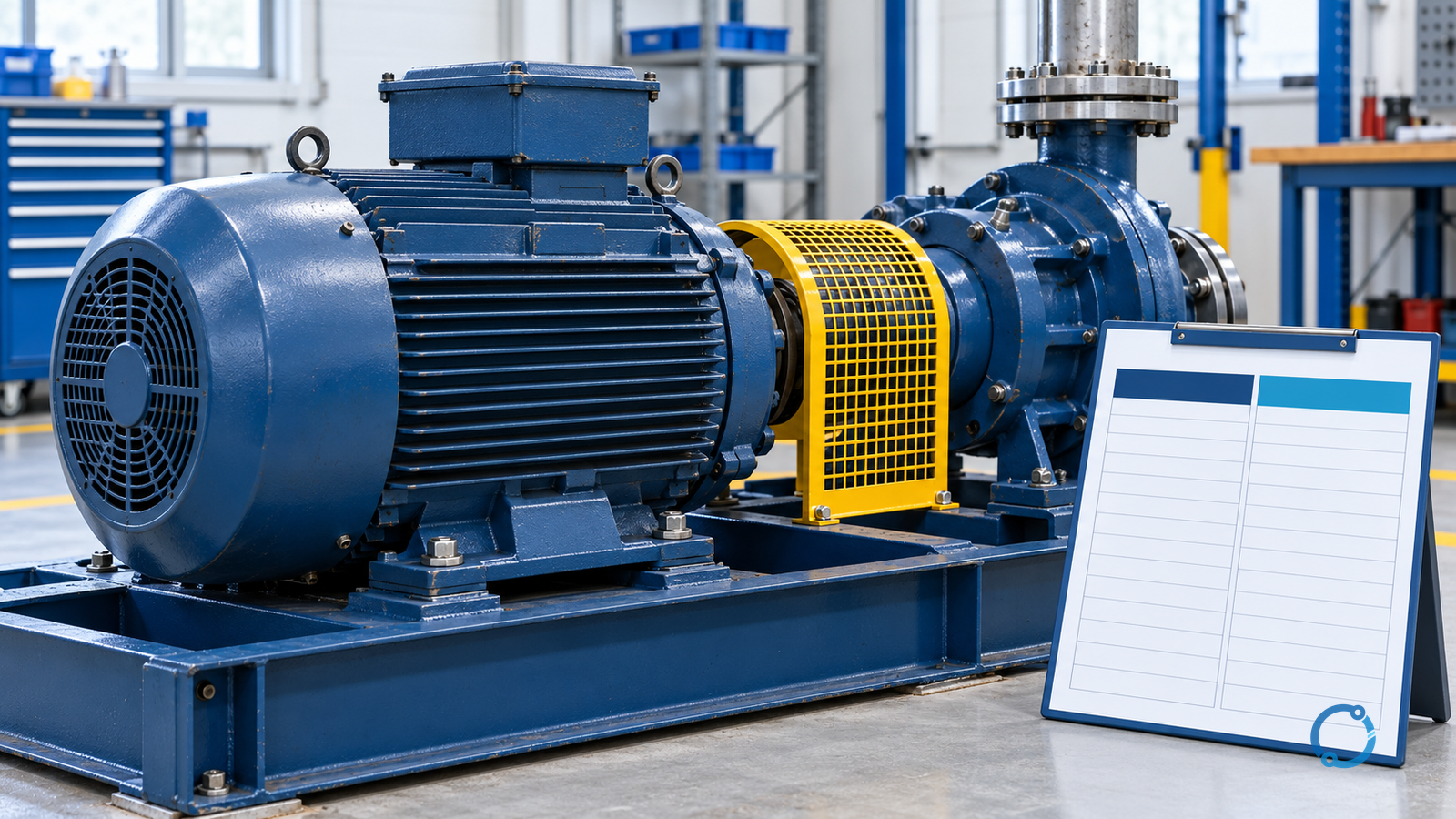
The right choice between repair and replacement depends on more than the price of a rewind and the price of a new motor. Repair is the better starting decision when the failure is localized, the stator core, rotor, shaft and frame remain serviceable, the motor still matches the driven duty, and a controlled repair can meet written acceptance criteria.
Replacement deserves serious consideration when the motor has irreversible damage, cannot satisfy the duty after repair, requires obsolete interfaces or spares, shows an unsuitable original design, or creates a lifecycle and production case that repair cannot offset. Neither conclusion is automatic. The decision becomes defensible only after the failure, repairability, available repair quality, outage consequences and measured operating inputs are placed in the same record.
This comparison covers general industrial induction motors. Hazardous-location, traction, nuclear, aerospace and other highly regulated machines may require additional approval, repair-shop qualification and OEM-controlled processes beyond this framework. The motor must be isolated and placed in a safe state before inspection, testing or removal. For U.S. general-industry electrical work, 29 CFR 1910.333 describes de-energization and qualified-person controls; local rules and site procedures still apply.
Answer the decision question before requesting quotations
A useful decision statement is:
For motor M-01, decide whether the installed motor should be repaired or replaced after confirming the failure mode, evaluating the complete machine and driven duty, specifying the acceptable repair or replacement outcome, and comparing the lifecycle and production consequences on the documented evidence available.
That sentence changes the purchasing conversation. The buyer is no longer asking only for a repair price or a replacement price. The buyer is asking each option to meet the same functional requirement and show what remains unknown.
Write the motor identity and system context first:
- equipment tag, manufacturer, model and serial number;
- rated voltage, frequency, power, speed, current, duty and enclosure;
- frame, mounting, shaft, bearing and conduit or terminal-box interface;
- driven machine and production function;
- operating schedule and criticality;
- supply arrangement and any drive or starter;
- motor protection settings and recent trips;
- maintenance, repair, rewind, alignment and bearing records;
- the event that caused the investigation;
- the required return-to-service date;
- available spare capacity and temporary alternatives.
The record should identify the decision owner and the evidence needed to release the motor back to service. A repair quotation is one input. The motor’s suitability for the job is another.
Establish the failure before choosing either path
A hot motor, vibration, earth-fault trip or winding resistance deviation does not identify the failed asset by itself. The investigation must separate:
- a fault inside the motor;
- a supply or protection problem;
- an alignment, coupling or driven-load problem;
- a cooling or environment problem;
- a duty mismatch or operating procedure problem;
- damage caused by the failure response, such as overheating after a blocked fan or repeated restart;
- an external event such as moisture ingress, contamination or mechanical impact.
The motor operating-temperature diagnostic process is useful when heat is the primary symptom. A temperature result should be read with current, ambient, enclosure condition, duty, ventilation and instrument validity. A hot bearing or one clearly hotter phase tells a different story from a uniformly hot frame.
For supply quality, use voltage-unbalance measurement and motor effects rather than treating an unbalance reading as an equipment verdict. For a drive-related failure, motor and VFD sizing for machine loads addresses the load, speed, torque and converter interaction. No repair decision should be based on only the winding test if the drive or machine explains why the motor failed.
Electrical and mechanical evidence should include, as appropriate:
- insulation-resistance and polarization information with test conditions and temperature;
- winding resistance and phase comparison using an approved method;
- supply voltage and current under normal and fault-related conditions;
- winding and bearing temperature records;
- vibration, alignment and coupling observations from the applicable specialists;
- bearing condition, lubrication and contamination evidence;
- shaft runout, frame cracks, mounting condition and cooling-path obstruction;
- motor protection event sequence and prior trips;
- driven-machine load, speed and torque history.
The test list is not a universal procedure. An energized test, a surge test, a partial-discharge test, a core-loss test or a rotor assessment should be selected for the motor type and failure question, then interpreted against the relevant standards, OEM instructions and qualified persons’ methods.
Determine what is actually repairable
A motor can be repairable in an electrical sense and still be a poor repair candidate. Inspect the complete machine, not just the failed winding.
Stator and winding condition
The repair shop needs to determine whether the defect is limited enough to leave a sound magnetic core and insulation system after stripping and rebuilding. Core damage, deep frame distortion, extensive winding failure and insulation tracking can change the repair scope. The visible condition before cleaning is part of the evidence; cleaning can remove both contamination and useful signs.
The decision record should state whether the winding can be reproduced with the same electrical characteristics and interfaces required by the application. “A rewind is possible” is not equivalent to “the original design will be restored.” The shop’s proposed process, material class and test plan require review against the applicable motor and site specification.
Rotor, shaft and mechanical condition
Check bearing journals, shaft extension, keyway, rotor bars and end rings, fan, balance condition, frame and mounting surfaces according to the repair scope. A stator repair does not automatically correct a bent shaft, recurring bearing current, poor fit or an imbalanced driven machine. If the mechanical damage is left in service, the repaired winding can fail again.
Terminal box, cooling and accessories
The terminal arrangement, enclosure, cooling fan, space heaters, temperature detectors and other accessories must remain suitable for the proposed service. Replacement components should match the control interface and environment. An obsolete accessory is not necessarily a reason to replace the whole motor, but it must be addressed in the repair plan rather than discovered during commissioning.
Repair-shop capability and evidence
The supplier should be evaluated against the job, not assumed to have identical capability for every machine. A useful repair specification defines:
- the received condition and failure-assessment requirements;
- approved cleaning and stripping methods;
- winding data and tolerances;
- insulation materials and process controls;
- bearing replacement and fits;
- balance and alignment responsibilities if included;
- testing before and after repair;
- documentation and traceability;
- warranty and exclusions;
- transport and storage controls.
The U.S. Department of Energy Motor Repair Tech Brief recommends a planned approach and a repair specification rather than relying on an informal price comparison. It does not establish a universal repair life or guarantee that a rewind restores every performance characteristic.
Check whether the installed motor is still the right motor
If the failed motor was undersized, incorrectly applied or unsuited to the driven machine, a like-for-like repair can preserve the root cause. Before approving the repair, confirm the actual duty:
- required speed range and number of starts;
- torque during acceleration and normal operation;
- load profile and part-load operation;
- driven-machine inertia and braking method;
- ambient and altitude;
- indoor or outdoor environment;
- supply quality and any converter waveform;
- enclosure and cooling method;
- mounting, shaft and dimensional interface;
- electrical connection and protection compatibility;
- applicable site and product requirements.
Use measured operation where available. Nameplate power is a rating boundary, not proof that the installed application is within it. A motor that appears nominally larger than the load may still be unsuitable if the starts, stopping time, harmonics, enclosure or environmental condition exceed its design basis.
The replacement three-phase induction motor checks provide a separate selection workflow once replacement is chosen. If the application has changed, include the cost and downtime of the required replacement interface in the comparison, not just the motor price.
Compare repair and replacement on the same acceptance criteria
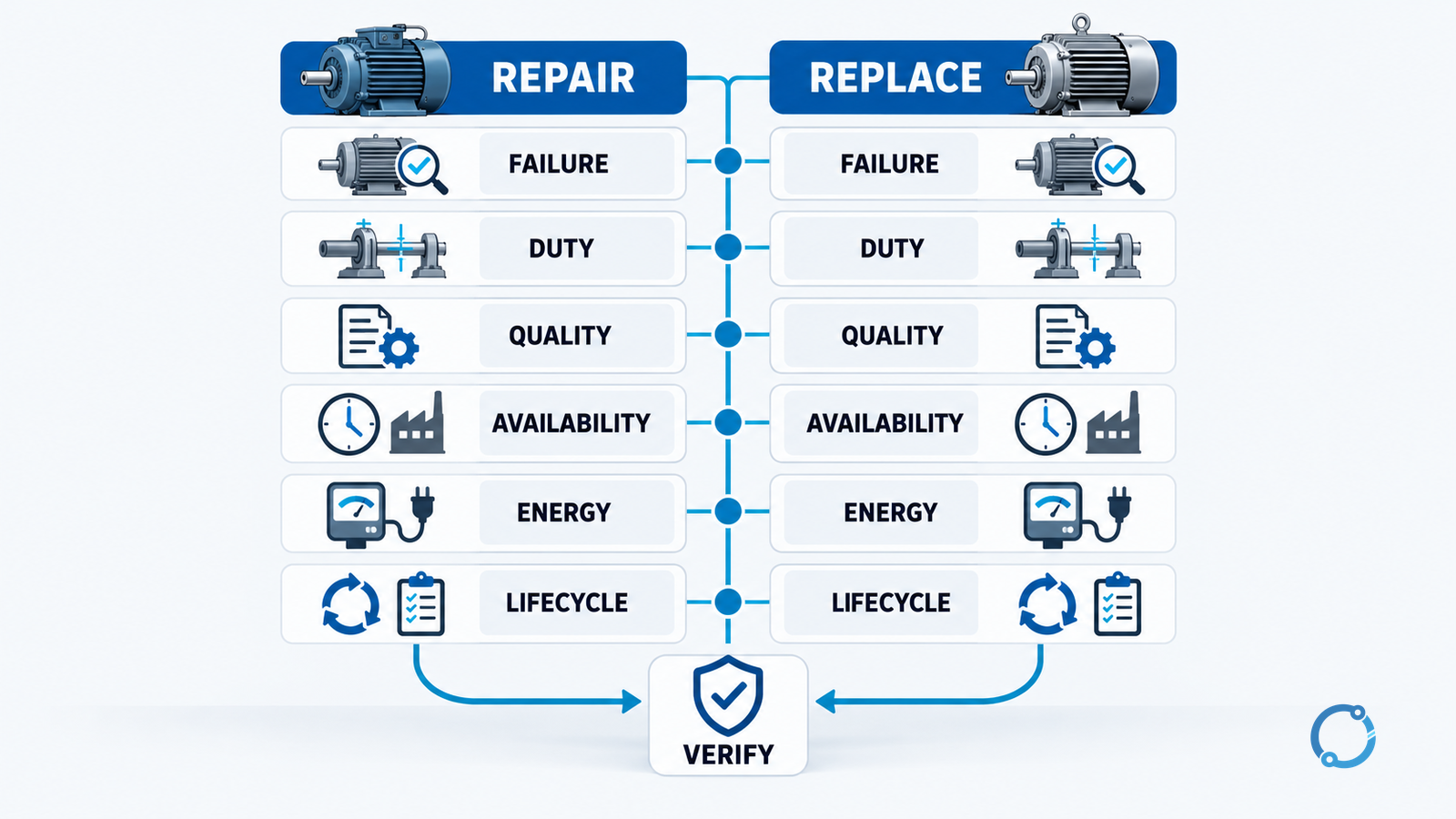
The two options should answer the same questions.
| Decision dimension | Repair path | Replacement path |
|---|---|---|
| Failure control | Can the shop remove the failure cause and restore a sound machine? | Does the new motor address the correct failure mechanism? |
| Electrical performance | Can the winding and magnetic system meet the required rating and test criteria? | Is the replacement rating suitable for the true duty? |
| Mechanical condition | Are shaft, rotor, frame, bearings and mounting serviceable? | Does the new frame, shaft and load interface fit? |
| Repair quality | Is the shop process, inspection and after-test evidence acceptable? | Is the new product’s evidence appropriate for the application? |
| Availability | When can the repaired motor return, and what is the credible repair outcome? | What is the documented delivery and commissioning time? |
| Energy | What is the measured input baseline and expected post-repair condition? | What does the proposed motor’s performance evidence show at the actual duty? |
| Lifecycle | What maintenance, efficiency and repeat-failure exposure remains? | What is the expected life and support model? |
| Transition | Can a temporary motor or partial process run reduce production loss? | Can the system accommodate the new electrical and mechanical interfaces? |
A matrix does not make the decision for the reader. It exposes whether one quotation is comparing a cheap partial repair with a complete replacement, or comparing a fully specified repair with an unverified catalog motor.
Compare downtime and production consequences
Purchasing and repair time are not the same as outage duration. Include:
- removal and transport time;
- diagnosis and quotation time;
- parts or winding availability;
- shop queue and repair duration;
- reassembly, alignment and commissioning;
- operator training and drawing changes for a replacement;
- storage and disposal;
- a realistic estimate of production loss per unit of outage time;
- the cost of a temporary motor or rental if that option exists;
- the risk that the repair will require a second intervention.
Do not use a generic downtime percentage or assume that a spare is available because the purchasing system lists one. Verify the spare’s condition, interface and readiness. A replacement that arrives quickly but requires a new coupling, starter setting or foundation is not equivalent to a repaired drop-in unit.
For critical machines, the lifecycle decision should also consider the value of a service-ready spare strategy. A slightly higher initial replacement cost may be justified when it creates a compatible spare, improves obsolescence management and reduces future outage exposure. That conclusion depends on the plant, not on an arbitrary payback threshold.
Calculate energy from measured inputs
Energy comparison needs the actual load profile. For a balanced three-phase motor, input electrical power can be expressed as:
P_input ≈ √3 × V × I × PF
where the voltage and current are measured under the defined operating condition and the power factor is measured or obtained from the applicable performance data. The estimate is not sufficient for a final comparison if voltage, current or power factor vary significantly with load, because part-load power factor and efficiency can differ from rated values.
For a defined operating period:
Annual energy = P_input × operating hours
Annual energy cost = Annual energy × tariff
If the repair or replacement changes only part of the operating envelope, calculate the affected time separately. A constant discount percentage, nameplate efficiency difference or nameplate power multiplied by a guessed load factor is not a substitute for measured duty.
Example numbers can help a team test a spreadsheet, but they must be labeled as illustrative and replaced with site data. Compare at least:
- current motor input power over a representative cycle;
- expected repaired performance if the repair shop provides a defensible estimate;
- proposed replacement performance at the same duty;
- changes in operating hours, speed, load or process;
- uncertainty in measurement and expected life.
The U.S. Department of Energy motor-system sourcebook frames performance within the complete motor system and operating practices. An energy calculation that ignores the pump, fan, compressor or process can produce an attractive motor business case that never pays back.
Build a transparent lifecycle cost
A decision-grade lifecycle comparison can be expressed as:
Lifecycle cost =
  purchase or repair cost
  + transport and installation
  + commissioning
  + expected energy cost
  + maintenance and spare cost
  + expected production-loss cost
  + disposal or residual value
For each line, record the quantity, unit, source and uncertainty. Separate one-time from recurring costs. Present the expected range rather than one decimal point that implies precision the inputs do not have.
Two cautions matter:
- A lower purchase price is not a lower lifecycle cost. A repair can be cheap and still cause repeated outages; a new motor can be expensive and still be the lower-cost option when energy, availability and support are counted.
- A higher efficiency label is not a measured saving. Confirm the efficiency basis, operating load and actual hours. If the original machine is oversized or the process can be operated differently, the correct comparison may include a system load change rather than only motor replacement.
Lifecycle cost does not resolve safety, compliance or repairability. A favorable calculation does not authorize a repair that cannot meet the required electrical or mechanical condition.
A practical decision record
Use the following fields to prevent the comparison from becoming a price-only argument.
| Field | Repair option | Replacement option |
|---|---|---|
| Failure mechanism | Confirmed or still uncertain | Confirmed or still uncertain |
| Scope | Exact repair operations and exclusions | Exact motor and interface changes |
| Duty fit | Evidence that the repaired motor will match the process | Evidence that the new motor matches the process |
| Electrical acceptance | Insulation, resistance, run and performance requirements | Product data and a site run test |
| Mechanical acceptance | Balance, alignment, bearing and coupling requirements | Frame, shaft, load and alignment requirements |
| Delivery | Shop lead time plus transport and commissioning | Purchase lead time plus modification and commissioning |
| Energy | Measured baseline and repair assumptions | Measured duty and proposed performance |
| Reliability | Remaining life and repeat-failure exposure | Expected life, support and spare strategy |
| Cost | Complete range, not only the quote | Complete installed and operating range |
| Decision owner | Person accepting the evidence | Person accepting the system change |
If any critical field is unknown, mark it as open. A decision can be provisional, but it should not be presented as final.
When repair is likely to be the better starting point
Repair is a credible starting point when:
- the failure is localized and the remaining mechanical condition is serviceable;
- the installed motor’s duty and interface have been verified;
- a suitably capable repair process can meet a written specification;
- the required return-to-service window is compatible with a quality repair;
- the energy and lifecycle comparison accounts for the repaired condition and repeat-failure risk;
- a temporary or spare arrangement controls production exposure.
Even then, compare more than one repaired path if the shop proposes different scopes. Ask what evidence will prove that the repaired machine is electrically and mechanically acceptable.
When replacement deserves the stronger case
Replacement deserves the stronger case when:
- damage extends through the core, frame or mechanical structure;
- repair cannot meet the required performance or interface;
- repeated failures show that the installed design or duty is unsuitable;
- the repair would preserve obsolete parts, controls or safety-related limitations;
- the shop cannot provide the required process, tests or records;
- outage exposure and spare strategy materially favor a new unit;
- the lifecycle comparison, with uncertainty included, favors replacement.
The presence of one of these factors does not automatically decide the case. It must be connected to the actual machine and the consequences of the choice.
Define acceptance before the motor returns
The repair or replacement decision is not complete at shipment. Set acceptance criteria before work begins.
For a repaired motor
- received-condition report and approved scope;
- winding data and material record;
- specified electrical tests with conditions and results;
- bearing, balance and alignment evidence where included;
- dimensional and interface checks;
- protection, rotation, cooling and accessory checks;
- controlled no-load and loaded run verification;
- baseline current, temperature, vibration and operating record.
For a replacement motor
- nameplate and ordered data match the approved specification;
- frame, shaft, coupling and terminal-box interfaces fit;
- supply, starter or drive and protection are compatible;
- rotation and control sequence are verified;
- installation and alignment are completed;
- no-load and loaded operating evidence are recorded;
- drawings, settings, spares and maintenance information are updated.
The first loaded check should use the same relevant operating points as the original evidence where possible. A motor that runs smoothly but draws abnormal current or heats differently has not yet demonstrated that the system problem is solved.
What cannot be inferred from a quotation
A repair price cannot prove repair quality. A new-motor price cannot prove duty fit. A catalog efficiency value cannot prove site energy savings. A short repair lead time cannot prove a reliable outage plan. A warranty cannot prove that a failure mechanism has been removed.
Keep those limitations visible in the final decision. The goal is not to defend a preferred answer. It is to make the chosen path testable: the failure is understood, the machine is suitable, the work has acceptance evidence, and the production and lifecycle consequences have been considered.
Sources
- IEC 60034-1:2026: Rotating electrical machines – Part 1: Rating and performance, published 2026, edition 15.
- U.S. Department of Energy: Motor Repair Tech Brief, accessed 2026-10-28.
- U.S. Department of Energy: Improving Motor and Drive System Performance – A Sourcebook for Industry, accessed 2026-10-28.
- U.S. Department of Energy: Motor Systems, accessed 2026-10-28.
- 29 CFR 1910.333: Selection and use of work practices, accessed 2026-10-28. This is a U.S. general-industry occupational-safety rule, not a universal electrical design standard.