
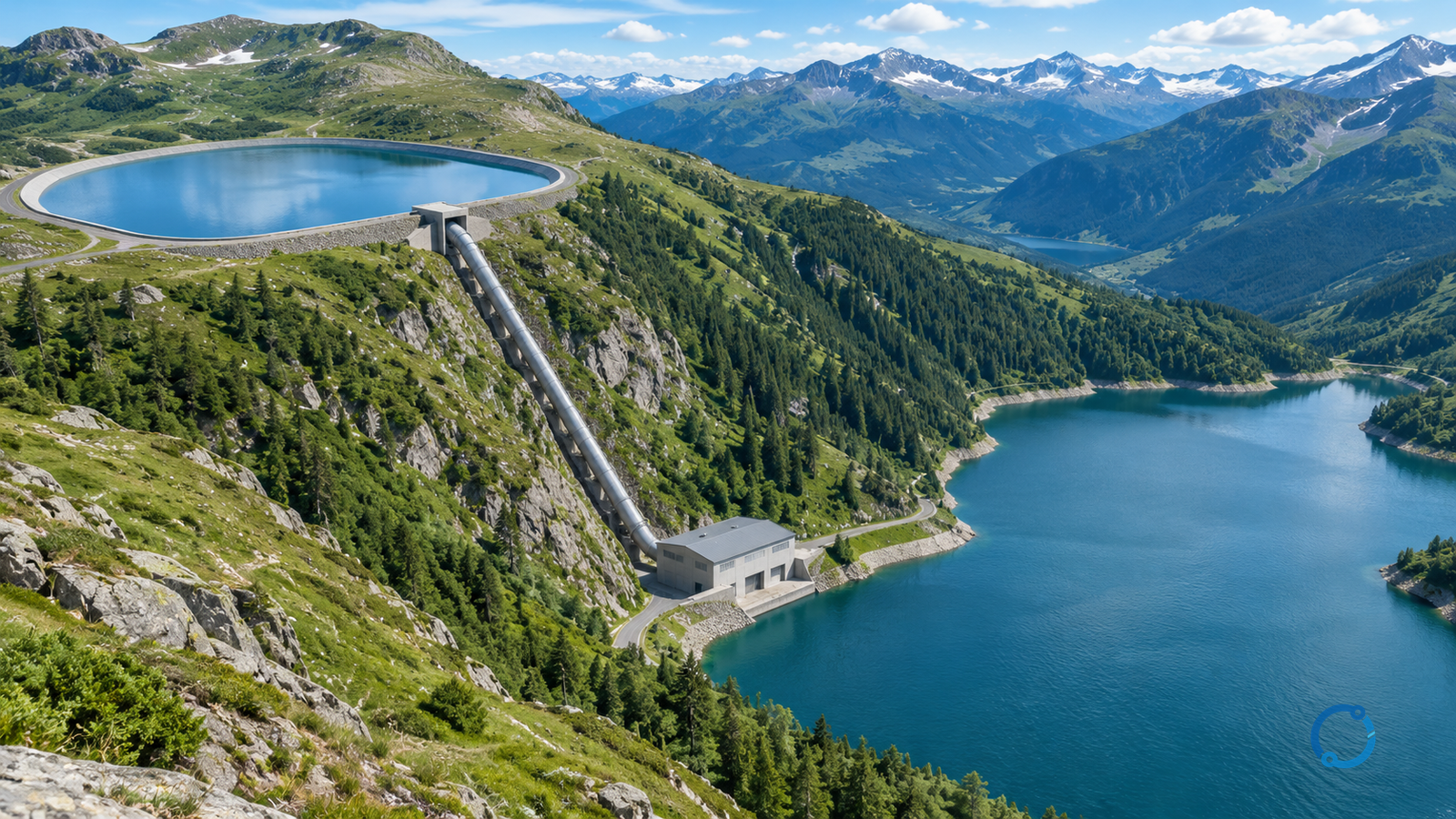
Pumped storage hydropower stores energy by moving water uphill. It uses electricity to pump water into an upper reservoir, then generates electricity when water flows back down through a turbine. It shifts electricity in time and returns less energy than was required for charging.
The stored energy comes from the water’s elevated position. Reusing the water does not create an unlimited source of energy.
Follow one charge-and-discharge cycle
The US Department of Energy’s pumped-storage explanation describes two reservoirs at different elevations. During charging, electrical equipment drives pumping. During generation, descending water drives turbines connected to generators.
| Stage | Water movement | Energy conversion |
|---|---|---|
| Charging | Lower reservoir to upper reservoir | Electrical input becomes stored gravitational energy, with losses |
| Holding | Water remains elevated | The reservoir retains an energy inventory |
| Generating | Upper reservoir to lower reservoir | Stored energy becomes mechanical rotation and electrical output, with losses |
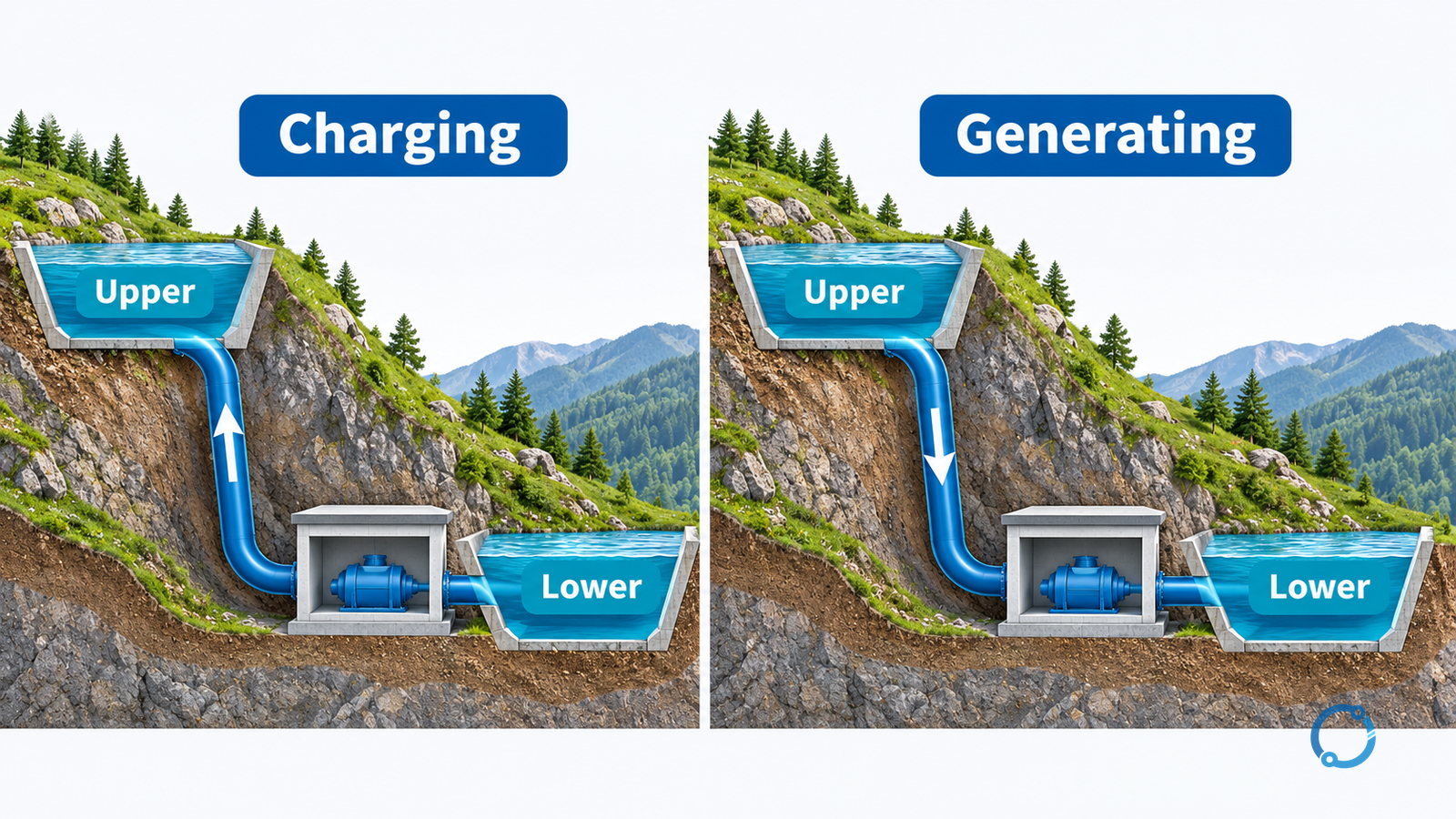
A common reversible arrangement combines pump/turbine and motor/generator functions. The explanation is about energy flow, not a claim that every installation uses identical machinery.
Estimate the energy stored by elevation
A simplified gravitational-energy calculation is:
Energy (J) = mass (kg) × gravity (m/s²) × height difference (m).
For water volume V, mass is density × V. Dividing joules by 3,600,000 converts to kWh. This is an ideal energy calculation; it does not include hydraulic or electrical losses.
Assume, solely for teaching:
- usable water volume: 100,000 m³;
- water density: 1,000 kg/m³;
- gravity: 9.81 m/s²;
- constant effective height difference: 100 m.
Then ideal stored energy is:
1,000 × 100,000 × 9.81 × 100 = 98,100,000,000 J = 27.25 MWh.
These are not dimensions or operating results from a real facility. Actual elevation difference changes with water levels, so treating it as constant is a simplification.
If an assumed generation-path efficiency were 90%, electrical output would be 27.25 × 0.90 = 24.525 MWh. This chosen percentage is not an expected value for all pumped-storage plants.
Why does it consume more energy than it returns?
Pumping and generating each introduce losses. EIA’s electricity-storage overview explains why electricity-charged storage uses more charging energy than it returns. With the same hypothetical 27.25 MWh stored and an assumed charging-path efficiency of 90%, electrical charging input is 27.25/0.90 = 30.278 MWh.
Returning 24.525 MWh gives round-trip efficiency of 24.525/30.278 = 81%. The two independently assumed 90% path efficiencies multiply to 81%; they do not average to 90%.
The system would need 30.278 MWh in to return 24.525 MWh in this simplified cycle. Its usefulness must therefore come from the value of providing electricity at another time or supplying a required grid service, not from creating extra energy.
Open-loop and closed-loop arrangements
DOE’s pumped-storage overview distinguishes arrangements with an ongoing hydrologic connection to a natural water body from closed-loop arrangements without that ongoing connection. Closed-loop does not mean that water supply and environmental questions disappear; it identifies a hydrologic arrangement.
For the electrical concept, both use elevation to store energy. Do not confuse this classification with whether the plant is electrically connected to the grid.
Storage volume and generating power answer different questions
The example’s 24.525 MWh of deliverable output could sustain an assumed constant 5 MW for 4.905 hours, only if the machinery and water-flow conditions support that power. Reservoir energy alone does not establish a turbine’s MW rating.
To interpret a project description, look for both power and usable energy, the water-level or head assumptions and the cycle-efficiency boundary. For related generation context, see OHELE’s explanation of how electricity is generated.