
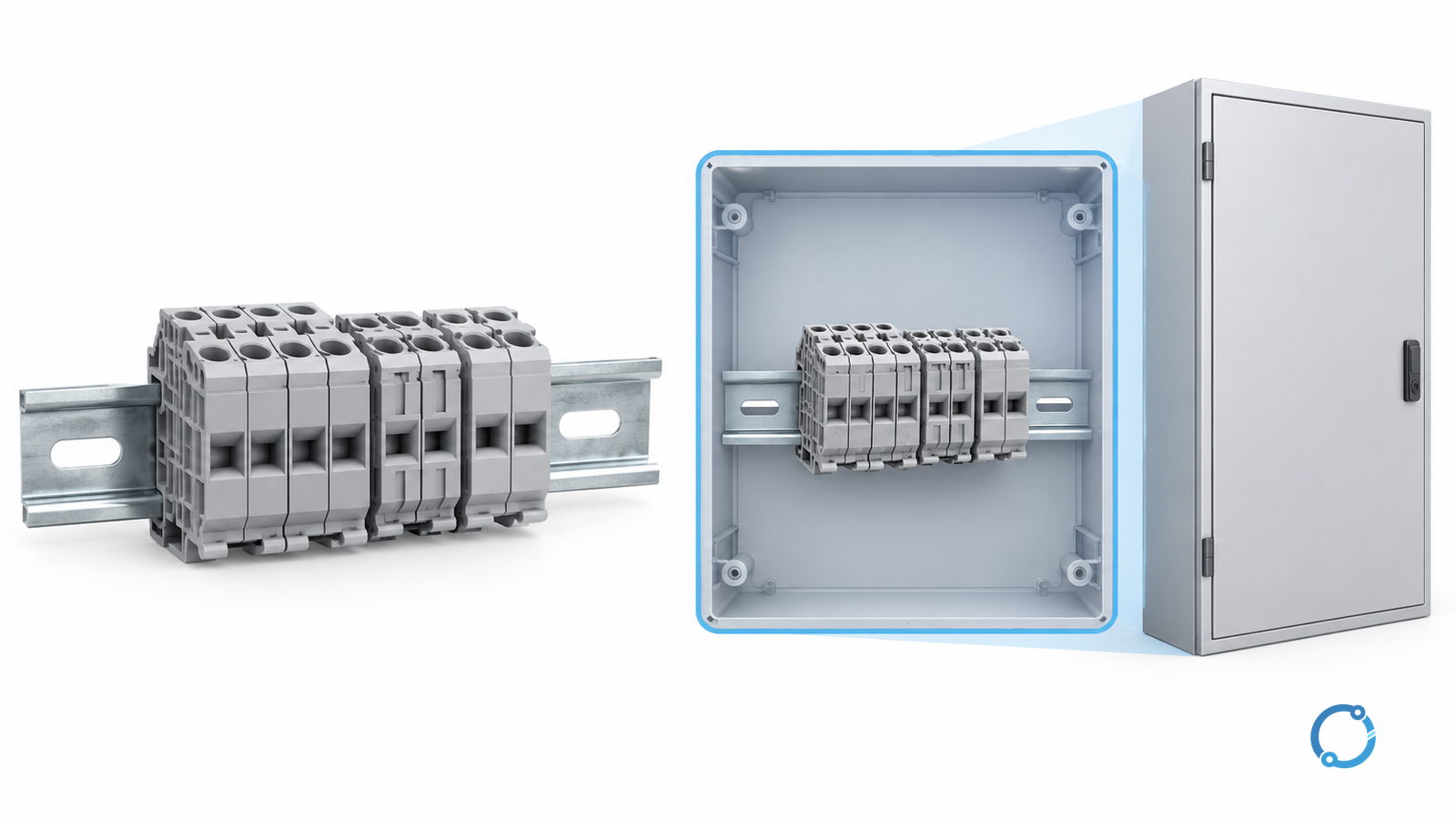
Read a terminal-block derating curve by matching the exact component and test arrangement, locating its defined ambient temperature, and reading the permitted current on the applicable trace. Do not choose the most favorable line or treat a curve for one conductor and loaded-contact arrangement as a universal rating.
This reference concerns published continuous-current versus ambient-temperature information for terminal and connector arrangements. Not every terminal family uses the same test method or publishes such a curve. The endpoint is a traceable rating interpretation, not a complete panel thermal or fault assessment.
Confirm what the document actually covers
Keep the exact part, mating component where relevant, conductor preparation and accessory arrangement with the source. A curve from a similar-looking product is not a substitute.
The International Electrotechnical Commission (IEC), in IEC 60512-5-2:2002, describes a current-temperature test method for electromechanical components, essentially connectors, at elevated ambient. Its public scope does not establish that every DIN-rail terminal must use this method or that a candidate has passed it.
IEC 60947-7-1:2025 has a distinct industrial copper-conductor terminal-block scope. Establish which component and evidence route the published curve represents instead of mixing those scopes.
Check axes, traces and conditions before reading a point
| Curve field | What to record | Reason it can invalidate a reading |
|---|---|---|
| Axes and units | Ambient in °C; current in A, or the actual plotted quantities | A temperature-rise plot is not automatically an ambient-current rating |
| Component identity | Exact terminal/connector and mating state | A partial assembly can differ from the installed combination |
| Conductor | Material, cross-section, preparation and stated conditions | Different heat paths or interfaces can change the basis |
| Loaded arrangement | Number of positions and simultaneous loading | An unloaded neighbor is not necessarily equivalent to a loaded one |
| Mounting/cooling | Support, orientation and environmental basis | Enclosed or differently cooled conditions may not match |
| Curve status | Base test curve, published derated limit or another trace | A measured base curve may not be a usable continuous rating |
The terminal-marking guide explains the related approval-system distinction. A printed current rating and a temperature curve must be interpreted within their own declared conditions, not averaged or combined.
Use the component’s local ambient
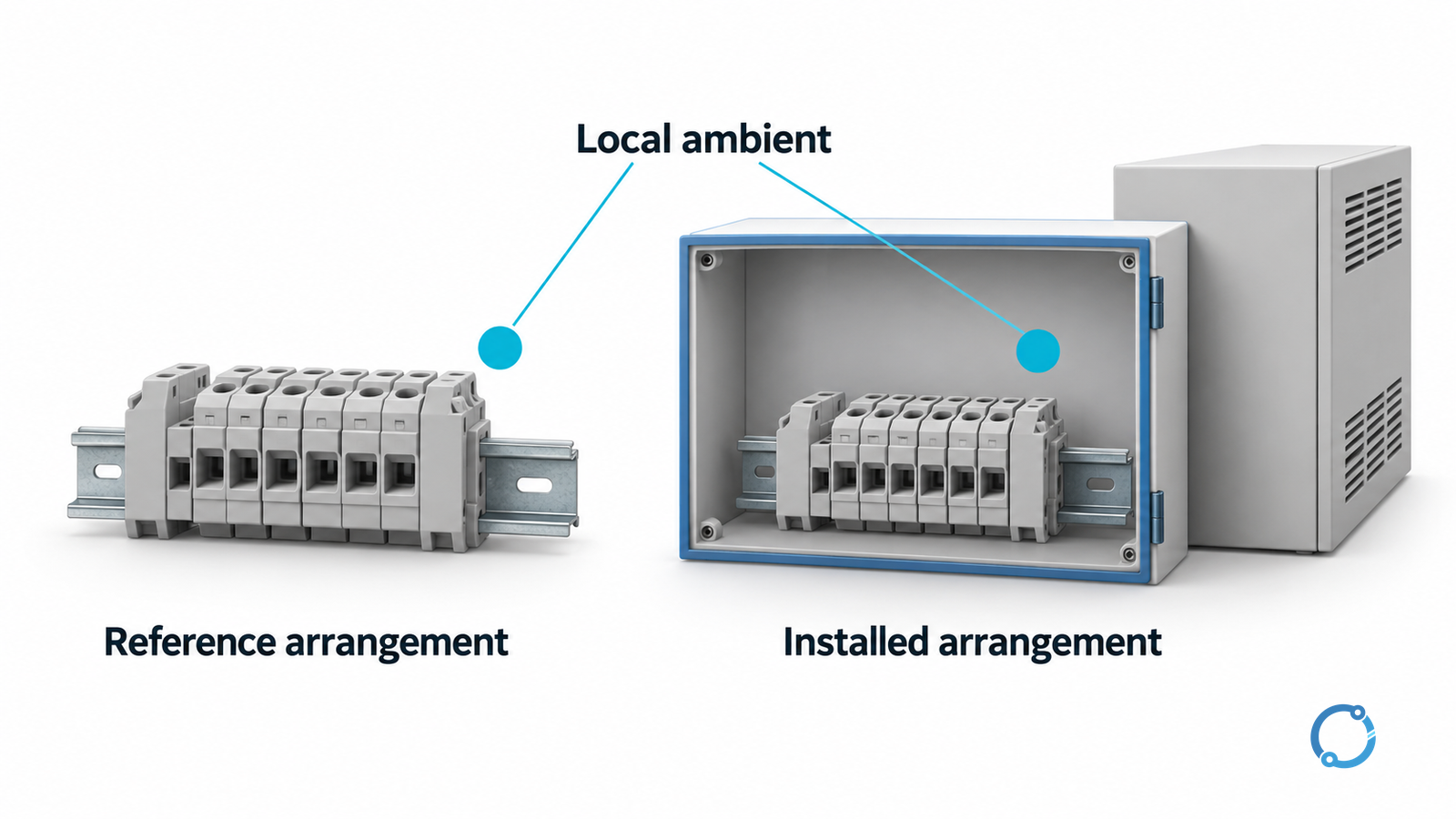
Identify where the document defines ambient and how the design establishes that condition. Air at the terminal can be warmer than room air because nearby devices and enclosure conditions affect heat removal.
Do not take the outside-room reading simply because it gives more current on the graph. Equally, do not subtract the terminal’s temperature rise from a measured surface reading unless the document and measurement method actually support that operation.
The terminal materials and losses guide provides the physical context. Do not convert its discussion of resistive loss into an invented component temperature limit.
Follow the correct trace and retain the reading
Once the configuration and ambient match, locate that ambient on the correct axis, move to the applicable published-limit trace, and read current on the other axis. Record the source revision, chosen trace, operating condition and reading uncertainty.
If several traces represent conductor sizes or loaded positions, choose the one that actually applies. Do not select a larger-conductor trace while retaining a smaller conductor in the build.
If the operating point lies outside the published domain, hold the selection for suitable evidence. Extrapolating a line beyond its tested temperature range is not a verification method.
Interpolate only when the basis permits it
Suppose a hypothetical published limit lists 44 A at 40°C and 32 A at 60°C. These are invented teaching inputs, not ratings of a real terminal.
If the source explicitly permits linear interpolation between those points, the interpolated value at 50°C is:
I = 44 + (32 − 44) × (50 − 40)/(60 − 40) = 38 A.
The arithmetic is exact under the stated linear assumption. It does not establish that a real curve is linear, that the underlying test arrangement matches, or that 38 A is a usable product rating. Without the permitted method, the intermediate value remains unresolved; obtain the applicable curve or written interpretation.
Do not scale current directly by the ratio of two Celsius ambient values. Do not apply an assumed blanket reduction factor to a published derated trace, which may already include a specified adjustment. Record the documented treatment rather than applying a second undocumented factor.
Keep other current-path limits separate
A valid terminal curve does not establish the capability of a bridge, fuse assembly, cable, protective-earth arrangement or entire panel. Identify the current in each relevant segment and compare it with its own applicable conditions.
Simultaneous loading, local heat sources and changed accessories can trigger a new thermal review. A fault-withstand or protection conclusion cannot be derived from continuous-current derating.
Use the terminal selection workflow for those wider circuit and accessory decisions. This page supplies the curve interpretation, not every other selection gate.
Complete a one-point interpretation record
Retain six items: exact component/arrangement, curve source/revision, applicable trace, local ambient basis, reading or authorized interpolation, and remaining system limits. Mark missing configuration or out-of-range operation as a hold.
Physical measurements or electrical testing require the qualified team’s approved procedure and safe access. Do not run an improvised overheating test or reach into a live panel to validate an article example.
The result should allow another reviewer to reproduce the reading and see why it applies. A bare claim such as “rated 38 A at 50°C” without its source and conditions does not complete that task.