
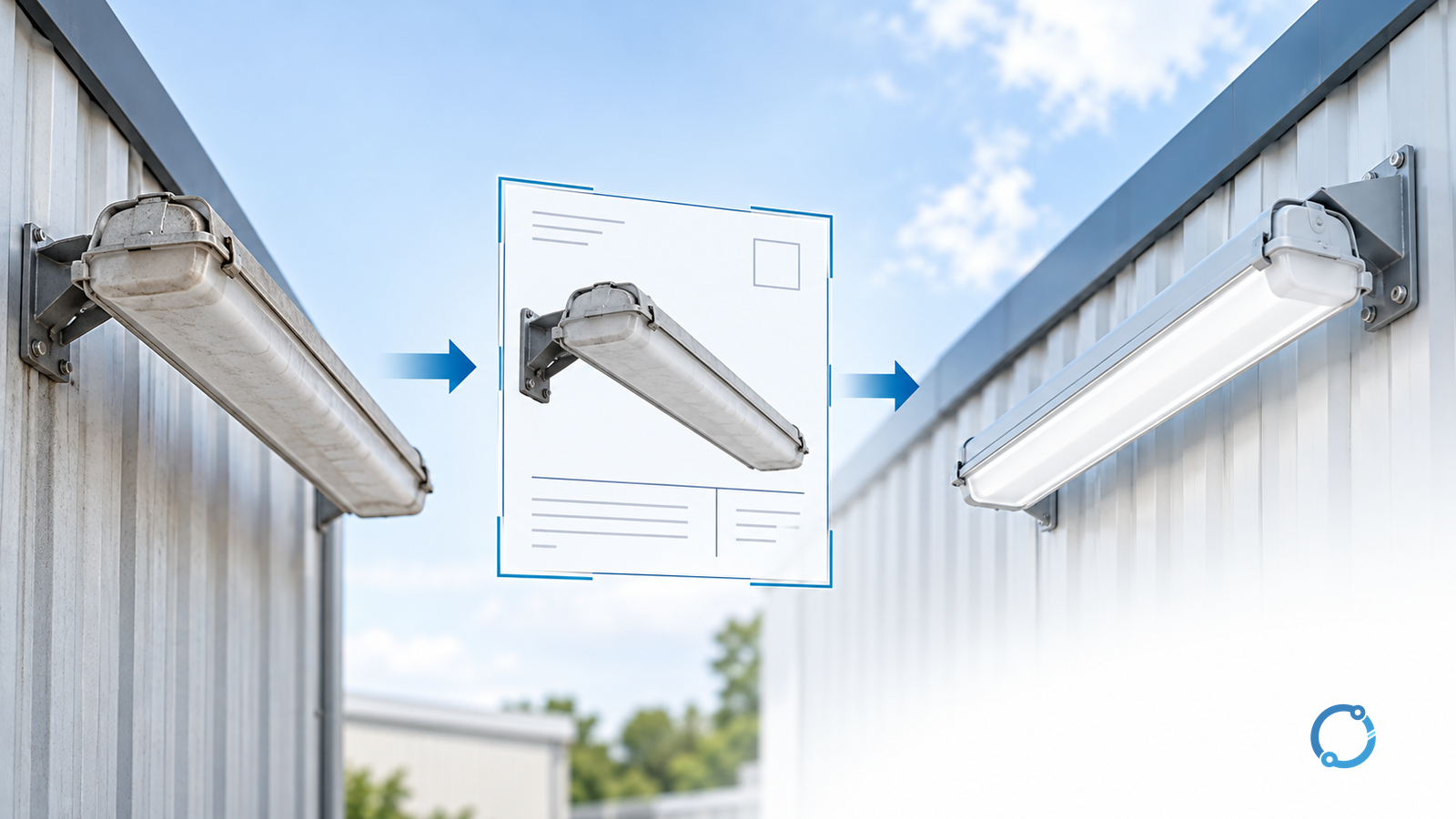
A hazardous-area LED retrofit is a controlled change to an installed lighting system, not simply a lamp-efficiency upgrade. Establish what the existing assembly permits, identify what will change, and verify both the explosion-protection basis and the lighting task before the installation returns to service.
The workflow below is for qualified designers and authorized maintenance personnel reviewing IEC-based Ex installations. It does not authorize an ordinary LED tube, driver or retrofit kit inside an Ex housing. No generic wiring sequence can establish approval for an unidentified luminaire.
Gate 1: establish the existing assembly and change boundary
Identify the existing luminaire, approval documentation, protection concept, installed accessories, supply arrangement and current condition. Begin with the applicable area basis; the ATEX lighting zone selection guide addresses that prerequisite.
Record the proposed action accurately:
- replace the complete luminaire;
- use a documented retrofit arrangement for the identified assembly;
- replace an explicitly permitted service part; or
- investigate a modification whose acceptability is not yet established.
Do not call all four “like-for-like.” A similar housing shape, matching mounting holes or lower lamp wattage does not prove that the original assessment remains valid.
The UK’s HSE guidance on electricity in potentially explosive atmospheres emphasizes risk assessment before new work under DSEAR. That legal context is UK-specific; elsewhere use the applicable local requirements rather than importing the regulation unchanged.
Gate 2: use a change-impact register
This proposed register turns a retrofit description into reviewable engineering questions.
| Change or retained interface | Question to close | Hold condition |
|---|---|---|
| Light source and driver | Is the exact proposed combination permitted? | Ordinary component compatibility only |
| Housing and protection features | Are their required functions preserved? | Damage or unsupported alteration |
| Electrical supply and controls | Are circuit and control interfaces still suitable? | Unverified supply or control assumption |
| Entries and mounting accessories | Does the complete arrangement remain supported? | Changed accessory outside documentation |
| Thermal and ambient conditions | Is the new configuration valid at the location? | “Lower watts” used as sole proof |
| Optical performance | Will the actual task still meet its acceptance criteria? | Lumens or wattage comparison only |
Supporting evidence must refer to the configuration that will actually be installed. If a proposed option changes midway through procurement, reopen the affected register rows rather than carrying forward the old approval.
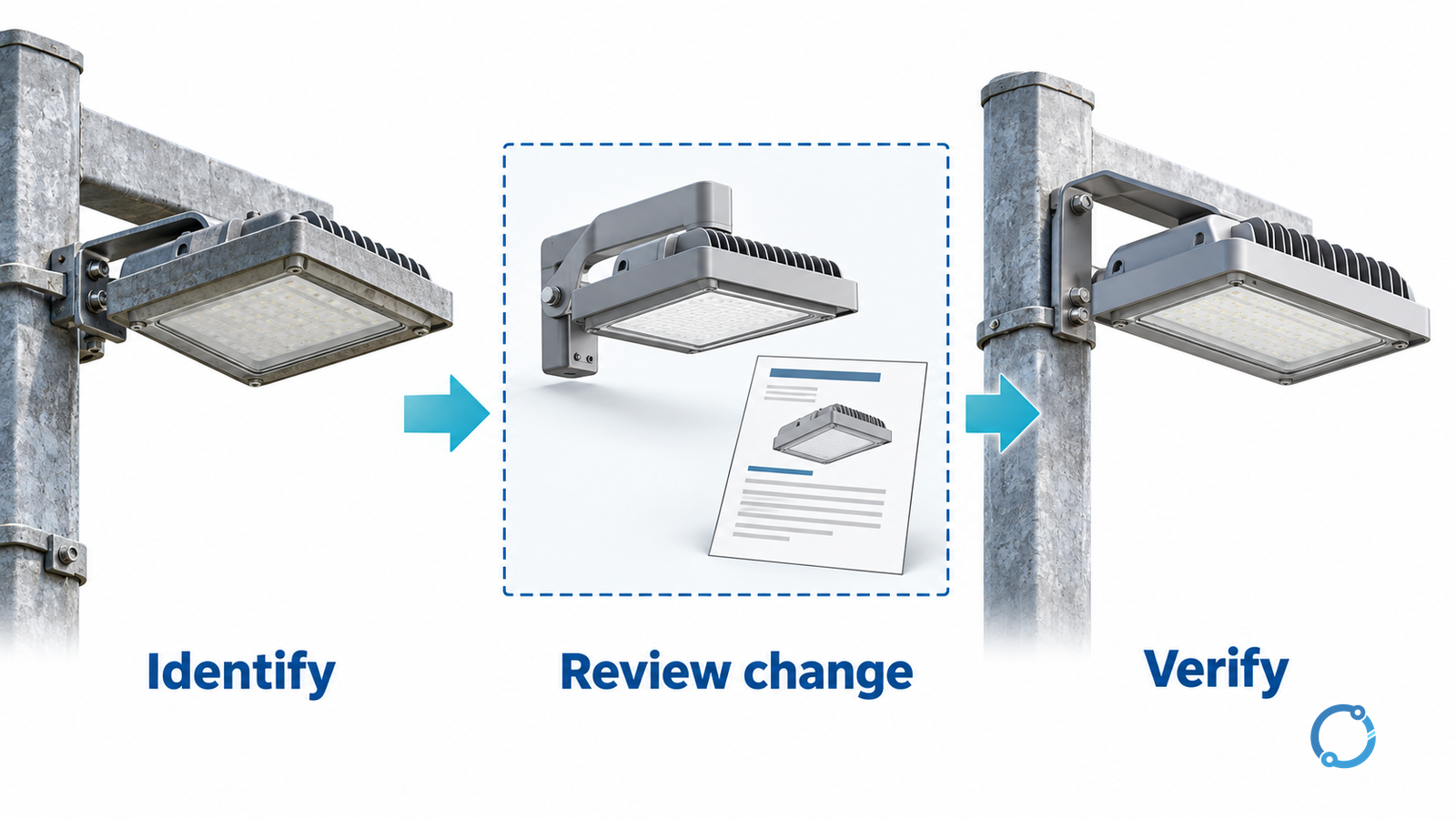
Gate 3: distinguish general retrofit evidence from Ex approval
DOE’s LED troffer retrofit best-practices overview distinguishes tubular LEDs, retrofit kits and complete luminaires for ordinary lighting upgrades. This is useful terminology—not evidence that any option is suitable inside hazardous-area equipment.
Require an identified acceptable route for the Ex assembly. If documentation supports a specific service replacement, remain within that boundary. If it does not support the proposed internal conversion, do not manufacture acceptability from ordinary lighting guidance.
Complete-luminaire replacement can provide a clearer configuration boundary, but it still needs a valid selection and installation review. It is not automatically compliant merely because the new unit is advertised as hazardous-area equipment.
Keep repair separate from ordinary maintenance. The official scope of IEC 60079-17:2023 covers Ex electrical installation inspection and maintenance and excludes repair, overhaul and reclamation. Where damage or modification moves the job into that separate domain, obtain the appropriate competent assessment before proceeding.
Gate 4: validate the proposed lighting and energy case
Compare the old and proposed arrangement at the same task, geometry and operating schedule. Retain the required lighting criteria, obstructions, mounting conditions and any emergency function. A reduction in connected watts is useful only after the required function remains supported.
For an independent hypothetical example, 24 existing luminaires each draw 100 W and operate 3,000 hours annually. Annual input energy is:
24 × 0.100 kW × 3,000 h = 7,200 kWh.
If 24 proposed luminaires each draw 60 W on the same schedule, their corresponding figure is 4,320 kWh. The calculated reduction is 2,880 kWh, or 40%.
These are assumed complete-luminaire input powers, not measured site data or a promised saving. The calculation excludes controls, changed operating hours and other loads. It does not prove equal illumination, acceptable temperatures, emergency duration or Ex approval.
If the lighting or approval review requires a different number of units, update the energy case. Do not preserve a favorable saving by retaining an arrangement that fails the task.
Gate 5: execute and release under the approved work plan
Establish the site’s authorized safe-work state before physical work, including required isolation and verification for the equipment and environment. Handle associated sources and stored energy through the applicable site procedure. This article is not permission to remove a cover or disturb an entry during energized service.
Install the accepted configuration using its applicable instructions. Do not drill, file, substitute sealing components or improvise internal wiring to make an unsupported conversion fit. Unexpected damage, missing identity or a different supplied variant is a stop condition.
IEC 60079-14:2024 includes installation selection and initial inspection within its scope. Determine the appropriate verification for the actual change under the adopted rules; do not assume that an old inspection record covers the new arrangement.
Release requires a closed change register, accepted installed configuration, required electrical and Ex inspection results, task-lighting verification, relevant emergency/control checks and updated maintenance records. Leave unresolved findings open and keep the affected equipment out of ordinary service pending an authorized decision.
A successful retrofit ends with an accepted system and a traceable change history. Energy savings support that decision; they do not replace it.
The entry configuration also needs its own review: see Ex cable gland selection and Ex stopping-plug checks for the cable, thread and certificate questions behind those interfaces.