
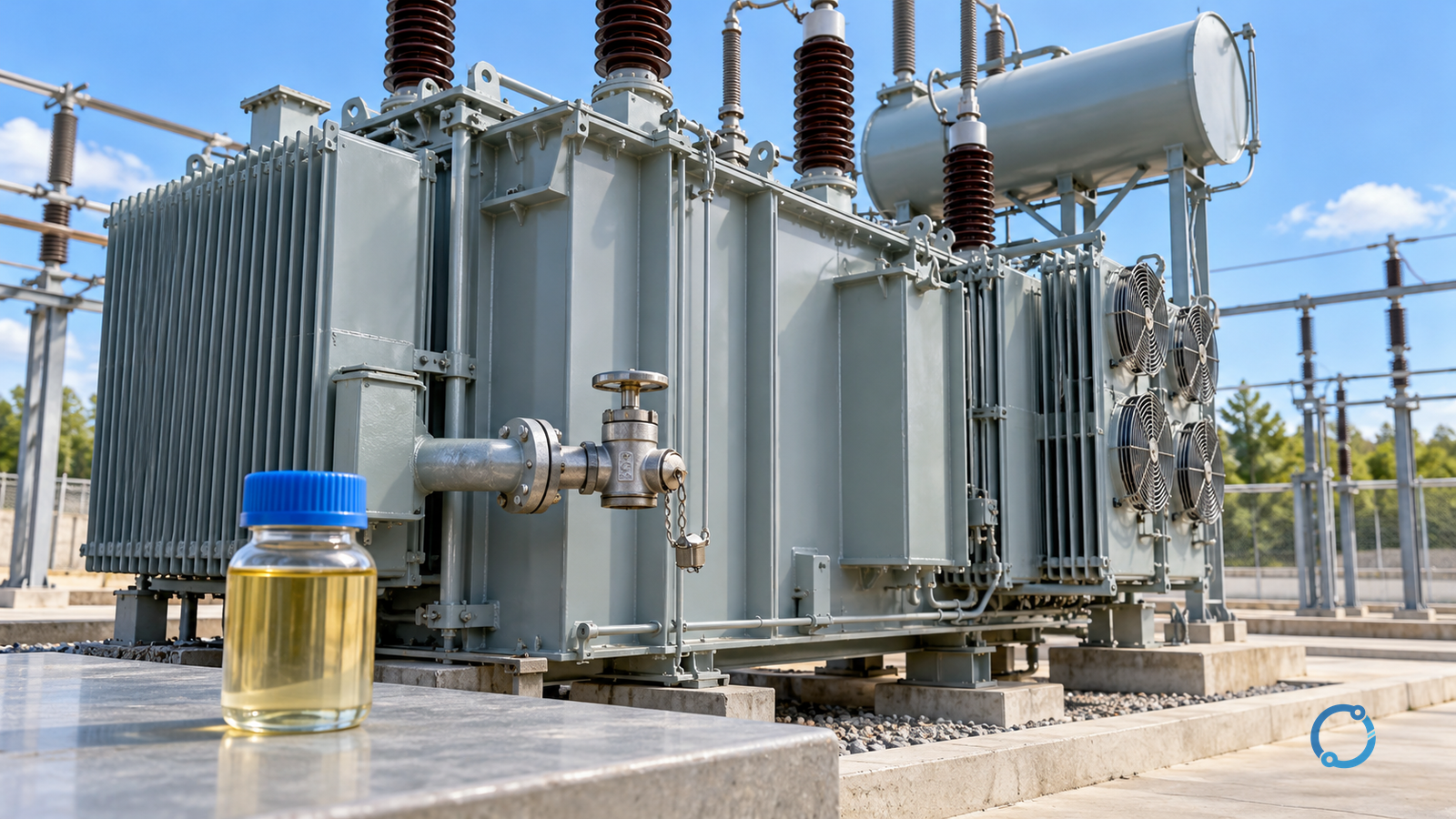
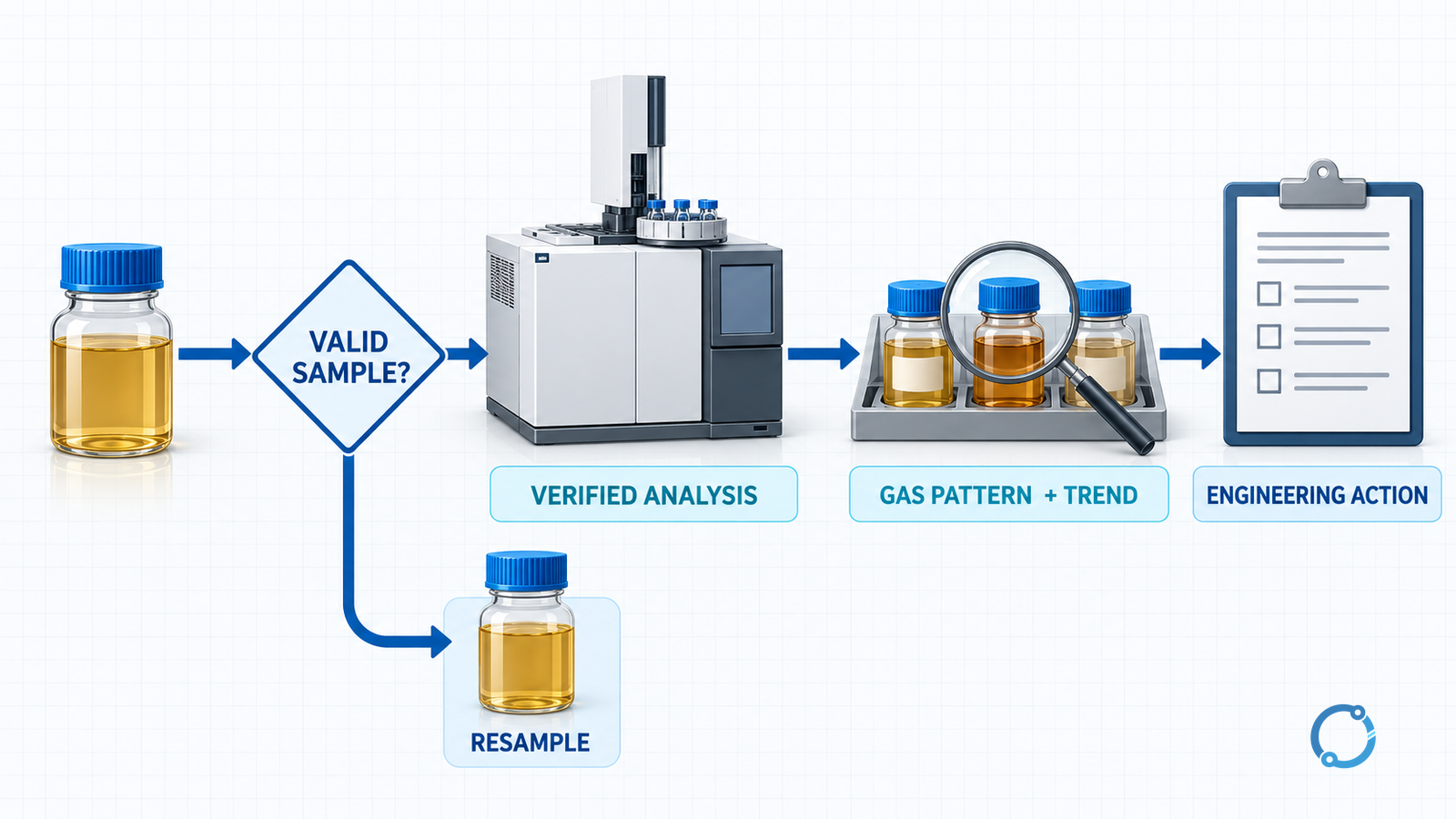
A dissolved-gas analysis (DGA) result is evidence about an oil-filled transformer, not a diagnosis by itself. First decide what question the report is meant to answer. Then verify that the sample, laboratory method and operating record describe the same transformer under a usable condition. Only after those gates should you compare gas concentrations, gas relationships and trends, and ask whether the evidence justifies monitoring, further tests, an outage inspection or immediate risk control.
IEC 60599:2022 describes how concentrations of dissolved gases or free gases can be interpreted to diagnose the condition of mineral-oil-filled equipment in service and suggest future action. Its scope covers equipment insulated with cellulosic paper or pressboard-based solid insulation, and it applies to other liquid-solid systems only with caution. The same publication is explicit that its indications are guidance and that resulting action requires proper engineering judgment. That sentence is the controlling boundary for this article: a laboratory gas label can identify a question, but it cannot complete the transformer decision alone.
Start with the decision, not the gas name
Two transformers can both have an elevated gas concentration and need different actions. One may have a stable historical pattern with no change in operation. Another may have the same concentration after moisture ingress, a through-fault, a cooling failure or a protection trip. The gas result does not contain enough information to tell those histories apart.
Write down the decision first:
- Is this a routine condition assessment from an in-service transformer?
- Is it a follow-up to an alarm, trip, Buchholz operation or protection event?
- Is it a pre-energization check after repair, transport or oil processing?
- Is it a comparison between two samples of the same unit, or a comparison with a generic fleet report?
- Is the immediate question whether to keep operating, add sensors, plan an outage or escalate for specialist investigation?
The answer determines which evidence is relevant. A routine monitoring report can often be handled on a trend basis. A report that follows a protective trip needs the trip record, relay flags, oil and winding temperatures, load history and the isolation state before the transformer is returned to service. A pre-energization report needs the repair and sampling history because a recent oil treatment can change the gas baseline.
Do not let the report title choose the action. The same gas value can be a baseline observation in one context and an unresolved risk in another.
Verify the sample before interpreting the gas
Gas concentrations are only as useful as the sample and analysis behind them. IEC 60567:2023 covers techniques for sampling free gases from gas-collecting relays and for analysing free and dissolved gases. It states that oil sampling from equipment such as power and instrument transformers is covered instead by IEC 60475:2022. The standard also describes different extraction methods before gas chromatography, including vacuum extraction, stripping and headspace partition.
That matters for a practical report review because a result without method context can be difficult to compare with the previous laboratory result. Before comparing the numbers, confirm:
| Evidence item | What to verify | Why it changes the interpretation |
|---|---|---|
| Transformer identity | Plant tag, serial number, winding or compartment sampled, oil type and any recent oil transfer | A report attached to the wrong unit is not evidence for this unit. |
| Sampling date and event time | Time since a trip, repair, oil addition, degassing or long outage | A fresh repair or oil treatment can create a new baseline. |
| Sample container and handling | Approved container, filling and sealing method, transport and laboratory receipt condition | Air ingress, leakage or delay can undermine a sample. |
| Laboratory method | Oil-sampling procedure, extraction method, instrument calibration and reporting basis | Different valid methods may produce results that require like-for-like comparison. |
| Operating state | Load, voltage, top-oil or winding temperature, cooling mode, tap position and any overload | Gas generation and dissolved concentration can reflect service conditions, not only a fault. |
| Previous trend | Earlier result, same extraction method where possible, and elapsed time between samples | A rate of change can carry more decision value than one concentration. |
This is not a claim that every report must contain every field. It is a gate: if a decision depends on a missing item, obtain it or limit the conclusion. IEEE C57.104-2019 likewise treats DGA quality verification and limitations as explicit parts of the interpretation guide, not as optional introductory material.
The report may be valid but unsuitable for the question
A properly analysed sample can still be weak evidence for a specific question. A sample from an oil tank may not represent gas trapped in a Buchholz relay. A sample taken long after a relay event may not describe the gas that operated it. A sample taken after venting or oil processing may describe the new state rather than the initiating event.
Do not identify a fault from gas smell or color, and do not improvise a gas collection or flame test. If the event is a relay operation, preserve the relay and gas evidence, then use the separate Buchholz relay troubleshooting workflow for the relay-specific chain. The DGA report in this article owns the gas interpretation; the relay page owns the relay element, contact and physical condition checks.
Build a transformer baseline around the gas result
A DGA result is most useful when it is attached to a stable operating and maintenance baseline. Collect the baseline before comparing it with historical results or with a laboratory commentary.
Electrical and thermal history
Record the transformer rating and application context without turning the article into a sizing exercise. The transformer kVA rating basis explains why the nameplate number is not the same as the permissible operating profile. For the DGA review, the useful items are:
- actual load and duration near each sample;
- cooling state and ambient conditions;
- top-oil and winding temperature records where available;
- voltage, frequency and phase-balance abnormalities;
- tap position and recent tap-change activity;
- through-fault, short-circuit or protection operations;
- oil level, leaks, pump or fan changes and recent maintenance.
High temperature can matter because thermal conditions affect gas generation and the interpretation of a thermal signal. That does not make one temperature reading proof of a thermal fault. A single temperature spike and a sustained overload leave different evidence, and a cooling-system failure must be confirmed separately.
Oil and insulation history
Record oil type, additives, any reclaimed or processed oil, moisture history, oil-filtration or degassing, and whether the sample came after a top-up. Also record any repair that opened the transformer or altered the gas-transfer path. The oil and paper insulation system, not just the gas analyser, is the physical context for the result.
If there is liquid leakage or water ingress, stop treating DGA as a self-contained result. Moisture and insulation condition may need separate tests and a different sampling plan. This page does not provide those tests or their acceptance values.
Protection and relay history
A gas result can be relevant to an event that also produced a differential trip, an overcurrent trip, an alarm or a pressure-relay operation. Keep the event records together. Do not use a normal DGA result to clear a protection operation, and do not use a gas pattern to reset a lockout by itself.
That is especially important when several protection functions operated. The correct next step may be to review the protection event and the complete transformer condition, not to ask DGA to settle a relay question it was never designed to answer.
Read the gas pattern as a set of related observations
Laboratory reports commonly list gases such as hydrogen, methane, acetylene, ethylene, ethane, carbon monoxide and carbon dioxide. Names alone are not a fault hierarchy. The interpretive task is to examine the pattern and the conditions under which it developed.
| Group or gas | Engineering question it can raise | What it does not establish alone |
|---|---|---|
Hydrogen (H2) |
Is there a signal associated with partial-discharge or other low-energy activity? | A specific fault, its location or a required repair. |
Methane (CH4) |
Is there evidence of thermal or decomposition activity that needs correlation with temperature and load history? | Whether the unit is safe to remain in service. |
Ethane (C2H6) and ethylene (C2H4) |
Is there a thermal pattern whose trend or relation to temperature deserves attention? | A unique fault temperature or a definitive fault mechanism. |
Acetylene (C2H2) |
Is there a high-energy decomposition signal that warrants urgent engineering attention? | The exact fault site, fault current or safe release action. |
Carbon monoxide (CO) and carbon dioxide (CO2) |
Is there evidence related to cellulosic insulation condition that should be read with moisture and load history? | That paper is damaged, or that the transformer has reached a replacement decision. |
| Total dissolved combustible gas | Is the overall gas burden moving in a way that changes the monitoring interval? | A universal urgency category without the applicable standard and laboratory basis. |
The table is an interpretation map, not a list of limits. IEC and IEEE contain detailed criteria and diagnostic methods that must be used in the appropriate edition and scope. Do not import a threshold from an unrelated transformer fleet, blog, datasheet or app. Concentrations reported in microlitres per litre, parts per million by volume, or another laboratory convention must be compared only after normalizing the reporting basis.
Ratios are supporting logic, not a verdict
Gas-ratio methods can be useful for organizing a pattern, but they are sensitive to measurement uncertainty, background gas and sampling context. A ratio can produce a plausible label while several different physical conditions remain possible. The safe output is a ranked question, not a conclusion:
The pattern is consistent with a thermal or decomposition signal that merits confirmation against trend, temperature and other evidence.
That wording leaves room for a thermal hot spot, a localized electrical discharge, contamination, a recent oil-processing artefact or a non-representative sample. It also makes the next evidence request visible.
Where the report gives a diagnostic suggestion, preserve the laboratory’s exact terminology and ask what data support it. Do not convert a classification category into a maintenance order without the transformer owner’s assessment framework.
Compare trend, severity and evidence quality together
Concentration answers “how much was present at this sample”? Trend answers “how is the gas state changing”? Evidence quality answers “can I trust this number enough to use it”? A defensible review keeps all three separate.
| Review dimension | Useful question | What to do if the answer is incomplete |
|---|---|---|
| Absolute result | Which gases, concentrations, reporting units and detection limits are present? | Obtain the laboratory’s complete report and ensure the values use the same basis. |
| Rate of change | Has the result changed since the previous sample, and over what interval? | Reconstruct the elapsed time and operating history before choosing a new monitoring interval. |
| Pattern | Do several gases move together, or is the signal isolated? | Check sample quality and analytical uncertainty before treating a small difference as a trend. |
| Correlation | Do temperature, load, cooling, moisture or protection events explain part of the change? | Retain the unresolved gas question and request the missing operating evidence. |
| Reproducibility | Was the sample and method comparable with the earlier result? | Compare cautiously and ask the laboratory whether a resample or repeat analysis is appropriate. |
| Consequence | What equipment, supply or safety function depends on the next decision? | Escalate according to the project’s risk and operating authority, not a generic fear phrase. |
The same concentration in a small distribution transformer and a critical grid transformer can have different operational consequences without the gas interpretation changing. This is why the correct first output of DGA review is a decision risk statement, not a transformer defect label.
An illustrative comparison
Consider two fictional samples from the same fictional transformer. In the first, one gas is slightly higher but the laboratory’s repeatability band overlaps the previous result, the transformer temperatures were normal and the sample method matches the earlier report. In the second, the same gas is higher and a second gas is also moving while top-oil and load records show a sustained change. The second result deserves a stronger follow-up because the pattern and context changed together. The first result may deserve verification before it is described as a trend.
This is not a rule for any real transformer. It shows why a report reader should preserve the measurement basis, compare like with like and look for an independent signal rather than treating a small number difference as a fault progression.
Choose the investigation that fits the unresolved question
DGA is one evidence stream. The next check depends on what remains uncertain.
| Unresolved question | More useful next evidence | Do not substitute |
|---|---|---|
| Is the sample representative? | Check sampling records, container condition and laboratory receipt; arrange a controlled resample where justified. | A second opinion based only on the same report. |
| Is there a thermal condition? | Correlate load, top-oil and winding temperature, cooling operation, oil flow and the gas trend; use the transformer’s approved diagnostic plan. | A fixed DGA threshold applied without the unit’s history. |
| Is there a low-energy discharge signal? | Move to the appropriate electrical, acoustic or electromagnetic diagnostic method under a qualified plan. | An improvised listening test or a gas smell observation. |
| Is paper insulation involved? | Combine gas evidence with moisture, oil quality and other condition indicators. | A CO or CO2 result treated as a complete paper assessment. |
| Did a relay or protection operation contribute? | Preserve the event record and use the relay-specific diagnostic path. | A normal DGA result used to clear the trip. |
| Is there a prompt operating risk? | Apply the operating authority’s protection, isolation and escalation procedure. | Continuing to operate because the transformer is still loaded. |
The transformer abnormal-noise diagnostic guide is useful when sound is one of the presenting symptoms, but sound is not required to confirm a gas-related concern. Keep each evidence stream linked to the question it can answer.
Set the stop and escalation boundary
A lab report needs an owner. Define who will review it, who can authorize a resample, who can change the operating regime and who must be involved when a protection trip or abnormal condition is unresolved.
Stop the routine-monitoring interpretation and escalate when any of the following is present or cannot be excluded:
- a transformer protection trip or repeated alarm without an explained cause;
- a sudden gas change accompanied by abnormal temperature, pressure, oil level or sound;
- visible oil leakage, smoke, unusual smell, transformer damage or a compromised enclosure;
- a sample with unknown identity, broken chain of custody or visible handling defect;
- an urgent operating consequence that exceeds the reviewer’s authority;
- a gas pattern that the responsible engineer cannot reconcile with the available evidence.
These are not universal gas thresholds. They are trigger points for human control. The transformer standard and the site’s operating procedure decide the detailed limits and release conditions.
What a useful DGA conclusion should contain
A defensible conclusion has five short parts:
- Scope: the transformer, sample date, service state and question the report was meant to answer.
- Quality: whether sample, analysis and method comparisons were adequate for this decision.
- Observation: the gas pattern and trend in their reporting units, without dropping inconvenient uncertainty.
- Interpretation: what the evidence supports and what competing explanations remain.
- Action and owner: the next check, the monitoring interval or operating restriction, who owns the decision and what event reopens it.
That format is more useful than a line that says “fault gas present” because it tells the next reader what is established, what is missing and what can safely happen next. It also prevents one person’s gas label from silently becoming the next person’s root-cause claim.
The practical answer
Transformer DGA is valuable because it can reveal a change in the oil-insulation system before an external inspection sees it. Its weakness is equally important: it reports gas evidence, not the whole condition of a transformer. Review the sample, baseline and trend before the gas label. Use standards as interpretation frameworks, not as stand-alone permission to operate. When the evidence becomes uncertain or the consequence is serious, stop, preserve the data and bring in the qualified engineering and protection expertise that the decision requires.
Sources
- IEC 60599:2022: Interpretation of dissolved and free gases, published 2022-05-25, edition 4.0.
- IEC 60567:2023: Sampling and analysis of free and dissolved gases, published 2023-12-08, edition 5.0.
- IEEE C57.104-2019: Guide for the Interpretation of Gases Generated in Mineral Oil-Immersed Transformers, active standard, published 2019-11-01.