
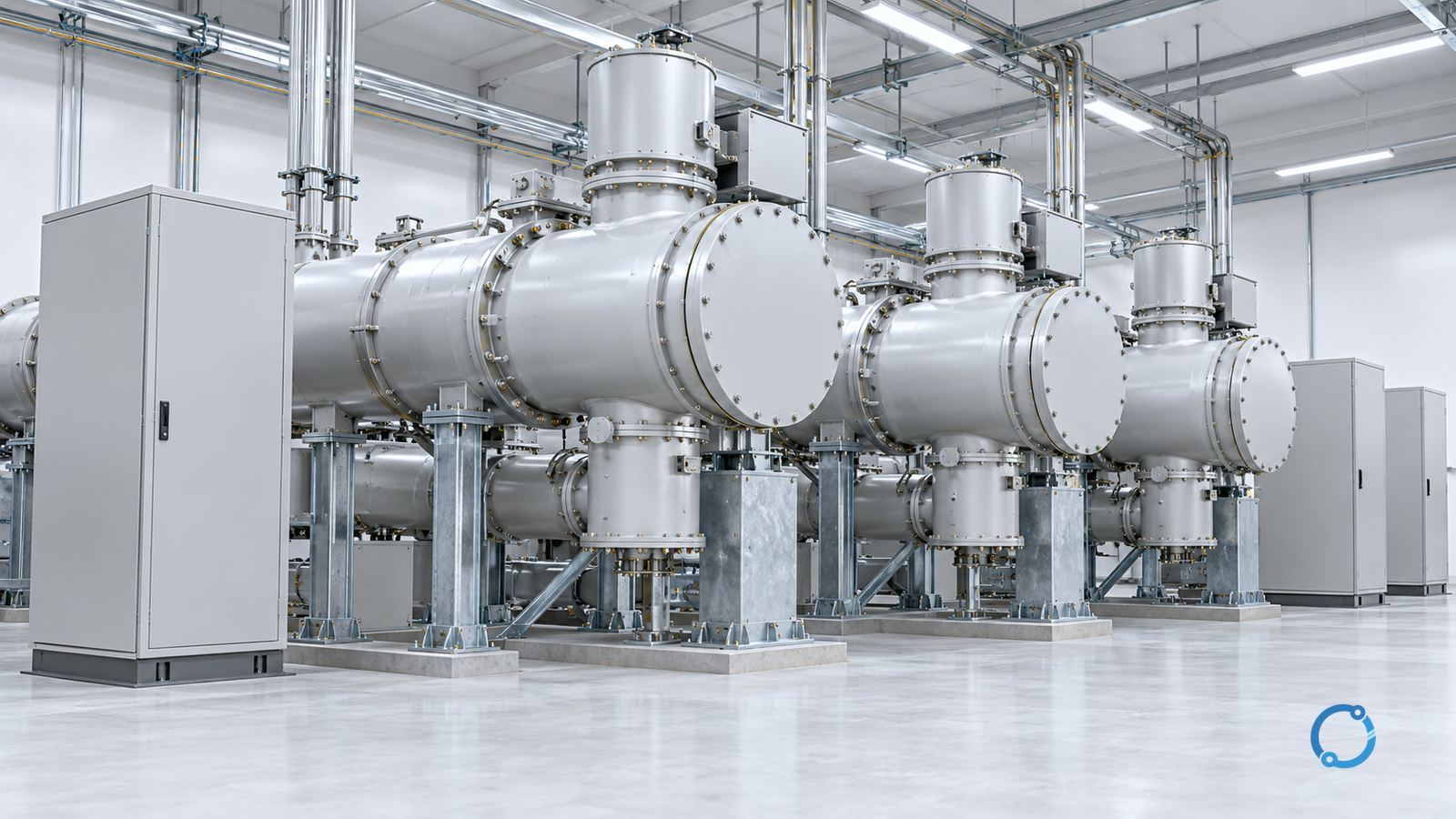
A gas-insulated switchgear (GIS) bay outage needs three reconciled boundaries: the primary electrical circuit, the protection/control interfaces and the gas compartments affected by the task. A bay name on a permit does not prove that these boundaries coincide.
Before maintenance, connect each boundary to the approved operating documents and work authorization. Before handback, reconcile every temporary test or isolation state with the intended as-left configuration. This article provides a review framework for that documentation journey, not an executable switching order.
The equipment context is high-voltage alternating-current (AC) GIS, including a possible 132 kV line or transformer bay. The public scope of the International Electrotechnical Commission (IEC) standard IEC 62271-203:2022 covers gas-insulated metal-enclosed AC switchgear above 52 kV at frequencies up to 60 Hz. That equipment standard’s scope does not supply a maintenance procedure for a particular installation, gas mixture or bay design.
Define the task more precisely than “bay maintenance”
Replacing an external control component, testing a protection function and opening a primary gas compartment are different jobs. Do not assign the same electrical, mechanical or gas-handling requirements simply because all three occur in one bay.
Collect the current single-line and general arrangement drawings, gas-compartment map, control/protection diagrams, interlock scheme, operating instructions, work scope and outage interfaces. Identify the actual equipment and document revisions. Where records disagree with site identification or condition, keep the task on hold until the responsible authority resolves the mismatch.
This is an existing-equipment outage and handback problem. The MV switchgear commissioning guide addresses a different endpoint: evidence for initial energization. A prior commissioning release cannot establish today’s temporary maintenance state.
Reconcile three boundaries in one register
The following register is an editorial review tool. It is not a reproduced IEC checklist or a substitute for the owner’s approved instructions.
| Boundary | What to identify | Important dependency | Evidence needed for this task |
|---|---|---|---|
| Primary electrical | Relevant bus, line/transformer connections and all possible sources | Adjacent bays, alternate feeds, induced voltage and stored energy | Approved isolation/clearance documents, verification and protective-grounding basis |
| Protection and control | Trip/close commands, auxiliary supplies, interlocks, indications and remote interfaces | Shared functions and paths that can operate equipment elsewhere | Task-specific interface schedule and controlled temporary-state record |
| Gas and mechanical | Compartment identity, physical access and work affecting pressure containment | Compartment boundaries may differ from bay naming | Actual compartment drawings and equipment-specific gas/mechanical procedure |
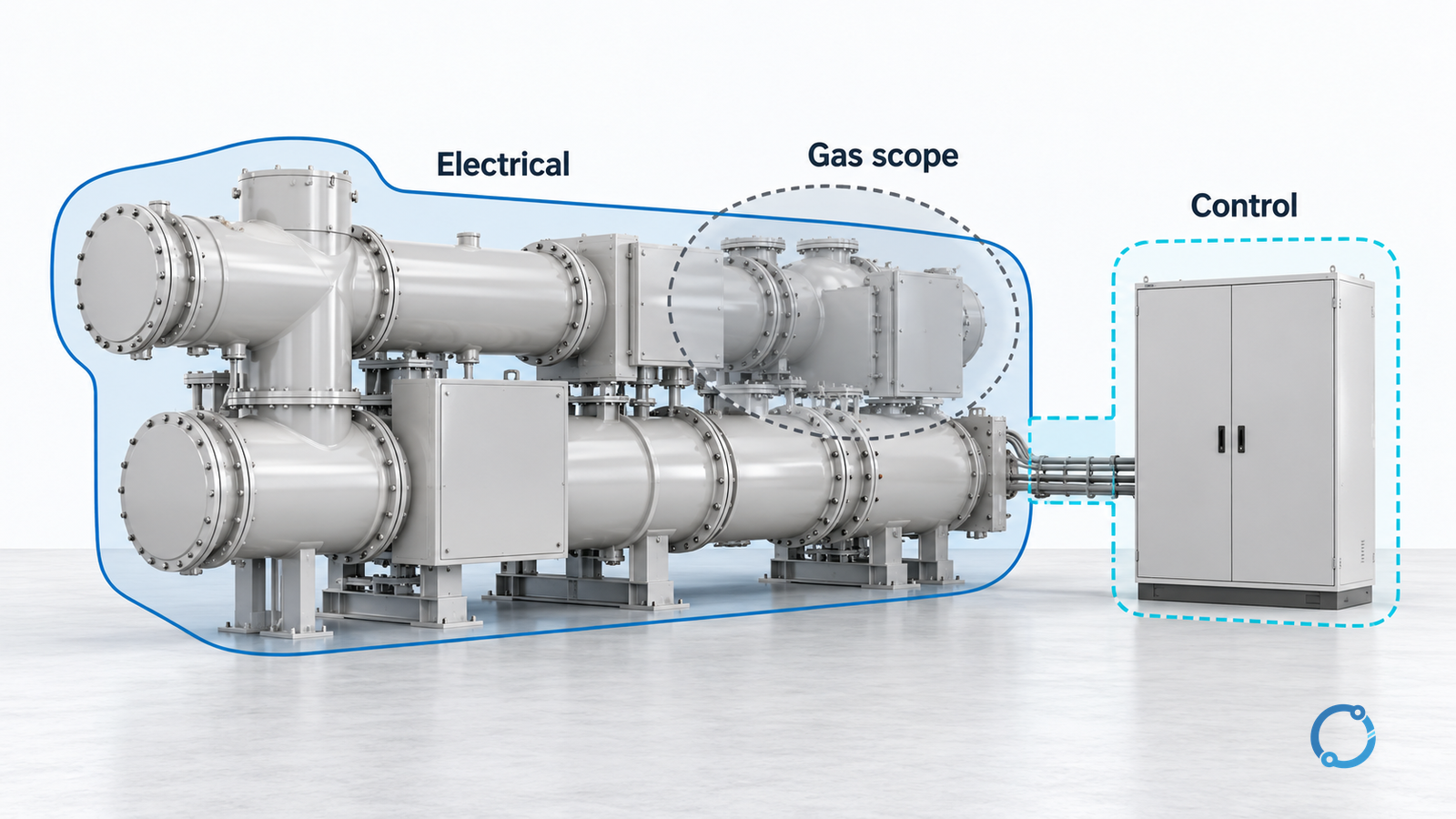
An electrical boundary answers which conductors and sources belong to the work. A gas boundary answers which pressure-containing space is affected. A control boundary answers which functions can issue commands, trip equipment or report a substituted state. None of those answers can be obtained reliably from the other two alone.
Require the approved electrical state, not an indication shortcut
For covered U.S. transmission and distribution work, the Occupational Safety and Health Administration’s (OSHA) deenergizing guidance distinguishes equipment that is merely shut down from equipment established as deenergized for work. Applicable source control, testing and protective-grounding requirements must be met by the qualified, authorized team. Other jurisdictions and activities need their governing provisions.
The review should identify the source-control document, responsible clearance authority, affected equipment and work limits. An open-breaker signal, local/remote selection or gas-density indication is not proof of the complete electrical work state.
Use the approved site-specific switching order and its required sequence. This article intentionally gives no list of breaker, disconnector and earthing-switch operations. Their identities, capabilities, interlocks and permitted states are installation-specific. Never bypass an interlock to make a generic sequence fit the actual bay.
Control interfaces that cross the outage
Map which protections and controls remain available, which are isolated for the task, and which shared functions are affected. A local control-power interruption can have implications different from primary isolation; classify it rather than assuming it makes the bay safe.
Record temporary relay modes, test switches, injected signals, disabled commands, substituted indications and isolated trip paths where the approved task requires them. Each temporary state needs an owner, purpose, affected function and restoration check.
The substation trip-circuit guide covers the complete detection-to-breaker path. Use it for that separate verification task rather than treating a successful relay test as proof of every field interface.
Remote supervision also needs an explicit handover. The SCADA specification and acceptance guide explains command authority and stale-data behavior. A maintenance flag on a screen does not by itself inhibit every possible operation.
Match gas work to the actual compartment and medium
A task that does not open or otherwise affect a gas compartment should not acquire an invented gas-handling step. Conversely, electrical isolation does not grant permission to loosen a pressure-containing flange.
Where gas or pressure-boundary work is included, require the actual equipment procedure, medium identification, competent personnel and applicable environmental and occupational controls. Determine how neighboring compartments and equipment in service are affected. Do not assume every GIS uses the same insulating medium or construction.
No universal gas pressure, purity, moisture limit, evacuation time or maintenance interval is specified here. Those values and acceptance methods must come from the applicable equipment and project evidence. Do not infer them from nominal system voltage or an unrelated bay’s service report.
Track work, test and as-left states separately
Use a state-change record rather than a single “maintenance complete” checkbox:
| State record | Purpose | Handback question |
|---|---|---|
| As found | Preserve initial condition, configuration and known defects | Is an initial defect still unresolved or newly understood? |
| Authorized work state | Identify the accepted boundaries and task controls | Did the actual task stay within the authorization? |
| Test state | Track temporary setups and functions represented or isolated | What did each test prove, and what remained outside it? |
| As left | Record accepted configuration and remaining restrictions | Has every relevant temporary state been dispositioned and verified? |
For example, a hypothetical interface test can leave a substituted position indication after its instrument is disconnected. A satisfactory test report does not close that restoration item. Reconcile the indication at its source, the restored signal path and the receiving system under the approved procedure.
Before reenergization, apply the actual clearance-release and restoration requirements. OSHA 1910.269(m) includes coordination of crews and the conditions for reenergization within its scope. One crew’s completion cannot authorize restoration while another clearance remains active. Protective grounds and tags are managed by that process, not removed through a blanket instruction in a blog.
Retain the accepted work scope, three-boundary register, maintenance/test evidence, temporary-state dispositions, unresolved restrictions and authorized handback. The review is complete when operations can trace the intended state to accepted evidence—not merely when tools have left the bay.