
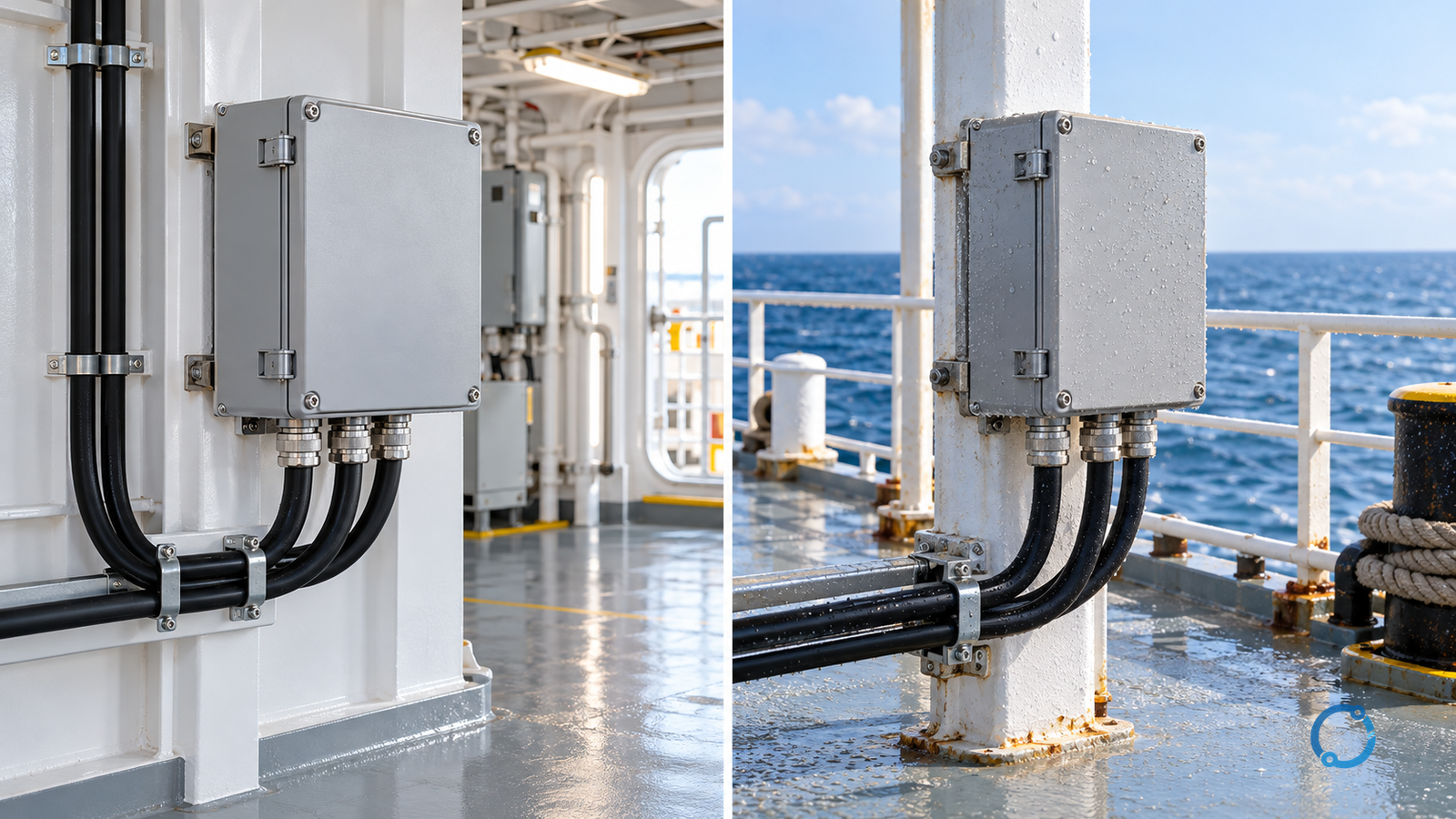
A corrosion-resistant marine terminal block is not a complete corrosion-resistant connection. The contact system, conductor preparation, cable support, enclosure and operating environment must work together. Selection should start with the actual vessel location and approval basis, not a material label or an IP rating.
This guide covers conventional shipboard terminal connections. It does not prescribe marina shore wiring, hazardous-area certification or a universal terminal material. The outcome is an exposure-to-evidence register that a qualified designer can use to accept or reject the complete assembly.
Describe the exposure before comparing products
A dry internal control cabinet, a machinery-space junction and an exposed deck enclosure are different environments. Record salt contamination, wetting, condensation, cleaning agents, temperature, vibration and access for inspection. A connection that rarely receives direct spray can still experience moisture when a cabinet cools.
Ingress protection is evidence about enclosure ingress performance under defined tests; it is not proof of indefinite resistance to marine corrosion. Likewise, a salt-spray test description does not establish a service lifetime without the relevant material, preparation, exposure and acceptance context.
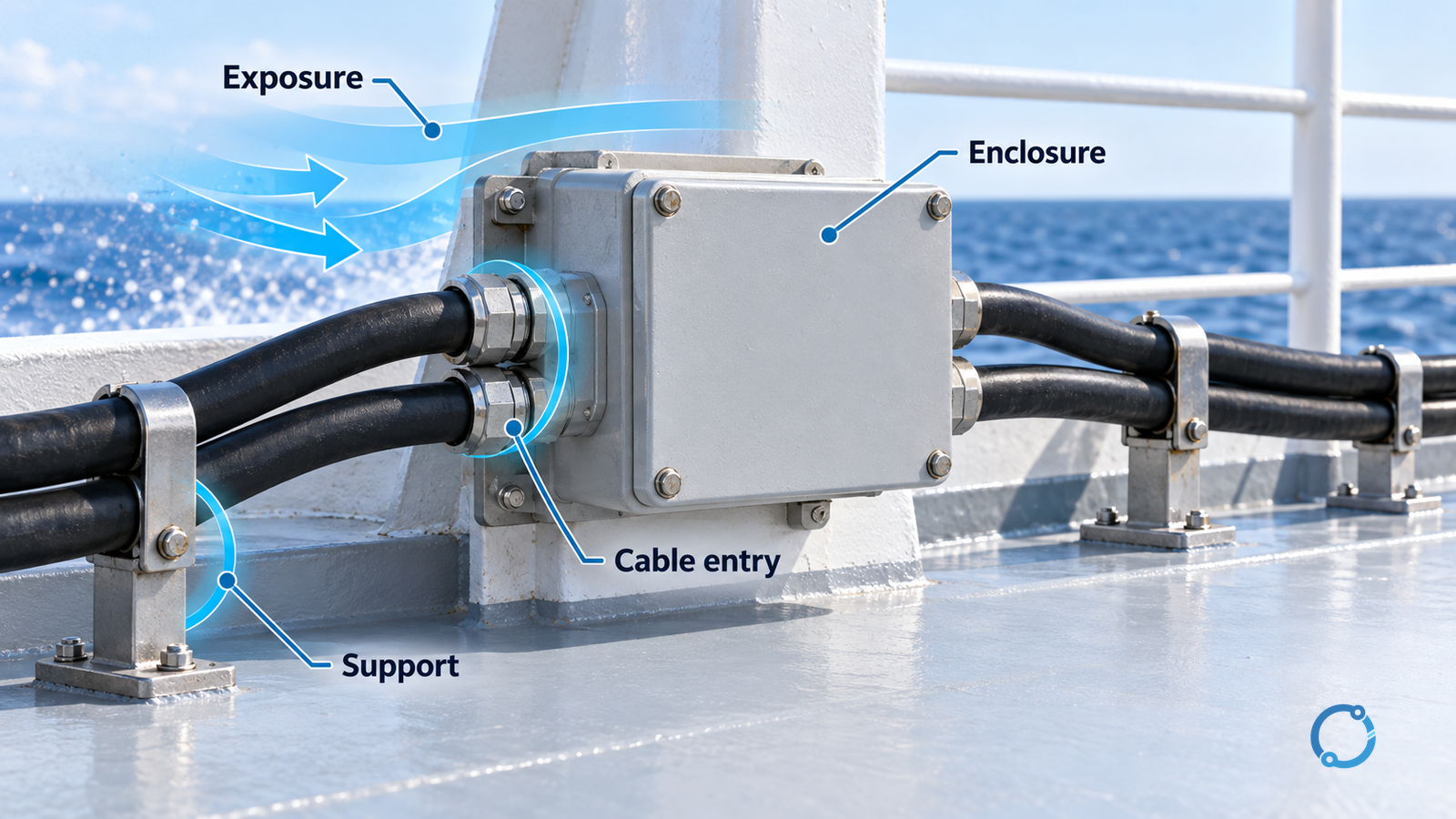
Separate vulnerable surfaces from electrical interfaces. Enclosure fasteners may corrode while contacts remain protected, or moisture may reach a contact inside an apparently intact enclosure. Inspecting only the outside misses the connection’s functional boundary.
Use an exposure-to-connection evidence register
| Exposure or interface | What to request | Reason to hold approval |
|---|---|---|
| Salt or chemical contamination | Materials, finishes and environmental qualification for the stated location | “Marine grade” is the only evidence |
| Condensation and cable entries | Enclosure/environment design, entry compatibility and moisture-management provisions | A nominal IP rating is assumed to prevent all internal moisture |
| Stranded conductor and contact | Permitted conductor class, area range and preparation instructions | Solid-wire evidence is applied to a stranded installation |
| Vibration and cable movement | Assembly qualification, retention method and cable-support arrangement | The terminal contact is carrying unsupported cable loads |
| Cable fire properties | Connection method preserving the required cable properties | A splice changes a required property without qualification |
| Maintenance access | Inspection points, identification and replacement constraints | The joint cannot be assessed or safely serviced as planned |
This register is an engineering acceptance framework, not a certification checklist issued by a flag administration or classification society. Add the vessel’s actual rules and approved drawings before procurement.
Match the conductor, finish and preparation method
The public scope of IEC 60947-7-1:2025 addresses industrial terminal blocks for round copper conductors, including screw and screwless clamping units. Component-standard evidence is useful, but does not automatically demonstrate suitability for a particular vessel installation.
Check the exact permitted conductor construction and preparation. Do not assume that a ferrule, soldered end or additional coating improves a connection simply because it looks protective. A preparation method outside the terminal’s documented conditions can change contact behavior or clamping performance.
Contact material, plating and mating-metal compatibility should be assessed together with moisture exposure. “Tinned copper” is not a blanket approval for every terminal interface. The broader terminal-block materials guide explains material tradeoffs; the marine decision still needs the complete exposure and qualification record.
For the conductor interface itself, the solid versus stranded wire guide helps distinguish construction choices. Do not transfer a successful connection method between conductor types without checking the terminal instructions.
Do not confuse installation rules with component compliance
IEC 60092-101:2018 provides general ship electrical-installation definitions and requirements within its stated scope. Determine the adopted ship-installation standards, flag requirements, class rules and any required product approvals separately. A terminal’s industrial conformity statement is not a vessel approval certificate.
For vessels subject to the relevant U.S. Coast Guard electrical rules, 46 CFR 111.01-11 addresses corrosion-resistant material or finish for vulnerable enclosure parts. 46 CFR 111.60-17 separately addresses retaining cable properties at connections and suitability of terminal devices for copper stranded conductors. These are U.S. vessel requirements, not universal rules for all boats or offshore equipment.
The distinction matters: corrosion resistance of an enclosure does not demonstrate retention of a cable’s electrical, mechanical or required fire properties at its termination. Close both questions in the register rather than treating either one as a substitute for the other.
Accept the installed connection, then establish its inspection baseline
Before release, qualified personnel should confirm the installed device, conductor, preparation, identification, fastening and cable support against approved documents. Use the specified assembly method and tightening requirements where applicable; do not invent a generic torque or retighten every technology by habit.
Record the initial condition so later inspections can identify changes: corrosion deposits, entry damage, cable movement, moisture traces, insulation discoloration or local heating. These signs are reasons for investigation, not proof of a specific failure mechanism. Safe isolation and approved inspection procedures govern any access to electrical connections.
The pollution-degree selection guide addresses contamination at insulation interfaces. It complements, but does not replace, marine exposure and vibration evidence. A defensible release record identifies what was verified, what conditions remain assumed and which environmental or installation changes trigger reassessment.