
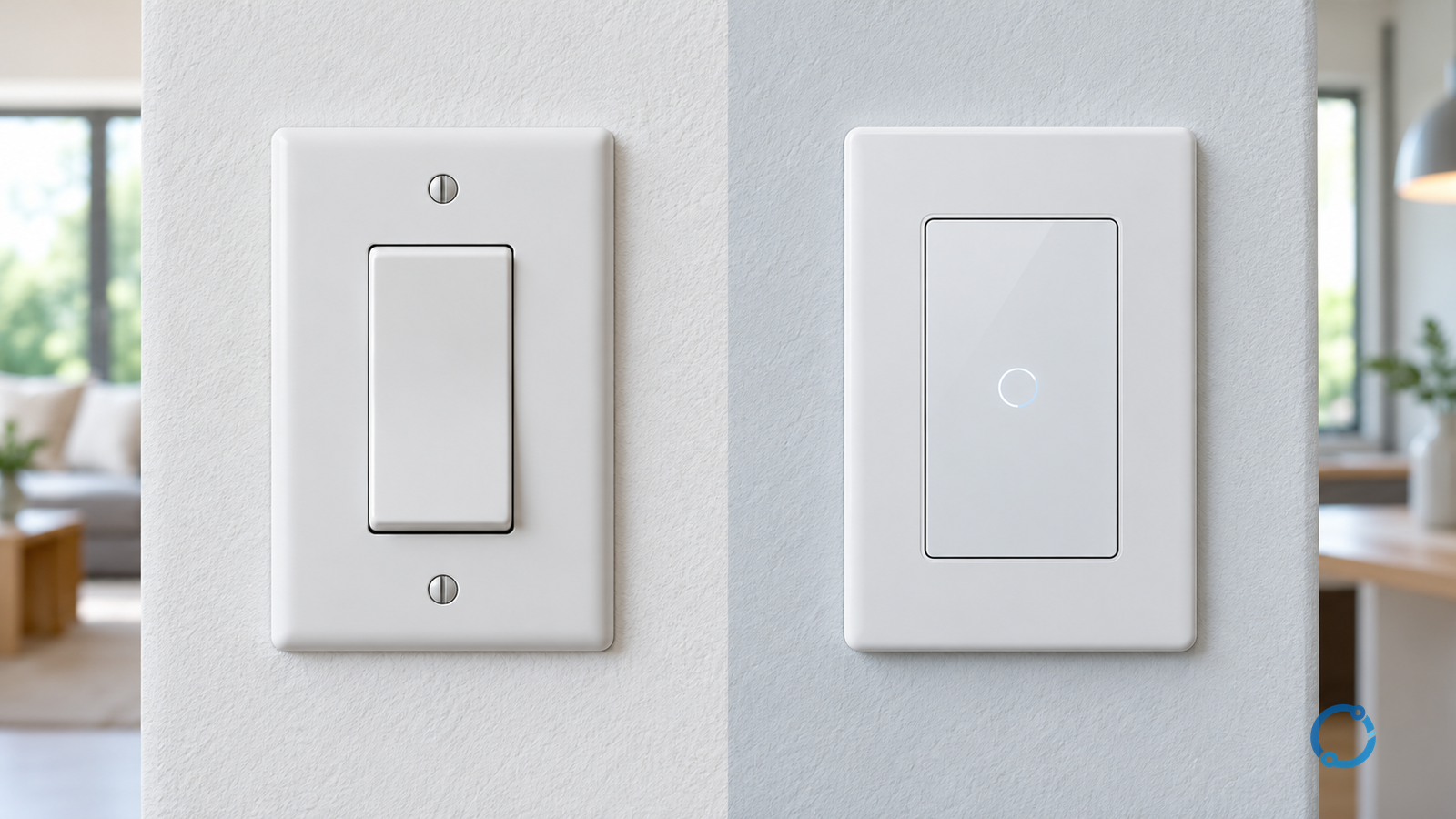
A conventional modular switch is usually the simpler choice when direct local control and a circuit that operates independently meet the need. A smart switch is justified when automation, scheduling or remote control has a defined operational value and its power, wiring, network and failure dependencies fit the installation.
Neither family is universally safer, more efficient or more reliable. The useful question is not “which switch is smarter?” but “what must the control do when the network is unavailable, the electronics fail or the load is incompatible?” This comparison is for fixed wiring accessories in homes and commercial buildings, not industrial switchgear or a substitute for an electrician’s installation procedure.
Decide the control task first
Write a requirement before comparing products:
| Requirement | Modular switch | Smart switch |
|---|---|---|
| Local on/off control | Direct mechanical or electronic operation, depending on the accessory | Local button or touch interface plus control electronics |
| Scheduled operation | Needs a separate timer or control system | May be provided by the device or a hub |
| Remote operation | Needs an external control layer | May use Wi-Fi, Bluetooth, Zigbee or another platform |
| Scene or group control | Depends on wiring or an external controller | Often a core function |
| Operation without network | Normally no network dependency | Depends on the design; local fallback must be checked |
| Operation after electronics failure | Depends on the exact switch design | May lose local or remote function; verify failure mode |
The terms “modular” and “smart” describe market families, not complete electrical specifications. A modular switch can contain electronics, and a smart switch can use a relay, semiconductor or hybrid output. Ask for the exact device type, wiring diagram, load rating and installation instructions.
Load compatibility is the first hard gate
Do not assume that a smart switch can replace a mechanical switch controlling any load. Check the declared load types and limits for lights, fans, motors, drivers, electronic transformers and mixed loads. Inrush current, minimum load, power factor, dimming method and neutral requirements can all change the answer.
For dimming, the control method matters. Leading-edge, trailing-edge, phase-cut, relay and low-voltage control are not interchangeable. A lamp or driver that works with one method may flicker, fail to start or be unsuitable for another. Obtain compatibility evidence from the actual device instructions and the luminaire or driver information.
The IEC 60669-1:2017 catalog identifies the general scope for manually operated fixed-installation alternating-current switches. The IEC 60669-2-1:2021 catalog addresses electronic control devices within its particular scope. A standard-scope reference is not a certificate for a specific product or a promise that every load is compatible.
Neutral and wiring can decide the project
Many smart switches require a neutral or a defined power-supply connection; others are designed for a particular wiring arrangement. A wall box may have only the switched and permanent line conductors available, or it may not have the neutral at the switch location. Adding a conductor is not a cosmetic change: the circuit, protection, box capacity and applicable installation rules must be assessed.
Before ordering, record:
- the existing switch-loop wiring;
- whether a neutral is present and suitable;
- the number of controlled circuits;
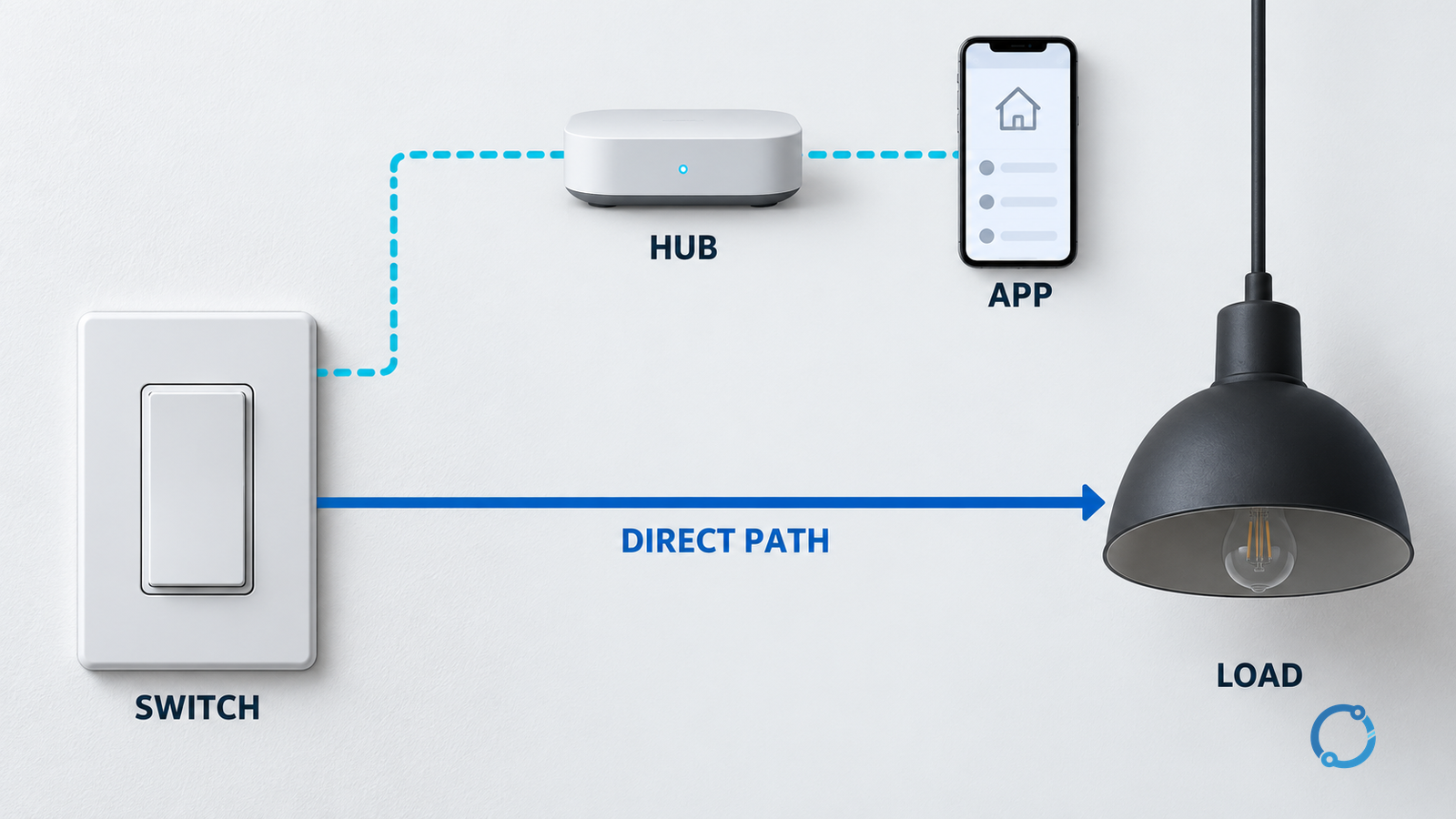
- whether the switch needs a hub or gateway;
- whether the device can operate as a two-way or multi-way control;
- the box depth and heat dissipation;
- the load’s inrush, standby and minimum-load behavior.
The modular switch and socket installation checklist covers verification gates around mounting, polarity, earthing and function testing. The switch and socket warning-sign guide explains when a user should stop and seek qualified help.
Compare failure behavior, not just features
A switch is part of a circuit that may need to work during an outage, a network loss or a control-system failure. Ask what happens when:
- the home network is unavailable;
- the cloud service or mobile app is unavailable;
- the electronic module loses power;
- the gateway is reset;
- the device firmware is updated;
- the relay sticks or the output fails;
- the switch is replaced or the building changes ownership.
Local switch action may remain available, may require the app, or may be lost depending on the design. A conventional switch has no network dependency but may still fail mechanically or electrically. Compare the actual failure modes, not an assumption that “mechanical” means trouble-free or “smart” means fragile.
Cybersecurity and privacy belong in the requirement
Remote-control devices can expose a control interface, account and data path. For a home, the consequence may be unauthorized switching; for a commercial site, it can affect access, lighting or process areas. Consider:
- account protection and local-network exposure;
- firmware-update support;
- device identity and pairing controls;
- cloud dependency and data retention;
- logging and recovery after a lost phone or account;
- removal of devices when a tenant leaves.
These are selection questions, not a certification of any protocol or brand. Do not claim that one wireless technology is secure without evaluating the complete implementation and operating process.
Serviceability and spare parts change the total choice
A modular system may offer straightforward replacement of a switch module, while a smart installation may depend on a hub, app version, account or a discontinued model. Check:
- replacement availability;
- local configuration backup;
- whether a replacement needs re-pairing;
- compatibility with existing hubs and sensors;
- access for firmware updates and support;
- documentation for the next occupant or maintenance team.
A conventional switch is not automatically easier to maintain if its circuit is poorly documented. A smart switch is not automatically harder to maintain if the building has a planned controller and support process. Evaluate the installed system, not only the wall plate.
Use a conditional selection rule
| Choose a modular switch when… | Choose a smart switch when… |
|---|---|
| The required function is direct local switching | A remote, scheduled or scene function has real operational value |
| The load is standard and the existing wiring suits the device | The load, neutral, hub and power-supply requirements are verified |
| A network or account dependency is undesirable | A managed network and recovery process are available |
| Simple repair and familiar operation are priorities | The system can be supported, updated and replaced |
| The design does not justify added complexity | The additional control layer is appropriately protected |
If the smart option fails one hard gate—load compatibility, wiring, neutral, heat, certification or safe enclosure—the answer is not to hide the issue with a larger product list. Keep the option on hold or choose a different control architecture.
A six-gate selection record
- Control need: what must be controlled, from where, and when?
- Electrical compatibility: load type, current, inrush, dimming and neutral.
- Wiring and enclosure: available conductors, box space, heat and mounting.
- Control dependencies: hub, app, network, account and firmware.
- Failure and safety: local operation, stuck output, loss of supply and maintenance.
- Acceptance: manufacturer instructions, applicable product evidence, installation verification and user handover.
The IEC 60364-6:2016 catalog identifies the scope of installation verification, but a product standard or a commissioning checklist does not authorize unqualified electrical work. Isolation, testing and replacement should follow the applicable installation rules and local procedures.
For contact and multi-way behavior, obtain the device’s switching diagram and confirm the number of poles, throws and positions needed for the circuit. For the installation boundary, use the modular switch checklist above. The correct choice is the simplest control architecture that satisfies the verified operational requirement without creating an unmanaged dependency.