

Stop using a switch or socket that shows scorching, melting, unexplained crackling, physical damage or an electric-shock symptom. Keep people away and arrange assessment by a competent electrical professional. Do not remove the faceplate, touch it to judge temperature, or reconnect a load to reproduce the fault.
This guide is for users of household and similar accessories, including occupants and people reporting defects in small workplaces. It covers external observations, not installation, repair or electrical testing. United Kingdom (UK) Health and Safety Executive (HSE) guidance and Electrical Safety First advice provide the safety references; local emergency arrangements and electrical rules still apply elsewhere.
If there is smoke, fire, sustained sparking, an exposed conductor or an injured person, follow the site’s emergency procedure and contact the appropriate emergency service. Do not approach the accessory to unplug it or operate its switch. Have the responsible person arrange isolation from a suitable safe location.
Warning signs: what to report and what not to do
A fault does not need to trip a breaker before it deserves attention. Electrical Safety First identifies heat, burn marks and unexpected buzzing or crackling among the warning signs users should not ignore. These observations justify investigation; they do not identify the exact internal failure. Electrical Safety First safety advice
| External symptom | Safe response | Avoid this shortcut |
|---|---|---|
| Scorching, discoloration, melting or a burning smell | Stop use, keep clear and report promptly; escalate any active emergency | Wiping away the mark and continuing to use the outlet |
| New crackling, sizzling or intermittent buzzing | Report the sound and circumstances without repeatedly operating the accessory | Pressing the switch harder or holding a plug at a particular angle |
| Cracked plate, missing piece or loose accessory | Keep it out of use pending assessment, especially if live parts might be accessible | Taping over the damage or removing the plate to look inside |
| Plug intermittently loses power in normal use | Stop using that connection and report the intermittent supply | Wiggling it to find a position that works |
| A shock or tingling sensation associated with equipment | Stop use, protect people from further contact and obtain urgent assistance | Testing the sensation again with a hand |
| Repeated protective-device operation | Report the affected circuit and loads; have the cause investigated | Repeatedly resetting, bypassing protection or increasing its rating |
| Water entry or dampness around an accessory | Keep clear and arrange isolation and assessment | Drying an energized socket with a cloth, heater or hair dryer |
A faint sound from an electronic dimmer or a power supply is not enough to diagnose an arc. Its origin and permissible behavior depend on the particular equipment. A new or changing sound accompanied by heat, intermittent operation or odor deserves a stop-use report, not a confident diagnosis based on sound alone.
Why a socket can overheat without an obvious overload
There are two different questions: is the circuit carrying too much current, and is a particular connection dissipating too much heat?
An overloaded extension lead concentrates the demand of several appliances in one supply path. A damaged or deteriorated contact can instead create local heating while the overall circuit current remains below a protective device’s overload operating region. A breaker is not a temperature sensor for every plug contact or switch terminal.
For a simplified resistive contact:
P = I²R
where P is local loss in watts, I is current in amperes and R is contact resistance in ohms.
As an illustrative calculation, not a measurement or an acceptable-resistance specification, assume a current of 8 A:
- At an assumed 5 mΩ contact resistance, loss is 8² × 0.005 = 0.32 W.
- At an assumed 50 mΩ, loss is 8² × 0.050 = 3.2 W.
The tenfold change in resistance produces tenfold heat at the same current. This calculation does not predict a faceplate temperature: the contact geometry, enclosure, materials and cooling path remain unknown. It also does not model intermittent arcing.
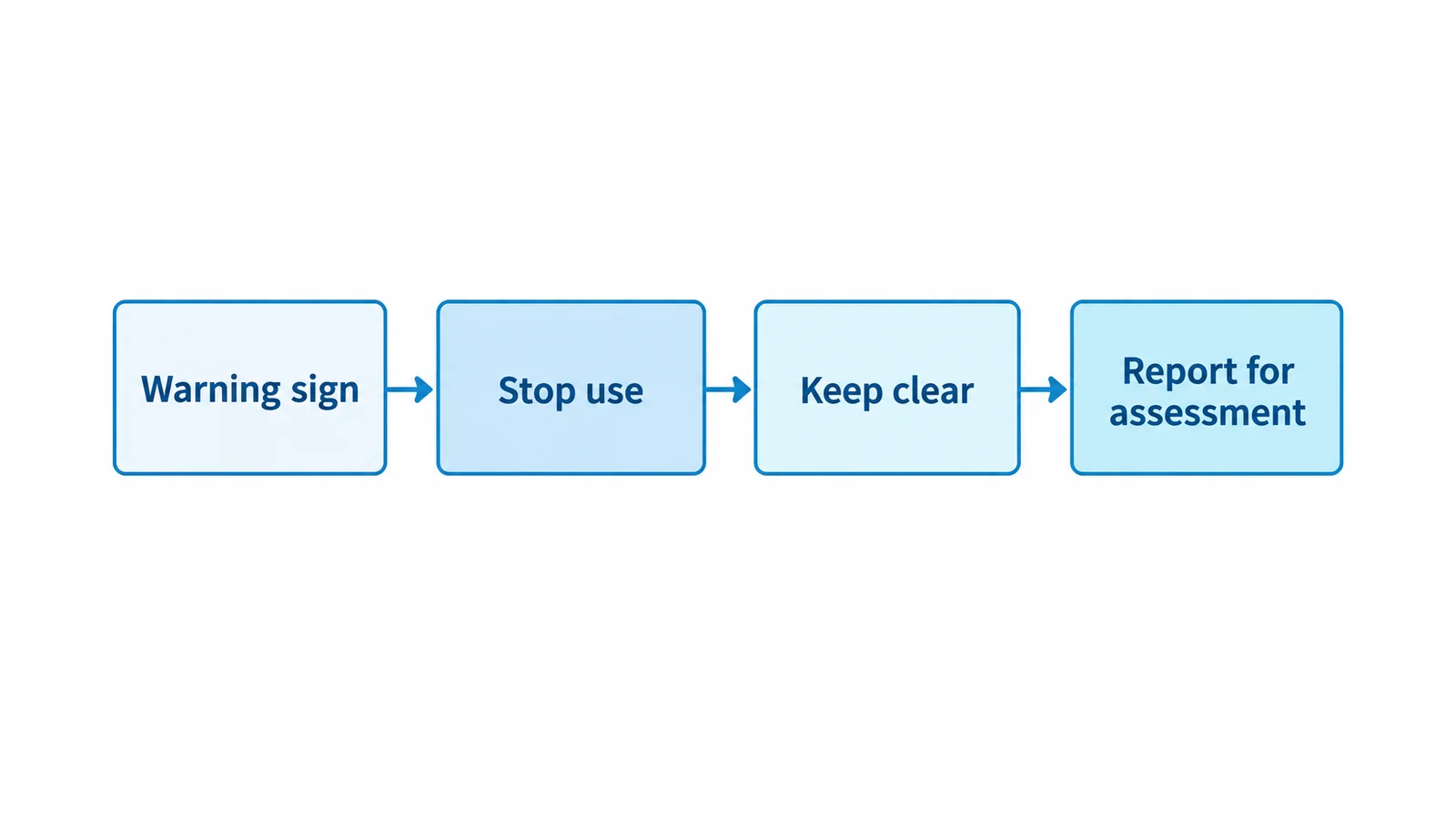
The practical consequence is simple: a socket that still supplies power is not necessarily fit for continued use. A higher-rated breaker cannot repair a bad connection. The separate circuit-breaker sizing guide explains why protection must match the circuit rather than be increased to suppress symptoms.
What a user can check without electrical work
For equipment with no warning signs, a routine external check can identify obvious damage before use. HSE advises users to remove equipment from service when plugs, cables or connectors are damaged or show overheating, and to leave repairs to competent people. HSE introduction to electrical safety
Look at accessible accessories without dismantling them. Check for a damaged enclosure, visible cable damage, trapped leads or signs that the equipment has been exposed to water. Read accessible appliance and extension-lead ratings without moving suspect equipment. Keep the area around outlets accessible rather than hiding a connection behind stacked storage.
For an extension lead, the relevant limit is the rating of the complete lead or adaptor, not the sum of the ratings printed beside its individual outlets. Do not assume several available sockets mean several independent supplies. Avoid cascading adaptors or extension leads; arrange adequate fixed outlets for recurring demand.
Do not turn observation into a stress test. In particular, do not load an outlet deliberately until it gets hot, insert improvised probes, or remove a socket to check the tightness of its terminals. A suspected defect ends routine user checking and starts the professional investigation.
The term lighting outlet has a code meaning that differs from a general-purpose socket. If the issue concerns what an installation is required to provide, use the lighting-outlet code questions guide and the locally adopted rules; visual checks cannot establish code compliance.
RCDs and socket testers do not clear a damaged accessory
A residual current device (RCD) provides additional protection against certain shock hazards. It does not make damaged equipment acceptable, and it is not a guarantee against all electrical injury. HSE explicitly treats an RCD as a secondary risk-reduction measure. HSE guidance on electrically powered equipment
A ground-fault circuit interrupter (GFCI) and an arc-fault circuit interrupter (AFCI) also perform different protective functions. Neither should be treated as permission to keep using a suspect outlet. See GFCI versus AFCI for their boundaries.
A simple plug-in socket tester has another limitation: a reassuring indication does not establish that every relevant fault is absent. HSE warns that some testers can miss faults and appear to indicate safety incorrectly. Do not use a tester on a visibly damaged or suspect socket to decide whether it can stay in service. HSE electrical-safety FAQ
Prepare a useful defect report
Give the responsible person observations, not an assumed diagnosis. A compact report can contain:
- Location: room, wall position and any safely visible circuit or asset identifier.
- Symptom: what was seen, heard or smelled, and when it first occurred.
- Equipment in use: appliance or load already connected when the symptom appeared.
- Pattern: continuous, intermittent, or associated with normal operation; do not repeat the operation to find out.
- Protection: whether a device operated, if that is already known without opening a panel.
- Current status: use stopped, people kept clear, responsible person notified and any emergency response initiated.
Photographs are optional and should be taken only from a safe position. Do not move the plug or remove a cover to make the report more complete.
Keep the accessory unavailable until the responsible electrical professional has assessed the cause, completed any necessary repair and verification, and authorized its return to service. A replaced faceplate, a quiet sound or a successful appliance run is not that authorization.