
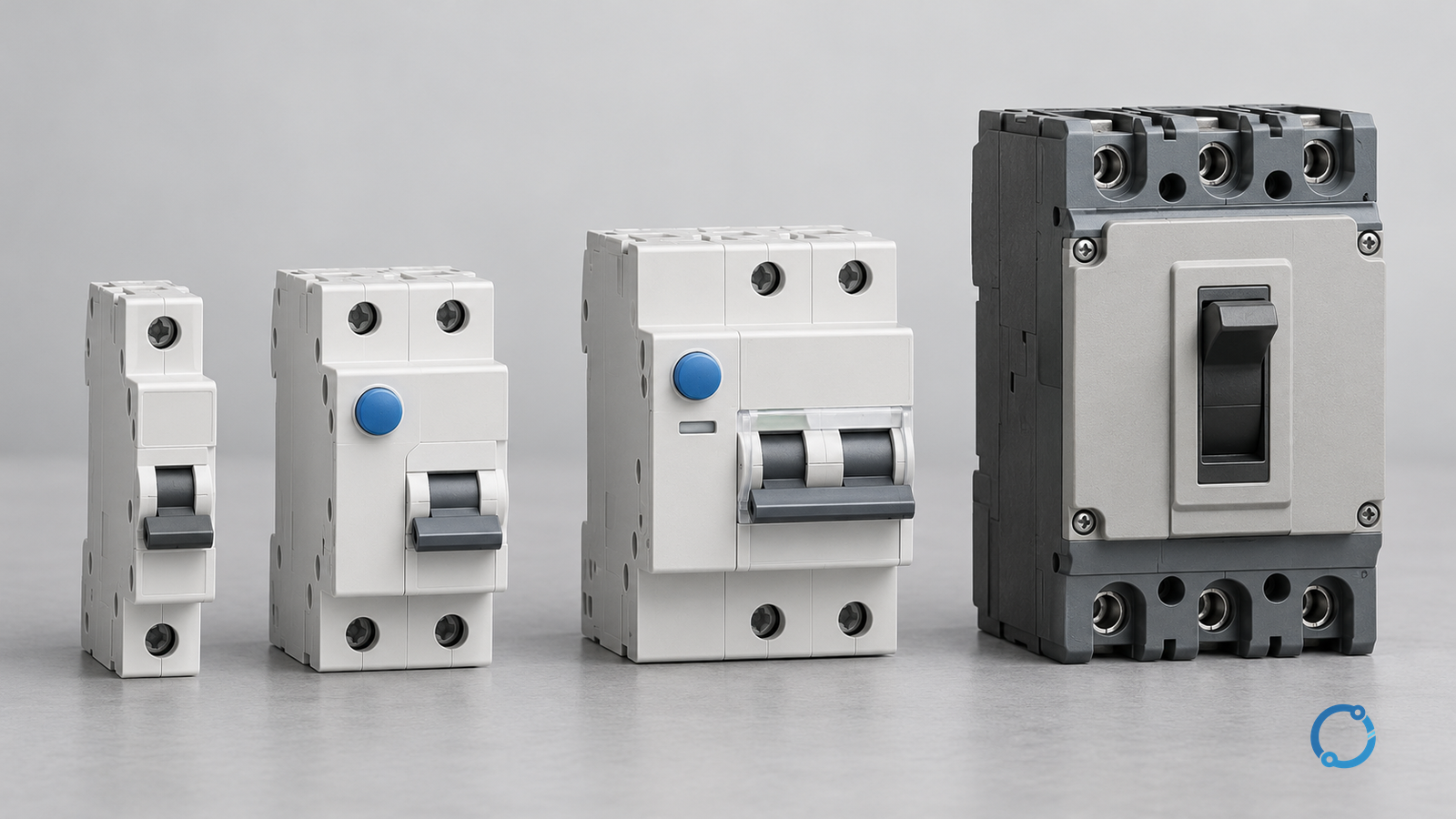
The five names are usually listed as if they were five points on one scale. They are not. They answer two different questions, and the confusion disappears once those questions are separated.
Question one: how is overcurrent handled? An MCB (miniature circuit breaker) and an MCCB (molded case circuit breaker) both interrupt overcurrent. They differ in size, rating range, adjustment, application and the standard under which they are evaluated.
Question two: is residual current detected? RCD (residual current device) is the umbrella term for residual-current protection. An RCCB is an RCD without integral overcurrent protection. An RCBO (residual current breaker with overcurrent protection) does both in one device.
“ELCB” is the outlier. It is an older term, still used in some markets, that historically described two quite different devices. Treating it as a synonym for RCD is common but imprecise.
So the practical answer to “which one do I need?” is not a product family. It is a short list of functions the circuit requires, followed by a device or combination that provides them.
Map the two protection functions
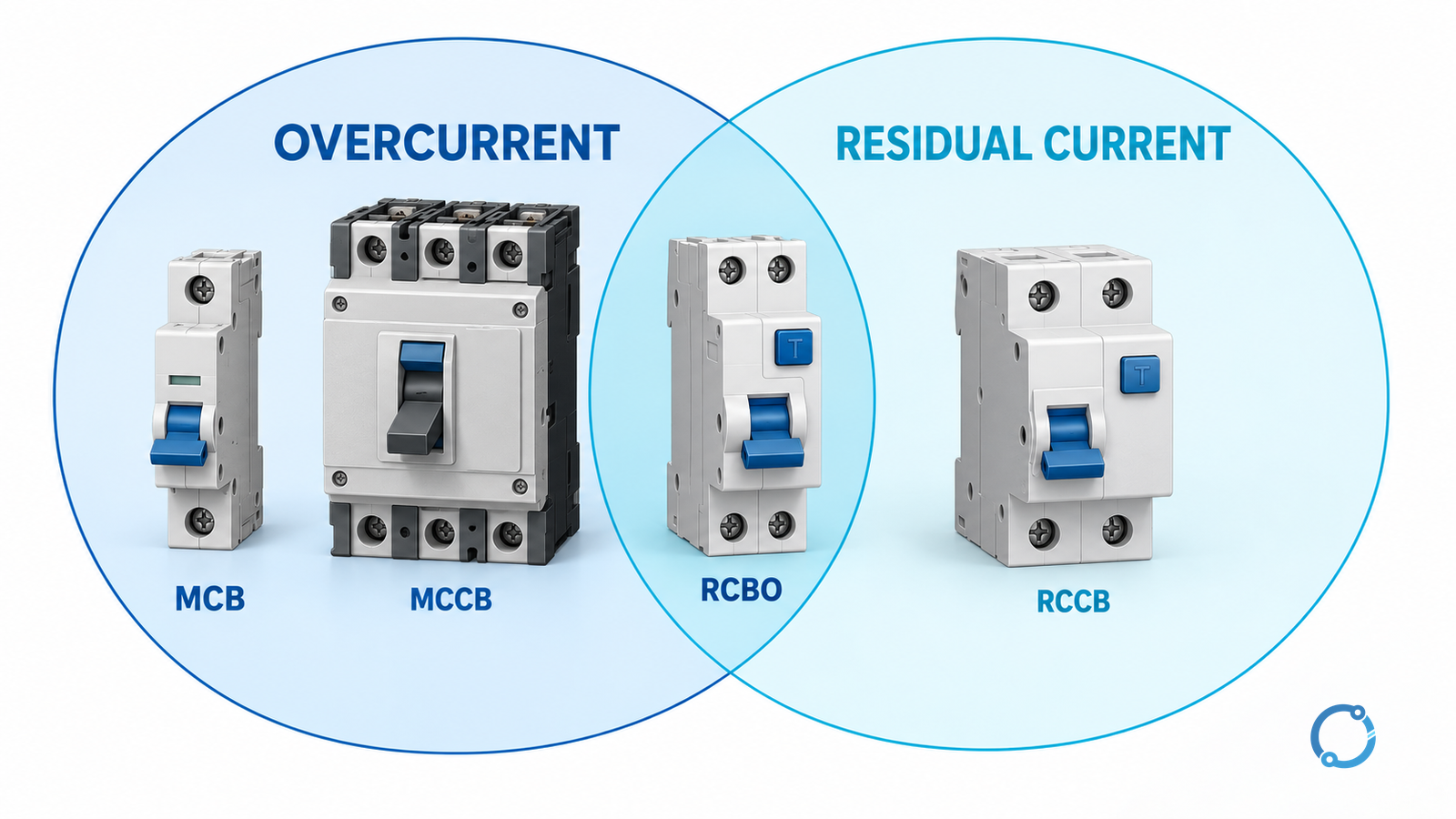
Compare overcurrent protection and residual-current protection separately. In the illustration, the overlap represents devices combining both functions.
| Device | Overcurrent protection | Residual-current detection | Typical position in the installation |
|---|---|---|---|
| MCB | Yes | No | Final circuits in domestic and similar installations |
| MCCB | Yes | No | Distribution feeders, industrial and commercial mains |
| RCCB (an RCD without overcurrent protection) | No | Yes | Circuit or group with coordinated overcurrent protection |
| RCBO | Yes | Yes | A single final circuit needing both functions |
| ELCB (current-operated) | Usually no | Yes | Legacy name for a residual-current device in some markets |
| ELCB (voltage-operated) | No | Indirectly, by sensing voltage | Legacy construction, not equivalent to an RCD |
The map already resolves most of the argument. An RCCB alone cannot replace required overcurrent protection, and an MCB alone cannot provide required residual-current protection. An RCBO is not a “better MCB”; it is a device that performs both jobs for one circuit.
MCB: the final-circuit overcurrent device
A miniature circuit breaker is the compact device that occupies one or a few DIN-rail modules and protects a final circuit. In the IEC system, breakers for household and similar installations are covered by IEC 60898-1:2015. The standard’s scope is the key point: it describes a product category with defined characteristics, not a universal performance level.
An MCB is normally selected for the combination of rated current, trip characteristic, breaking capacity and the circuit’s expected fault level. The trip characteristic shapes how quickly the device responds at different overcurrents; it does not change what the device is for.
What an MCB does not do is detect residual current. A circuit that requires residual-current protection needs a device that provides it, whether that is a separate RCD or an RCBO.
MCCB: the larger overcurrent device
A molded case circuit breaker covers a higher range of ratings and is built for distribution and industrial applications. In the IEC system these breakers fall under IEC 60947-2:2024, the part of the switchgear series that deals with circuit-breakers.
The practical differences from an MCB are not only “bigger”. An MCCB commonly offers adjustable overcurrent settings, higher breaking capacity, a wider range of accessories, and a construction intended for feeder and mains duty. That adjustability is useful because it allows coordination with downstream devices, but it also means the settings are part of the design and must be recorded, sealed or controlled.
An MCCB is still an overcurrent device. Some MCCB families include residual-current modules or earth-fault elements, but that is a product-specific feature, not something the family name guarantees.
RCD is the family; RCCB has residual-current protection only
A current-operated RCD responds to the residual sum of the currents in the live conductors passing through its sensing arrangement. A single-phase circuit includes line and neutral; a three-phase circuit includes all relevant phases and neutral where present. A residual difference can arise from an insulation fault or normal leakage. Operation depends on the specified waveform response, sensitivity and time characteristic. The IET explains the RCD family and its device types.
In IEC terminology, a residual current circuit breaker without integral overcurrent protection is covered by IEC 61008-1:2024. That “without integral overcurrent protection” phrase is not a technicality. It tells you that the device must be installed in a circuit that already has overcurrent protection, or combined with a device that provides it.
An RCCB therefore needs coordinated overcurrent protection. Residual-current protection does not replace protective earthing or bonding, and cannot detect every shock condition, including balanced line-to-neutral contact. The fault-protection design must match the earthing system; a low-impedance metallic return path is not available in every earthing arrangement. OHELE’s guide to neutral-earthing system selection explains why the earthing arrangement changes what a residual-current device can achieve.
The type of residual current matters too. Alternating, pulsating direct and smooth direct residual currents do not behave the same way in every sensing principle. OHELE’s comparison of RCD types AC, A, F and B covers that selection problem separately, because it is a different decision from the MCB/MCCB question.
RCBO: both functions, one device
An RCBO combines overcurrent protection and residual-current detection in a single unit. In the IEC system it is covered by IEC 61009-1:2024, the part that explicitly includes integral overcurrent protection.
The advantage is straightforward: one device combining the functions, with a product-dependent module width and connection arrangement, and a trip that removes both functions from the same circuit. That is valuable where space is limited or where a single final circuit needs its own residual-current protection without a separate RCD upstream.
The tradeoff is also straightforward. An RCBO protects one circuit. A shared RCCB can cover several circuits with a different component and installation cost, but a residual-current trip then affects the whole group. The choice between “one RCBO per circuit” and “one RCD for a group” is a discrimination and continuity decision, not merely a cost decision.
An RCBO concentrates both functions in one replaceable unit. A protective operation disconnects the circuit; a failed device cannot be assumed to fail safely. Follow the prescribed tests and keep compatible spares for the combined function.
The ELCB terminology problem
“ELCB” originally stood for earth leakage circuit breaker. Two constructions have used that name:
- A voltage-operated device that senses a potential difference between protected exposed metalwork and its reference earth and trips a breaker. Its sensing principle depends on the earthing arrangement, and it is not equivalent to a modern residual-current device.
- A current-operated device that senses residual current in the same way an RCD does. In many markets this is what people now mean when they say ELCB.
The IET historical overview distinguishes these legacy constructions. Because the same acronym describes both, a specification that says only “ELCB” is ambiguous. The useful specification states the sensing principle, the sensitivity, the number of poles and the standard the device is evaluated to. If a drawing or a tender document says “ELCB” and nothing else, that is a question to resolve before ordering, not after.
North American names are not translations
The IEC vocabulary above does not map one-to-one onto North American product categories.
In the United States, molded case circuit breakers are covered by UL 489. Supplementary protectors are covered by UL 1077 and are not branch-circuit breakers; using one as a substitute for branch-circuit protection is a scope error, not a rating question. Ground-fault circuit interrupters are covered by UL 943, and the code framework that governs their required locations is NFPA 70, as adopted locally.
This matters when a project mixes IEC-style nomenclature with a UL-style bill of materials. “RCBO” may have no direct UL category equivalent, and a device that provides residual-current protection in one market may be listed under a different category and with different trip characteristics in another.
What each device does not do
The fastest way to prevent a protection gap is to state the negative:
- An MCB does not detect residual current.
- An MCCB does not automatically provide residual-current protection, even when it has adjustable settings.
- An RCCB provides no integral overcurrent trip function; its fault withstand and backup protection still need coordination.
- An RCBO does not remove the need for correct earthing and bonding.
- A supplementary protector is not a branch-circuit breaker.
- A residual-current device does not replace selectivity analysis.
Each of these is a scope statement, not a criticism. A device that is used outside its function is not a bad device; it is a misapplied one.
Building a protection schedule
A protection schedule is more reliable than a device list because it starts from the circuit.
For each circuit, record:
- The overcurrent duty. Expected load current, fault level at the point of installation, and the required breaking capacity.
- The residual-current requirement. Whether the circuit needs residual-current protection, of what type and sensitivity, and whether the requirement comes from a code, a client specification or an engineering risk assessment.
- The earthing arrangement. What the protective conductor does, and whether the sensing principle is compatible with it.
- The discrimination requirement. Which upstream device must not trip when this circuit faults, and which downstream device is allowed to.
- The physical constraint. Rail space, terminal capacity, cable size and access for testing.
Only after those five are written down does the device selection become a lookup. A circuit needing both functions may use a suitably rated RCBO if its module width fits. A circuit needing overcurrent protection with a shared residual-current device upstream gets an MCB plus an RCCB. A feeder with adjustable settings and high fault level gets an MCCB, with residual-current protection added separately if required.
Selectivity is the part that is most often assumed and least often checked. OHELE’s guide to low-voltage circuit-breaker selectivity sets out why two correctly rated devices can still trip in the wrong order. For motor circuits, the guide to motor protection circuit breaker design covers the additional overload and starting considerations that a general-purpose breaker schedule does not capture.
Common mis-selections
Replacing an MCB with an RCBO of a different curve. The residual-current function is added, but the overcurrent response changes. The replacement must match the circuit’s required characteristic and breaking capacity, not only its width and current rating.
Assuming residual-current function proves isolation suitability. An RCCB or RCBO may also be suitable for isolation when its applicable standard, marking and instructions establish that function. Verify the required poles, isolation rating and main-switch role independently. An RCCB still needs coordinated overcurrent protection.
Assuming an MCCB with adjustable settings is selective by default. Adjustability makes coordination possible; it does not achieve it. The settings have to be chosen and verified against the downstream devices.
Treating “ELCB” as a specification. The word does not identify the sensing principle, the standard or the sensitivity.
Forgetting that a residual-current trip can be caused by several circuits. If an RCD protects a group, a fault on any one circuit removes supply from all of them. That may be acceptable, but it should be a decision rather than a surprise.
Conclusion
MCB and MCCB describe overcurrent devices of different size, application and standard. RCD names the wider residual-current family. RCCB provides residual-current protection without integral overcurrent protection; RCBO combines both functions. ELCB is an older term that should be replaced by a description of the actual sensing principle.
Choose by function first: write the overcurrent and residual-current requirements for each circuit, then select the device or combination that provides them, then verify discrimination and physical fit. The acronym on the box is the last thing to check, not the first.