
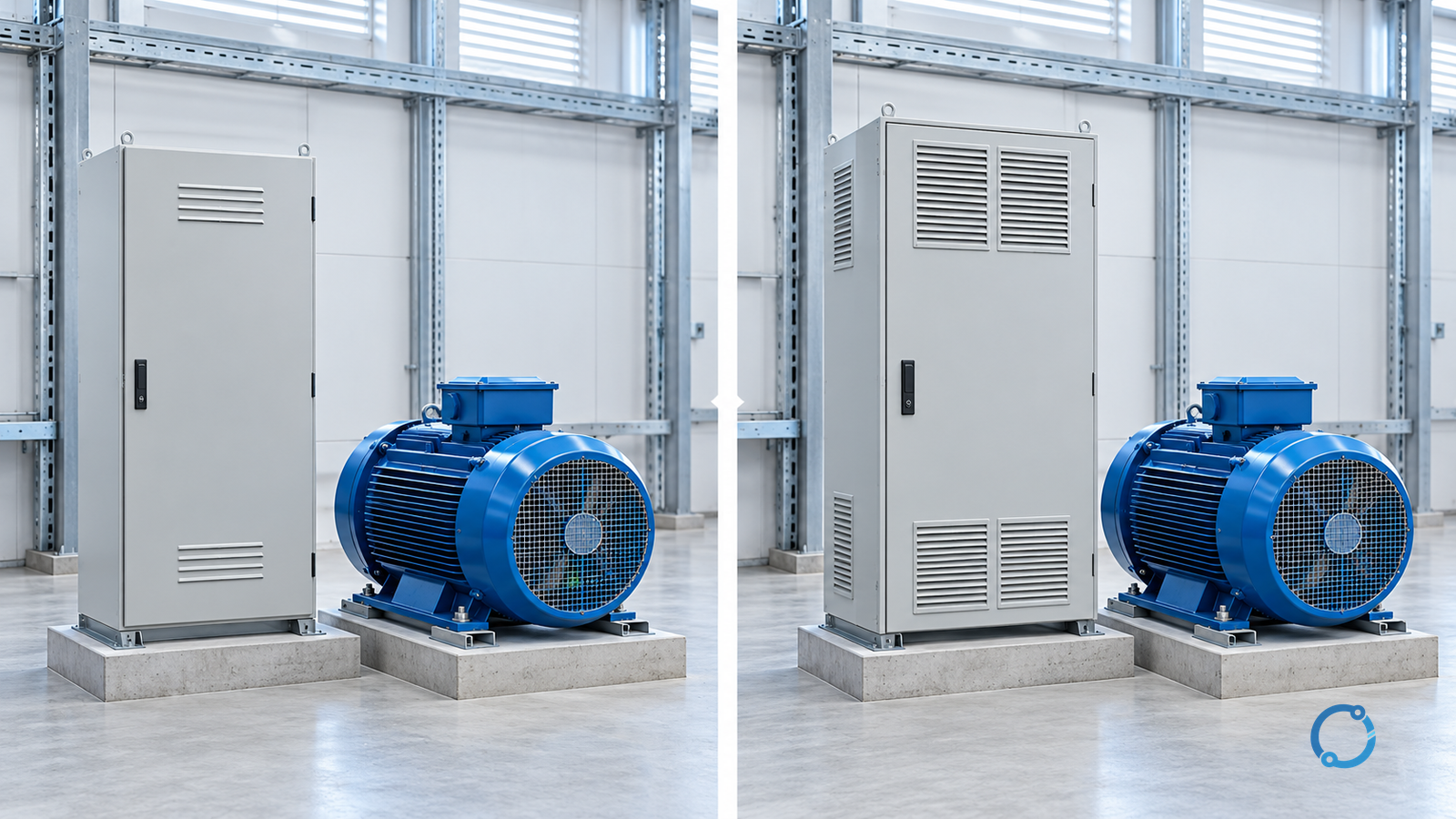
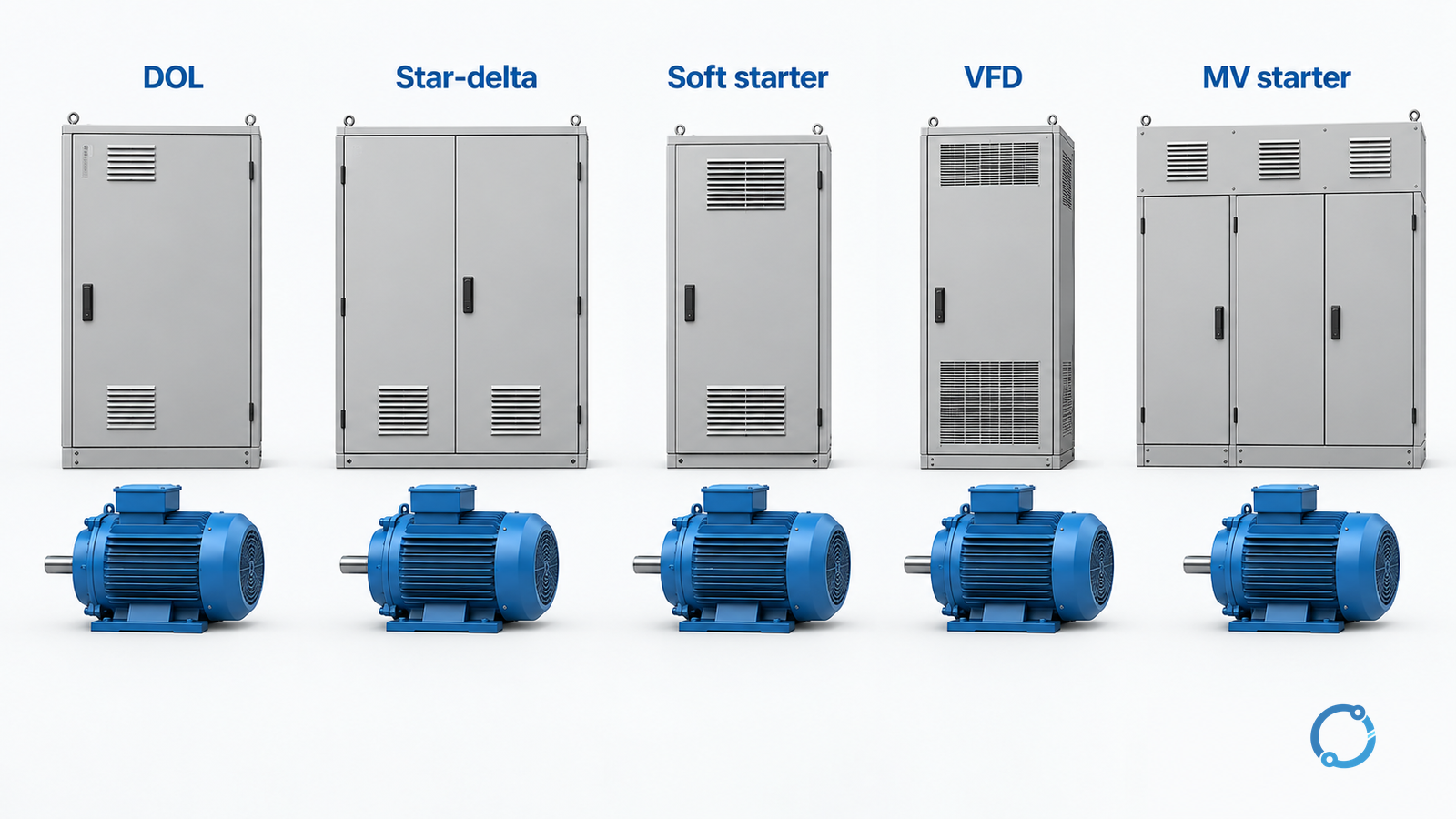
Choose a motor-starting architecture by matching the driven load, supply event, starting duty, run-speed requirement and consequence of failure—not by ranking device names. Direct-on-line (DOL) starting is a candidate when the motor, load and network can accept a full-voltage start. Star-delta is a candidate only when the motor winding, starter transition and load can tolerate reduced-voltage acceleration. A soft starter fits a fixed-speed process that benefits from managed voltage and torque during start or stop. A variable-frequency drive (VFD) becomes relevant when speed, torque or stopping must be controlled through the operating cycle. A medium-voltage (MV) contactor/starter is an equipment platform; its acceleration principle, fault protection and switching duty still have to be defined.
That is a screening decision, not a specification. IEEE 3002.7-2018 describes motor-starting studies that use system models to evaluate starting current, voltage drop and validation assumptions. The final choice depends on that evidence. IEEE 3002.7-2018
The decision in one matrix
The matrix uses the same dimensions for each option. A row identifies when a method deserves further study; it does not approve it.
| Method | Start and run behavior | Duty and system consequence | Principal disqualifier |
|---|---|---|---|
| DOL | Uses available line voltage and frequency; the motor starts with a full-voltage current-and-torque event | Fixed speed; starts and reversals expose the motor, coupling and switchgear to the full event | Network or machine cannot accept it, or accelerating torque is insufficient |
| Star-delta | Starts with motor windings in star, then transitions to delta | Fixed speed; reduced star-stage torque, additional switching and a transition must all be acceptable | Motor winding, load margin or starter sequence is incompatible |
| Soft starter | Controls applied voltage during start and can provide controlled stopping | Usually fixed speed; torque falls with voltage and repeated duty is thermally limited | Process needs low-speed running or sustained torque control |
| VFD | Varies frequency and voltage to control acceleration, running speed and torque | Continuous control within the motor-drive envelope; braking, harmonics, EMC and cable effects are system questions | Fixed speed makes the extra interfaces unjustified, or the system cannot meet the load envelope |
| MV contactor/starter | Equipment platform whose acceleration depends on the specified starter | Complete MV switching, protection and tested-assembly duties must be coordinated | Acceleration method, protection and equipment architecture are not coordinated |
First separate three questions
Many poor comparisons start by asking which device ranks first. Split the requirement first.
Is full-voltage starting acceptable? DOL does not shape the motor’s torque-speed characteristic; it connects the motor to the available supply. The US Department of Energy sourcebook notes that energizing large motors across the line can create high inrush current, voltage sags and other power-quality problems. DOE motor and drive sourcebook
The check is whether the source, transformer, feeder, protection and sensitive connected loads tolerate the event, and whether the motor develops enough torque at the resulting terminal voltage to accelerate the real load. Use the voltage-sag troubleshooting guide when the question is diagnosis rather than architecture.
Is reduced voltage enough, or is reduced speed required? Star-delta and soft starting reduce the voltage applied during acceleration. That can reduce current and torque, but neither is a speed-control system after the motor reaches normal running conditions. Reduced voltage is useful only when the motor still produces enough torque at every point required by the driven machine.
“Starting current is lower” is incomplete. Pumps, fans, conveyors, compressors, crushers and mixers can present different torque and inertia profiles. The machine-load VFD sizing guide shows how torque, inertia and duty change the required capability; that analysis remains necessary even when the chosen method is not a VFD.
Is the process fixed-speed or variable-speed? A soft starter normally hands the motor over to fixed-frequency operation. A VFD remains in the power path and controls frequency, voltage and motor torque through running. That is the decisive functional difference.
Do not choose a VFD only to “soft start” a constant-speed machine unless its additional interfaces and operating benefits are justified. Conversely, a soft starter cannot satisfy a process that needs multiple speeds, cycle-wide torque control or low-speed acceleration.
Evaluate each method fairly
DOL and star-delta: fixed-speed starting with full-voltage dependence
DOL use case: adequate accelerating torque, a driven load that tolerates the mechanical shock, a supply that tolerates the event, and switching rated for the required starts.
Main limitation: the analysis must include the motor, load, source impedance, terminal voltage, protective-device behavior and mechanical response. IEC 60034-12:2024 publicly scopes DOL and star-delta starting performance for specified cage induction motors; that framework does not prove a particular motor or network is suitable. IEC 60034-12:2024
Star-delta use case: a compatible motor, a load that accelerates with the reduced star-stage torque, an acceptable transition, and coordinated starter and protection.
Star-delta limitation: when the starter changes to delta, the motor must have sufficient speed and torque margin for the transition. Insufficient accelerating torque, excessive inertia, a poorly timed transition or an unsuitable motor can turn “reduced current” into a failed start. A six-terminal motor is not proof that any star-delta starter and load combination will work.
Soft starter: control the event, then run fixed speed
Strongest use case: a fixed-speed application where managed voltage produces acceptable torque and reduces the electrical or mechanical severity of starting, stopping or cycling.
Main limitation: soft starting does not guarantee a low disturbance in every case. Applied voltage, firing behavior, bypass arrangement, harmonics and the controlled range all matter. Reduced voltage also reduces available torque, so a heavily loaded or high-inertia start can stall or take too long.
IEC 60947-4-2:2020 with Amendment 1:2024 covers semiconductor motor controllers, starters and soft starters up to 1,000 V AC. That equipment scope is not a universal application rating. IEC 60947-4-2:2020+AMD1:2024
VFD: control the running system, not only the start
Strongest use case: the process needs controlled speed, acceleration, torque or stopping, and the compatible motor-drive system can meet that demand within its electrical, thermal, environmental and mechanical limits.
Main limitation: a VFD changes the entire motor-drive system boundary. IEC 61800-2:2021 describes an adjustable-speed AC power drive system as including semiconductor conversion, control, protection, monitoring and the AC motor. It covers line-to-line inputs up to 35 kV AC within its defined scope. IEC 61800-2:2021
The comparison must include motor insulation and winding compatibility, cooling over the speed range, drive current and overload time, harmonics and EMC, cable length, braking, bypass and isolation, and control and failure-state interfaces. A VFD can provide both soft acceleration and process speed control; its justification should be the combined duty, not the assumption that every drive saves energy. The VFD selection guide is the next step once the process points toward variable speed; the motor calculation reference supports the speed, torque and power relationships.
MV contactor/starter: name the platform and the principle
Medium-voltage motor control is not a separate acceleration physics. A contactor-based MV starter may implement a DOL or reduced-voltage arrangement, while an MV VFD is a different power-conversion architecture. IEC 62271-106:2021 scopes AC contactors, contactor-based controllers and motor starters for systems above 1 kV through 24 kV, at frequencies up to 60 Hz. IEC 62271-106:2021
That scope does not answer “which starting method should this motor use?” The complete MV starter must also address making and breaking duty, fault protection and coordination, isolation and earthing, control and trip supply, switching transients, interlocks and the tested assembly.
See switching devices in medium-voltage switchgear for the distinction between breakers, contactors, disconnectors, earthing switches and fuses, and circuit breaker vs. contactor switching duty when fault interruption and frequent operation need to be separated.
Exclude a method before comparing cost
Cost comparisons are meaningless until technically unsuitable candidates are removed.
| Requirement or condition | Candidate to examine first | Why the others may fail the screen |
|---|---|---|
| The process requires several controlled running speeds | VFD | DOL and star-delta normally run at fixed frequency; a soft starter normally controls only the start or stop event |
| The network cannot accept DOL, but fixed-speed operation is acceptable | Soft starter; star-delta only if motor and load fit the transition | Star-delta may still fail the torque or transition requirement |
| The load cannot accelerate with reduced voltage | Re-examine the mechanical starting method, motor and starting torque; VFD may be required | Star-delta and voltage-based soft starting can reduce torque below the load requirement |
| The motor is not arranged for star-delta | DOL, soft starter or VFD, subject to evidence | Star-delta cannot be imposed on an incompatible winding |
| Frequent reversing or controlled stopping is central | VFD with an appropriate braking and duty arrangement; soft stop only where sufficient | A simple DOL or star-delta starter may impose unacceptable thermal or mechanical duty |
| The requirement is on/off at fixed speed and the full-voltage event is acceptable | DOL | A VFD adds interfaces and losses that may serve no process requirement |
| MV protection and isolation dominate the design | Evaluate the complete MV switchgear architecture before the acceleration method | “MV contactor” does not establish protection, isolation or the starting principle |
| A drive is proposed for expected energy savings | Verify the load-speed relationship and actual operating profile | The VFD category alone does not prove an energy benefit |
These rules produce candidates, not winners. A soft starter and a VFD can both limit starting current, but solve different running requirements. Star-delta and soft starting can both reduce voltage, but do not have the same transition.
Screen the six project dimensions
1. Motor and driven load. Record current, speed, torque curves, starting performance, winding arrangement and the allowable motor envelope. Add breakaway torque, machine torque-speed curve, inertia, acceleration load and the most demanding credible restart. The load curve has veto power: reduced current without accelerating margin does not pass.
2. Supply and network. Model the source at the point of common coupling and at the motor terminals, including transformer or generator, cable, upstream impedance, other loads and the operating configuration. When a generator or transformer dominates the response, perform the separate source-side starting study rather than inferring success from a starter rating.
3. Starting, stopping and reversing duty. Record starts per shift, starts per hour, total starts over the maintenance cycle, acceleration time, intervals, reversals, soft-stop needs and emergency restart. Check motor thermal capacity and the complete starter against that timeline. “Frequent starting” has no universal number because acceptability belongs to the equipment and process.
4. Process control. If flow, pressure, tension, positioning, synchronization or speed regulation is required, state that early. A fixed-speed starter cannot provide it. A VFD can provide variable speed only within the declared envelope. A soft starter may be better when gentle acceleration and stopping are the only control objectives.
5. Fault impact and switching architecture. A starting method is not a complete protection scheme. Starting current is not fault current, and the device that performs normal starting may not interrupt a fault. The starter, short-circuit protective device, overload function, isolation arrangement and control system must work as a coordinated assembly. Use the motor protection and circuit-breaker design guide for that separate task.
6. Availability, environment and failure consequence. Consider ambient temperature, altitude, enclosure, contamination, cooling, spares, maintenance competence and the consequence of losing the starter or drive. High shutdown cost may justify redundancy or bypass, but that is a reliability decision, not evidence that one method is universally superior.
Work on starters and drives requires isolation, verification and a qualified person following the local safety procedure. The design must define a safe state for loss of control power, a failed bypass contactor, a drive trip or an incomplete start sequence.
A practical screening record
The screen is complete only when each candidate has a reason to remain or leave.
| Field | Entry |
|---|---|
| Motor and machine | Nameplate, winding data, torque-speed demand and inertia |
| Normal and demanding start | Load condition, terminal voltage, acceleration time and repetition |
| Network case | Source configuration, transformer/generator, feeder and sensitive loads |
| Run requirement | Fixed speed, multiple speeds, controlled torque or stopping |
| Candidates | DOL, star-delta, soft starter, VFD or MV contactor-based starter |
| Exclusions | Reason tied to a failed requirement |
| Surviving candidates | Architectures worth comparing in the detailed study |
| Switching and protection | Normal switching, fault interruption, isolation and earthing |
| Drive-specific checks | Motor compatibility, harmonics, EMC, cables, cooling and braking |
| Holds and owner | Missing evidence; responsible engineer and required review |
The record exposes missing requirements before a familiar solution is selected and gives the detailed study a clean input.
What this comparison does not decide
It does not calculate motor, transformer, generator, cable or drive ratings. It does not set protection curves, arc-flash boundaries or switching-device ratings. It does not approve star-delta for a motor without winding evidence, prescribe a universal soft-start profile or confirm that a VFD can accelerate a particular load. It also does not establish compliance with IEC, IEEE, local electrical codes, utility rules or a tested switchgear assembly.
The useful output is a defensible shortlist and a clear list of questions for the motor-starting study. If the project cannot answer the six dimensions, the correct status is “hold pending evidence,” not “select the lowest-cost starter.”
Sources
- IEC 60034-12:2024 — starting performance of single-speed three-phase cage induction motors
- IEC 60947-4-1:2023 — low-voltage electromechanical contactors and motor starters
- IEC 60947-4-2:2020+AMD1:2024 — semiconductor motor controllers, starters and soft starters
- IEC 61800-2:2021 — rating specifications for adjustable-speed AC power drive systems
- IEC 62271-106:2021 — medium-voltage AC contactors and motor starters
- IEEE 3002.7-2018 — motor-starting studies and analysis
- US DOE — Improving Motor and Drive System Performance: A Sourcebook for Industry