

Electrical safety culture becomes observable when a worker can raise a concern, obtain a controlled response, and see that the corrective action actually works. Build that feedback loop around the electrical task: report the condition, control the immediate exposure, assign an accountable owner, verify the correction, and return the result to the people affected.
A training attendance total or a year without a recorded injury does not establish that loop. The useful question is whether the plant can demonstrate that its electrical hazards are identified, controlled and reviewed as equipment and work change.
This article provides a practical management framework for industrial facilities. U.S. Occupational Safety and Health Administration (OSHA) program guidance and training rules are distinguished below. It is not a complete legal compliance audit, an energized-work authorization or a report of a particular company’s results.
Define the work the program must control
List recurring and nonroutine electrical tasks, including operation, isolation, testing, fault investigation, maintenance, commissioning and restoration. Identify who requests the work, who performs it and who has authority to approve its conditions.
Include the interfaces that are easily missed: production priorities, outside contractors, temporary supplies, night shifts, remote commands and handover between electrical and non-electrical teams. A contractor’s training record does not settle which organization controls the equipment or communicates a changed operating state.
Create a task-linked baseline from available drawings, equipment/maintenance records, hazard assessments and known defects. An arc-flash study provides analytical information for its defined system and assumptions; it does not replace the work process or prove that an unreviewed configuration remains covered.
Do not turn this baseline into an arbitrary score. Keep the actual gap visible: missing equipment identity, unresolved protection impairment, unreliable isolation information or an undocumented task authority.
Use a report-to-verification loop
| Stage | Responsible action | Evidence that the stage is complete |
|---|---|---|
| Report | Make concerns accessible to workers and capture the task/condition | A traceable report without requiring the worker to diagnose the fault |
| Control | Have the responsible authority assess immediate exposure and restrictions | An accepted interim-control decision communicated to affected people |
| Assign | Name the correction owner, priority, resources and review point | A specific action with a real owner, not “maintenance to investigate” |
| Verify | Check whether the completed action controls the reported condition | Appropriate evidence and disposition of any remaining limitation |
| Feedback | Explain the result and update affected work information | Reporter/worker communication and updated task or equipment records |
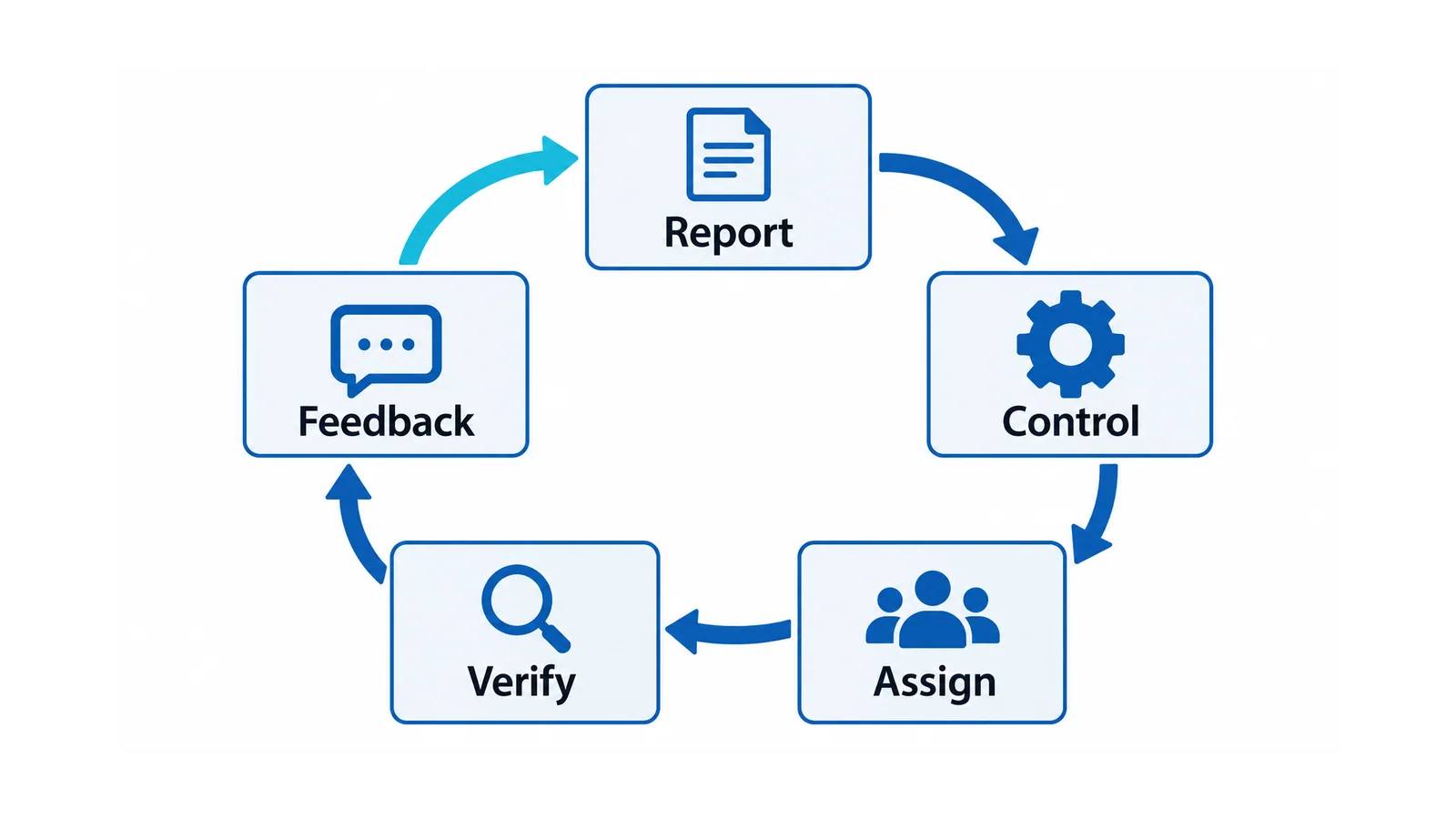
A work order marked complete may satisfy an administrative stage while leaving the electrical issue unresolved. For example, replacing a damaged cover does not establish that the original source of damage was corrected. Verification should address the reported mechanism and the correction’s possible effects on other controls.
The required evidence depends on the action. A revised procedure may need a task demonstration; a repair may need inspection/testing; a protection change may need study and configuration reconciliation. Do not force every correction into the same “photo attached” acceptance rule.
Make reporting safe and usable
OSHA’s worker-participation guidance recommends accessible reporting, worker involvement in solutions and protection against retaliation. It also supports workers requesting a temporary suspension of work they believe unsafe. These are program recommendations here; the page separately identifies relevant legal protections.
Translate participation into a site process. Specify whom a worker contacts, how urgent concerns reach the person who can act, and how the plant controls a paused task before anyone resumes it. A slogan such as “everyone can stop work” is incomplete if no one knows the escalation and restart authority.
Offer reporting routes usable across shifts, languages and employment arrangements. Ask for location, task, observable condition and immediate concern, rather than requiring technical certainty. “The indication disagrees with the equipment state” is enough to trigger assessment even if the reporter cannot identify the defective component.
Give feedback on what was found and what changed. Investigations should examine equipment, design, work conditions and organizational decisions instead of ending at “operator error.” Preserve accountability for deliberate actions without making routine reporting feel like a penalty.
Do not reward low reporting numbers as proof of good performance. Fewer reports can mean fewer hazards, poor access, weak feedback or fear of consequences. Interpret the count with worker participation and the conditions actually observed.
Link competence to the task
Define the knowledge and skills needed for each assigned activity. Training about recognizing an electrical hazard is different from qualification to test exposed electrical parts or perform a particular switching task. Job title, tenure and attendance are incomplete substitutes for the required competence.
For covered U.S. general-industry work, OSHA 1910.332 requires training relevant to assigned electrical work practices, with additional requirements for qualified persons. Its training degree is linked to employee risk. The regulation should not be paraphrased as a universal once-a-year classroom rule.
Use the applicable legal and site requirements to define evaluation and authorization. Controlled demonstrations, supervised task assessment and review after equipment or procedure changes can provide evidence suited to the task. This is a program-design approach, not a new mandatory interval.
Record the task boundary, evaluator, demonstrated capability and restrictions. Contractor and shift handovers should make those limits visible to the people assigning the work.
For personal protective equipment (PPE), preserve the separate arc-rated PPE inspection and replacement process. Training completion does not prove that issued equipment remains suitable or serviceable.
Choose indicators that reveal control performance
OSHA distinguishes leading indicators, which examine preventive activity and potential problems, from lagging indicators that record events already experienced. Use both. A leading measure is helpful only when its definition makes the relevant failure visible.
The following measures are suggested definitions, not OSHA-prescribed targets:
| Measure | Define it before counting | Interpretation limit |
|---|---|---|
| Urgent reports with accepted interim controls | Applicable urgent reports and evidence of the control decision | Acknowledgement alone is not a control |
| On-time corrective-action closure | Actions due in the period and formally closed by their due dates | Closure may still lack effectiveness verification |
| Verified closure | Closed actions with the specified verification evidence | A low denominator can hide overdue open actions |
| Repeat condition | A clearly defined recurrence at the same or relevant similar interface | Better reporting can initially expose more repeats |
| Task-specific competence assessment | Required tasks/people and accepted demonstration criteria | Assessment volume alone does not prove adequate coverage |
| Injury, shock or other incident record | Consistent event definitions and reporting process | No recorded event does not prove every control works |
Pair quantities with the critical backlog. If a high-priority isolation defect is overdue, a strong overall closure percentage must not obscure it. Preserve absolute open counts, severity and interim controls alongside the rates.
Worked example: closure and verification differ
Assume a hypothetical review period with 24 corrective actions due. Of those, 18 were administratively closed on time, and 12 of the 18 have the required effectiveness-verification evidence. No site measurements or claimed safety improvements are implied.
On-time closure = 18 / 24 × 100 = 75%
Verification coverage of those closed actions = 12 / 18 × 100 ≈ 66.7%
Verified on-time closure across all due actions = 12 / 24 × 100 = 50%
The same population contains 6 actions not closed on time and 6 closed on time without the specified verification evidence. Record what controls the associated exposures and who resolves each remaining item.
Do not combine different periods or count “opened this month” against “closed this month” without a defined cohort. A program can legitimately close an older action this month; that does not make it a newly opened action’s on-time result.
None of these percentages calculates the probability of an electrical accident. They expose process gaps that need review. If the six actions not closed on time are safety-critical, review their present status and controlled disposition before focusing on the rounded dashboard figure. “Not closed on time” can include an action closed late; it does not mean every one is still open.
Review implementation, then improve the system
OSHA’s program-evaluation guidance recommends checking implementation and using both leading and lagging evidence to improve the program. Apply that review to real electrical work, including nonroutine and contractor tasks.
Sample whether workers can identify the escalation route, whether an urgent report received a meaningful control, whether a correction was verified and whether affected people received the result. Examine whether workload, resources or a production decision repeatedly defeats the written process.
Keep technical controls connected to this review. The maintenance, mitigation and containment guide explains the equipment/protection functions that require evidence. The management loop must notice when one of those credited functions is impaired and route the condition to the responsible technical authority.
A useful action register contains report identity, task/equipment, assessed consequence, interim control, owner, due date, correction, verification basis/result and feedback record. Keep necessary sensitive information controlled while making the relevant operating restrictions available to affected workers.
Review the program when tasks, equipment, staffing or contractor interfaces change, or when repeated findings reveal a weakness. The desired outcome is a plant that can explain what it knows, what remains uncontrolled and who is acting on it—not a claim that its safety culture has eliminated every risk.