
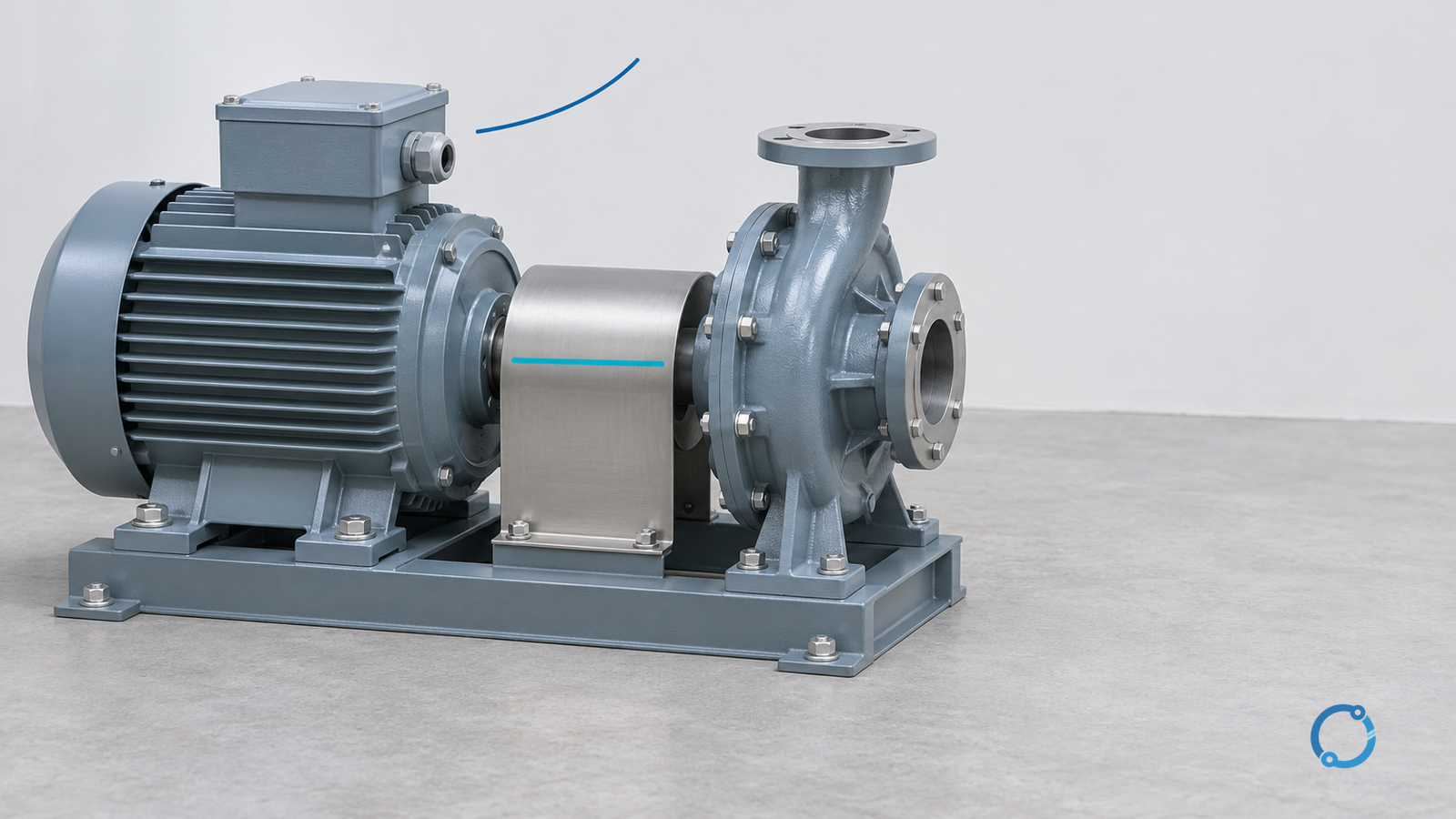
Motor efficiency is the ratio of useful mechanical power at the shaft to electrical power entering the motor at the same operating point. The basic calculation is:
Efficiency = shaft output power / electrical input power x 100%
The result is only as meaningful as the measurement boundary. Input power must be measured or calculated at the motor terminals, not at the plant’s monthly utility meter. Shaft output must represent the mechanical power delivered to the driven equipment, not the motor’s nameplate rating. And load factor must not be confused with efficiency: load factor compares actual output with a reference output, while efficiency compares output with input.
This reference explains the energy balance, the unit conversions, the difference between calculated and nameplate efficiency, and the measurement limits that should appear beside any field result. The worked example is illustrative; it is not a performance claim for a particular motor.
The energy balance behind the formula
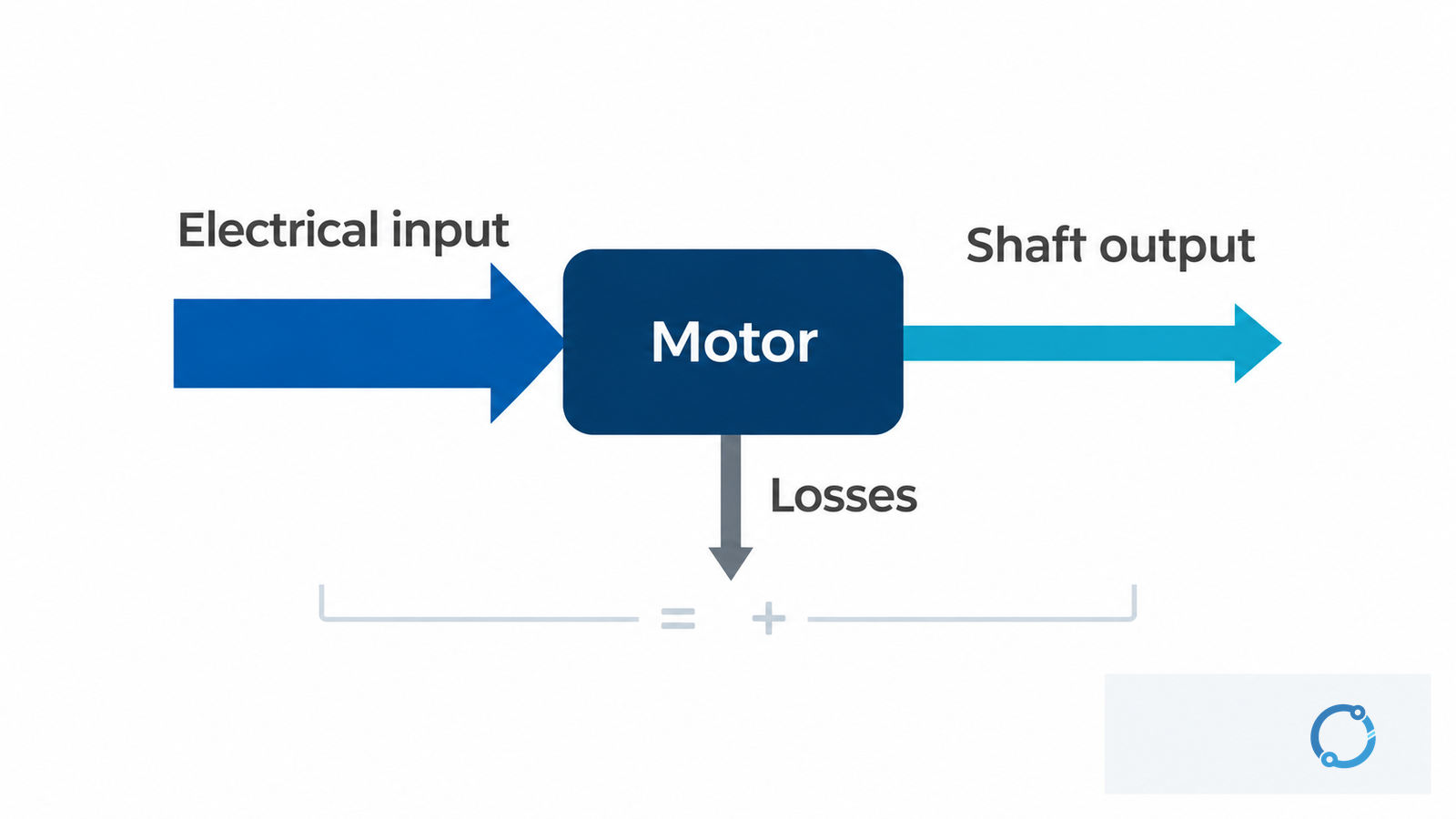
In steady-state operation, the electrical input power is either delivered as useful shaft power or dissipated as losses:
Electrical input = shaft output + losses
The losses include the motor’s electrical and mechanical loss mechanisms. A difference between measured input and measured output gives total loss for that operating point. It does not, by itself, divide the loss into stator resistance, rotor resistance, core, stray-load, friction, windage, or other components. Those separations require a test method, model, or additional measurements.
The efficiency equation can therefore be written in three equivalent forms:
- Efficiency = output / input x 100%
- Efficiency = output / (output + losses) x 100%
- Losses = input – output
All three forms require the same operating point and compatible units. Mixing kilowatts and watts, or comparing a measured shaft output with a nominal electrical input, will produce a meaningless result.
Input power for a three-phase motor
For a balanced three-phase motor operating with approximately sinusoidal voltage and current, input power can be estimated from line voltage, line current, and power factor:
Input power (kW) = sqrt(3) x line voltage (V) x line current (A) x power factor / 1,000
This formula assumes a balanced three-phase set and a meaningful power-factor measurement. A panel ammeter and a nameplate power factor are not a substitute for a power measurement when the result will be used for an energy decision. Voltage unbalance, waveform distortion, instrument phase error, and changing load can all affect the calculation.
If the motor is supplied through a variable-frequency drive (VFD), define the boundary explicitly. Input power measured at the drive input includes drive losses and is not the same as power measured at the motor terminals. Shaft output is still the mechanical output at the motor shaft. A VFD can change the motor’s operating point, so a comparison with a line-operated nameplate value may not be like-for-like. The OHELE guide to induction-motor calculations with VFDs covers related speed, torque, and power relationships.
Shaft output from torque and speed
If torque and rotational speed are measured at the same operating point, shaft power can be calculated as:
Shaft output (kW) = torque (N m) x speed (rpm) / 9,550
The constant is an approximation of 60,000 divided by 2 pi. Use the actual measured speed, not the nominal synchronous speed, when the motor is operating below or above its rated point. Torque must be measured at the shaft or derived from a valid dynamometer or equivalent method. A motor’s rated torque is not a measurement of the actual driven load.
The measurement locations matter. If the torque meter is installed between the motor and a gearbox, the result is the power delivered to that interface. If the driven machine is downstream of a gearbox, the output at that point includes gearbox losses. The efficiency calculated from electrical input at the motor and mechanical output after the gearbox is a system efficiency, not a motor efficiency.
A worked example with illustrative inputs
Suppose a balanced 400 V, three-phase motor has a measured line current of 50 A and a measured power factor of 0.86. The calculated electrical input is:
P_in = 1.732 x 400 x 50 x 0.86 / 1,000 = 29.79 kW
Suppose a torque measurement at the same operating point is 190 N m at 1,450 rpm. The shaft output is:
P_out = 190 x 1,450 / 9,550 = 28.85 kW
The efficiency at this point is:
Efficiency = 28.85 / 29.79 x 100% = 96.8%
The total loss by difference is:
Losses = 29.79 – 28.85 = 0.94 kW
These numbers are illustrative and rounded. They do not establish an expected efficiency for another motor, another load, or another measurement setup. A real result should include instrument accuracy, power-quality conditions, temperature, speed, torque, and the exact measurement boundary.
Efficiency is not load factor
Load factor compares the actual mechanical output with a rated or reference output:
Load factor = actual output / rated output
If the illustrative motor has a rated output of 30 kW and is producing 28.85 kW, its load factor is about 96%. That does not mean its efficiency is 96%. The two percentages happen to be close in this example, but they answer different questions. Load factor describes how much of the rating is being used. Efficiency describes how much of the input power becomes useful output at that operating point.
A lightly loaded motor can have a low load factor and a different efficiency from its rated value. The exact shape of the part-load efficiency curve depends on the motor design and the measurement conditions. Do not assume that efficiency stays constant from no load to full load, and do not calculate energy savings by applying a single full-load percentage to every hour of operation.
The OHELE guide to motor operating temperature is a useful reminder that thermal conditions and loading are related but not identical. Temperature is not an efficiency measurement. The motor sizing guide addresses the separate question of matching a motor and drive to a machine load.
What nameplate efficiency can and cannot tell you
Nameplate efficiency is a declared value associated with a defined rating, test method, and set of conditions. IEC 60034-30-1:2014 is an official IEC publication for efficiency classes of line-operated AC motors within its defined scope. The IEC 60034-30-1 listing identifies the publication and its scope; it does not prove that an installed motor is operating at its declared efficiency today.
Nameplate data is useful for comparing products and establishing a reference. It is not a field measurement. A motor may be:
- operating at a different load;
- supplied at a different voltage or frequency;
- affected by voltage unbalance or waveform distortion;
- operating at a different temperature;
- connected through a drive;
- mechanically misaligned or overloaded; or
- degraded by a winding, bearing, or ventilation problem.
Those conditions can change the operating point or the losses without changing the nameplate value. Use the nameplate to define the expected basis, then measure the actual operating point if the decision depends on present performance.
Measurement uncertainty and comparison rules
An efficiency result should be accompanied by a short method note:
- Where was electrical power measured: utility feeder, drive input, or motor terminals?
- Was the motor balanced and operating steadily during the measurement?
- Was power factor measured or assumed?
- How were torque and speed measured, and at which shaft interface?
- What were the instrument accuracies and calibration dates?
- Were the motor and driven equipment at a stable temperature?
- Does the result represent one point or a time-weighted operating profile?
If the input and output measurements come from different periods, the quotient is not an efficiency value. If a power meter includes another load on the same feeder, the result belongs to that feeder, not to the motor. If torque is estimated from motor current, the estimate contains assumptions about the motor’s torque-current relationship and may not remain valid across the load range.
For a replacement or energy project, compare the same boundary and the same operating profile before and after the change. The OHELE guide to replacing a three-phase induction motor discusses the mechanical and electrical inputs that belong in that decision. Voltage unbalance is another separate influence; the voltage-unbalance measurement guide explains why a single average voltage is not enough.
A compact calculation procedure
Use this sequence for a defensible first calculation:
- Record the motor rating, connection, supply, and operating state.
- Measure three-phase voltage, current, and power factor at the chosen boundary.
- Calculate electrical input in kW.
- Measure torque and speed at the same operating point, or use a documented output measurement.
- Convert torque and speed to shaft output in kW.
- Calculate efficiency and total loss by difference.
- Compare the operating point with the rated condition and state the uncertainty.
The procedure is intentionally simple. Its value comes from keeping the measurement boundary visible. A precise-looking percentage built from mismatched inputs is less useful than a bounded estimate with a clear method.
The bottom line
Motor efficiency is a ratio at an operating point, not a label that can be assumed for every hour of service. Calculate input power at the motor boundary, calculate shaft output from torque and speed, and treat the difference as total loss. Then compare the result with the rated basis and distinguish it from load factor.
Use nameplate and efficiency-class data to establish the design reference. Use measured voltage, current, power factor, torque, speed, and operating conditions to describe actual performance. When the boundary or uncertainty is unclear, state the limitation rather than turning an estimate into a guarantee.