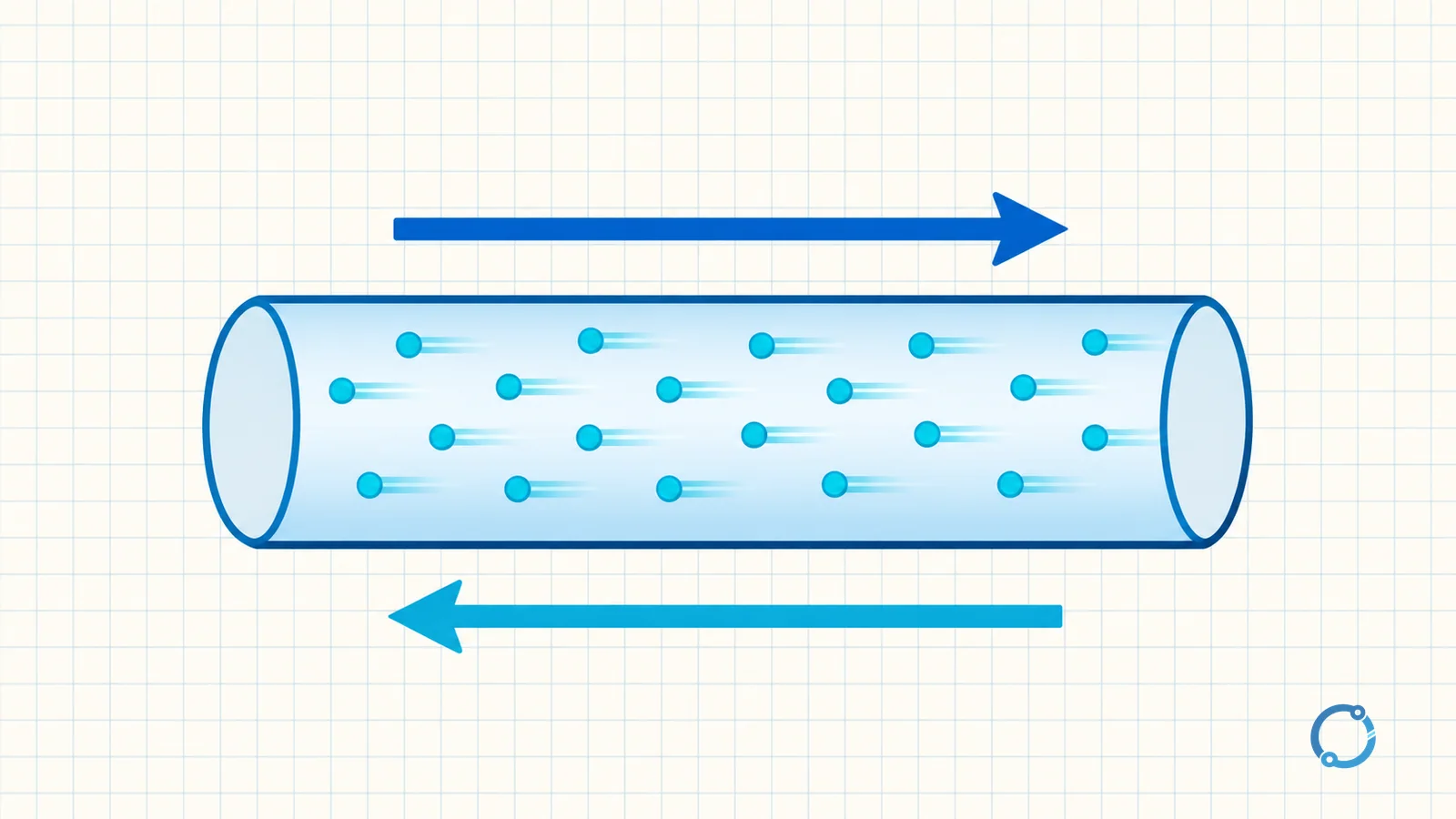
Short answer: Electric current is the net rate at which electric charge crosses a chosen cross-section. For an average current over a time interval:
I = Q / t
Here, I is current in amperes, Q is the net charge transferred in coulombs, and t is time in seconds. One ampere equals one coulomb per second:
1 A = 1 C/s
Current is therefore not the same thing as the amount of charge stored in a conductor. It describes how quickly net charge passes a point or crosses a surface. A large amount of charge moving very slowly can produce the same current as a smaller amount moving faster, provided the rate of net charge crossing the section is the same.
The direction of current needs special care. Circuit diagrams normally use conventional current, drawn as though positive charge moves from the higher-potential side of a source through the external circuit toward the lower-potential side. In a metal conductor, the mobile charge carriers are electrons, which move in the opposite direction. Both descriptions are consistent when their charge signs are handled correctly.
This page explains the definition, the carriers, the calculation relationships and the direction convention. It does not cover semiconductor band theory, electrochemical design or high-frequency current distribution.
Charge and the carriers that move
Electric charge is a property of matter. A body can have a net positive or negative charge, and individual particles carry charge of a fixed sign. Current exists when charge moves through a material or through space in a way that produces a net transfer across a chosen section.
The carriers depend on the conducting medium. In a metal conductor, the atomic lattice is relatively fixed and some electrons are free to move through it. These mobile electrons are the dominant charge carriers for ordinary metal conduction. In an electrolyte, positive and negative ions can move in opposite directions under the influence of an electric field. The net current is determined by the combined charge transport, not by one visual direction of particles alone.
That distinction is why “current is electrons moving” is an incomplete definition. Electrons are the usual carriers in metals, but current can also be carried by ions or other charged particles in another medium. The common concept is the rate of net charge transfer.
The conductors and source still have to form a practical circuit. Charges already exist in the material before a circuit is energized; a source does not have to create a fresh supply of electrons at the switch. The source provides an electric field and energy that cause the existing carriers to drift in a coordinated way around the closed path.
Worked example: charge and time
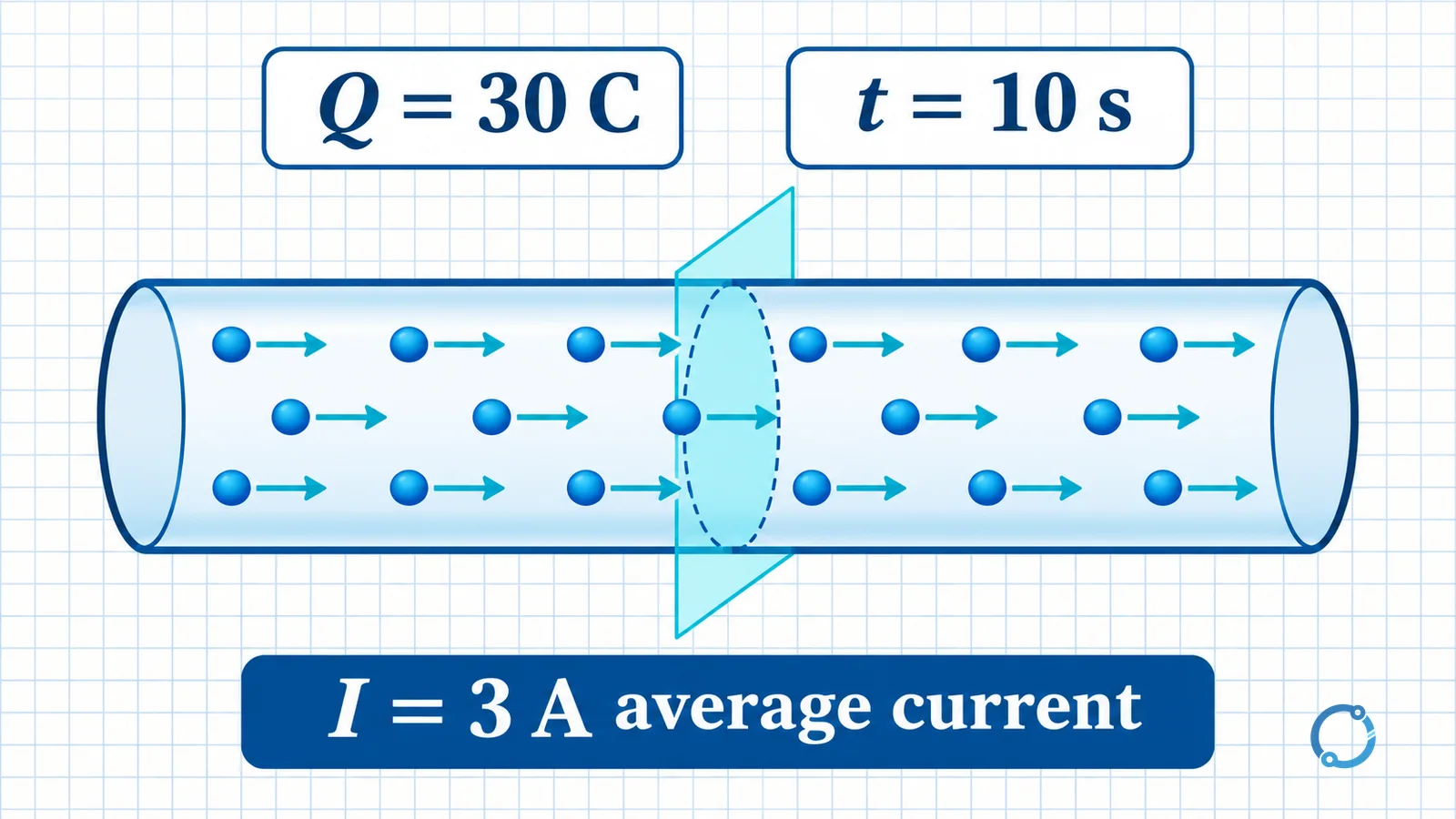
Suppose 30 C of net charge crosses a selected cross-section in 10 s. The average current is:
I = Q / t
I = 30 C / 10 s
I = 3 A
The result is an average current because the calculation uses the total charge over a time interval. If the rate varies within that interval, the instantaneous current can differ from 3 A even though the interval average is 3 A.
This distinction matters when a current changes with time. A motor starting, a capacitor charging or a lightning path forming can have a current that changes rapidly. A single interval average summarizes the charge transfer, but it does not automatically describe the peak or the shape of the waveform.
Why conventional current points the other way
Circuit analysis uses a convention based on the motion that positive charge would have. Conventional current flows from the positive terminal of a source, through the external circuit, and back to the negative terminal in the usual external-circuit representation. In a metal, the mobile electrons drift in the opposite direction because they carry negative charge.
The two descriptions do not contradict each other. Electric current is defined from net charge transfer. A negative charge moving one way contributes a current in the opposite direction. If the electron flow is reversed and its negative sign is included, the resulting conventional current points the same way as the original convention.
The convention became established before the details of electron motion were understood. Modern circuit theory retains it because the equations for voltage, current, power and magnetic effects remain consistent when current arrows follow positive-charge flow. There is no need to reverse every arrow in a schematic merely because the physical carriers are electrons.
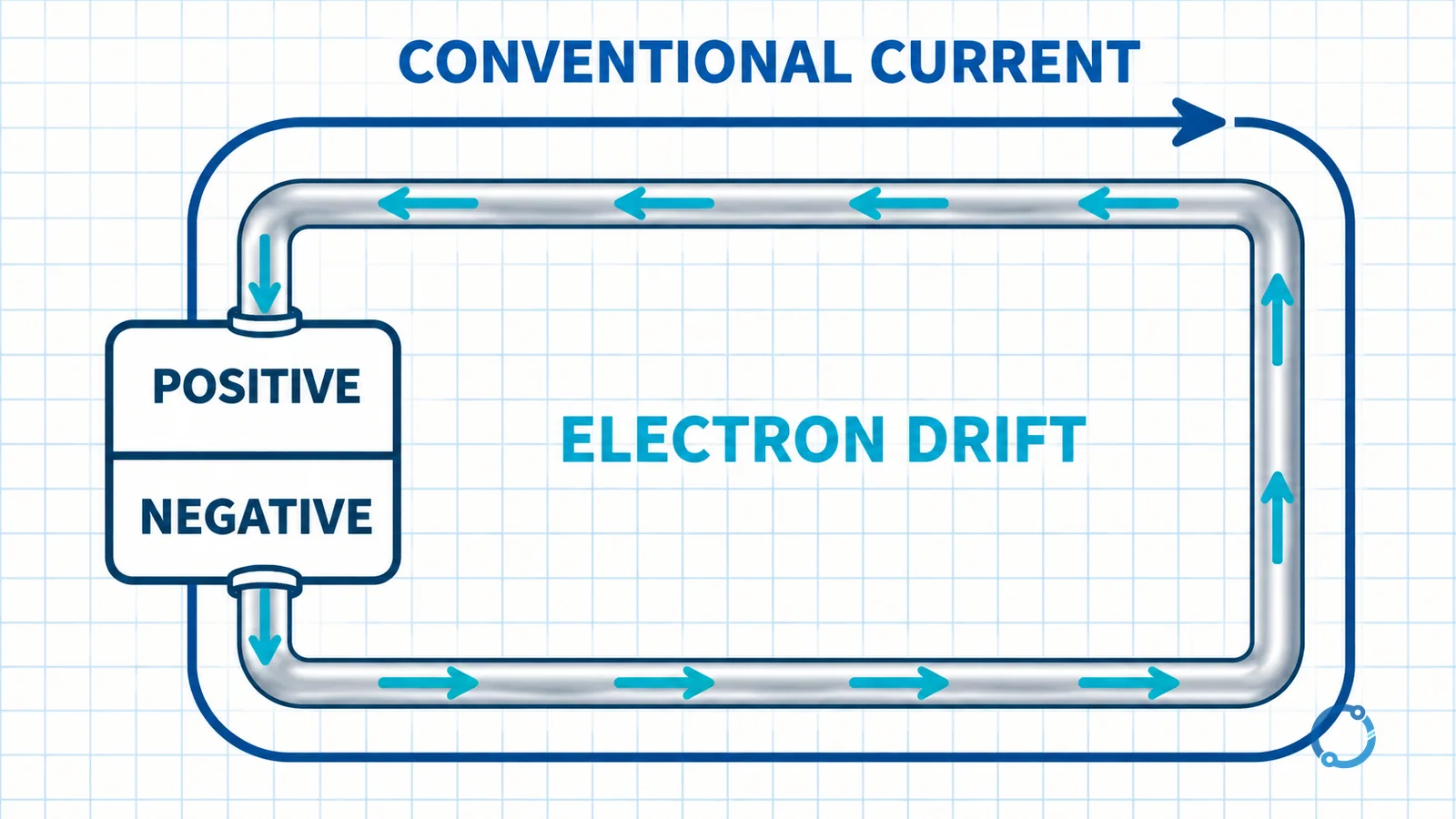
The convention matters when interpreting current arrows in a schematic, a current transformer, a shunt or a directional power calculation. It also matters in a conversation where someone says “current flows from negative to positive”: that statement may be describing electron drift rather than conventional current. State which carrier or convention is intended.
A closed circuit and a source
A sustained current needs a closed conducting path and a source that maintains a potential difference around that path. The meaning of voltage explains potential difference; for current, the practical point is that a source separated from a complete circuit does not by itself produce a steady current through the external path.
An electrostatic discharge is a useful boundary case. A charged object can transfer a short pulse of charge through the air or a person and produce a transient current, but there is no sustained current unless a source and a closed path maintain the flow. A battery, generator or electronic supply can maintain the potential difference that drives a continuing current through a connected circuit.
Current does not necessarily divide equally among all available conductors. It follows the connected paths according to their impedances and the applied potential. The source, conductors, load and return path all form part of the circuit.
Three ways to calculate current
From voltage and resistance
For an ohmic element, current is:
I = V / R
The Ohm’s law explanation covers the relationship in more detail. As a consistency check with the power example below, the already stated 120 V and 0.5 A values satisfy this relationship when the resistance is taken as their ratio. No new operating point is introduced here.
Ohm’s law is not a universal description of every device. A lamp filament changes resistance with temperature, and a semiconductor junction is strongly nonlinear. Use the relationship where the element or operating range supports it.
From DC or unity-power-factor power
Power, voltage and current are linked:
P = V x I
For a resistive DC load drawing 60 W at 120 V:
I = P / V
I = 60 W / 120 V
I = 0.5 A
This example assumes the stated electrical input is the power delivered at the load and that the current and voltage quantities are consistent. The same arithmetic applies at unity power factor in a suitable single-phase AC calculation, but power factor must be included when voltage and current are not in phase.
From single-phase AC power and power factor
For a single-phase sinusoidal AC load using RMS voltage and current:
I = P / (V x PF)
Suppose the electrical input is 2.2 kW, the RMS voltage is 230 V, and the power factor is 0.85.
I = 2200 W / (230 V x 0.85)
230 V x 0.85 = 195.5 V
I = 2200 / 195.5
I = 11.253... A
I = 11.3 A when rounded to one decimal place.
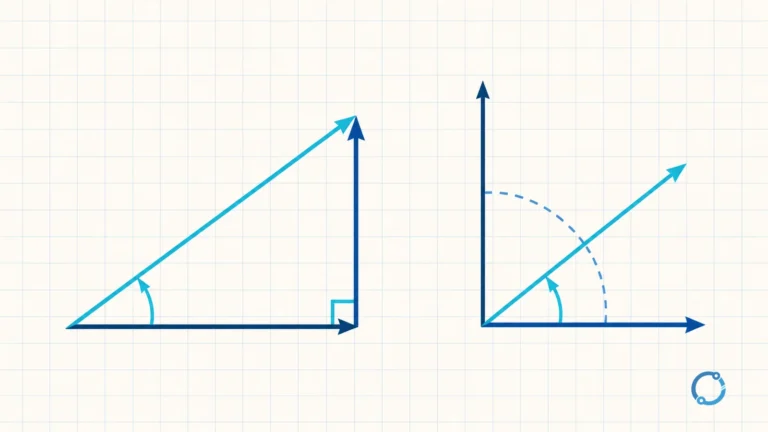
The power factor appears because P = V x I x PF relates real power, RMS voltage, RMS current and the sinusoidal displacement factor. The power factor definition explains real, reactive and apparent power. The 11.3 A result is not a breaker rating or a conductor recommendation.
AC and DC current
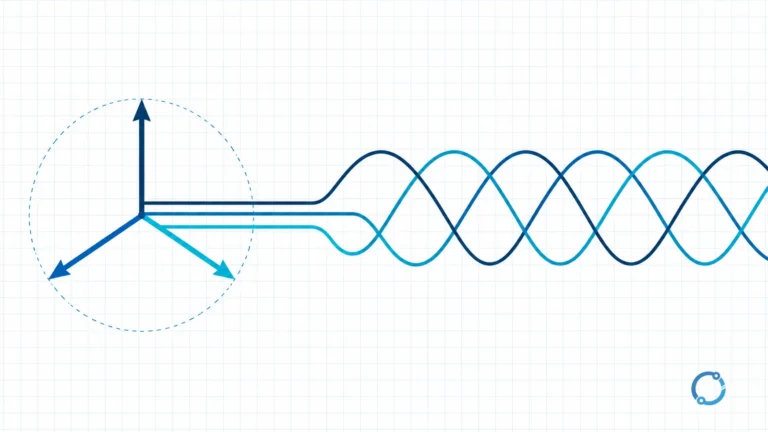
In a direct-current circuit, the current direction remains approximately constant. In an alternating-current circuit, the current reverses periodically, so an ammeter normally reports an RMS value that represents the equivalent heating effect rather than a single signed instantaneous value. The AC versus DC current comparison covers waveform, frequency and applications; this page only needs the distinction between steady and time-varying current.
Series and parallel current
In a series path, the same current passes through every element because there is no alternative route for charge. In a parallel group, the current divides among the branches and the total current is the sum of the branch currents. The series and parallel circuits guide explains voltage division and equivalent resistance; the current rules here are only a bridge to those calculations.
Three effects of current
Heating
Current through a resistance transfers electrical energy into heat. The power dissipated by a resistance is I^2 R in the ideal resistive model, so the heating effect rises sharply as current increases. This is why conductors, terminals and equipment have current and temperature limits. A fuse uses controlled heating to interrupt an overcurrent; the difference between an MCB and a fuse explains that protective role, while detailed selection remains separate.
Magnetic effect
A current produces a magnetic field around the conductor. That field is the basis of the magnetic force used by motors, relays and many transformers and inductors. The explanation of how an electric motor works follows the conversion from current and magnetic field to torque, while the relay overview shows how a small coil current can move contacts and control another circuit.
Chemical effect
Current in an electrolyte can produce electrochemical changes at the electrodes. Electrolysis, electroplating and battery charging rely on ionic charge transfer and chemical reactions. The exact amount of material changed depends on the electrochemical system, so current alone is not enough for a material-transfer calculation.
How current is measured
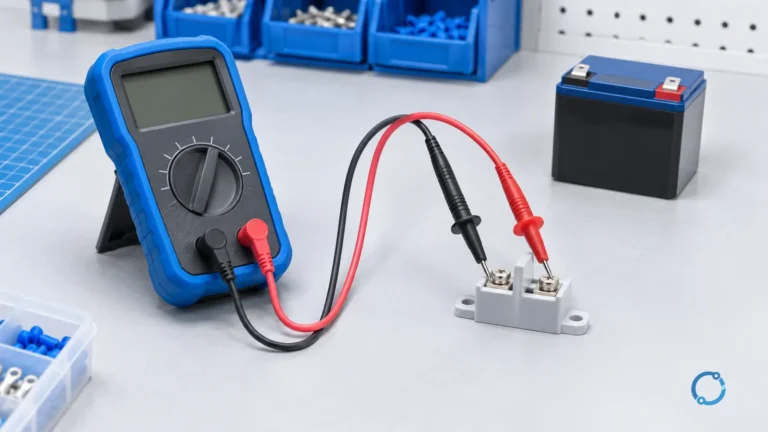
An ammeter is connected in series with the path whose current is to be measured, so the current under test passes through the meter. A clamp meter measures the magnetic field around a conductor and can be used without breaking the circuit when the meter and conductor arrangement are suitable. Do not assume that a clamp meter is safe or accurate for every circuit: check its category, range and instructions, isolate or de-energize before changing test connections where required, and use a qualified person for energized work. The multimeter measurement guide covers voltage, resistance, continuity and current modes.
What current does not tell you by itself
Current is one quantity in a larger electrical description. Two circuits can carry the same current while having different voltages, power factors, temperatures, fault duties or safety consequences. A current reading also does not identify the voltage that produced it or the resistance of the path.
That is why current must be combined with voltage, power, resistance, time and the equipment rating before making a design decision. A conductor carrying a small current can still have a dangerous voltage relative to earth, and a short-duration current can be more damaging than a steady current of the same numeric value.
Common mistakes
Saying that electrons always carry the current
Metals use mobile electrons, but electrolytes and other media can use ions. The general definition is net charge transfer, not one named carrier.
Reversing the current arrow because electrons are negative
Conventional current is the standard circuit-analysis direction. If electron drift is the subject, label it explicitly and account for the negative charge. Do not draw an arrow and leave its convention ambiguous.
Using the power formula without power factor
For a single-phase AC load with a displacement between voltage and current, P = V x I x PF. Omitting PF overstates the current for a given real power and voltage.
Treating an average as an instantaneous value
I = Q/t over a long interval gives an average. A waveform can have a much larger peak, and a protection device may respond to a short-duration value rather than the interval average.
FAQ
What is electric current measured in?
Electric current is measured in amperes. One ampere equals one coulomb of net charge passing a cross-section per second.
Why does conventional current oppose electron flow in a metal?
Conventional current is defined as the direction positive charge would move. Electrons are negative, so their drift through a metal is opposite the conventional-current arrow, while the net charge transfer still points in the conventional direction.
Can current flow without a closed circuit?
A sustained current needs a closed path and a source that maintains a potential difference. A very short charge-transfer event such as an electrostatic discharge can produce a transient current through a limited path.
How do you calculate current from power and voltage?
Use I = P / V for a DC or unity-power-factor case. For a single-phase sinusoidal AC load, include power factor: I = P / (V x PF).
Why does a series circuit have the same current everywhere?
There is only one path through the series elements, so the same net charge must pass through each cross-section during a given interval. The current can be the same while the voltage drops differ.
Sources
This article uses the charge, current, voltage, power and connection relationships stated in the text. The fixed arithmetic is provided as reproducible teaching material. No external standards or product ratings are used.