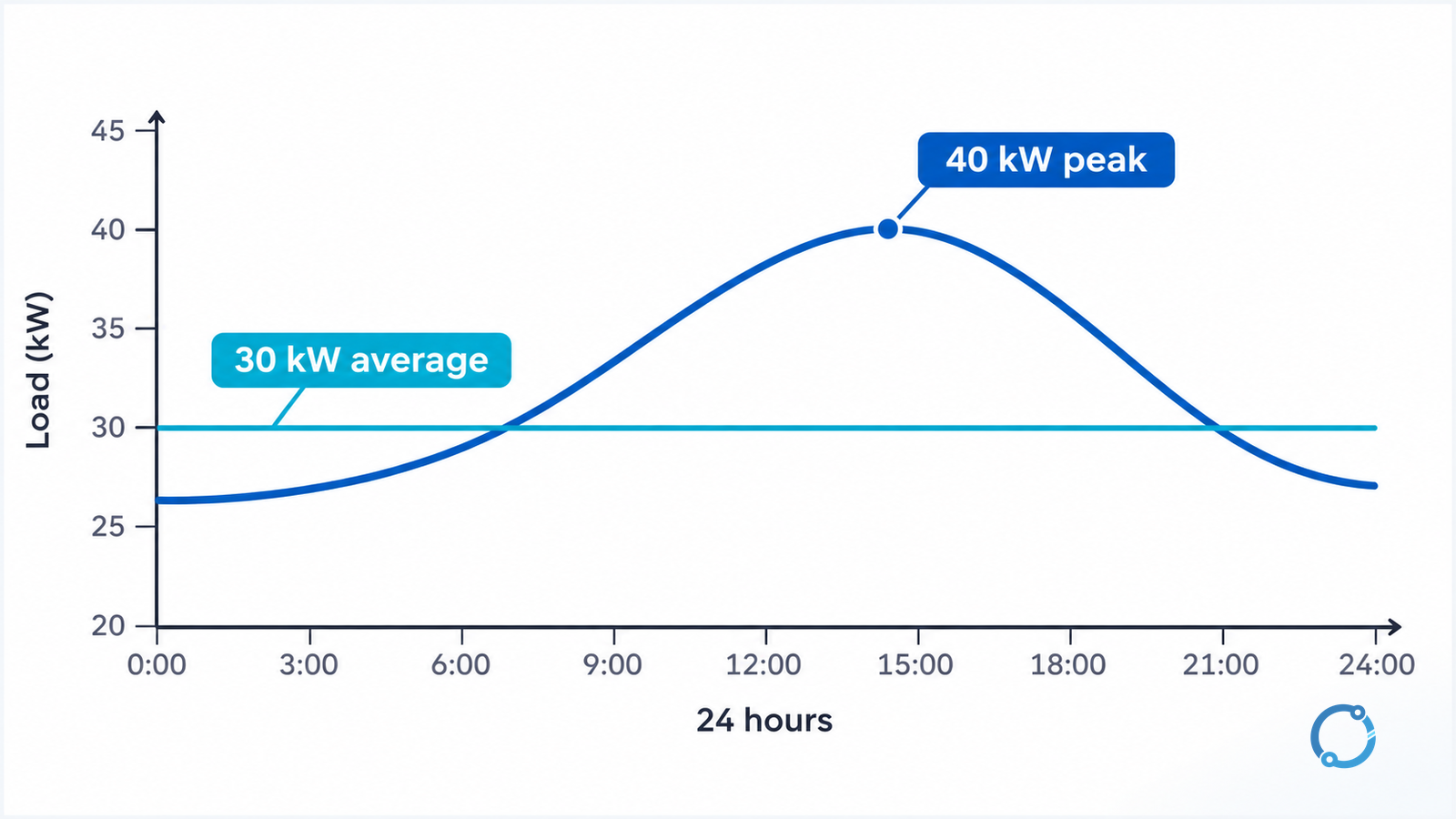
Load factor compares average electricity demand with the highest demand in the same period. The U.S. Energy Information Administration defines it as the ratio of average load to peak load during a specified time interval; peak load is the maximum load in that period.
When your bill gives energy in kilowatt-hours (kWh), peak demand in kilowatts (kW), and the number of hours in the billing interval, the equation is:
Load factor = kWh / (peak kW x hours)
The result is a dimensionless ratio, usually written as a percentage. It is not a power, an energy total, or an efficiency.
Why the formula works
Energy divided by time gives average load:
average kW = kWh / hours
Load factor is then average kW / peak kW. Combining the two steps gives kWh / (peak kW x hours). The unit check is kWh / (kW x h) = 1, so a result such as 0.62 or 62% describes how fully the peak is used over the interval, not how much energy was consumed.
The EIA electricity measuring guide separates power in watts or kilowatts from energy over time in watt-hours or kilowatt-hours. OHELE’s kW vs kWh explainer covers those units; the peak-demand denominator is what makes load factor a separate calculation.
Worked example with two equal-energy bills
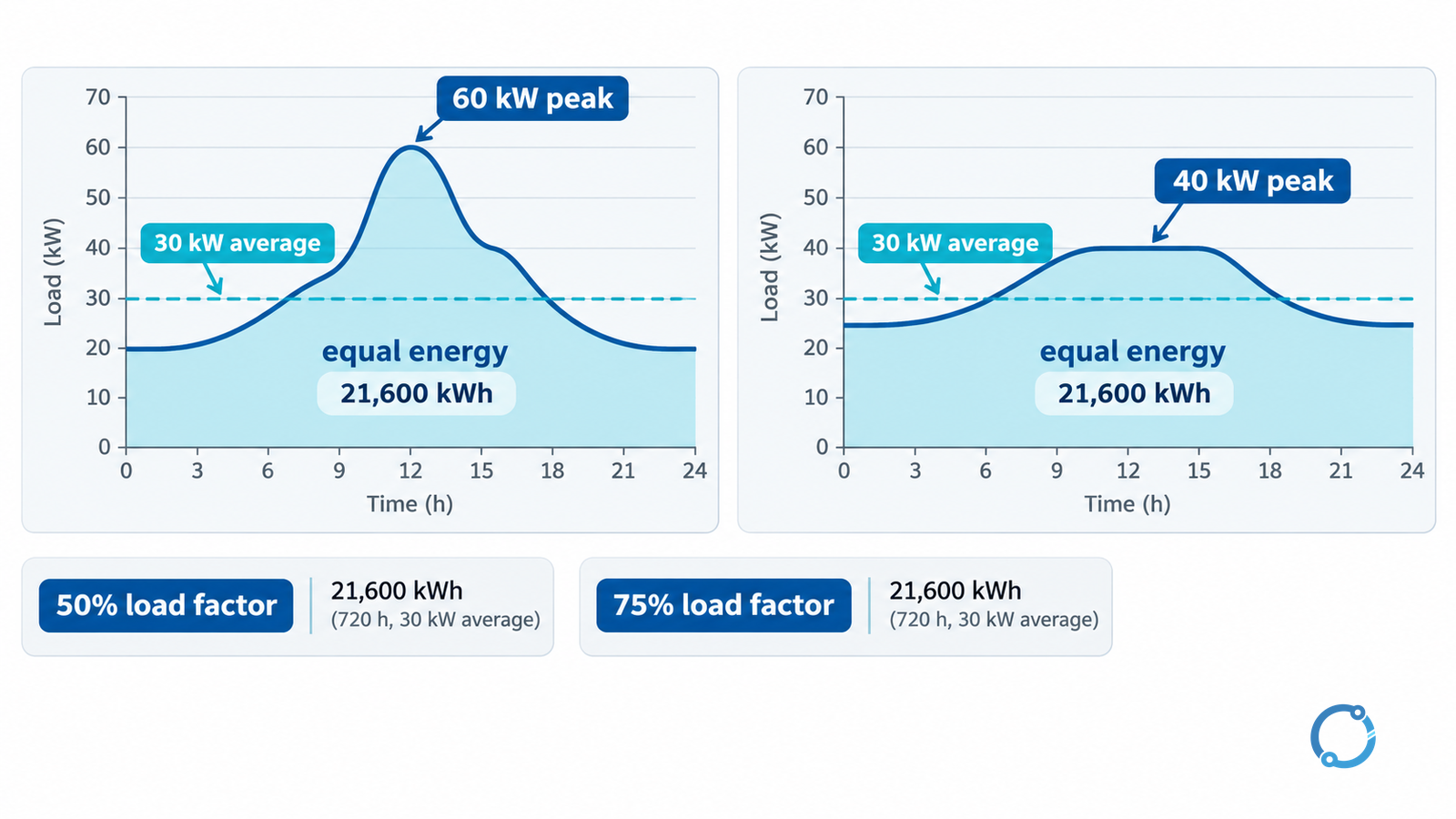
Assume two facilities each use 21,600 kWh over a 30-day billing interval of 720 hours. Their measured billing peak demands differ. These are hypothetical inputs, not tariff data.
| Input | Facility A | Facility B |
|---|---|---|
| Energy | 21,600 kWh | 21,600 kWh |
| Interval | 30 days = 720 h | 30 days = 720 h |
| Average load | 21,600 / 720 = 30 kW | 21,600 / 720 = 30 kW |
| Billing peak | 60 kW | 40 kW |
| Load factor | 30 / 60 = 0.50 = 50% | 30 / 40 = 0.75 = 75% |
Using the one-line formula gives the same results: 21,600 / (60 x 720) = 0.50 and 21,600 / (40 x 720) = 0.75. The two bills have identical energy, but Facility A’s higher short-duration peak produces a lower load factor.
What you must take from the bill
Before calculating, identify four things:
- The exact start and end of the billing interval, converted to hours.
- Total energy for that same interval, in kWh.
- Billed or measured peak demand, in kW, with the same interval.
- The utility’s definition of that peak, including its averaging window and whether demand is measured for the whole interval or only specified time-of-use periods.
The DOE WINDExchange guidebook calls peak demand the maximum consumption level in kW during a billing period, usually measured over a 15- or 30-minute duration, and explicitly says the definition may vary by utility. Do not assume that an instantaneous meter maximum and a 15-minute billed demand are interchangeable.
DOE’s Federal Demand Flexibility guidance says a demand charge is based on the customer’s highest demand in kW during a billing cycle, while time-variable energy rates depend on when electricity is consumed. A bill can therefore contain both energy charges and demand charges, with different measurement rules.
How to interpret the number
| Observation | Safe interpretation | What it does not prove |
|---|---|---|
| Higher load factor | Average demand is closer to the recorded peak for the stated interval | That the site is energy efficient |
| Lower load factor | The peak is larger relative to average demand | That energy was wasted |
| Same kWh, lower factor | A higher peak or a different measurement window changed the denominator | That total consumption changed |
| Changed factor after load shifting | The interval’s average-to-peak relationship changed | That every component of the bill will fall |
A low load factor can describe a process that legitimately runs hard for a short time. It can also point to simultaneous equipment starts worth investigating. The ratio alone does not identify the cause. Compare the load profile, operating schedule and the exact tariff before drawing a cost conclusion.
Calculation traps
- Do not mix a monthly kWh total with a daily or seasonal peak; both must cover the same interval.
- Do not use a 30-day, 720-hour interval unless that matches the bill. A 28-day interval is 672 h and a 31-day interval is 744 h.
- Do not divide kWh by kW without also using hours;
kWh / kWgives hours, not a ratio. - Do not compare load factors from different tariffs when one uses a 15-minute peak and another uses a 30-minute or time-window peak.
- Do not treat load factor as power factor. Power factor is the ratio of real power to apparent power; load factor compares average and peak demand over time.
Sources
- EIA Glossary: Load factor.
- EIA Glossary: Peak load.
- EIA: Measuring Electricity.
- DOE: Federal Demand Flexibility.
- DOE WINDExchange: Small Wind Guidebook, glossary definition of peak demand.