Short answer
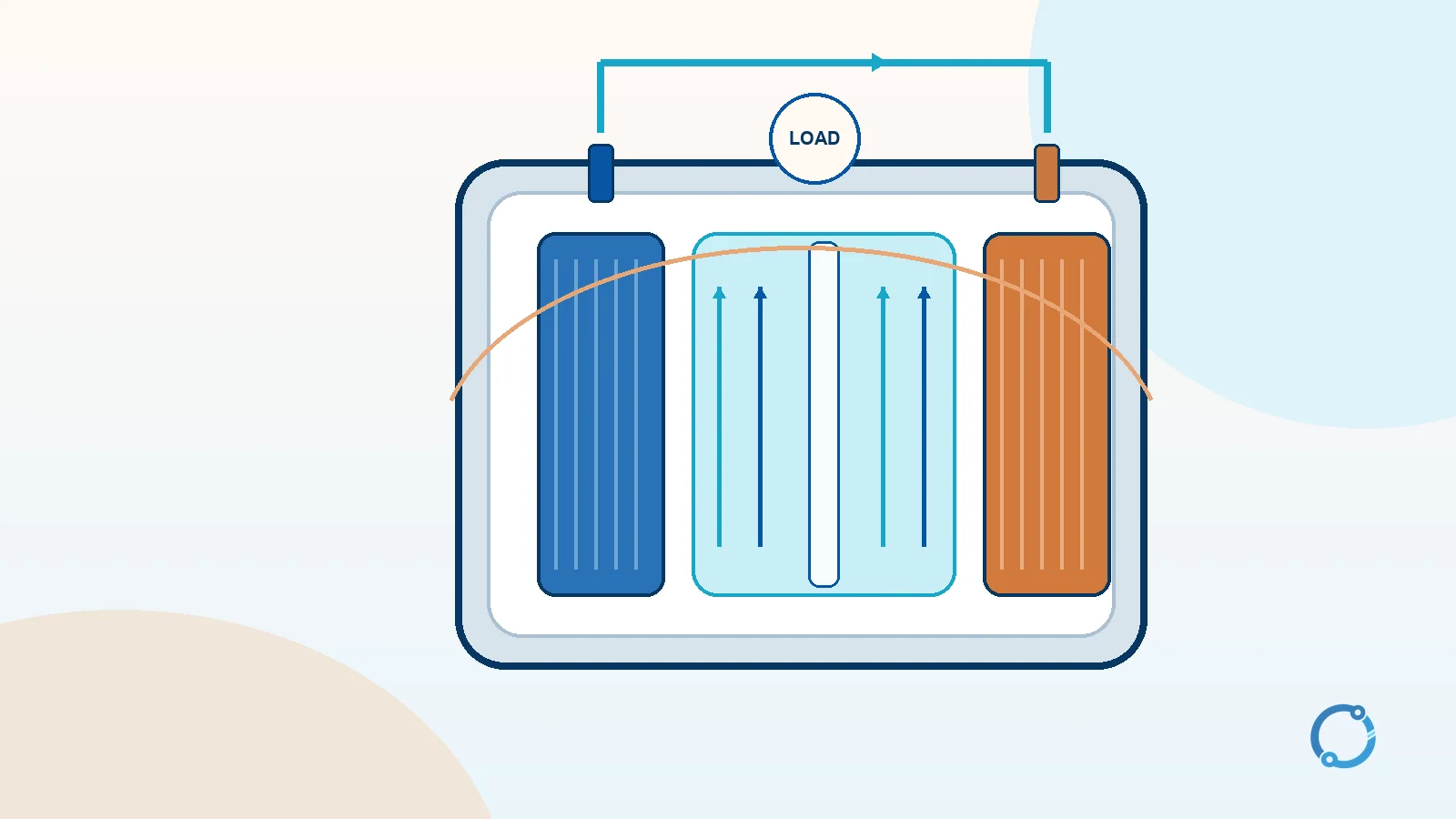
A battery stores chemical energy and converts it into electrical energy when an external circuit is connected. It does not store electricity as a tank stores water. Two electrodes made from different materials, an electrolyte and a separator form an electrochemical cell. During discharge, an oxidation-reduction reaction releases electrons at the negative electrode, those electrons travel through the external circuit, and ions move through the electrolyte to keep charge balanced.
The voltage comes from the electrochemical difference between the electrode reactions. The capacity comes from how much active material can react under the specified conditions. The terminal voltage is not a direct measure of all remaining energy, and the ampere-hour rating is not the same as a watt-hour rating. The electric current and voltage guides explain the two quantities that make a battery useful in a circuit.
The four parts of a cell
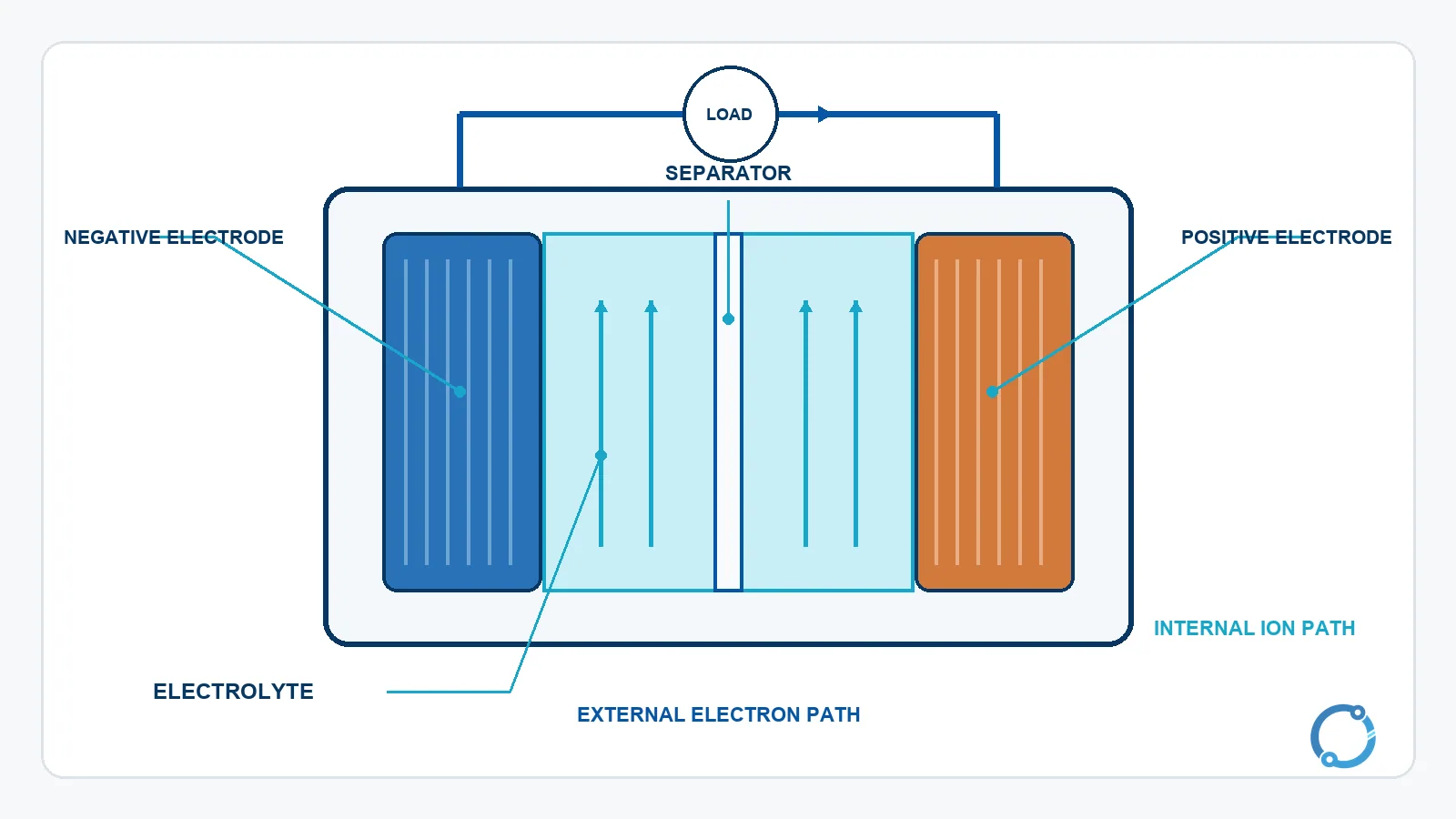
The word cell describes one electrochemical unit. A battery can be one cell in everyday language, but technically a battery is a group of two or more connected cells. A useful cell model has four parts:
- Negative electrode: the electrode where oxidation occurs during discharge. It releases electrons to the external circuit.
- Positive electrode: the electrode where reduction occurs during discharge. It receives electrons from the external circuit through the load.
- Electrolyte: an ion-conducting medium that completes the internal charge path. It is not a wire and does not carry electrons through the cell in the same way a metal conductor does.
- Separator: a physical barrier that keeps the electrodes from touching while allowing ions to move between them.
The electrode and electrolyte materials determine the cell voltage, the direction of the reactions and the practical limits of charge and discharge. The physical size affects how much active material and current-carrying area are available, but size alone does not set the voltage of a particular chemistry.
The names anode and cathode can cause confusion because they are defined by the electrochemical reaction direction. During discharge, the negative electrode is the anode and the positive electrode is the cathode. During charging, the external source reverses the current and the electrochemical roles reverse: the positive electrode becomes the anode and the negative electrode becomes the cathode in the charging reaction. For that reason, this article uses negative electrode and positive electrode for the physical terminals, then states the anode and cathode role for the process being discussed.
What happens during discharge
The discharge process can be followed as a sequence:
- At the negative electrode, an oxidation reaction releases electrons.
- Those electrons travel through the external conductor and the load.
- At the positive electrode, a reduction reaction accepts electrons.
- Ions move through the electrolyte and separator so that charge does not accumulate uncontrollably inside the cell.
The external electron flow is from the negative terminal toward the positive terminal through the load. Conventional current is defined in the opposite direction, from positive to negative through the external circuit. Both descriptions are useful, but mixing them without stating the convention creates errors. The electric-current guide explains this distinction in more detail.
Inside the cell, the electrolyte is the ionic path. The separator prevents a direct electronic short between the electrodes. A battery is therefore not powered by electrons jumping through the electrolyte from one plate to the other; the cell chemistry and the ionic transport support the reactions at the two electrode surfaces.
Where the voltage comes from
The cell voltage is set mainly by the chemistry of the electrode reactions and the electrolyte environment. It is not determined by the external dimensions of the battery, although design and operating conditions affect how the voltage behaves under load. A larger cell of the same chemistry can deliver more charge or current capability without automatically having a proportionally larger nominal voltage.
As a broad teaching example, a lead-acid cell has a nominal voltage of approximately 2 V. A 12 V lead-acid battery therefore uses six cells connected in series in the conventional design:
2 V x 6 = 12 V
The value is nominal, not a guarantee that the terminals will measure exactly 12 V at every state of charge, temperature and load. Charging voltage, internal resistance and surface charge also affect a measurement. This is why a voltage reading is not a complete state-of-charge test for every chemistry.
Lithium-based cells are a family rather than a single chemistry. A common nominal value is often described as approximately 3.2 V to 3.7 V, but the exact value depends on the chemistry, manufacturer’s specification and test conditions. The article therefore uses the approximate range only as orientation, not as a universal cell rating.
Amp-hours, watt-hours and energy
An ampere-hour is the amount of charge delivered by a current of one ampere for one hour. If a battery delivers 10 A for 2 h, the charge moved is 20 Ah under the ideal definition. The rating assumes stated test conditions; the available ampere-hours can change with discharge rate, temperature and end voltage.
Ampere-hours alone do not tell you the energy. Energy also depends on voltage:
Wh = V x Ah
Take a nominal 12 V, 100 Ah battery. The nominal energy is:
12 V x 100 Ah = 1,200 Wh
1,200 Wh = 1.2 kWh
The word nominal matters. The terminal voltage changes during discharge and the usable energy is lower than the simple product when the battery is operated at high current, at low temperature, or to a restricted depth of discharge. The battery storage MW versus MWh article explains why power capability and energy capacity are separate design questions.
An ideal runtime calculation
Suppose the 12 V, 100 Ah battery is treated as an ideal source and a 200 W load is connected. Ignoring conversion losses, voltage sag and the usable-energy limit:
t = energy / power = 1,200 Wh / 200 W = 6 h
So the ideal runtime is six hours. This is a teaching calculation, not a promise of six hours from every 100 Ah battery. An inverter or converter has losses, the load may not be constant, the battery may not be allowed to discharge completely, and the terminal voltage may fall before the nominal energy is delivered.
The C-rate is another useful way to express current relative to capacity. For a 100 Ah battery, the C/10 rate is:
100 Ah / 10 h = 10 A
If the manufacturer permits a C/10 discharge within its specified voltage and temperature limits, the ideal one-hour multiplier gives ten hours. The actual permitted rate, end voltage and temperature window remain battery-specific. The substation battery charger sizing article shows why a real DC system needs more than this simple capacity division.
Series and parallel battery connections
Individual cells often need to be combined to obtain a higher voltage or more charge capacity. For two identical ideal 12 V, 100 Ah blocks:
Series connection:
- Voltage adds:
12 V + 12 V = 24 V. - Ampere-hour capacity stays at
100 Ahfor the two-block string. - Nominal energy is
24 V x 100 Ah = 2,400 Wh = 2.4 kWh.
Parallel connection:
- Voltage stays at
12 V. - Ampere-hour capacity adds:
100 Ah + 100 Ah = 200 Ah. - Nominal energy is
12 V x 200 Ah = 2,400 Wh = 2.4 kWh.
Both arrangements contain the same ideal energy, but they present different voltage, current and wiring requirements. The series and parallel circuits guide explains the underlying connection rules. A practical battery pack also needs cell balancing, fusing, temperature monitoring and a battery management system where the chemistry and application require them. Those are system-level functions, not consequences that can be inferred from the amp-hour arithmetic alone.
Why a real battery delivers less than the nominal calculation
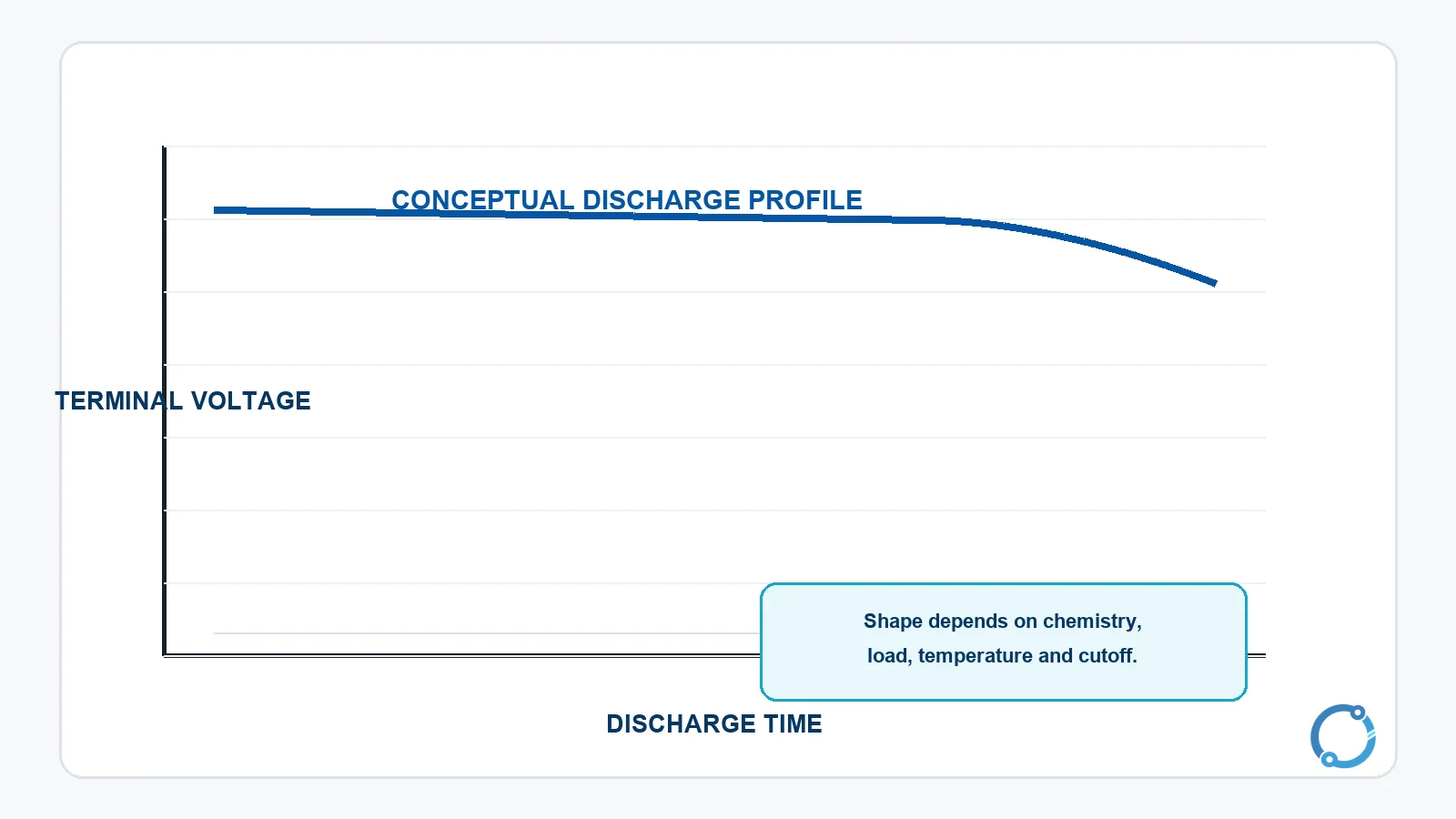
The first limitation is discharge rate. Internal resistance causes a voltage drop when current flows, so a high current can reach the system’s low-voltage cutoff before the battery has delivered its rated ampere-hours. The terminal voltage also changes as the active materials and electrolyte change during discharge.
The internal resistance model is simple but useful: the battery behaves as an ideal voltage source behind a resistance. With no current, the terminal voltage can look close to the open-circuit voltage. Under load, the terminal voltage is reduced by the current multiplied by that internal resistance. The resistance is not necessarily constant: it can change with temperature, state of charge, ageing and the length of the internal current path. Two batteries with the same nominal voltage and Ah label can therefore behave differently under a high-current load.
The second limitation is temperature. Electrochemical reaction rates and ion transport depend on temperature. A battery that performs acceptably at one temperature may have less usable capacity or a different voltage profile at another. Temperature management is therefore part of the battery system, not an optional accessory.
The third limitation is depth of discharge. A system may stop discharge at a specified voltage to protect the battery or preserve cycle life, even though more charge remains chemically available. The permitted depth of discharge is chemistry- and application-specific, so this article does not publish a universal percentage.
The fourth limitation is ageing. Active material changes, side reactions accumulate and internal resistance can rise. A battery may still accept charge but deliver less useful energy than it did when new. The exact degradation rate cannot be inferred from the nominal amp-hour label.
A battery specification also needs a defined end voltage. The same battery discharged to two different cutoff voltages will deliver different ampere-hours and watt-hours. The load’s minimum operating voltage may force a cutoff earlier than the battery’s electrochemical limit, especially when an inverter or electronic converter cannot accept a wide input range. This is one reason the energy available to a system can be lower than the product of the nameplate voltage and nameplate Ah.
Power and energy remain separate limits even after the battery is assembled into a pack. A pack may be able to supply a large current for a short time without containing enough energy for a long runtime, or it may contain substantial energy while its converter or cabling limits the available power. The load profile, converter efficiency and protection settings must be considered together rather than treating Ah as a complete system specification.
Charging is the reverse process
Charging supplies electrical energy to drive the electrochemical reactions in the reverse direction. The external source forces current through the battery, the active materials are restored toward their charged forms and ions move through the electrolyte to maintain charge balance. The terminal voltage must be appropriate for the chemistry and the charger must respect the manufacturer’s voltage, current and temperature limits.
Cells that cannot be recharged are called primary cells. Secondary cells can be recharged, although repeated charging does not make them lossless or indefinitely durable. The same cell can experience side reactions, heat and material changes, so a charger designed for one chemistry must not be assumed to work for another.
The lead-acid chemistry is a familiar rechargeable example. During discharge, the active materials and electrolyte change; charging drives the reactions backward. Charging can produce gases under some conditions, which is why ventilation and the manufacturer’s instructions matter. This article does not provide charging setpoints or a maintenance procedure because those depend on the actual battery design and installation.
Safety and connection boundaries
A battery is an energy source even when it is not connected to a charger. A short circuit can produce a very high current, heating, fire or mechanical damage. Terminals that are exposed or accidentally bridged are therefore a hazard. Large battery banks require enclosure, insulation, fault protection and a documented isolation procedure.
Do not assume that disconnecting the charger makes a battery safe to service. The battery itself remains energized, and a pack may contain stored energy in multiple cells and modules. Work on battery systems only under the applicable electrical safety program and with the tools and personal protective equipment specified for the installation.
The solar-panel explainer provides the DC source context for a photovoltaic system, but a PV array and a battery are not interchangeable. A PV module generates power when illuminated; a battery stores electrochemical energy and can deliver it later. The balance of system must handle both source behavior and storage behavior.
Frequently asked questions
What is the difference between a cell and a battery?
A cell is one electrochemical unit with two electrodes, an electrolyte and a separator. A battery is technically a group of two or more connected cells, although the word is often used for a single-cell product in everyday language.
What are the anode and cathode in a battery?
During discharge, the negative electrode is the anode and the positive electrode is the cathode. During charging, the electrochemical roles reverse. The physical negative and positive terminals do not change names, which is why using both the terminal name and the process direction avoids confusion.
Does a higher Ah rating always mean a battery lasts longer?
Not by itself. Ah describes charge capacity under stated conditions, while runtime depends on the load, voltage, usable depth of discharge, temperature, conversion losses and ageing. Use the system’s voltage and energy calculations as well as the battery’s test conditions.
Can batteries be connected in series and parallel at the same time?
Yes, battery blocks can be arranged in series-parallel combinations when they are designed and managed for it, but the blocks should be compatible and the system must include appropriate balancing, protection and monitoring. The ideal arithmetic does not replace the pack designer’s requirements.
Why does terminal voltage fall under load?
Current flowing through the battery’s internal resistance produces an internal voltage drop, and the electrochemical conditions also change during discharge. The terminal voltage therefore falls as load current increases and as the state of charge moves toward the end of the usable range.