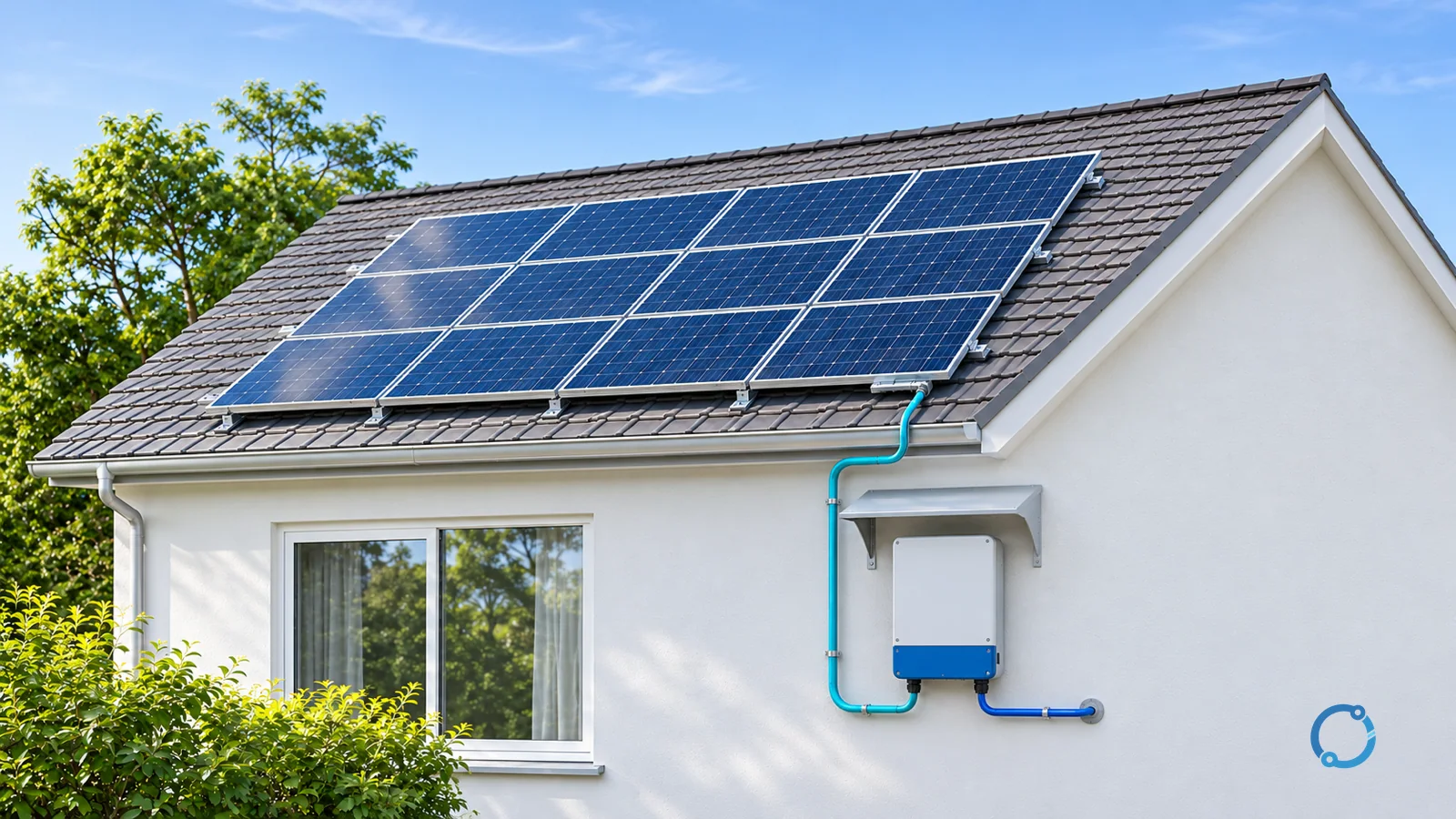
Short answer: Estimate the number of panels by dividing annual household energy use by the annual output of one panel under the same sunlight and system assumptions:
panels = annual kWh / (peak sun hours x 365 x module kW x system derate)
The result is a first-pass count, not an installation design. Use a whole number of panels and round upward after the calculation. The three inputs that change the answer most are annual energy use, location-specific solar resource and the assumptions used for real-world system losses.
This article uses one fixed example so every step can be checked:
- Annual household electricity use:
9,600 kWh - Module nameplate power:
400 W, which is0.4 kW - System derate:
0.85
These are teaching values, not claims about a typical household or a particular solar module. The method is the transferable part.
Step 1: Get annual energy use in kWh
Start with a year of electricity bills, not a monthly guess. Add the kWh values for twelve consecutive months so seasonal heating, cooling and occupancy changes are represented. If bills are missing, a utility account export or a full year of metered interval data may provide the same information.
The relevant unit is kilowatt-hour, not kilowatt. A kilowatt describes power at an instant; a kilowatt-hour describes energy delivered over time. A house can have a high momentary power draw while using modest energy, or a steady low draw that accumulates substantial energy over a year. The kW and kWh explanation covers that distinction in more detail.
For the example:
annual energy = 9,600 kWh
The goal is not to reproduce the previous year exactly. The goal is to estimate the solar array needed to offset a stated quantity of annual energy. If the house will add a large load, change occupancy or electrify heating, use a documented future-load assumption instead of the historical bill alone.
Step 2: Find peak sun hours, not daylight hours
Peak sun hours convert the solar resource at a location into an equivalent number of hours at a defined reference irradiance. They are not the time from sunrise to sunset. A location may have many daylight hours but a much smaller number of peak sun hours because the sun angle, clouds and atmosphere reduce the available irradiance during much of the day.
Peak sun hours vary by location, season, tilt, orientation and weather. The U.S. Southwest generally has a stronger solar resource than much of the northern United States, but a specific house still needs a site-specific estimate. The National Renewable Energy Laboratory’s PVWatts tool uses location, system and loss inputs to model production. A local weather dataset or an experienced solar designer can provide another check.
This article does not assign a universal peak-sun-hour value to a country or state. Instead, it compares three transparent scenarios: 3.5, 4.5 and 5.5 peak sun hours per day. These are example inputs chosen to show the sensitivity of the result.
Step 3: Convert module watts to kW
Solar module power is commonly shown in watts under standard test conditions. Convert it to kilowatts before combining it with the annual-hour calculation:
400 W = 0.4 kW
The nameplate value is not a promise that the module will deliver 400 W continuously. Actual output changes with irradiance, cell temperature, spectrum, soiling, mismatch and the operating point selected by the inverter. That is why the next input is a system derate rather than a claim that every module produces its label value for every hour.
Step 4: Apply a system derate
The example uses 0.85. This means the estimated annual output is 85 percent of the simple nameplate-and-sunlight result. The single factor is a teaching shortcut that conceptually stands in for several real-world effects:
- inverter conversion losses;
- module temperature effects;
- soiling and dirt;
- module mismatch and connections;
- wiring losses;
- availability or operating losses.
The list does not assign a separate percentage to each item. A real design should use a modeling tool, actual equipment data and a documented loss assumption. A higher derate produces a larger estimated output and fewer panels; a lower derate produces a more conservative output and more panels. The number must therefore be visible and tied to the source of the estimate.
The full worked example
The annual output estimate for one module is:
annual kWh per module = module kW x peak sun hours x 365 x derate
For the example module:
annual kWh per module = 0.4 x peak sun hours x 365 x 0.85
The panel count is:
panels = 9,600 kWh / annual kWh per module
The table applies the same formula to the three example solar-resource values.
| Peak sun hours per day | Estimated annual output per 400 W module | Calculation for 9,600 kWh | Panels after rounding up |
|---|---|---|---|
| 4.5 | About 558 kWh | 9,600 / 558.45 = 17.19 |
18 |
| 3.5 | About 434 kWh | 9,600 / 434.35 = 22.10 |
23 |
| 5.5 | About 683 kWh | 9,600 / 682.55 = 14.06 |
15 |
The arithmetic is intentionally shown to two decimal places before rounding. A fractional module is not a purchasable or installable unit, so the design estimate moves to the next whole module. The resulting counts are 18, 23 and 15, respectively.
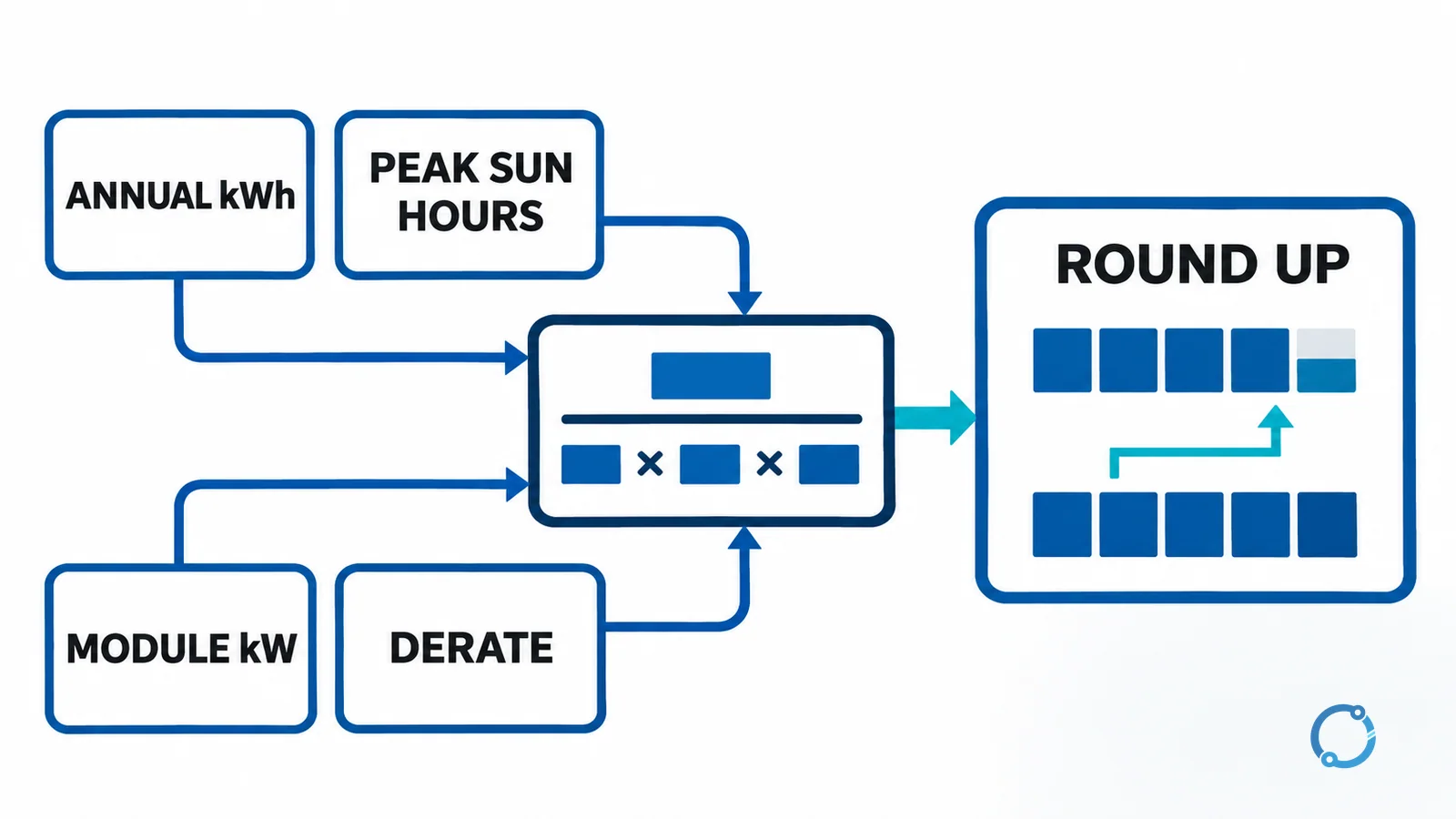
The lower the assumed solar resource, the more modules are needed to produce the same annual energy. This is why a count copied from another region or another roof is not a reliable design. The module count is a consequence of the assumptions, not a universal number for a house.
What the result means for roof area
Module dimensions vary, so roof area must be checked against the selected product and the usable mounting layout. For a rough illustration, assume each module occupies about 1.9 m2. Eighteen modules would occupy:
18 x 1.9 m2 = 34.2 m2
That is approximately 34 m2 of module area before accounting for walkways, setbacks, obstructions, structural spacing and the difference between the roof’s gross area and the usable array area. The area is only an illustration; the module datasheet and the actual roof plan control the final layout.
Roof geometry can change the answer even when the annual energy calculation is sound. A roof may be large enough in total area but have limited contiguous space with a suitable orientation. Shading from trees, chimneys, parapets or nearby buildings can also reduce the usable output. The calculation estimates energy; the site layout determines whether the modules can be placed.
Full offset versus partial offset
The calculation above targets annual energy equal to the example household’s annual use. That is a 100 percent annual-energy offset in the simple model. The house may still import electricity at night and export during sunny periods, depending on the system, loads, storage and utility rules.
A partial offset is a deliberate decision to supply less than the full annual kWh. The same formula can be used with a lower target:
target kWh = annual use x offset fraction
For example, a 50 percent annual-energy target would use 4,800 kWh in the numerator instead of 9,600 kWh. The module count would fall, but the actual bill impact would depend on when the energy is produced and how the utility credits or charges for imports and exports.
Net metering and export compensation are policy and tariff topics, not universal engineering constants. This article therefore does not assume a particular credit rate, buyback price or billing method. Verify the local utility rules before treating an annual-energy estimate as a financial result.
The role of the inverter and the rest of the system
The modules are only the DC generation portion of the system. An inverter converts DC to AC, and the balance of system includes conductors, connectors, disconnects, protection, mounting and monitoring. The solar-panel principle guide follows that chain from the photovoltaic cell to the inverter and AC output.
Inverter sizing, string voltage, conductor current and protection are separate design checks. A panel count that matches annual kWh does not by itself establish that the inverter’s input window, the string voltage at temperature extremes, the conductor ampacity and the interconnection equipment are suitable. Those checks belong in a real design using the selected equipment datasheets and the locally adopted electrical requirements.
The result is also sensitive to the difference between a modeled estimate and actual operation. Weather varies, equipment degrades and the household’s future consumption may change. The calculation is useful because it makes the assumptions visible, not because it predicts a guaranteed annual production.
Common mistakes
Dividing annual kWh by a module’s nameplate watts
Nameplate watts are a power rating under defined test conditions. Annual energy also depends on solar resource, time, temperature, conversion and other losses. Use a consistent kW and hour calculation and include an explicit derate.
Treating daylight hours as peak sun hours
Sunrise-to-sunset hours do not represent the equivalent hours at the reference irradiance. Use a location-specific solar model or a documented local dataset. A long summer day with clouds and a low sun angle can have a much lower energy yield than its clock length suggests.
Leaving out the derate factor
A calculation that assumes every module produces its nameplate power for every peak-sun-hour equivalent will overstate output. The right derate is not universal, but hiding the assumption makes the result harder to review and easier to misuse.
Before using the estimate for a real installation, replace the example inputs with a full year of household data, a location-specific peak-sun-hour value and a documented loss assumption. Then check the candidate module dimensions, inverter input limits, roof layout and local electrical requirements. The annual-energy equation gives the first quantity; the complete design still needs those equipment and site checks.
FAQ
How many solar panels does a house need?
It depends on annual energy use, location-specific peak sun hours, module power and system losses. In the fixed example here, a 9,600 kWh annual load with 400 W modules and a 0.85 derate needs about 18 modules at 4.5 peak sun hours, 23 at 3.5 and 15 at 5.5.
Are peak sun hours the same as daylight hours?
No. Peak sun hours express the solar resource as an equivalent number of hours at a reference irradiance, while daylight hours are simply the time between sunrise and sunset. Use a location-specific solar model rather than counting daylight hours.
Why does the number of panels change with location?
The available solar resource changes with latitude, season, weather, tilt, orientation and shading. A site with fewer peak sun hours needs more module capacity to produce the same annual energy, assuming the other inputs remain unchanged.
Why round the panel count up?
Modules are installed as whole units. A result of 17.19 modules cannot be provided by 17.19 physical modules, so the first-pass estimate rounds up to 18. A real design may need more modules after roof layout, equipment limits and other constraints are checked.
Does this estimate guarantee my electricity bill will be zero?
No. The calculation estimates annual energy production under stated assumptions. Bills depend on when energy is used, utility tariffs, import and export rules, fixed charges and actual system performance. A 100 percent annual-energy estimate is not a guarantee of a zero bill.