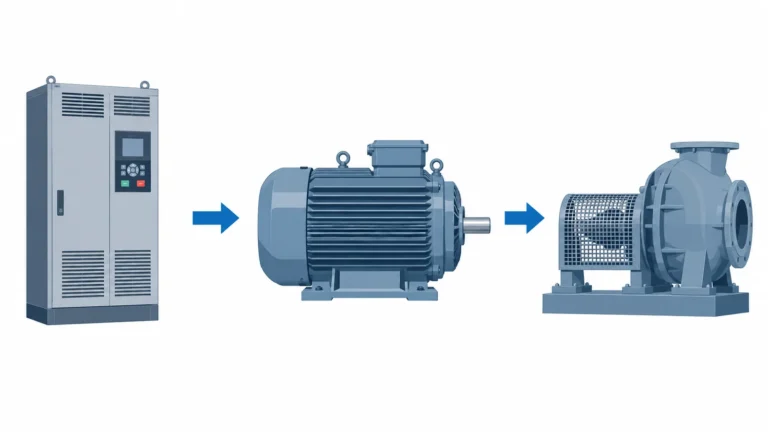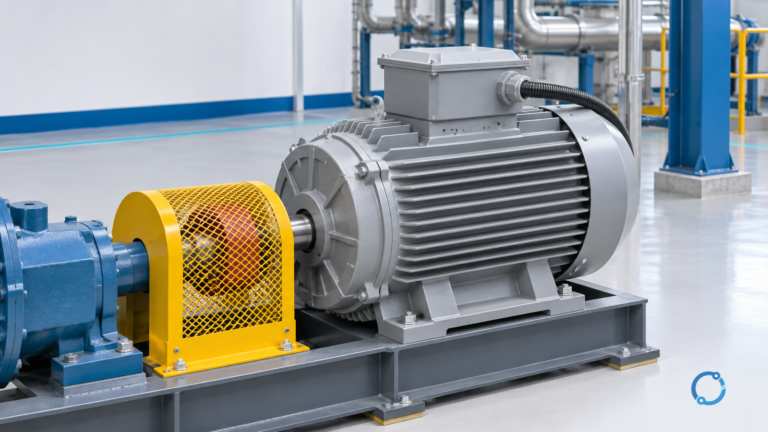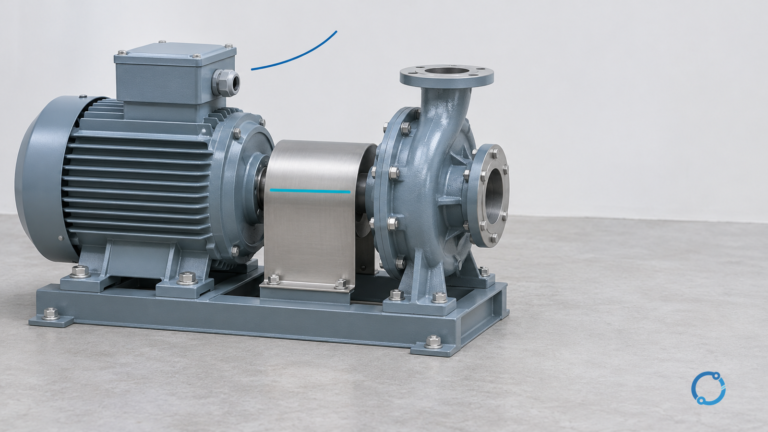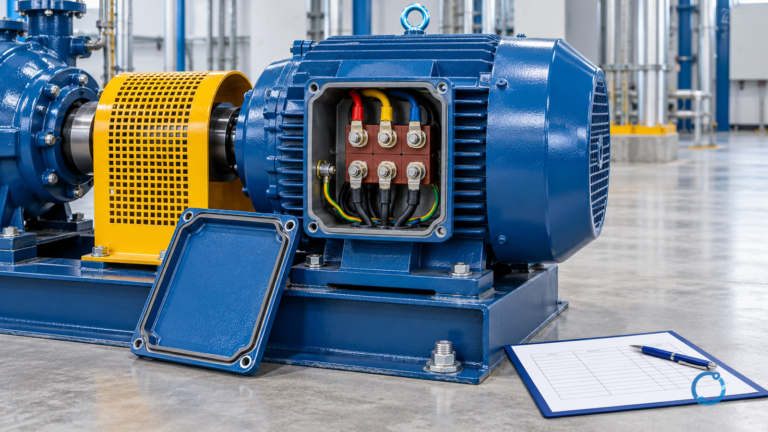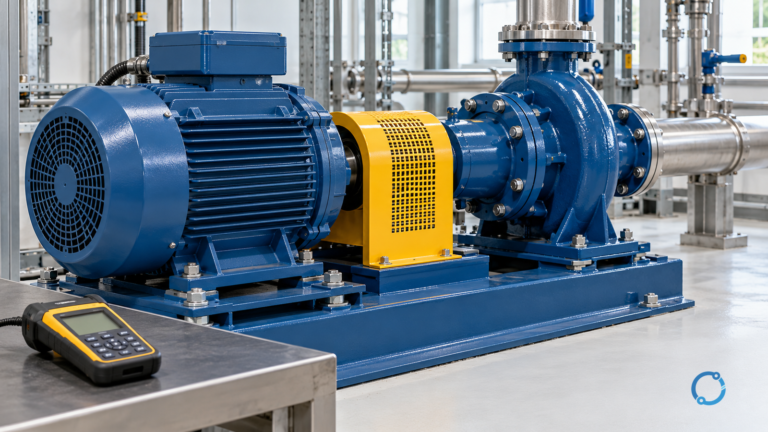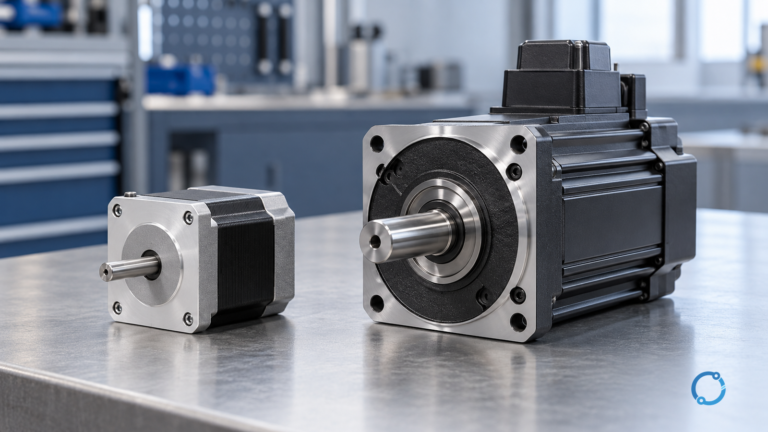
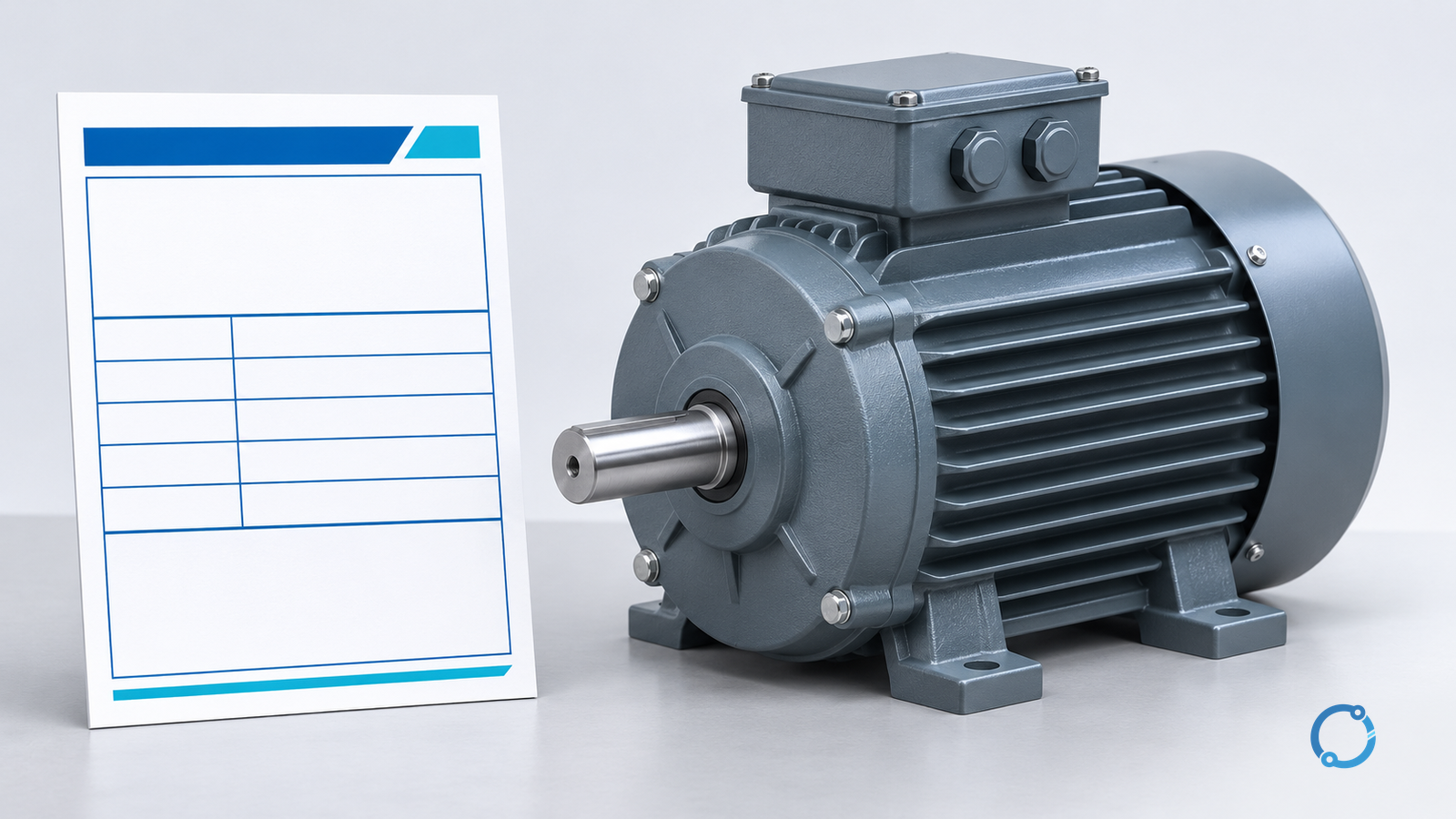
IE2, IE3 and IE4 are International Energy efficiency classes for motor efficiency; they are not, by themselves, a legal approval. In the European Union, Regulation (EU) 2019/1781 sets Ecodesign requirements for in-scope electric motors and variable speed drives placed on the EU market. The European Commission’s motor guidance says that in-scope motors must reach IE2, IE3 or IE4 depending on rated power and other characteristics.
The short distinction is: an IE code describes a place in an efficiency-classification system; a regulation defines which products, dates, markets and duties are subject to a legal requirement. A nameplate claim, a test standard and a declaration of conformity are separate questions.
What the IE scale actually measures
The European Commission describes motor efficiency as mechanical output power divided by electrical input power. It calls IE1 the lower class and IE5 the highest in the scale used on its product page. Where a specific minimum efficiency applies depends on the standard edition, motor rating, number of poles, supply and duty.
The IEC 60034-30-1:2025 catalog specifies efficiency classes for single-speed AC motors rated in accordance with IEC 60034-1 or IEC 60079-0 and operated on a sinusoidal 50 Hz, 60 Hz or 50/60 Hz supply. Its stated scope includes rated power from 0.12 kW to 1,000 kW, rated voltage from 50 V to 1,000 V, and two, four, six or eight poles. It also says most covered motors are rated for duty type S1, continuous duty, while some motors rated for other duty cycles are covered if they can operate continuously at rated power.
IEC 60034-1:2026 is the current edition of the separate rating-and-performance standard. Its official catalog entry identifies edition 15.0, published 13 March 2026, replacing the 2022 edition. It applies to rotating electric machines except rail and road vehicle machines covered by IEC 60349; machines with an integrated frequency converter are treated as a power drive system, with IEC 60034-1 applying to the motor component.
EU Ecodesign requirement crosswalk
The following table separates the classification question from the EU placing-on-market question. Dates and examples are taken from the European Commission’s official motor page.
| Question | IE efficiency class | EU Regulation 2019/1781 |
|---|---|---|
| What does it define? | A class in a motor efficiency-classification system | Ecodesign requirements for in-scope motors and VSDs placed on the EU market |
| Which official document? | IEC 60034-30-1:2025 and related IEC rating/test standards | Regulation (EU) 2019/1781 |
| When? | Use the edition named in the motor documentation | Entered into application 1 July 2021; selected later tier from July 2023 |
| Which motors? | Catalog scope: 0.12-1,000 kW, 50-1,000 V, 2/4/6/8 poles, single speed, continuous rated-power capability | Commission scope description: 0.12-1,000 kW, 1-phase and 3-phase induction motors, including some special-purpose and brake motors |
| Class requirement | A motor may be described by an IE class when tested and rated under the applicable standard | Motors must reach IE2, IE3 or IE4 depending on power and characteristics |
| Does a label prove compliance? | No; it identifies an efficiency classification, not legal scope or conformity | No; compliance still depends on product, documentation, duty and market conditions |
The Commission gives two useful date-and-power examples: three-phase motors with rated output from 0.75 kW to 1,000 kW had to reach IE3 from July 2021; motors from 75 kW to 200 kW had to meet IE4 from July 2023. It also describes the regulation as applying to motors including those integrated into other products, and to induction motors without brushes, commutators, slip rings or electrical rotor connections rated for 50 Hz, 60 Hz or 50/60 Hz sinusoidal voltage.
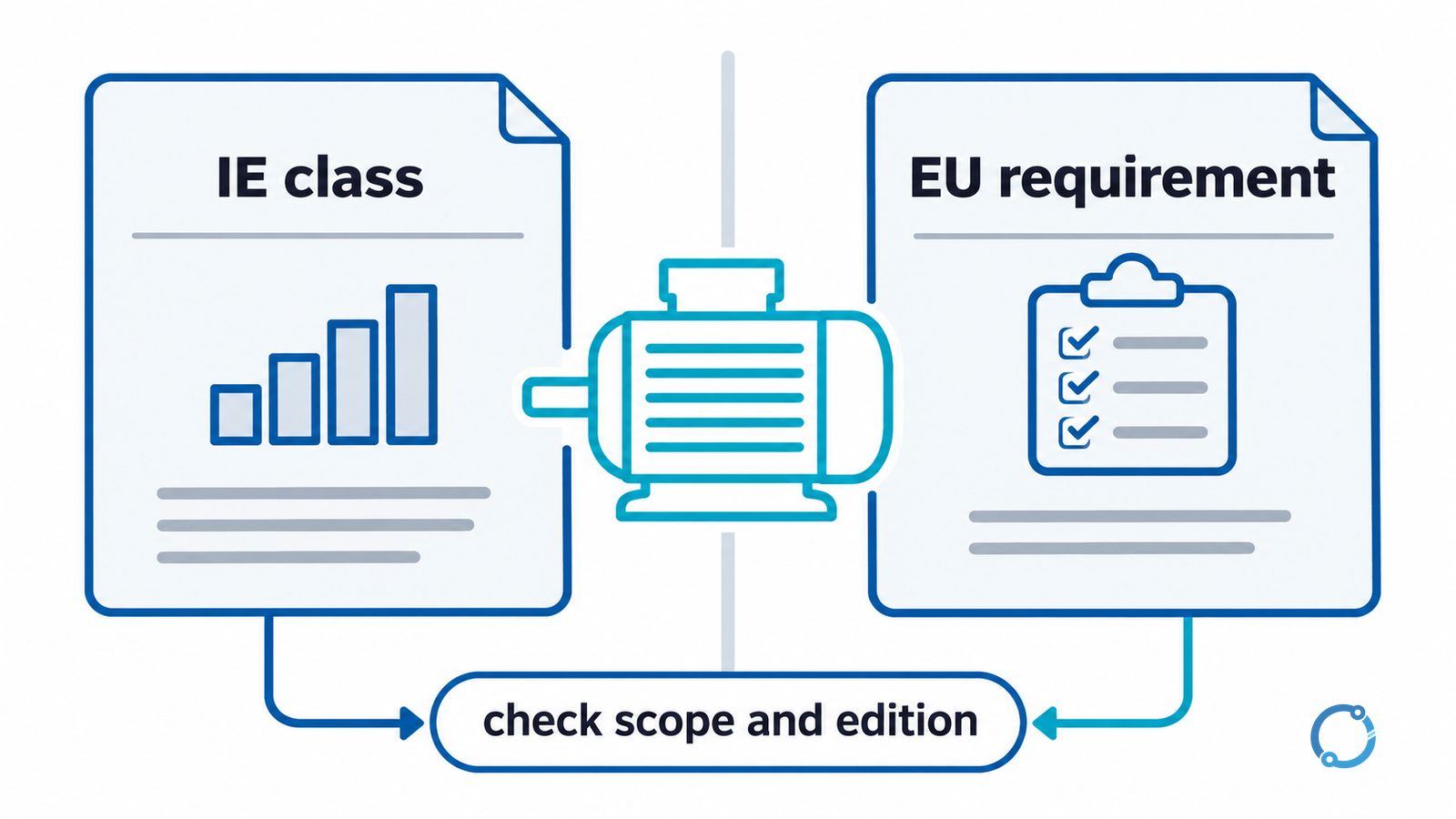
Verification worksheet for a motor claim
Before repeating or relying on an IE3 or IE4 claim, record:
- Market and date: where the motor is placed on the market and which regulation date applies.
- Motor type: single- or three-phase induction motor and whether it has brushes, commutators, slip rings or rotor connections.
- Rated output: kW value and whether it falls within the stated 0.12-1,000 kW scope.
- Supply: voltage and 50 Hz, 60 Hz or 50/60 Hz sinusoidal rating.
- Poles and speed: pole count and whether the motor is single-speed; 10-or-more-pole and multi-speed motors are excluded from IEC 60034-30-1:2025.
- Duty: whether the motor can operate continuously at rated power within its insulation temperature class; identify S1 or another duty rating.
- Integration: whether the motor can be tested separately from a pump, fan, gearbox, brake or integrated converter.
- Standard editions: the efficiency-class edition, rating standard and test method named in the documentation.
- Evidence: the test result and required product documentation, not a sales-page badge.
IEC 60034-30-1:2025 explicitly excludes motors with 10 or more poles, multi-speed motors, motors with mechanical commutators, and motors completely integrated into another machine where separation would make the motor inoperative. It also excludes compact drives where the motor cannot be tested separately from its integrated frequency converter. These exclusions are scope statements, not evidence that a particular product complies with or is exempt from EU law.
Why edition and scope matter
A class label without an edition and operating basis is incomplete. The 2025 IEC catalog says rated efficiency and efficiency classes are based on a 25 °C ambient reference under IEC 60034-2-1, while ambient marking can range from -30 °C to +60 °C and altitude marking can be up to 4,000 m; the efficiency-class rating basis is altitudes up to 1,000 m. Those are standard-scope conditions, not a promise about every installed motor’s real-world energy use.
The 2026 edition of IEC 60034-1 also changed how converter duty is defined and clarified machines with integrated EMC-active components. A specification that merely says IE3 or complies with IEC 60034-1 should therefore be checked against the named edition, the complete product documentation and the locally adopted regulation.
Common mistakes
- Treating
IEas a certification mark rather than an efficiency class. - Applying one minimum class to every motor rating and duty without checking the regulation’s conditions.
- Comparing an IE class from one standard edition with a limit from another without disclosing the editions.
- Assuming a motor efficiency calculation from shaft output and input power is the same as a standardized IE classification.
- Reading a supplier badge as proof of EU conformity documentation.
- Ignoring exclusions for integrated, multi-speed, high-pole-count or converter-integrated machines.
For the underlying power ratio, see OHELE’s motor efficiency calculation guide. It explains input power, shaft output and losses; it does not replace a standard-based class determination.
Sources
- European Commission: Electric Motors.
- EUR-Lex: Commission Regulation (EU) 2019/1781.
- IEC: IEC 60034-30-1:2025, official catalog scope and edition.
- IEC: IEC 60034-1:2026, official catalog scope and edition.