
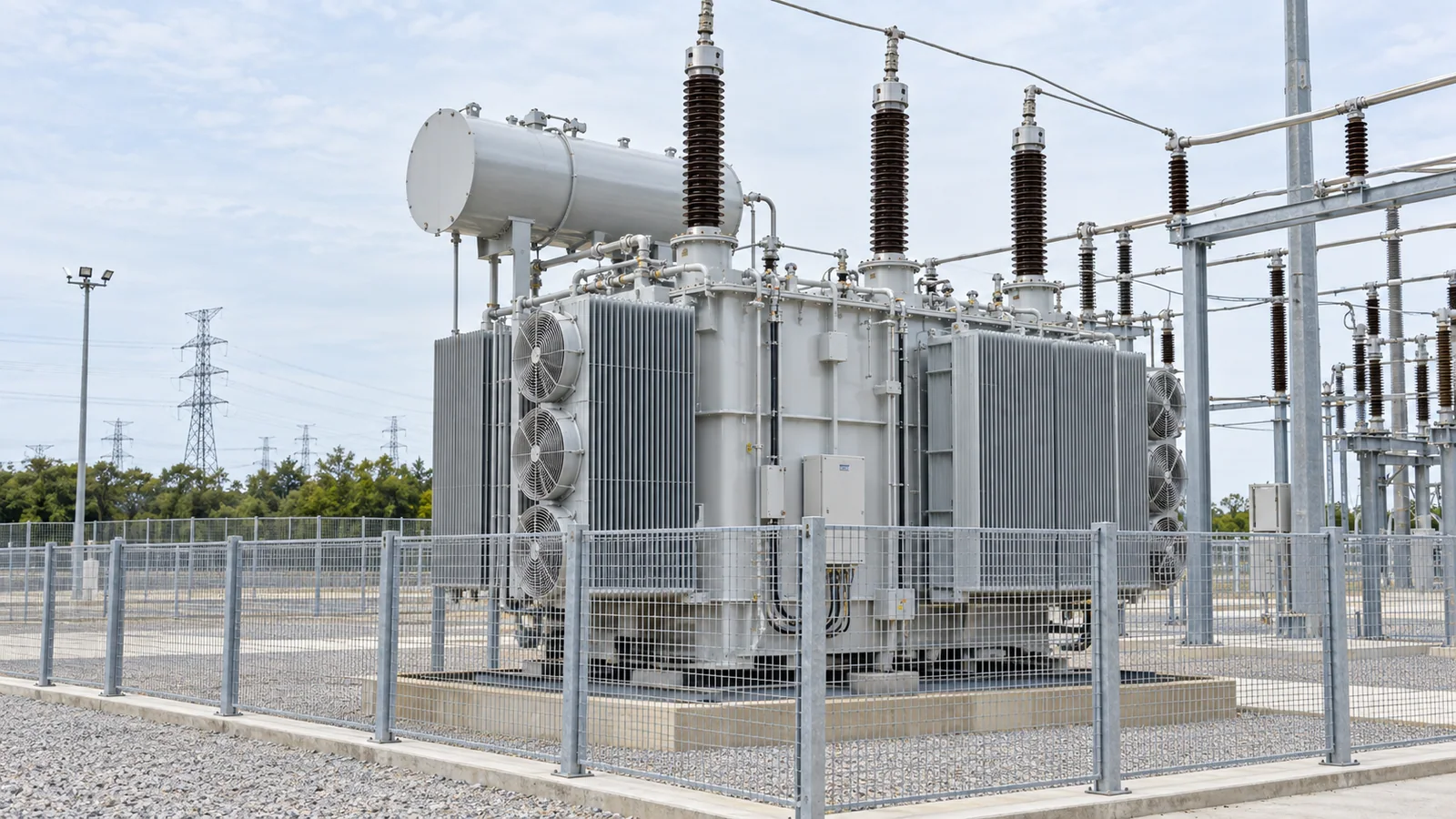
A power transformer normally produces some audible sound. The useful warning is a new, louder, irregular, or relocated sound compared with that unit’s baseline under comparable operating conditions. Sound alone cannot identify an internal fault. First check alarms and protection indications, oil level and leakage, temperatures, load, voltage, cooling equipment and recent switching. Escalate immediately under the site’s operating procedure if the change accompanies a gas or differential alarm, visible arcing, smoke, significant oil release or a rapidly worsening condition. Let qualified personnel decide whether to isolate the unit and which tests are safe.
This guide focuses on operating power transformers, especially mineral-oil-immersed units with fans, pumps or an on-load tap changer (OLTC). Dry-type transformers share some acoustic mechanisms but not oil, gas-relay or dissolved-gas checks. It is a symptom-triage guide for trained utility or industrial personnel, not a live-work procedure.
Why a transformer hums—and why louder does not always mean damaged
Core magnetostriction and electromagnetic forces make a transformer vibrate. Winding currents, cooling fans and pumps, structural resonance, nearby equipment, and the building can add or transmit sound. The IEC 60076-10-1 application guide explains sources and characteristics of transformer sound and why on-site measurements can differ from factory results. Changes in voltage, harmonics, load, tap position, cooling state or background noise may change what an observer hears without proving a component failure.
A steady hum that has existed since commissioning is a different observation from a hum that rises suddenly with unchanged operating conditions. The comparison must be to the same transformer, or to a documented acceptance baseline, using a consistent location and operating state. Do not diagnose a “loose core” from the pitch of a phone recording.
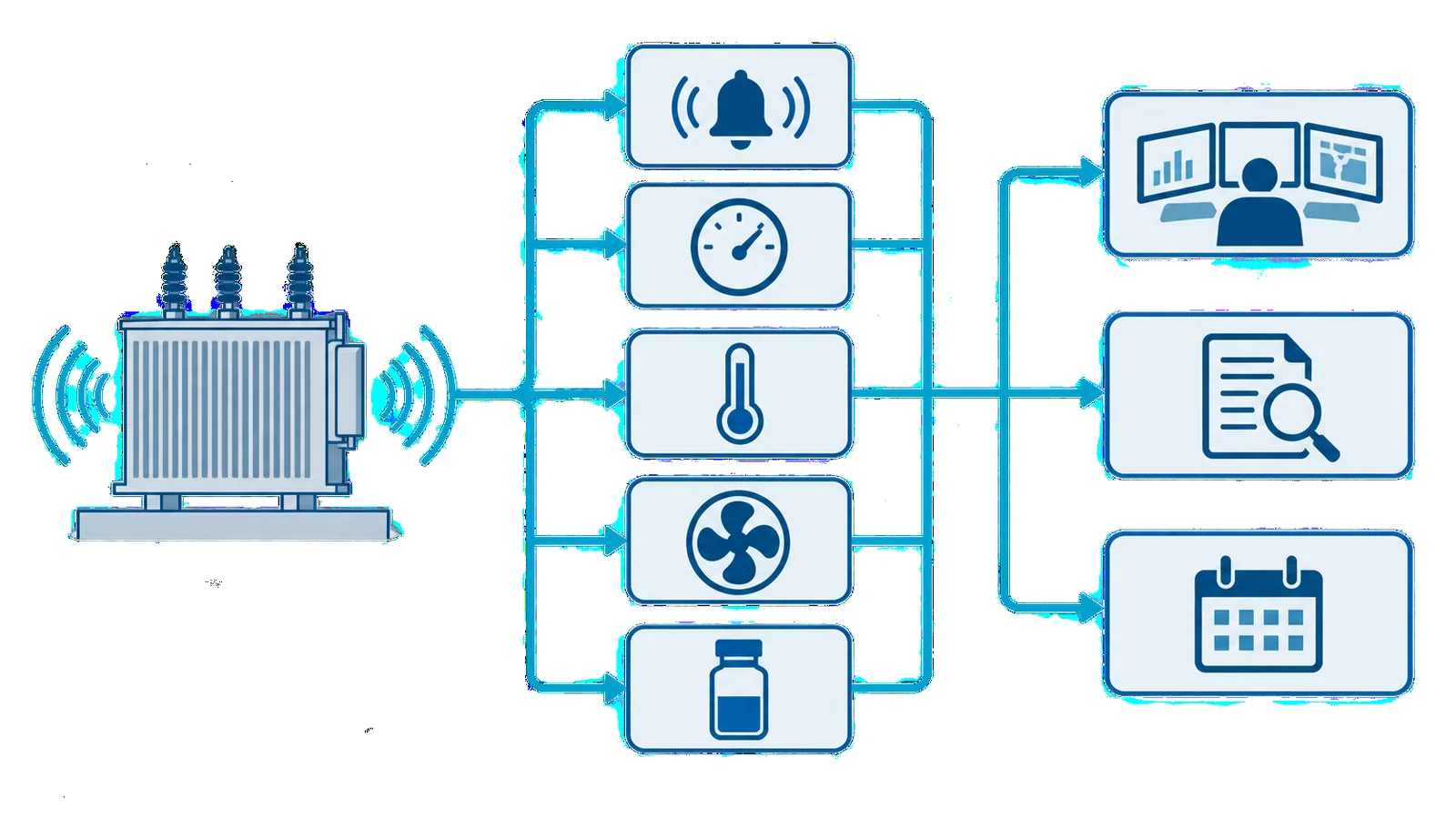
Five sound patterns: useful clues, not five fault labels
| Sound pattern | Possible sources to consider | Corroborating observations | Triage direction |
|---|---|---|---|
| Hum becomes louder or changes pitch | Excitation condition, load-current forces, harmonics, resonance, cooling equipment | Voltage, load, tap position, harmonics if monitored, fan/pump state, baseline recording | Compare operating state and trend; investigate an unexplained step change |
| Irregular rattle, knock or metallic vibration | Loose external fitting, panel, fan, pump, mount or internal mechanical issue | Location from a safe vantage, vibration trend, cooling status, recent transport or fault event | Escalate if persistent or accompanied by alarms; qualified mechanical review after safe isolation |
| Repeated click or clunk | Expected OLTC or control operation, relay/contactor action, motor-drive issue | Tap-command and operation log, event time, tap position, control alarms | Distinguish a commanded event from unexpected cycling; investigate mismatch |
| Crackle, snapping or sharp hiss | Electrical discharge or arcing is possible; also investigate external corona, leaks and other equipment | Protection/gas alarms, visible effects from a safe location, dissolved-gas trend where applicable, specialist discharge tests | Treat a new persistent event as high priority; follow operating escalation, do not approach to localize by ear |
| Gurgle or bubbling-like sound | Oil movement, cooling or trapped gas, external plumbing sounds; actual gas generation needs evidence | Oil level, pressure, gas relay, leak indication, temperature, pump state | Escalate promptly with gas or pressure alarm; use approved oil/gas sampling and analysis |
Several causes can sound alike, and one transformer may have more than one source. A quiet unit can also have a serious developing defect. The table is a screening aid, not a fault classifier.
First decide urgency, then collect evidence
Immediate operating escalation
Notify the control room or responsible operator and follow the site’s abnormal-condition procedure when noise appears with a protection trip, gas relay or sudden-pressure indication, visible smoke or arcing, a significant oil leak, rapid temperature rise, or an abrupt severe change. The operator may need to reduce load, transfer supply or remove the unit from service, but that decision depends on the protection scheme, network state and approved procedure. Do not simply keep running to collect more sound samples.
Prompt engineering assessment
A persistent new rattle, click sequence unrelated to commanded OLTC movement, marked sound change with otherwise normal indications, or a trend that continues to worsen warrants a planned qualified assessment. Record the change, check independent operating data, and set a monitoring and inspection plan. “No alarm” is not proof of no defect.
Trend under a controlled baseline
If the difference is small and corresponds to a verified change in load, voltage, tap or cooling state, record it and compare at equivalent conditions. Continue routine monitoring only if the responsible engineer accepts the explanation and no other adverse indicator appears.
These are editorial triage categories, not universal trip settings or mandatory time limits. Site rules and the asset’s protection design govern actual decisions.
Record sound without creating a new hazard
The safest initial record can often be made from an existing authorized observation point or remote monitoring system. Note the time, asset ID, exact location of the observer, ambient and weather conditions, load, voltage, tap position, temperatures, fan/pump state, alarms, and any recent switching or fault. If a recording is permitted, use a repeatable position and device setting; do not move closer solely to make the sound louder.
Do not press a metal rod, screwdriver or ear to an energized transformer tank. A tank or nearby metalwork must not be assumed safe to touch. In U.S. electric-power work, OSHA 29 CFR 1910.269 limits work near exposed energized equipment to qualified employees under the applicable approach and work-practice requirements. The correct access boundary and protective measures depend on the site and jurisdiction.
| Field in the observation record | Why it matters |
|---|---|
| Asset and time | Align sound with events and trends |
| Observation point and distance | Make later comparisons meaningful |
| Load, voltage and tap | Separate changed operating conditions from unexplained change |
| Fan, pump and OLTC state | Identify auxiliary sources and timed operations |
| Alarms, temperatures, oil level and leakage | Establish urgency and independent evidence |
| Recording or spectrum method | Preserve a comparable record, not a diagnosis |
No fixed “one to two metre” listening position is appropriate for all installations. Physical access, energized parts, barriers, acoustic reflections and the existing measurement plan decide where an observer can safely stand.
Use sound measurements for a defined question
For a contractual sound-level question, use the specified measurement method and acceptance conditions. IEC 60076-10:2016 defines sound pressure and sound intensity methods from which sound power levels are determined; it is primarily for factory measurements, with on-site use only to the extent practical. The associated application guide explains why site reflections and background sources can change results.
That is different from a condition-monitoring question such as “has this unit become louder under the same operating state?” A handheld dB reading at one arbitrary location is not a universal pass/fail test. There is no blanket 65 dB limit for every oil-immersed transformer at a fixed two-metre distance in those IEC catalog scopes. Acceptance values must come from the purchase specification, applicable product standard, test report, and measurement method for the particular unit.
Sound level, spectrum and vibration can help establish a trend or point a specialist toward a source. They cannot independently establish winding deformation, partial discharge, or insulation health.
Match the next test to the suspected mechanism
Operating-state review. Correlate the sound with load, voltage, tap position and cooling changes. For mineral-oil-immersed units, IEC 60076-7:2018 covers thermal effects of ambient and load conditions; an oil-temperature change is evidence to interpret, not proof that overload caused the sound.
Dissolved-gas analysis (DGA). Where an oil-filled transformer’s internal electrical or thermal condition is in question, use properly obtained samples and trends. IEC 60599:2022 provides guidance for interpreting dissolved and free gases in mineral-oil equipment, while warning that results require engineering judgment. DGA does not locate an audible rattle or replace protection indications.
Acoustic emission and partial-discharge investigation. Specialist sensors and procedures can look for discharge-related emissions. IEEE C57.127-2018 addresses acoustic-emission detection and location from partial discharges and other sources in liquid-insulated power transformers and reactors. This is not the same as a technician hearing a crackle from a distance.
Tap-changer and mechanical review. Compare an unusual click pattern with the OLTC event log and motor-drive indications. IEC/IEEE 60214-2:2019 includes application guidance covering field operation, maintenance and monitoring. Internal inspection, vibration measurement or frequency-response work belongs in a controlled specialist plan after the required isolation; none is justified by sound alone.
Electrical and insulation testing. Protection events, winding resistance, insulation tests and other checks may be useful after an outage, selected by a qualified engineer for the suspected failure mode. The insulation-resistance testing guide explains why a single IR value cannot rule out partial discharge or internal mechanical problems. A differential trip requires analysis of the protection zone and event record; see the transformer differential-relay guide.
What a useful diagnosis concludes
A defensible report should distinguish observed symptom, operating context, evidence, working hypotheses and decision. For example: “A new periodic rattle began after a fan change; it occurs only with fan group B running; no transformer protection alarm is present; maintenance will inspect that auxiliary equipment under the approved isolation.” This points to a testable next step without claiming that the transformer core is defective.
If the sound cannot be explained, keep the uncertainty visible. Escalate according to the site’s risk rules and combine the acoustic record with independent diagnostics. The purpose of listening is to notice change early, not to replace electrical, thermal, oil or protection evidence.
Sources
- IEC 60076-10:2016 — determination of transformer sound levels
- IEC 60076-10-1:2016+AMD1:2020 — sound-level application guide
- IEC 60076-7:2018 — loading guide for mineral-oil-immersed transformers
- IEC 60599:2022 — dissolved and free gas interpretation
- IEEE C57.127-2018 — acoustic emissions from electrical discharges
- IEC/IEEE 60214-2:2019 — tap-changer application guidelines
- OSHA 29 CFR 1910.269 — electric-power safety work practices