
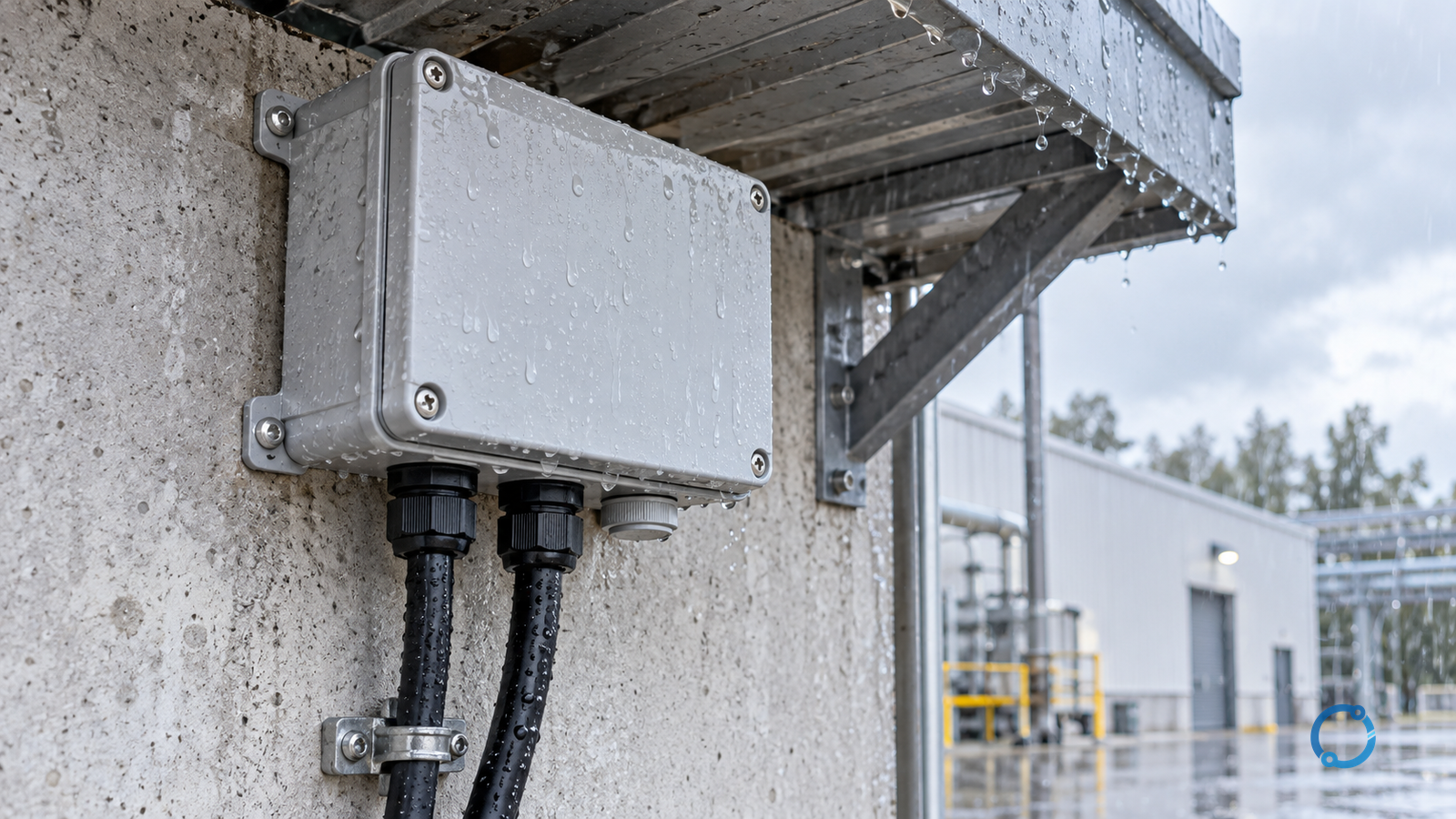
Choose outdoor terminations as part of a complete enclosure, cable-entry and service arrangement. A terminal described as “waterproof” cannot make an unsuitable box, gland or damaged lid seal safe. First define the exposure, then verify the assembled protection boundary and the conditions around the terminals inside it.
This guide concerns electrical junction boxes exposed to outdoor conditions. Immersion, explosive atmospheres and specialised underground or marine assemblies require separate application-specific assessment. The output is an acceptance record for the enclosure and terminations—not a claimed IP certification or a universal outdoor terminal recommendation.
Separate enclosure ingress from terminal suitability
IEC 60529 classifies degrees of protection provided by enclosures. An IP declaration concerns defined test conditions; it does not, by itself, establish suitability for every condensation cycle, chemical exposure or installation detail. Do not transfer an enclosure’s declaration to an altered assembly without the relevant evidence.
The terminal still needs an appropriate electrical application, conductor interface, temperature range and environment. The outer enclosure and the inner termination are related layers, not interchangeable claims.
Turn the site description into requirements
| Exposure or task | Assembly question | Evidence to retain |
|---|---|---|
| Rain or washdown | What direction and severity can reach the installed box? | Suitability of the complete enclosure and entry arrangement |
| Temperature cycling | Can moisture already inside condense on internal surfaces? | Condensation assessment and approved mitigation strategy |
| Sun, chemicals or salt | Which exposed materials and seals face that environment? | Application-specific suitability information |
| Cable movement | How is cable load prevented from compromising entries or terminations? | Support, strain relief and gland/cable compatibility |
| Inspection or replacement | Can the enclosure be opened, worked on and correctly resealed? | Safe access and post-service verification procedure |
“Outdoor” is too broad to replace these inputs. A sheltered box in a mild location and an exposed box subjected to cleaning jets are not the same application. Do not choose the same assembly solely because both sit outside.
Review every enclosure opening
Identify the lid joint, cable entries, unused openings and any approved ventilation, drainage or access features. Verify the lid and gasket combination, closure condition, installed orientation and manufacturer-specified assembly procedure. Debris, damaged seals or a cable trapped across a lid joint can invalidate the intended closure.
Cable glands must suit the actual cable construction and diameter range, entry interface and environment. IEC 62444:2010 addresses cable-gland construction and performance requirements; a compliant gland is not proof that an arbitrary gland/cable/box combination preserves the enclosure’s protection.
Use appropriate verified closures for unused openings. In covered US workplaces, OSHA 1910.303 addresses environmental suitability and effective closure of unused openings. The specific equipment instructions and applicable jurisdiction still determine the installation requirements.
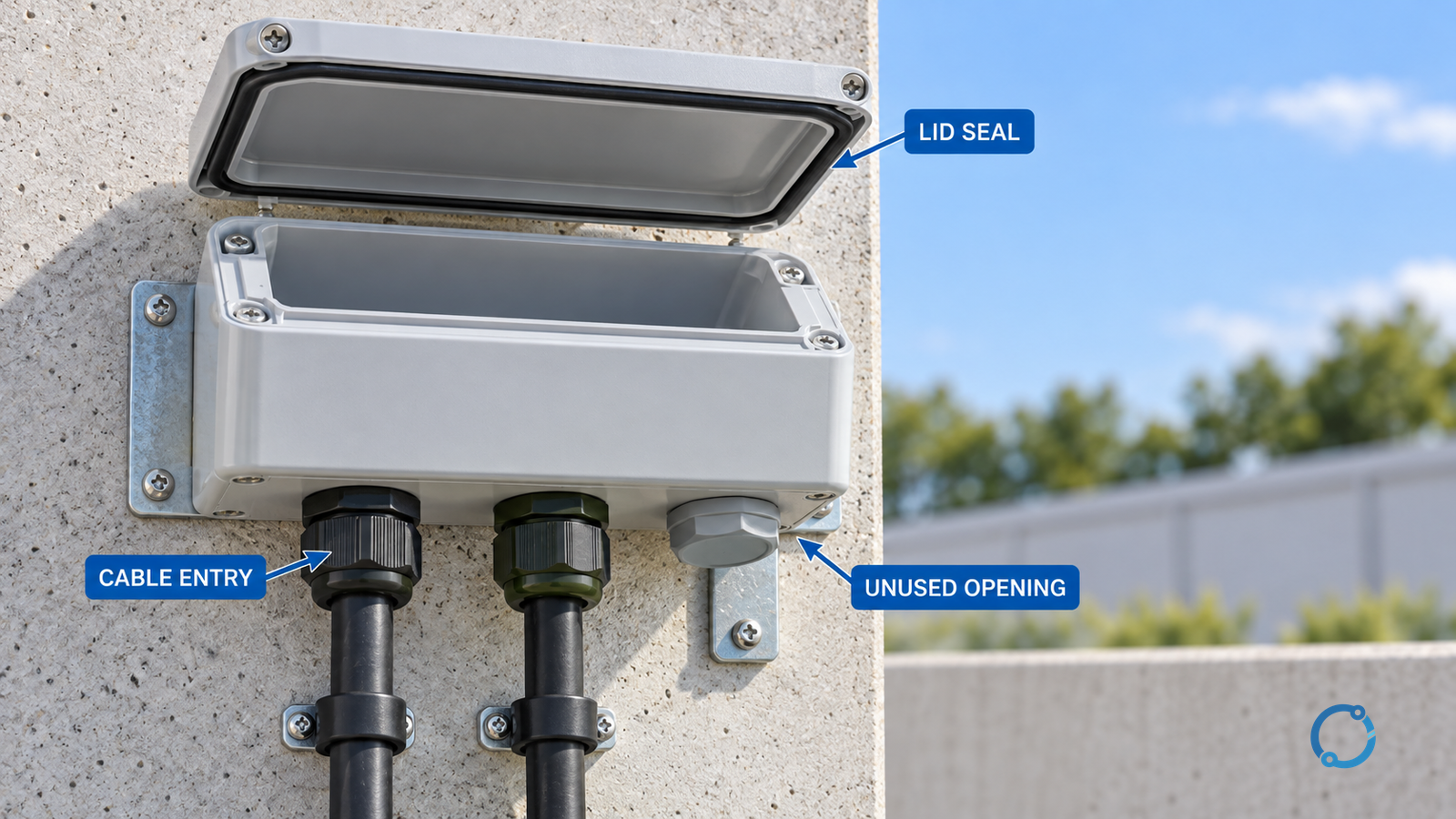
Do not add a drilled drain hole or a generic vent as an improvised cure. Such changes can alter protection and require an approved assembly design. A weather shield may reduce exposure, but it does not replace verified enclosure suitability.
Address condensation without promising a dry interior
Sealing against external ingress does not remove moisture introduced during assembly or service. Temperature changes can create condensation if the internal conditions permit it. Therefore assess moisture sources, operating temperatures and maintenance exposure separately from the enclosure ingress declaration.
Possible design measures include suitable positioning, an approved pressure-management or drainage arrangement, or controlled heating where justified. None is a universal recipe. Confirm electrical supply, temperature control, material compatibility and the effect on the complete enclosure before selecting a measure.
The pollution-degree selection guide addresses the local environment relevant to terminal insulation. Do not infer a permanently clean, dry microenvironment from the word “sealed.”
Select and support the internal terminations
Record voltage/current application, conductor type and size, permitted preparation, connection instructions and temperature conditions. Check the terminal support, conductor bend space, cable restraint and access to inspect each connection. Do not let the enclosure lid become the support for an overloaded or overcrowded harness.
Review materials and corrosion suitability for the actual exposure without claiming a generic service life. The terminal-materials guide explains the separate durability inputs. Compatibility depends on the complete application, not one attractive material label.
Include required protective bonding and separation of different circuit functions in the equipment design. Do not invent a bonding arrangement from a general illustration. For general connection and mounting requirements, use the panel terminal-block selection guide while retaining this article’s enclosure-boundary checks.
Make service resealing an acceptance gate
Qualified personnel must isolate and verify equipment under the applicable procedure before opening or working on it. If water, tracking, heat damage or damaged insulation is found, stop and resolve both the damage and the moisture path; simply drying the box and re-energising is not a complete corrective action.
Before release, verify the approved terminations, cable support, glands, unused closures, lid seal and assembly instructions. Record any approved condensation-control features and their operating requirements. Retain the as-left enclosure configuration so later service does not silently change the protection boundary.
The selection is complete only when the terminal’s electrical suitability and the enclosure’s installed protection arrangement are both supported. “Waterproof terminal block” alone is not that evidence.