
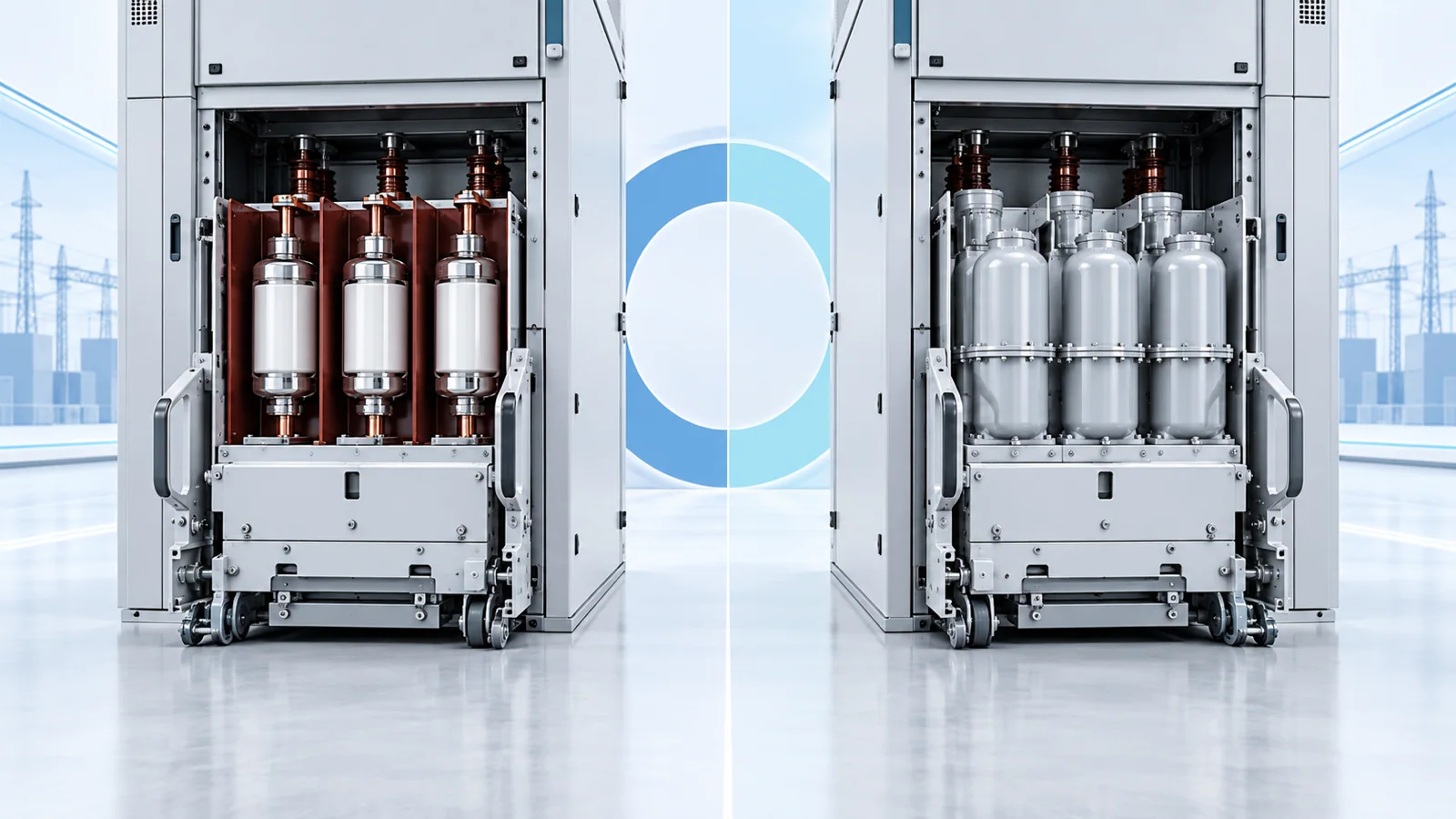
For most new 11–36 kV projects, a vacuum circuit breaker should be the starting point—not because vacuum is universally superior, but because it can meet many distribution duties without placing sulfur hexafluoride (SF6) inside the interrupter. The final choice still depends on the complete switchgear design, verified switching duties, available space, service environment, local regulation, maintenance capability, and the owner’s long-term gas policy.
The first step is to avoid a false either-or comparison. A circuit breaker’s interrupting medium and a switchgear assembly’s insulation system are separate design decisions. A vacuum interrupter may be installed in air-insulated, solid-insulated, alternative-gas-insulated, or SF6-insulated switchgear. Selecting a “vacuum breaker” therefore does not, by itself, prove that the complete panel is SF6-free.
The decision at a glance
| Selection condition | Direction to investigate first | What must still be verified |
|---|---|---|
| New general-purpose indoor distribution switchgear | Vacuum circuit breaker | Complete assembly ratings, insulation system, internal-arc classification, operating duty, and local service support |
| Project has an explicit SF6-free or low-GWP policy | Vacuum interruption with air, solid, dry-air, or another accepted insulation design | Actual gas composition, global warming potential, regulatory status, end-of-life route, and type-test evidence |
| Extremely restricted footprint or harsh external environment | Compare compact gas-insulated designs with other compact architectures | Room interfaces, cable access, pressure relief, environmental limits, gas obligations, and maintainability |
| Extension of an established SF6 fleet | Compare compatibility benefits against lifecycle and regulatory exposure | Bus and protection interfaces, spares, training, gas inventory, leakage response, and future replacement strategy |
| Frequent motor, reactor, transformer, capacitor, or cable switching | Do not choose by medium alone | Application-specific switching duties, transient studies, surge protection, and relevant test evidence |
| Project is in the European Union | Screen F-gas rules before tendering | Voltage band, commissioning date, procurement exceptions, gas GWP, documentation, and national enforcement |
This table is a screening tool, not a purchase specification. Ratings and application evidence control the technical decision.
First separate interruption from insulation
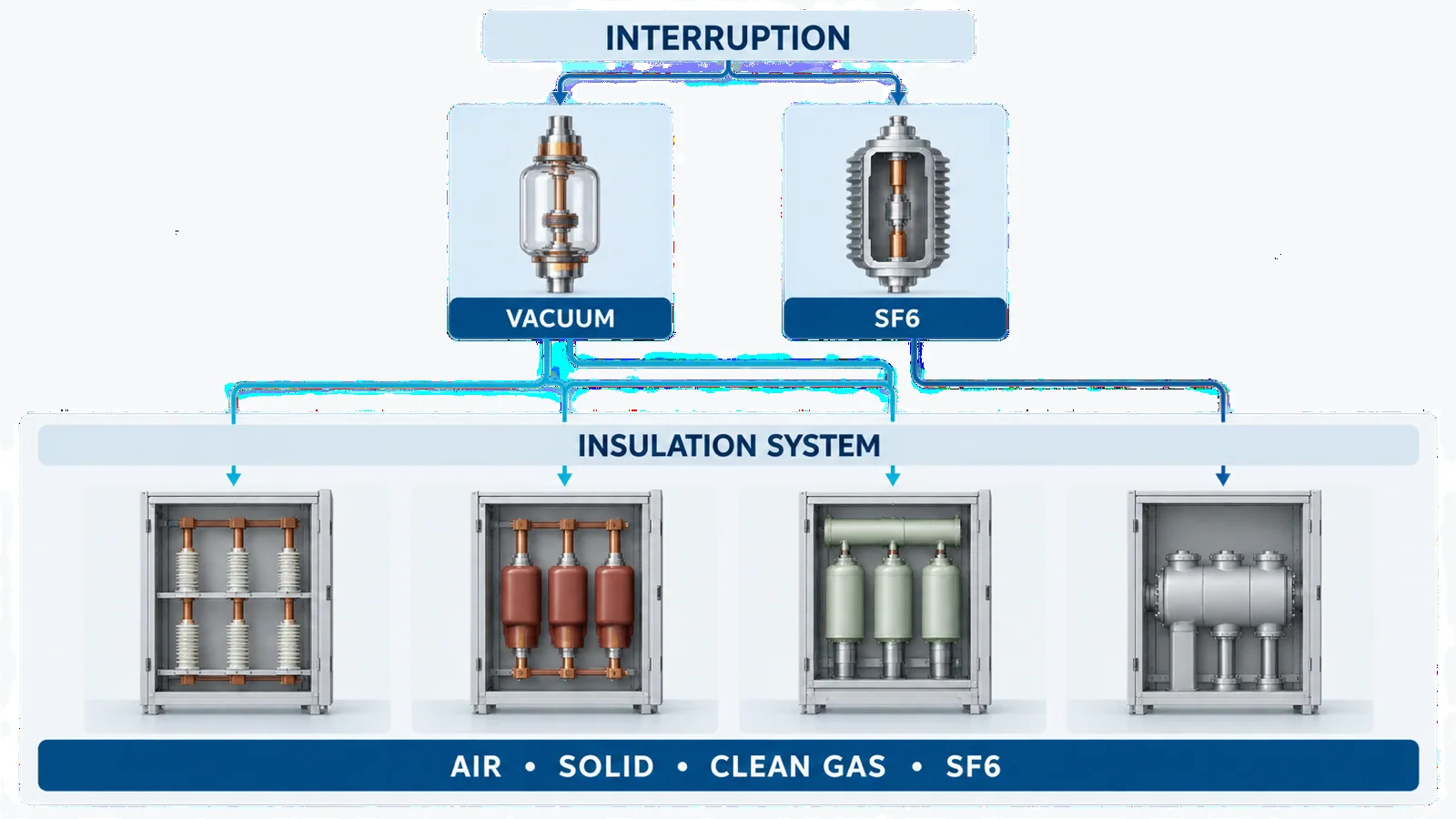
In a vacuum circuit breaker, the contacts separate inside a sealed vacuum interrupter. The arc is extinguished as the alternating current passes through a natural current zero and the dielectric strength across the contact gap recovers. The interrupter is one component within a larger breaker mechanism and switchgear assembly.
In an SF6 circuit breaker, SF6 participates in interruption and dielectric recovery. In gas-insulated switchgear, SF6 or another gas may also insulate busbars, disconnectors, earthing switches, and other live parts. These roles can overlap, which is why procurement documents should declare both:
- the circuit breaker’s interrupting medium; and
- the insulation medium used in every switchgear compartment.
This distinction is not theoretical. The UK Health and Safety Executive’s switchgear guidance includes an example of a 33 kV fixed-pattern vacuum circuit breaker inside SF6 gas-insulated switchgear. A label saying “VCB” can therefore coexist with an SF6 inventory.
What the standards establish—and what they do not
IEC 62271-100:2021 with Amendment 1:2024 covers three-phase AC circuit breakers above 1 kV and the applicable making-and-breaking tests. It provides the main circuit-breaker performance framework, but a reference to the standard alone does not establish that a proposed breaker is suitable for every network duty.
For the complete assembly, IEC 62271-200:2021 with Amendment 1:2024 applies to prefabricated AC metal-enclosed switchgear above 1 kV and up to and including 52 kV. It addresses the assembly rather than only the interrupter and includes matters such as construction, accessibility, loss of service continuity, and internal-arc classification.
The practical lesson is simple: compare complete, type-tested switchgear arrangements at the required rating. Do not compare one vendor’s vacuum interrupter brochure with another vendor’s complete SF6 panel.
Also distinguish the network’s nominal voltage from the equipment’s rated voltage. An “11 kV,” “22 kV,” “33 kV,” or “36 kV” project name is not enough to select a panel. Confirm the highest voltage for equipment, insulation coordination, system earthing, frequency, normal and special service conditions, and the locally adopted standard before fixing the voltage class.
Technical comparison for 11–36 kV applications
| Criterion | Vacuum circuit breaker | SF6 circuit breaker | Selection implication |
|---|---|---|---|
| Interrupting chamber | Sealed vacuum interrupter | Gas-filled interruption chamber | Compare verified ratings and test duties, not a generic technology claim |
| Switchgear insulation | Can be paired with air, solid, alternative gas, or SF6 | Commonly integrated into gas-insulated arrangements | Ask for a compartment-by-compartment insulation declaration |
| General distribution duty | Widely applicable when the offered breaker and assembly carry the required ratings | Also technically capable in suitable designs | Use system duty and type-test evidence as the gate |
| Footprint | Depends heavily on the complete insulation architecture | Gas insulation can support compact arrangements | Compare actual lineup dimensions, cable zones, pressure relief, and access |
| Switching transients | Application review may be needed for inductive or other sensitive loads | Application review may also be needed for special duties | Require a transient or switching-duty review where the connected load warrants it |
| Routine attention | No SF6 handling for the vacuum interrupter; the mechanism, auxiliaries, insulation, and assembly still require maintenance | Gas density, seals, handling arrangements, and gas records may add lifecycle tasks | Compare the full maintenance plan, not “maintenance-free” claims |
| Environmental exposure | The interrupter avoids SF6, but the surrounding cabinet may not | SF6 leakage and recovery have climate consequences | Calculate gas inventory and ownership obligations for the entire assembly |
| End of life | Interrupter and equipment disposal still require a defined route | Gas recovery and trained handling are required where applicable | Include decommissioning responsibilities and cost in the tender |
| Legacy compatibility | May require interface or fleet changes in an older SF6 system | Can align with an established fleet | Balance compatibility against future policy, availability, and regulatory risk |
Neither column proves reliability, safety, or compliance on its own. Those outcomes depend on the engineered product, ratings, tests, installation, protection, operation, environment, and maintenance.
A six-gate selection process
1. Define the electrical duty
Start with the system study and operating philosophy. At minimum, establish:
- highest system voltage and frequency;
- continuous current and expected load growth;
- rated short-circuit breaking current and making current;
- short-time and peak withstand requirements for the assembly and earthing circuit;
- transient recovery voltage duties where applicable;
- operating sequence and reclosing duty;
- cable, overhead-line, transformer, motor, reactor, and capacitor switching duties;
- system earthing method and protection clearing times;
- required mechanical and electrical endurance classes;
- normal and alternate operating configurations.
Do not increase a breaker rating simply as a substitute for a short-circuit study. Conversely, do not assume a breaker is suitable because its headline short-circuit current exceeds the calculated fault level; the complete set of rated characteristics and duties matters.
2. Select the assembly architecture
The switchgear room and installation constraints often decide more than the interrupter medium. Compare:
- air-insulated, solid-insulated, gas-insulated, or hybrid construction;
- indoor or outdoor service;
- fixed or withdrawable breaker arrangements;
- cable entry, termination space, test access, and earthing facilities;
- pressure-relief paths and internal-arc installation conditions;
- loss-of-service-continuity and partition requirements;
- extension philosophy, transport sections, floor loading, and aisle clearances;
- altitude, pollution, humidity, temperature, condensation, corrosion, and seismic conditions.
A compact panel is not automatically the lowest-risk solution. Space saved in the lineup can be lost if pressure relief, cable bending, rear access, or replacement clearances are overlooked.
3. Review special switching duties
Vacuum and SF6 breakers can both satisfy demanding duties when correctly designed and applied, but sensitive loads require evidence beyond a general-purpose short-circuit rating. High-voltage motors and shunt reactors fall within the scope of IEC 62271-110:2023, which addresses inductive-load switching for equipment above 1 kV.
For transformer energization, motor switching, reactor switching, capacitor banks, long cables, or frequent operation, ask the system designer to assess the relevant transient phenomena and determine whether surge arresters, resistance-capacitance networks, controlled switching, or another measure is needed. Do not assume that one interrupter medium eliminates all switching transients.
4. Apply environmental and regulatory gates
SF6 has strong dielectric properties, but it is also a highly persistent greenhouse gas. The US Environmental Protection Agency’s SF6 overview identifies electrical insulation and current interruption as major power-sector uses and explains that emissions can occur during manufacturing, installation, servicing, use, and decommissioning.
Regulation can change the feasible shortlist. In the European Union, Regulation (EU) 2024/573 prohibits putting certain new or extended electrical switchgear using fluorinated greenhouse gases into operation on staged dates. For medium-voltage primary and secondary distribution, Article 13 sets dates of:
- 1 January 2026 for switchgear up to and including 24 kV; and
- 1 January 2030 for switchgear above 24 kV and up to and including 52 kV.
The regulation contains derogations, procurement conditions, documentation duties, and transitional provisions, so the voltage headline is not a complete compliance decision. Check the consolidated official text of Regulation (EU) 2024/573, the project date, gas global warming potential, national enforcement, and legal advice where needed.
Outside the EU, requirements differ. Even where new SF6 equipment remains legal, an owner may still impose an SF6-free purchasing policy or carbon-accounting requirement. Treat corporate policy and future disposal obligations as tender inputs, not afterthoughts.
5. Compare lifecycle capability and cost
Evaluate cost across the planned ownership period rather than using purchase price alone. Include:
- switchgear room, foundation, cable, and building interfaces;
- commissioning and test equipment;
- inspection and mechanism maintenance;
- gas inventory, monitoring, leak response, recovery, and reporting where applicable;
- trained personnel and contractor availability;
- spare breakers, mechanisms, auxiliaries, seals, and special tools;
- outage duration for repair or module replacement;
- end-of-life dismantling, gas recovery, transport, and disposal;
- expected availability of parts and competent service over the asset life.
IEC 62271-4:2022 covers handling procedures for gases used for insulation or switching during installation, commissioning, repair, operation, and end of life. Its scope also includes alternatives to SF6. “SF6-free” therefore does not necessarily mean “no gas-management procedure”; the actual insulating medium and service instructions still matter.
6. Verify the offered design
Before award, require a compliance schedule that maps the offered equipment to the project specification. Useful evidence includes:
- exact circuit-breaker and assembly type-test references;
- rated characteristics and applicable IEC editions;
- declared interruption and insulation media;
- gas type, quantity, GWP, leakage information, and monitoring method where applicable;
- internal-arc classification and installation conditions;
- loss-of-service-continuity category and partition class;
- special switching-duty evidence;
- interlocking, earthing, isolation, and test provisions;
- operating mechanism, control supply, trip and close coils, and auxiliary contacts;
- environmental limits and any derating;
- maintenance instructions, expected inspection tasks, and end-of-life procedure;
- deviations, exclusions, and assumptions.
Reject statements such as “IEC compliant,” “maintenance-free,” or “environmentally friendly” when they are not tied to the exact offered configuration and supporting documentation.
When an SF6-based design may still be rational
An SF6-based circuit breaker or switchgear design may remain a rational option when it is permitted, the exact assembly has verified performance for the duty, compactness or environmental sealing materially benefits the installation, and the owner can manage the gas throughout its lifecycle. It may also simplify a carefully evaluated extension of an installed fleet.
That decision should be documented rather than inherited by habit. Record why alternatives were unsuitable, how leakage and handling will be controlled, who owns the gas and records, and how the equipment will be decommissioned. In a jurisdiction with restrictions, confirm that the proposed installation fits the law and any claimed derogation.
When vacuum should lead the shortlist
Vacuum should normally lead the shortlist for new 11–36 kV distribution projects when available products meet the required duties and the owner wants to reduce dependence on SF6. It is especially compelling when the complete switchgear can also use air, solid insulation, dry air, or another accepted low-impact insulation system.
But specify the complete outcome. “Vacuum circuit breaker required” is not the same as “SF6-free switchgear required.” If the environmental objective covers the whole asset, state the permitted and prohibited insulating gases, documentation requirements, leakage expectations, and end-of-life obligations explicitly.
Final selection rule
Choose the complete switchgear system that passes all six gates: electrical duty, assembly architecture, special switching performance, regulation, lifecycle capability, and verifiable evidence. For many new 11–36 kV projects, that process will favor vacuum interruption. SF6 can still be technically effective, but its use now carries environmental, handling, policy, and—in some regions—regulatory consequences that must be justified across the full equipment lifecycle.
Qualified engineers should complete the system studies and specification, and qualified personnel should install, operate, maintain, and decommission the equipment under the applicable safety rules and manufacturer instructions.
Sources
- IEC 62271-100:2021 — Alternating-current circuit-breakers
- IEC 62271-200:2021 — AC metal-enclosed switchgear up to 52 kV
- IEC 62271-110:2023 — Inductive load switching
- IEC 62271-4:2022 — Handling procedures for insulating and switching gases
- Regulation (EU) 2024/573 on fluorinated greenhouse gases
- US EPA: Sulfur Hexafluoride (SF6) Basics
- UK HSE: Keeping electrical switchgear safe