

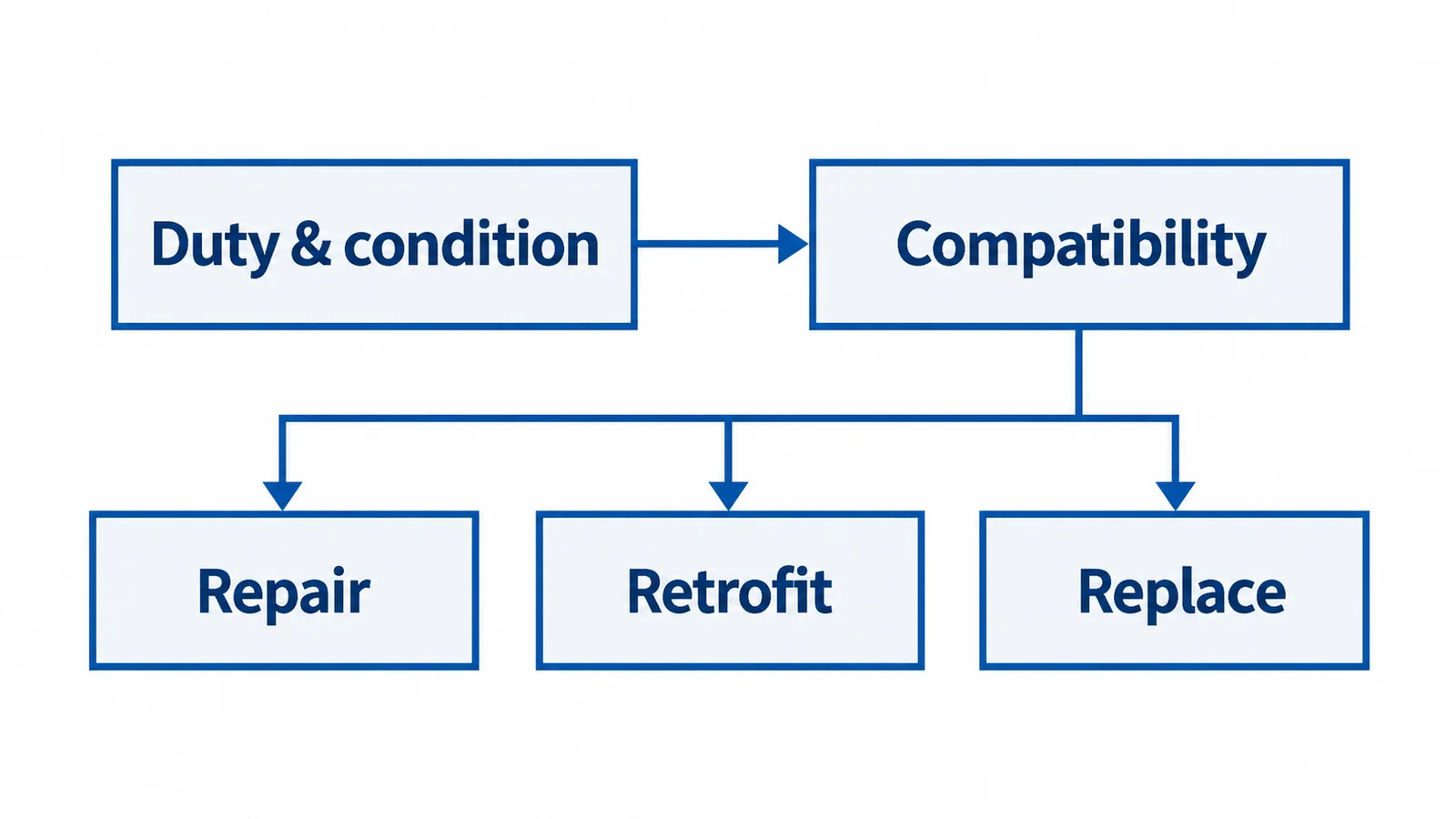
Calendar age should trigger a review, not automatically decide replacement. Repair is defensible when the defect is localized and the retained assembly remains fit for its duty. Retrofit can be appropriate when an engineered upgrade restores a supported, demonstrably compatible system. Replacement becomes the stronger option when the required duty, insulation condition, mechanical integrity or supportability cannot be established for the retained equipment.
Apply technical and safety gates before comparing prices. A cheaper intervention that cannot establish fitness for service is not an acceptable alternative.
This guide concerns existing industrial AC metal-enclosed medium-voltage (MV) assemblies. IEC 62271-200:2021+AMD1:2024 covers such assemblies above 1 kV and up to and including 52 kV, within its stated conditions. Low-voltage boards, household panels and other switchgear constructions need their own assessment and applicable rules. No universal replacement age or inspection interval is proposed here.
Establish today’s duty before assessing yesterday’s design
A sound old assembly can be unsuitable after the electrical system changes. Review the present load and available fault duty, operating sequence, protection scheme, environment and required continuity of service—not only the original drawing or breaker label.
Check what changed: added transformers, generation, interconnections, larger loads, altered grounding or protection settings, and different operating arrangements. Confirm the relevant breaker and assembly ratings and their conditions. The MV circuit-breaker ratings guide separates interruption and withstand questions; a breaker rating alone does not establish the duty of every retained bus, joint or compartment.
CIGRE’s substation equipment overstress guidance frames the problem as equipment condition and performance interacting with changing stresses. That is a more useful assessment basis than assuming all units of the same vintage have the same remaining life.
Use evidence to identify the extent of deterioration
Gather the original design information, modifications, maintenance and failure history, duty studies, parts availability, and relevant inspection/test trends. Distinguish a repeatable trend from a single result obtained under different conditions.
| Assessment area | Question it must answer | What an unresolved result means |
|---|---|---|
| Insulation and environment | Are retained insulation, clearances and compartments suitable in their present condition? | Cosmetic refurbishment alone is insufficient. |
| Current path | Are conductors, joints and contacts suitable for load and fault duty? | A new switching device does not establish the bus system’s fitness. |
| Mechanism and interlocks | Can the required operations and safety interlocks be verified? | Do not rely on operator workarounds or defeated interlocks. |
| Protection and control | Does the complete scheme detect faults and command the correct interruption? | A relay upgrade alone does not prove the trip chain. |
| Enclosure and installation | Are structural condition, segregation and installation interfaces acceptable? | Component replacement may leave an assembly-level defect. |
| Supportability | Are compatible parts, instructions and competent support available? | Repair lead time and future restoration uncertainty may dominate cost. |
Select tests for the actual equipment and suspected mechanism, using approved procedures and interpretation criteria. There is no single test that proves the complete assembly safe. Access, inspection, sampling and electrical/mechanical testing require qualified personnel under isolation, verification, discharge/earthing where applicable and the site’s safety controls. Active damage or an uncertain safety-critical function requires an immediate authorized risk decision, not routine operation while this comparison is completed.
Compare three feasible interventions fairly
| Option | Strongest case | Principal limitation | Evidence needed before return to service |
|---|---|---|---|
| Repair or refurbishment | Localized defect; adequate duty; retained insulation and structure verified; supported parts available | Can leave broader deterioration or obsolescence unresolved | Defect corrected, affected functions tested, retained assembly fitness established |
| Engineered retrofit | Sound retained assembly; upgrade addresses a defined function; interfaces and assembly behavior can be validated | A fitting breaker or relay is not proof of complete compatibility | Design responsibility, interface assessment, applicable test/validation basis and commissioning record |
| Assembly replacement | Duty or condition cannot be credibly restored; major redesign needed; support risks unacceptable | Larger capital/outage project with new cable, protection and installation interfaces | New design verification, installation acceptance and complete protection/operating checks |
Repair is not inherently a short-term patch. Replacement is not inherently excessive. Their suitability depends on what can be verified and what the facility needs. Retrofit belongs between them only when it is a defined engineering solution—not an assortment of newer components.
A retrofit must preserve or re-establish assembly evidence
Check mechanical fit, operating travel, connections, auxiliary/control circuits, interlocks, protection coordination and the effects on the retained assembly. A same-width draw-out device is not necessarily electrically or mechanically interchangeable. The MV switching-device guide helps separate the functions being retained or changed.
IEC TR 62271-307:2024 provides guidance on extending the validity of type tests for enclosed switchgear in its scope. It is a Technical Report, not an automatic approval of a retrofit. Determine the applicable design-validation basis and whether additional evidence or testing is needed; do not assert that every original rating or classification survives a modification.
In particular, do not assume that changed enclosure openings, compartment arrangements or devices retain an original internal-arc classification. Nor does an assembly classification replace the site’s personnel risk assessment. Revisit the arc-flash study when a modification changes the system inputs or protection behavior relevant to it.
Rank cost and outage consequences on a common basis
After technical screening, compare costs over the same planning horizon and with consistent assumptions. Include engineering, equipment, installation, cable/interface work, outage duration, temporary supply, commissioning, planned maintenance, spares and expected restoration exposure. Use actual quotations and facility evidence; do not insert generic failure probabilities to make a spreadsheet appear precise.
CIGRE’s risk- and asset-health decision framework emphasizes the broader technical, reliability and business context. For an industrial facility, an engineering judgment should distinguish equipment condition from the consequences of its failure. A rarely used spare feeder and a production-critical incomer can justify different interventions even with similar observed condition.
Test the recommendation against plausible changes in outage cost, parts lead time and scope uncertainty. If a small assumption change reverses the result, disclose that sensitivity and the evidence needed to resolve it. Do not conceal an unverified safety gate inside a weighted cost score.
Two illustrative decisions
A supported mechanism defect in an otherwise verified assembly may justify repair, followed by approved functional and protection checks. Its age alone does not force replacement.
Conversely, replacing a breaker in an assembly whose present bus fault duty or insulation condition cannot be established does not resolve those gaps. The project needs further assessment or an intervention that establishes the required assembly fitness, potentially full replacement. These are decision examples, not field cases or claims of OHELE testing.
Define the return-to-service package before the outage
Record who owns design acceptance, the isolation and outage plan, retained versus changed scope, applicable drawings, test criteria, protection settings and restoration authority. Verify affected interlocks, switching functions and the complete trip path—not just component movement. The breaker-trip troubleshooting guide covers that command-chain boundary.
The final decision should name the chosen intervention, rejected alternatives, unresolved assumptions, verification results and a future review trigger. If the retained equipment’s required duty or safety-critical behavior remains unproven, “repair completed” is not a return-to-service decision.