

An electrical busbar price is meaningful only when the electrical duty, material, dimensions, finish, fabrication, verification, and delivery basis are defined. A quote for a plain copper bar by weight is not directly comparable with a formed, plated, insulated, supported, and tested busbar assembly.
The practical purchasing question is therefore not “What is the price per kilogram?” It is:
What technical scope is included in the price, which cost inputs can move, and what evidence will show that the quoted busbar is suitable for the assembly?
For low-voltage assemblies, IEC 61439-1:2020 establishes general definitions, service conditions, construction requirements, technical characteristics, and verification requirements. IEC 61439-2:2020 covers power switchgear and controlgear assemblies. These standards do not turn every loose bar into a universally certified component; they help define the assembly-level duties and verification context.
The cost model in one line
A useful internal model is:
Quoted price ≈ metal content + conversion + surface treatment + insulation and supports + inspection or testing + packaging and logistics + overhead and risk
The quotation may split or combine these items. The purpose of the model is to expose the fields that make two offers different, not to predict a universal market price.
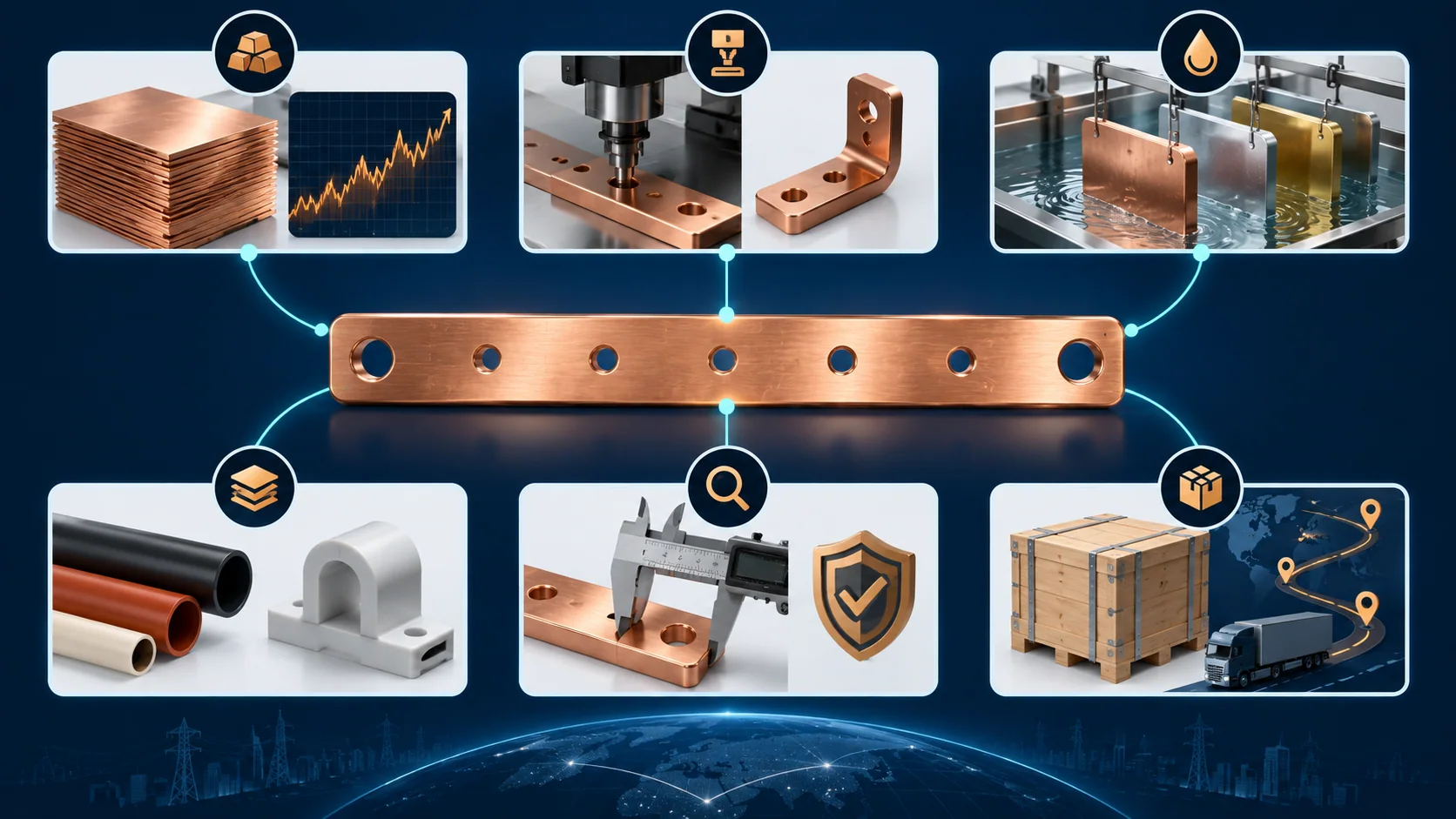
| Cost block | What changes the cost | What to request |
|---|---|---|
| Metal content | Copper or aluminium grade, cross-section, length, mass, scrap, and yield | Material grade, density basis, net mass, and cut length |
| Conversion | Cutting, punching, drilling, bending, forming, deburring, and tooling | Drawing, tolerances, hole pattern, bend schedule, and tooling charges |
| Surface treatment | Bare surface, tin, silver, nickel, plating thickness, masking, and finish area | Finish specification, thickness, test method, and affected surfaces |
| Insulation and supports | Sleeving, coating, heat shrink, barriers, spacers, insulators, and hardware | Material, temperature rating, creepage and clearance design, and part list |
| Testing and documentation | Dimensional checks, resistance, dielectric or assembly tests, inspection records, and certificates | Inspection and test plan, acceptance criteria, and document list |
| Delivery | Packaging, moisture protection, export packing, freight, insurance, duties, and Incoterms | Ship-to basis, package dimensions, lead time, and delivery terms |
| Commercial risk | Commodity exposure, currency, capacity, schedule, warranty, and change control | Quote validity, escalation formula, payment milestones, and exclusions |
Material cost is the starting point, not the finished price
Copper usually dominates the mass value of a copper busbar, but the material line can still be ambiguous. Ask whether the quoted basis is:
- a fixed price for the complete part;
- a metal reference price plus a fabrication premium;
- a fixed metal price on the quotation date;
- a formula linked to a published reference with a defined pricing window; or
- a delivered price that already includes freight, duties, and insurance.
The London Metal Exchange copper page describes the LME Official Price as a global benchmark used for indexation in physical copper contracts. That makes it a possible reference point for a transparent escalation formula, not a substitute for the fabricator’s conversion, regional premium, freight, or risk terms.
For a formula-based quote, record at least:
- the reference metal and grade;
- the price source and publication date or averaging window;
- the mass basis used for escalation;
- the treatment of scrap, yield, and offcuts;
- currency and exchange-rate basis;
- the trigger and cap, if any, for price adjustment;
- what happens when the reference is unavailable.
If a quote says “copper price at delivery” without defining the index or date, it is not yet a comparable commercial term.
Geometry changes both material and process cost
Cross-sectional area affects continuous-current and temperature-rise performance, but the cheapest geometric shape is not automatically the best design. Width, thickness, spacing, edge radius, support span, enclosure ventilation, and parallel-bar arrangement can affect temperature rise, insulation coordination, and short-circuit mechanical duty.
Fabrication adds a second layer of cost:
- long straight bars may be inexpensive to cut but costly to package;
- many holes and slots increase machine time and deburring;
- tight bend radii can require special tooling or a wider bend allowance;
- repeated small batches can create setup cost;
- high flatness or positional tolerances can increase inspection time;
- complex three-dimensional forming can produce more scrap;
- a change to the drawing after tooling can create rework or a new setup.
The drawing should therefore distinguish the bar itself from the finished part. “Copper busbar, 100 A” is not a sufficient RFQ description. The supplier needs the current duty, dimensions, material, finish, hole pattern, bend geometry, insulation, supports, and assembly context.
Surface treatment is a functional specification
Plating is often treated as a cosmetic line item, but it can affect contact resistance, corrosion behavior, joint preparation, and the acceptable storage and handling method. The price changes with:
- plated area rather than only bar mass;
- plating metal and thickness;
- selective plating or masking;
- pre-treatment and cleaning;
- dimensional buildup at holes or contact faces;
- environmental or salt-spray requirements;
- test and certificate expectations.
State which surfaces require treatment and which must remain bare. Define how the contact interface will be prepared and whether post-plating drilling, filing, or field modification is permitted. A low price that assumes a different contact finish is not a saving if it creates a joint-design problem.
Insulation, supports, and assembly integration
An insulated or laminated busbar is a system of conductive layers, insulation, terminals, supports, and mechanical interfaces. Its price includes more than the conductor.
Ask how the design accounts for:
| Design item | Procurement implication |
|---|---|
| Insulation system | Material, thickness, temperature class, dielectric duty, and production controls |
| Creepage and clearance | Distance through air and along surfaces under the actual pollution and voltage conditions |
| Supports | Type, spacing, mechanical strength, temperature, and fault-force duty |
| Joint hardware | Bolt, washer, coating, torque, locking method, and access |
| Parallel bars | Spacing, current sharing, magnetic forces, and assembly tolerances |
| Enclosure | Heat dissipation, barriers, IP rating, access, and internal separation |
| Field connection | Lug or terminal compatibility, conductor size, bend space, and tightening access |
If the busbar is part of a tested low-voltage assembly, ask whether the quoted item is a replacement part, a design-specific assembly, or a new configuration that requires additional verification. IEC 61439-1 places emphasis on assembly characteristics and verification, including temperature-rise behavior. A component quote cannot silently transfer the assembly manufacturer’s verification responsibility.
The RFQ fields that make prices comparable
Use a structured request-for-quotation schedule:
| RFQ field | Example of the required definition |
|---|---|
| Application | Panelboard, switchboard, motor-control center, converter, battery, or other assembly |
| System | AC or DC, phase arrangement, nominal voltage, frequency, earthing system |
| Continuous duty | Design current, load profile, ambient, enclosure, ventilation, and temperature-rise limit |
| Short-circuit duty | Prospective fault current, duration, peak or mechanical duty, and assembly rating |
| Material | Copper or aluminium, grade, temper, and applicable material standard |
| Geometry | Width, thickness, length, edge treatment, flatness, and bend radii |
| Machining | Hole size, slot, thread, counterbore, tolerance, deburr, and drawing revision |
| Finish | Bare, tin, silver, nickel, insulation, coating, thickness, and contact-surface limits |
| Assembly | Supports, spacers, barriers, flexible links, hardware, labels, and packing method |
| Verification | Inspection, resistance, dielectric, temperature-rise, or assembly-test records |
| Quantity | Prototype, pilot, batch size, annual volume, spares, and forecast uncertainty |
| Commercial basis | Currency, price validity, metal index, Incoterms, lead time, warranty, and exclusions |
The more custom the part, the less useful a single unit-price comparison becomes. Compare the normalized scope and total installed risk.
How to compare two quotations
Normalize each offer in this order:
- Remove differences in delivery terms and currency.
- Recalculate metal content from the same drawing and mass basis.
- Separate raw-metal exposure from conversion and surface-treatment charges.
- Confirm that holes, bends, plating, insulation, supports, and hardware are included.
- Check whether testing and documentation are included or priced separately.
- Compare lead time from drawing approval, not from the date of the first inquiry.
- Record exclusions and assumptions beside the price.
- Review the technical submittal before treating the lowest number as responsive.
This approach often reveals that a higher nominal price includes work that the lower offer leaves for the buyer. The comparison should end with an approved technical-commercial matrix, not a ranking based on metal price alone.
Quality and compliance questions
Ask for evidence that matches the scope:
- material certificate or traceability basis;
- dimensional inspection record;
- plating thickness or surface-treatment record;
- insulation material and temperature information;
- drawing revision and change-control process;
- assembly verification or test record where applicable;
- short-circuit mechanical-duty assumptions;
- torque, joint, and installation instructions;
- packing and corrosion-protection method;
- certificate scope and limitations.
In North American panelboard work, the UL Solutions panelboard application guide explains why panelboard markings, busbar ratings, short-circuit current ratings, terminals, and field modifications matter. Use the product listing and the adopted installation code as the controlling documents for that jurisdiction.
Red flags in a busbar price
Treat these as clarification points:
- no drawing revision or material grade;
- price stated only by kilogram for a formed or insulated assembly;
- no reference date for copper or aluminium;
- unspecified plating thickness or contact-surface treatment;
- “tested” without an inspection and test plan;
- no statement of short-circuit duty or support assumptions;
- a lead time that starts before technical approval;
- a change clause that allows substitutions without technical review;
- an offer that assumes field drilling, painting removal, or unapproved busbar tapping;
- a certificate that covers a different assembly, voltage, or environmental condition.
The correct response is not to reject every flexible quote. It is to convert every assumption into a visible, reviewable field before placing the order.
The buyer’s final checklist
Before selecting a busbar quotation, confirm:
- The bar or assembly has one clear drawing and revision.
- The current, voltage, environment, temperature-rise, and fault-duty inputs are defined.
- Material, mass, dimensions, finish, insulation, supports, and hardware are included.
- Commodity-price and currency exposure are explicit.
- Testing, certificates, and delivery documents are listed.
- The assembly-level verification responsibility is assigned.
- Lead time starts at the agreed technical milestone.
- Field modifications and substitutions require approval.
- The quote can be compared on total scope and installed risk.
Electrical busbar price becomes easier to manage when the request separates commodity exposure from engineering and fabrication scope. A good purchasing package does not promise the lowest price; it makes the chosen price traceable, comparable, and suitable for the electrical duty.