
When a substation circuit breaker trips unexpectedly, first establish what ordered it to open and whether it actually interrupted current. Do not treat every open breaker as a defective breaker, and do not repeatedly reclose it to see whether the trip repeats. Preserve the relay event and disturbance records, sequence-of-events (SOE) log, breaker position and alarm indications, and the network configuration. The responsible operator decides the switching state under the site’s procedure; qualified protection and maintenance staff then trace the event from initiating condition through trip command, DC control circuit, mechanism and pole response.
This is a diagnostic framework for AC power-system substations, not an instruction to enter an energized cubicle or override an interlock. Fault isolation, access, testing and restoration require an approved clearance and local operating authority. In the United States, OSHA’s electric-power work rule sets qualified-person and de-energizing requirements for its covered installations; other jurisdictions have their own rules.
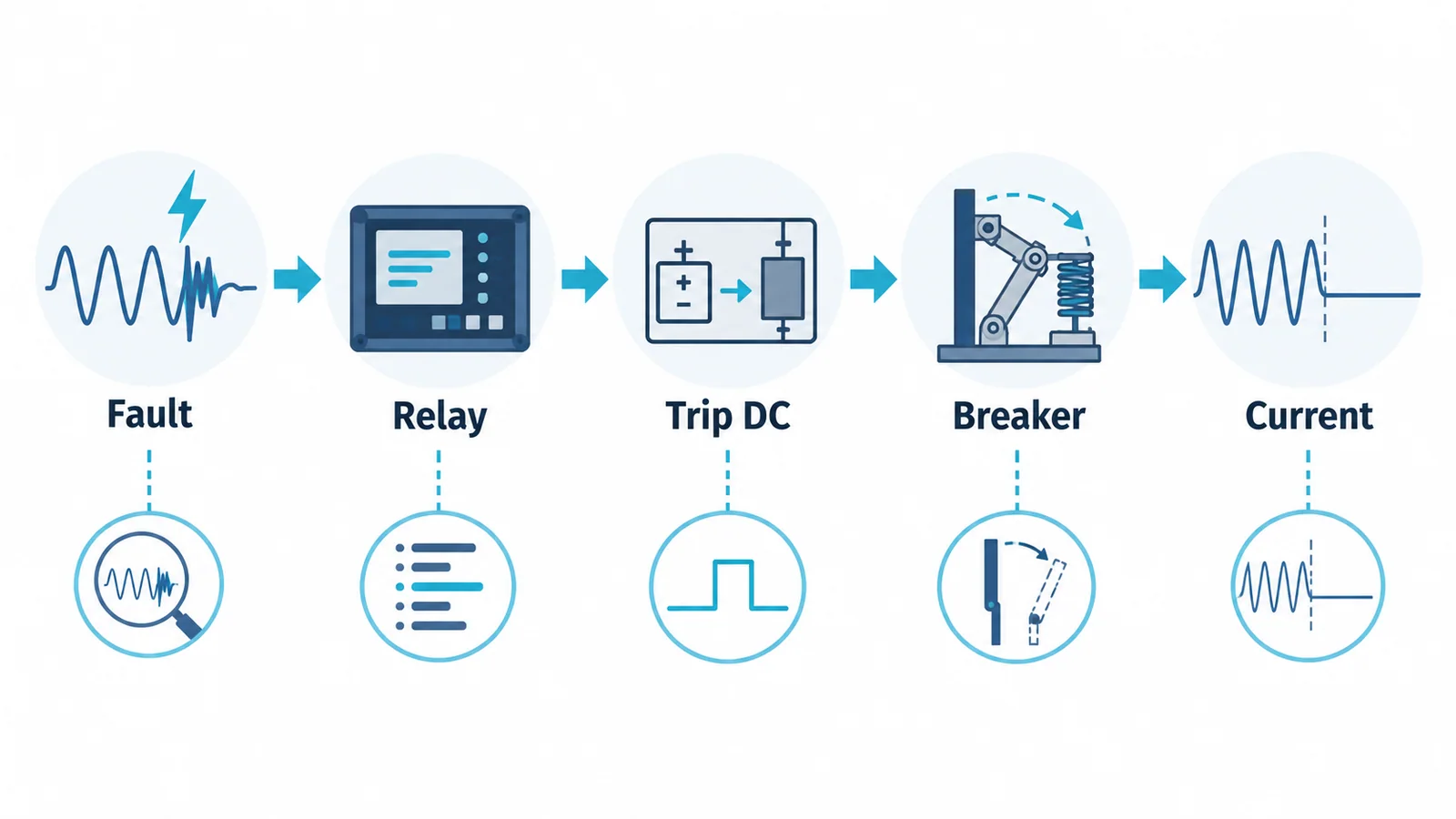
Start with the trip chain
A breaker opening can be a successful response to a line, transformer, bus or equipment fault. It can also follow an incorrect trip command, a control-circuit defect, a mechanical problem or a misleading indication. A breaker-failure scheme is a different issue: it detects a failure to clear when opening is required. IEEE C37.119-2025 covers detecting failed fault clearing and isolating the affected fault, as well as related performance failures. That scope is why the first question is which link in the trip chain diverged from expectation.
| Evidence at first review | Likely branch to examine | What it does not prove |
|---|---|---|
| Protection element and trip output assert with matching fault quantities | A genuine protection operation, or a settings/measurement issue | That the breaker itself was faulty |
| Trip output asserts but position stays closed or current persists | Trip circuit, mechanism, auxiliary indication, or failed interruption | Which component failed without further evidence |
| Position changes open with no recorded protective trip | Manual/remote command, interlock, control wiring, auxiliary contact or record gap | That the mechanism opened “spontaneously” |
| Breaker-failure element operates after a primary trip | Failure-to-clear sequence and backup isolation | That the initiating fault was caused by the breaker |
| Repeated open-close events | Auto-reclose, automation logic, control instability or repeated faults | Permission to keep cycling the equipment |
Preserve a time-aligned record
Collect the relay’s event report and oscillography, SOE log, supervisory control and data acquisition (SCADA) commands, local annunciation, breaker counter and mechanical indicators, and disturbance records from adjacent bays. Capture the system one-line and switching state at the time of the event. Record whether an automatic reclosing sequence was enabled and how many operations occurred. Preserve original files before changing settings, clearing targets or replacing a component.
Check clock synchronization and event timestamp quality. A few apparent milliseconds in an unsynchronized SOE can reverse the perceived order of a trip output and breaker-position change. Waveform current cessation, auxiliary-contact transitions and relay outputs should be compared as separate pieces of evidence, not collapsed into one “trip time.” A local status contact can be wrong while the poles are in another state.
Diagnose by symptom, not by replacing the breaker first
Protection operated and current cleared
Review the operated element, measured currents and voltages, zone boundaries, setting group, instrument-transformer inputs, and the network configuration. A relay trip may be correct even when no damage is immediately visible. Investigate the protected asset and fault location. Where transformer differential protection was involved, the differential-relay settings workflow explains why CT ratios, vector compensation and restraint have to be evaluated together. Return to service depends on evidence that the underlying fault is cleared or safely managed, not merely on successful breaker operation.
Trip command issued, but breaker did not open or clear
Treat this as urgent because an uncleared fault can require backup protection. Review the trip output and DC supply indications, trip-circuit supervision, lockout state, mechanism alarms, breaker position and current waveform. A weak station DC system, open trip path, failed trip coil or mechanism issue are hypotheses, not diagnoses from one alarm. A qualified team can plan isolated testing of the control path and mechanism, then compare results with the equipment’s approved acceptance criteria. Do not bypass the failed channel to return an unverified breaker to duty.
Breaker opened without the expected protection record
Search for operator commands, remote control, interlocks, mechanical-trip devices, local test switches, other relays and automation. Confirm the event recorder actually monitored the relevant contacts and that the clocks were aligned. A control-path fault can be intermittent; preserve wiring and relay state before intrusive work. Do not assume a “nuisance trip” until the triggering path has been established.
Fault recurs after reclose
Stop the sequence under the local procedure. Repeated closing into an uncleared fault can add stress to the breaker and connected equipment. Compare each operation’s relay element, current waveform, fault location estimate and breaker timing. The decision whether to test, isolate another section or restore supply is an operator and protection-engineering decision, not an article-level rule.
Choose tests only after a hypothesis is defined
An isolated breaker may need operation timing, contact resistance, insulation, trip/close circuit and mechanism checks, depending on the suspected failure. The same list is not a generic instruction to perform every test after every trip. IEEE C37.10-2025 addresses practices for investigating, analyzing and reporting high-voltage breaker failures. IEEE C37.09-2018 concerns standardized high-voltage breaker test procedures, not a field pass/fail value that can be guessed from a nameplate.
| Suspected issue | Evidence to request | Decision gate |
|---|---|---|
| Fault on protected circuit | Relay oscillography, adjacent-end records, inspection of affected zone | Fault disposition and protection review complete |
| Missing trip energy or command | DC logs, trip-circuit supervision, event output, isolated circuit test | Trip path demonstrated under approved procedure |
| Slow or incomplete breaker motion | Position and current timing, mechanism alarms, specialist mechanical test | Performance evaluated against applicable equipment criteria |
| Indication mismatch | Auxiliary-contact and pole-state evidence | Indication corrected and independently verified |
| Repeated automatic operations | Reclose logic, command history, fault records | Cause of each operation understood; limits respected |
Return to service needs a documented case
The final report should state the initiating event, protective command, breaker response, root-cause confidence, corrective work, test result, outstanding uncertainty, and who authorized restoration. “Breaker closes successfully” is not enough if the protected fault remains unexplained or the trip path is still unreliable. Record changed settings and restored configuration so the next event can be compared with a trustworthy baseline.
For the substation’s wider control-power and protection context, see Distribution Substation Basics. For a new breaker specification rather than a trip investigation, use the medium-voltage circuit-breaker ratings guide.