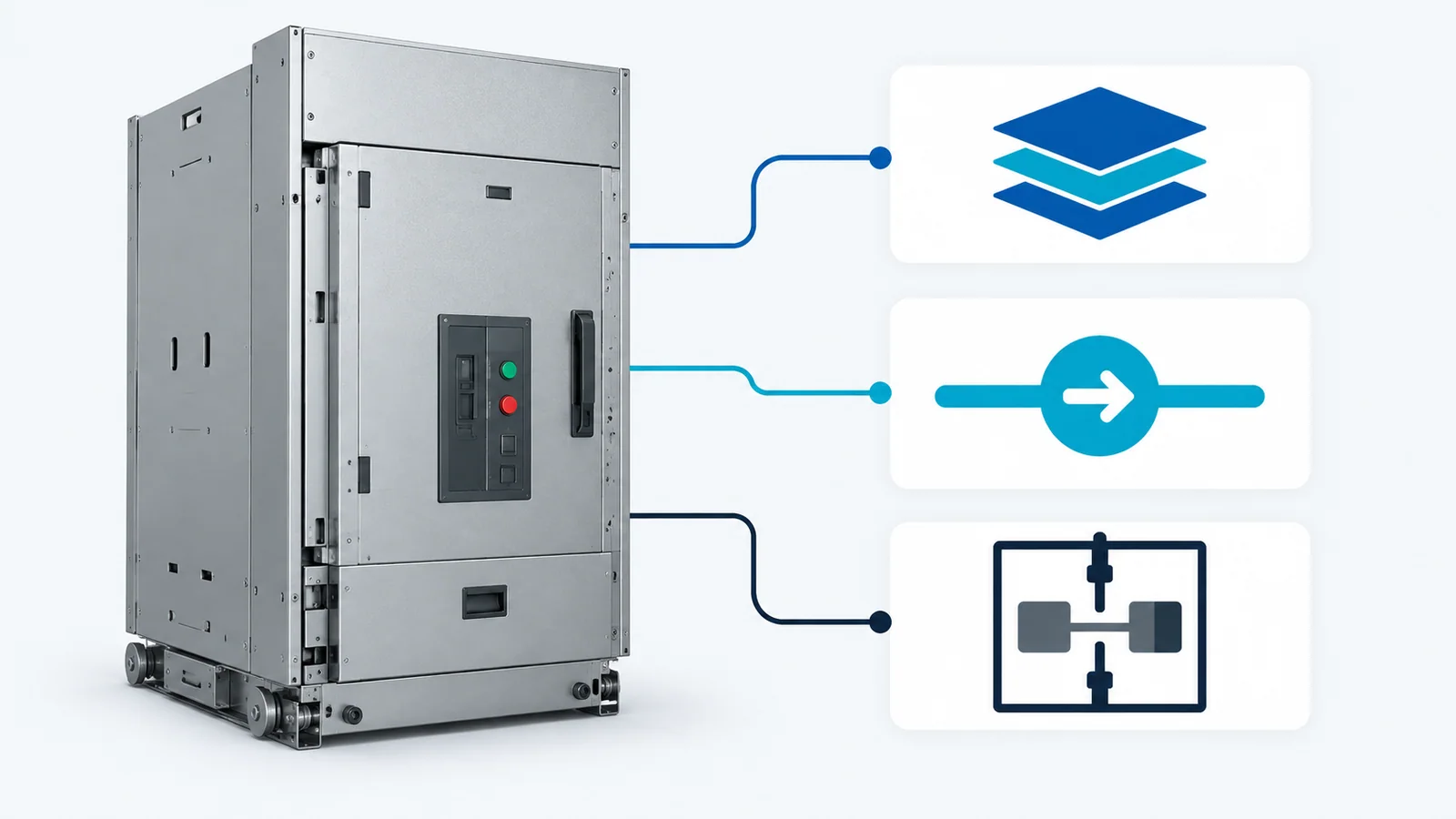
An MV circuit breaker is not adequately specified by “kV, A and kA.” Match each rated duty to the corresponding system condition: maximum operating voltage and insulation stress, continuous load current, prospective short-circuit interruption, peak making duty, short-time withstand, transient recovery voltage (TRV), operating sequence and any special switching duty. The rating set must apply to the actual breaker and switchgear assembly, not to a superficially similar catalog variant.
This is a reference for general-purpose three-phase AC circuit breakers above 1 kV in IEC-based or IEEE-based MV systems. IEC 62271-100:2021 with Amendment 1:2024 covers AC circuit breakers above 1 kV in its stated scope. IEC 62271-1:2017+A1:2021 supplies common switchgear specifications except where the device standard says otherwise. North American projects may use the IEEE C37.04-2018 rating structure. Do not mix individual ratings from different standards without a documented equivalence analysis. Generator circuit breakers have the dedicated IEC/IEEE 62271-37-013 duty and are addressed separately.
Map each rating to a study result
| Breaker rating or capability | What it represents | Project input to compare |
|---|---|---|
| Rated voltage and insulation level | The specified operating-voltage and dielectric-withstand envelope | Highest system voltage and insulation-coordination study |
| Rated normal/continuous current | Carrying current within defined service conditions | Load profile, future duty, ambient/enclosure conditions |
| Rated short-circuit breaking current | Interruption capability under the standard’s defined test conditions | Prospective fault duty at the breaker and contact-parting time |
| Rated short-circuit making current | Ability to close onto a fault, commonly assessed with peak asymmetrical duty | Peak making current from study |
| Rated short-time withstand current and duration | Thermal/electrodynamic withstand while closed for the specified time | Fault magnitude and protective clearing interval |
| TRV capability | Ability to withstand the voltage appearing across contacts after interruption | Network recovery-voltage study and switching application |
| Operating sequence and mechanical duty | Tested sequence of open and close operations | Reclosing policy and required switching service |
| Special switching capabilities | Application-specific tasks such as capacitive or other duties | Cable, line, capacitor, transformer or reactor switching study |
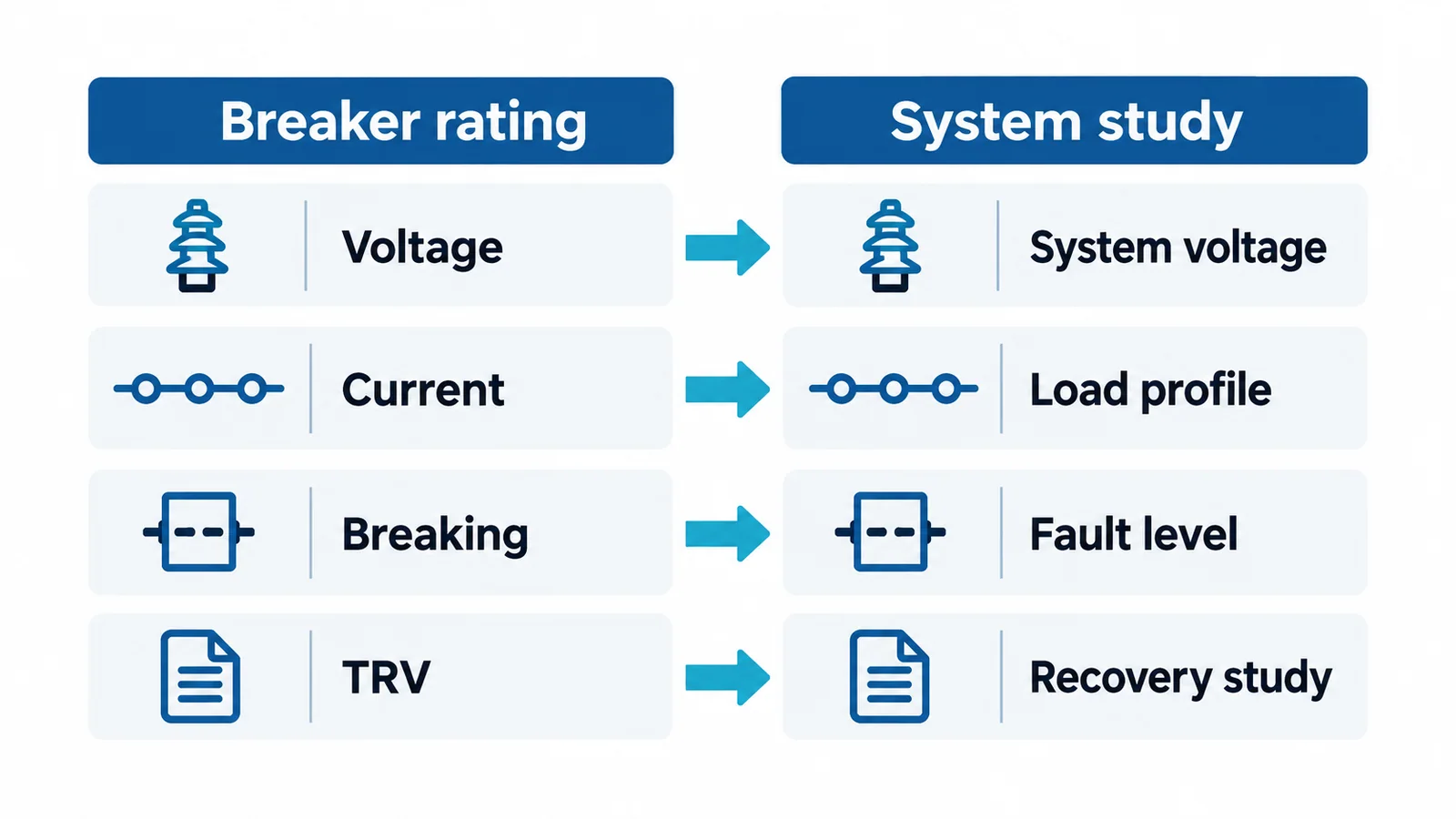
The table is a specification map, not a replacement for the full test standard. The exact definitions, assigned values and required tests depend on the applicable edition and the product’s declared ratings. IEEE C37.09-2018 describes test procedures verifying several assigned high-voltage breaker ratings; its public scope expressly excludes generator circuit breakers.
Breaking, making and withstand are not interchangeable
The rated short-circuit breaking current relates to interruption. The making current is associated with closing onto a fault and must account for the first peak, which may be much higher than the symmetrical RMS value. The short-time withstand current and duration concern surviving a fault while the breaker remains closed. A breaker can therefore meet a numerical breaking-current requirement and still fail the specification on peak making or short-time duty.
Use a short-circuit study at the installation point. Identify the maximum and any relevant minimum fault conditions, source X/R or equivalent asymmetry information, and the time at which the breaker is expected to part contacts. A simple conversion between fault MVA and kA may give a useful magnitude check, but it cannot establish the DC component, TRV, peak making duty or special switching performance. Do not substitute an upstream bus’s fault level without accounting for the actual breaker location and network configuration.
TRV and special switching can govern the choice
After current interruption, voltage appears across the opening contacts. Its magnitude and rate of rise are governed by the network, not by the steady-state voltage label alone. The intended IEC or IEEE rating/test basis must be compared with the project’s credible TRV. Switching a cable, capacitor bank, unloaded transformer, reactor or line introduces application-specific considerations that a generic “short-circuit kA” line cannot settle. The vacuum breaker current-chopping explainer discusses one mechanism relevant to inductive-current switching; it is not a substitute for application tests.
A procurement review that catches missing data
Before accepting a schedule or replacement breaker, ask for:
- The exact IEC or IEEE standard, edition, product variant and rated configuration, including the switchgear interface.
- The system maximum voltage, insulation-coordination basis, altitude and environmental conditions where relevant.
- Continuous load and thermal assumptions for the installed enclosure.
- Short-circuit study results at the breaker: interruption, peak making and withstand-time duty.
- TRV and special switching assessment where the system application requires it.
- Required operating sequence, auxiliary power and control compatibility, and evidence of the proposed device’s tested capabilities.
If a row is missing, do not infer it from a larger kA number. A high-value next step is to request the missing system study or product evidence. The switching-device overview distinguishes breakers from disconnectors and contactors; the generator circuit-breaker guide addresses generator-specific fault and TRV behavior. MV fuse ratings have a different interruption model, explained in the MV fuse ratings guide.
Sources
- IEC 62271-1:2017+A1:2021 — common AC switchgear specifications
- IEC 62271-100:2021 — AC circuit breakers, amended 2024
- IEEE C37.04-2018 — high-voltage circuit-breaker rating structure
- IEEE C37.09-2018 — high-voltage circuit-breaker tests
For related equipment and application checks, see ANSI Circuit Breaker Ratings: How to Compare the Highest Numbers.